{{ 'now' | timezone: 'America/New_York' | date: '%b %d, %Y' }}
|
|
|
Hi, and welcome back to Line Sheet. Happy New Year to those who celebrate—and if you’re waiting for the Rapture… there’s still time.
As previewed, I’ve arrived in Milan and even managed to find a single-origin espresso within walking distance of my flat. Today, I made it to two events: the Glenn Martens Diesel presentation-slash-Easter egg hunt (more thoughts on this soon), and the premiere of the Gucci short film The Tiger, starring Demi Moore, Ed Harris, Ed Norton, Keke Palmer, Elliot Page, etcetera, and co-directed by Spike Jonze and Halina Reijn (of Babygirl fame). The project was filmed this past August at an architecturally significant house in Pasadena, just a 10-minute drive from my own home. To say I felt targeted… anyway, I haven’t slept in 24 hours and need a minute to process. I’ll be back tomorrow with my thoughts on the film, the fashion, and the machinations of the screening itself. (Where else in the world could you find Gwyneth Paltrow, Luca de Meo, and Mark “The Cobrasnake” Hunter in one room?)
Up top, you’ll find my quick take on what the new campaigns portend about the future of (spending on) fashion. Sarah Shapiro and I also talk tariff purgatory.
For the main event, Sarah traveled (virtually) to London to talk shop with Clare Hornby, the founder of Me+Em, the solutions-based apparel brand that is proliferating stateside. I met Clare more than a year ago, just as she was getting her U.S. operations off the ground, and I am so impressed by the strategy she’s employed: it’s virtually impossible for international brands to make it in the U.S. market—even Sir Philip Green struggled after some initial success bringing Topshop to Nordstrom. Sarah and Clare broke it all down for us. This is one of those conversations that investors will want to weigh in on.
By the way, a friendly reminder that Puck is 4 years old. To celebrate, we are staging our annual sale. If you want 20 percent off an Inner Circle upgrade (you know it’s worth it), just click here.
Mentioned in this issue: Me+Em, Clare Hornby, Kate Middleton, Jonathan Anderson, Simone Bellotti, Jil Sander, Dario Vitale, Greta Lee, Loewe, Gab Waller, Jodie Barnes, Louise Trotter, Bottega, and many more…
|
|
|
A MESSAGE FROM OUR SPONSOR
|
|
|
Three Things You Should Know…
|
- Campaign season: It’s becoming common practice for designers to tease their runway vision via the red carpet and advertising campaigns. This summer, Jonathan Anderson dropped his men’s campaign, shot by Theo Wenner, a few days prior to the men’s show, and introduced couture and women’s ready-to-wear on the Venice red carpet. Simone Bellotti created a campaign for Jil Sander early, too. Dario Vitale’s wares were also at Venice, and he recently released pages of inspiration in anticipation of his Friday preview. Louise Trotter took a similar approach by dressing Vicky Krieps and others weeks before she was scheduled to show her first Bottega collection.This week, the trend hit its apotheosis. First, there were the David Sims portraits introducing Anderson’s selection of ambassadors for Dior. As I wrote yesterday, the Dior images with Greta Lee, Mia Goth, and Mikey Madison—limp and expressionless in their recline, equally delicate and deadpan—stoked desire, from the signature bar jacket in a textured, nubbly wool to the flower-sprayed Lady bag to the branded rugbies.
Today, Anderson’s successors at Loewe, Jack McCollough and Lazaro Hernandez, set their stage with truly gorgeous, sun-drenched images shot by Talia Chetrit and styled by one of Line Sheet’s favorites, Jodie Barnes. There are only a few items to consider, but McCollough and Hernandez managed to establish a rich new brand identity for Loewe, filled with color and light, without dismissing its very successful recent past. The people have spoken, and they loved it. We
need optimism in this industry, and both Anderson and the new Loewe guys delivered on that front. Now comes the real test: the runway.
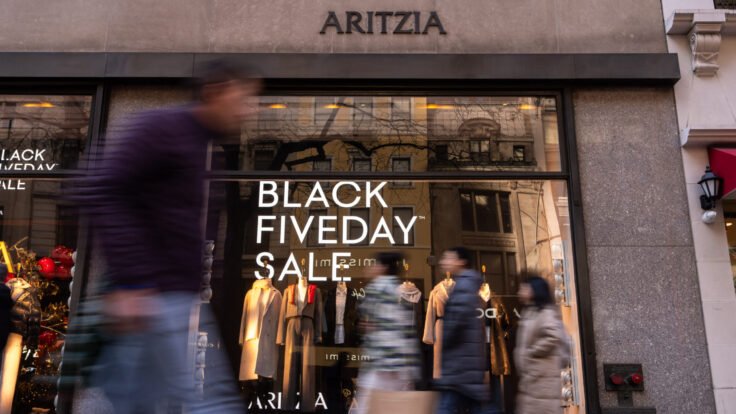
- Waiting for the man… in customs: The economic impact of the tariffs is coming into full view. Postal traffic to the U.S. dipped 80 percent the week after the $800 de minimis exemption was lifted, according to the Universal Postal Union, a trade organization. (Remember, FedEx and DHL are the exception, not the rule, when it comes to apparel distribution.) For brands that can only pass so much of the impact on to the consumer, the rising cost of importing goods is eating into the margins. Meanwhile, brands and retailers are watching their U.S. orders plummet because customers are afraid of having to absorb those duties themselves. Many larger brands and retailers have vowed to cover all duties—it’s the right thing to do, even if it’s incredibly costly. Even so, stuff is getting stuck in customs,
sometimes for weeks.
|
|
|
 |
Sarah Shapiro |
|
- Global fashion sourcing goes local: Here’s another customs issue to ponder. The rise of online fashion sourcers like Gab Waller, famous for locating impossible-to-find items, has a lot to do with the fact that they can access products from stores all over the world. (If the Chanel 25 or YSL Icarino aren’t available in your preferred size in Beverly Hills, perhaps they might be in stock in Lisbon.) Recently, though, Waller told me she’s highlighted items dispatched from the U.S. to protect clients from having to pay extra fees. That doesn’t mean her clients have stopped demanding items from overseas, of course. Waller just makes sure they’re clear on the duties and tariffs that will be due on receipt.
|
|
|
A revelatory chat with Me+Em founder and C.E.O. Clare Hornby about how her U.K. brand, known for Kate Middleton’s bubblegum pink dress and dressing yummy mummies, managed to crack the notoriously difficult U.S. market.
|
|
|
Breaking into the U.S. market is notoriously difficult for international brands—and the feat, of course, has only been further complicated by Trump’s tariffs. And yet Me+Em, a brand whose clothes are designed to transition from the playground to the boardroom to dinner and drinks, has established itself as an unequivocal success story. The British brand, which compares to TWP and Veronica Beard, first became known for their trousers, but also has been popular with coordinating sets. Of course, its visibility skyrocketed after Kate Middleton wore several pieces, like a brown fuzzy sweater vest for a meeting with Melania Trump, and stepped out more than once in a bubblegum pink silk shirtdress.
The company was doing around $150 million in net annual revenue before opening its first U.S. store, in March 2024, on Madison Avenue. Post U.S. expansion, they are now doing around $200 million in net annual revenue. Locations soon followed in SoHo, East Hampton, and Dallas. I’m told there’s been an 86 percent year-over-year increase in new customer acquisition stateside.
|
|
|
A MESSAGE FROM OUR SPONSOR
|
|
|
In a recent conversation, C.E.O. Clare Hornby told me she founded Me+Em in 2009 with the
goal of delivering the Four F’s: flattering, functional, forever, and fair (pricing). We chatted candidly about her impressions of the U.S. consumer—in particular, she told me, American women want complete outfits chosen for them, whereas U.K. customers prefer to cherry-pick items and put their looks together. As usual, our conversation has been lightly edited and condensed.
|
Sarah Shapiro: Why are physical stores so important for
Me+Em?
Clare Hornby: Because the whole ethos of the business is the quality-price ratio. We’re direct-to-consumer, so we aim to offer exceptional quality for the price, and stores are a discovery channel. We try to educate in stores around the quality, the silhouettes, the outfit building, and the regular drops that we do. Stores are really important from an educational standpoint, but also so customers can realize the quality—you only really realize it when you touch
it.
What similarities and differences do you see between shoppers in London and New York?
The similarities are that the customer is exceptionally busy, so she’s either working, traveling, a combination of the two, socializing a lot—they have busy lives. That is definitely consistent across both cities. Age-wise, it’s also quite similar—we’re quite multigenerational, so we get grandmothers and granddaughters. In the New York stores, we get lots of stories about
multigenerational shopping, which is always really nice to hear.
Probably more customers in New York are shopping for first-time jobs. Careers in America start with a higher salary than in the U.K., so you can afford the brand a bit younger. A lot of American customers discovered us in the U.K. because the customer travels so much between New York and London and other cities.
The trend of how American shoppers come in and out of the neighborhoods is slightly different. You have more of an offseason than we do. Your stores are busy when the schools are back, but you definitely ship out of those cities en masse more than the London customer does.
How did you decide on Dallas as your second U.S. location after New York?
Really it was a number of customers that we already had. When we looked at the data, we could see that we were popular in Texas, probably because the collections are very trans-seasonal, but they’re also full of layering, and there are as many neutrals as there are colors and prints.
We offer quite a broad collection—even though it feels very holistic, it’s actually got quite a lot for everyone. We picked up a lot of customers in Dallas—and across Texas—so really it was the data telling us where to go, rather than us trying to decide. We also send out the lookbook every month, so we had information that that’s where we should open up.
|
What’s the current breakdown between U.K. and U.S. business?
The U.K. is still bigger than the U.S. There are a lot of reasons—we’re an established business; the collections are much bigger—but the growth in the U.S. is about six times [faster]. And then we’re growing in Europe. We’re trying to finalize a store in Paris, and we’re looking in Germany.
|
|
|
How do you approach building out your collections and assortment?
The collections are
built in quarters, so we look at color stories, texture stories, print stories by quarter, and then we drop in edits each month. We aim to really think about what you need that month, but the colors and the textures all flow in quarters. Some of the colors are evergreen colors, some of the styles are evergreen, but most importantly, the shapes are evergreen.
Once we educate you on a shape, then you can buy that shape in endless colors, textures, fabrications, and price points. We really
established ourselves in the U.K. on trousers and tailoring—trousers are probably the most difficult thing to get right. We have some fantastic designers and technicians that are very painstakingly finessing the fit, and we’ve become really well known for our flattering fits, but also attention to detail, where we put pockets. It’s really considered as if we were a very high-luxury business.
How has the jacket category performed differently in the U.S. versus the
U.K.?
It’s really interesting—our jackets sell phenomenally well in the U.S. because I think you wear them more than we do, even though our weather can be more unpredictable. Americans love air conditioning so much. Every Brit in America turns down the air conditioning as soon as they walk into a room, so jackets and tailoring are so important, whether you’re putting that with a trouser suit or wearing it with a dress or a t-shirt.
How do you
approach affiliate marketing and partnerships like ShopMy?
We’ve been big on affiliate marketing for a long time, definitely with the influencer affiliates, but also with the press affiliates—that whole area of linking through from recommendations and making sure that all your S.E.O. backlinks are really established. ShopMy is really growing—that’s a really great partner, and we’ve been growing with them particularly this year. They link into Substack as well; a lot of great
content creators are on Substack, and a lot of the affiliate is through ShopMy.
|
What We’re Reading…
and Listening To…
|
If you’re stuck on one fashion bus or another (there was a Milan-bound plane out of London that got rerouted
to Southend-on-Sea this morning), might we suggest this wide-ranging interview with New York Times Company C.E.O. Meredith Kopit Levien. She stays impressively on message, but Puck’s Dylan Byers and Julia Alexander also ask the right questions. [The Grill Room]
H&M-owned Cos is getting the most out of showing at
New York Fashion Week by tapping the right front-row celebrities. Thai actress Tipnaree Weerawatnodom’s (a.k.a. Namtan) Instagram post from the show earned an estimated $1.7 million in media value, according to Launchmetrics. The post was so successful that it catapulted Cos into the week’s top five brands ranked by social media chatter. (The others were Calvin Klein, Michael Kors, Coach, and Tory Burch.) [Inbox]
Vuori has invited a longtime Nike C-suite exec,
Andrew Campion, to join its board of directors. These days, Campion is the C.E.O. of Unrivaled Sports, a holdco that owns several businesses—from venues to summer camps—that support youth sports. He’s also just a big board guy, currently repping Starbucks, Williams Sonoma, and the Los Angeles 2028 Olympics. [ Business
Wire]
Amanda Lee Burkett, a downtown girl who styles and does other creative things, launched a Substack about being a person in the city. She is fun to watch and now, fun to read. [ You Can Talk About It, But Only With Me]
Jenn Hyman, the C.E.O. of Rent the Runway, has taken to social media to defend the character of Gwyneth Paltrow, who is on
Rent the Runway’s board of directors. To be honest, her points are fair, although it’s unclear why Hyman decided to share them. [ TikTok]
|
Until tomorrow,
Lauren
P.S.: We use affiliate links because we are a business. We may make
a couple bucks off them.
|
|
|
Puck fashion correspondent Lauren Sherman and a rotating cast of industry insiders take you deep behind the scenes of this
multitrillion-dollar biz, from creative director switcheroos to M&A drama, D.T.C. downfalls, and magazine mishaps. Fashion People is an extension of Line Sheet, Lauren’s private email for Puck, where she tracks what’s happening beyond the press releases in fashion, beauty, and media. New episodes publish every Tuesday and Friday.
|
|
|
Puck’s daily art market email, anchored by industry expert Marion Maneker, offers unparalleled access to the mega-auctions and
galleries, elite buyers and sellers, and the power players who run this opaque world. Wall Power also features Julie Brener Davich, a veteran of Christie’s and Sotheby’s, who provides unique insights into how the business really works.
|
|
|
Need help? Review our FAQ page or contact us for assistance. For brand partnerships, email ads@puck.news.
You received this email because you signed up to receive emails from Puck, or as part of your Puck account associated with {{customer.email}}. To stop receiving this newsletter and/or manage all your email preferences, click here.
|
Puck is published by Heat Media LLC. 107 Greenwich St, New York, NY 10006
|
|
|
|