Happy Sunday, and welcome to Wall Power. I’m Marion Maneker, back in
New York, and I’ve already hit the shows for Robert Rauschenberg’s centennial at the Guggenheim and Museum of the City of New York.
Tonight, I want to highlight one of the benefits of having Air Mail join the Puck family of brands. If you are already an Air Mail reader, as I am, you’ll know they cover the international culture scene quite well. If you’re not, that gives me the opportunity to bring you a dispatch from our new partners: Roxanne
Robinson’s investigation into how the work of Larry Rivers, once considered the godfather of pop art, found its way from MoMA to a second-tier gallery in Lambertville, New Jersey. It’s a tale of mismanagement, family tension, and one ill-advised Instagram stunt. Read more below the fold.
But first… |
-
Francis Ford Coppola recoups some of his Megalopolis losses: In 2021, Francis Ford Coppola sold a number of his wineries for a reported $500 million to fund his long-languishing film Megalopolis. I guess that wasn’t enough. On Saturday, Phillips auctioned Coppola’s prototype of an F.P. Journe watch—a design that used a human hand to display the hours, conceived by the filmmaker and executed by the renowned independent watchmaker—for nearly $11 million.
(Another Journe prototype sold for nearly $5 million at a charity auction four years ago.) Meanwhile, the first F.P. Journe watch Coppola received, as a present from his wife, Eleanor, sold for almost $600,000.
The rest of Coppola’s watch collection, sold with no reserve, also made prices that reflected the director’s provenance. This Sunday morning, his humble IWC Portugieser hammered at $17,000 against a $3,000 estimate, and his Breguet, estimated at $4,000, hammered at
$48,000. One Patek Philippe hammered at $69,000, more than 11 times the estimate, while another went for $70,000, or more than four times the estimate. A Blancpain minute repeater also made $72,000 over a $15,000 estimate. Coppola may need cash, but his reputation is still sterling. - Matty Boy’s cross-country tour: Recently, I spoke to West Coast collector Stavros Merjos, who had been in Las Vegas last month for the
opening of artist/fashion designer Matt DiGiacomo’s latest pop-up. You might remember how DiGiacomo’s Anti-Promo shut down West 27th Street in the spring, when it took over Ross + Kramer in Chelsea to sell limited-edition hand-painted clothing items, editioned merchandise, and DiGiacomo’s paintings and sculptures.
Anti-Promo later took its road
show to Atlanta, where DiGiacomo and the brand were hosted by collector Lauren Amos and the High Museum. For the Las Vegas event, timed to coincide with the Formula One Grand Prix, Anti-Promo took a temporary space in the Bellagio across from Ferrari’s temporary retail space. Interest from DiGiacomo’s fans and Anti-Promo’s resellers proved to be stronger than expected, and the planned run had to be
cut short after an overflow crowd mobbed the opening. No matter: The Miami pop-up this week sold out.
|
Now a dispatch from our Air Mail friends… |
|
|
How the contents of Larry Rivers’s estate and foundation ended up in a
second-tier gallery near New Hope, Pennsylvania. |
|
|
Five months ago, Jim Alterman posted a video on Instagram from his
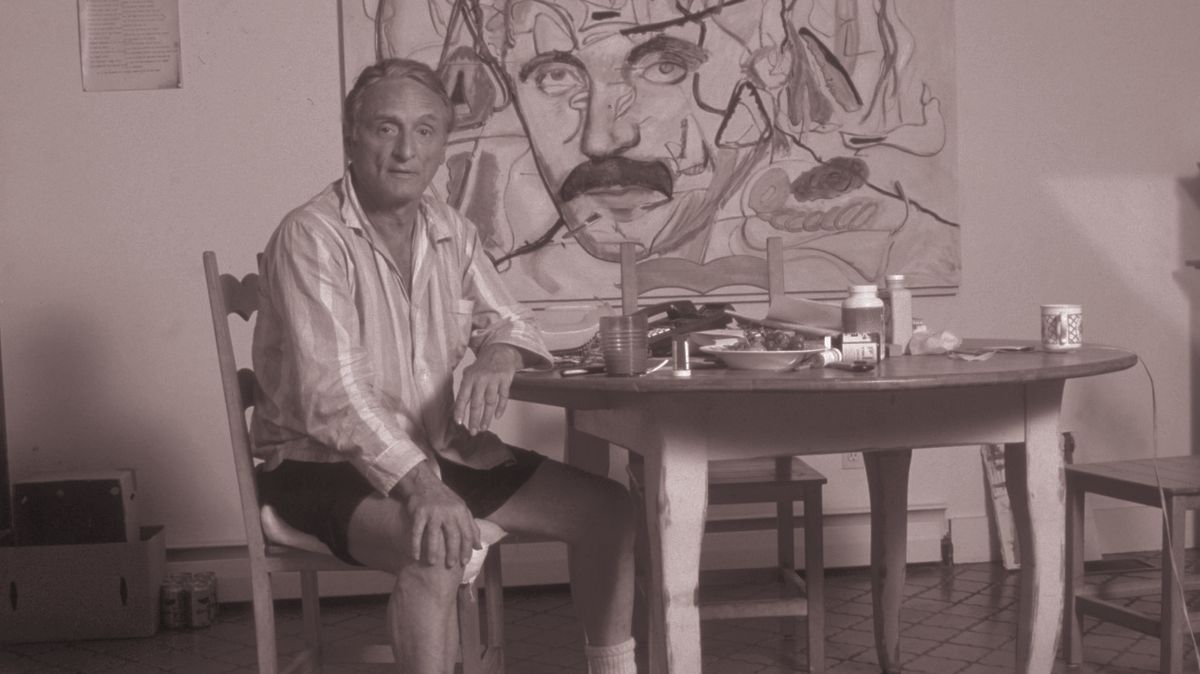
gallery, Jim’s of Lambertville in New Jersey, just across the river from New Hope, Pennsylvania, in which he “smashed” a work by Larry Rivers—once hailed as the “godfather of pop art”—over his adult son’s head. “It was a student artwork,” Alterman clarified, part of Rivers’s estate and foundation holdings. “I wouldn’t smash a real Larry Rivers painting, but it looked good on social media.”
Rivers, who died in 2002, also loved to shock. His 1970 installation Caucasian
Woman Sprawled on a Bed and Eight Figures of Hanged Men on Four Rectangular Boxes depicted a lynching; another, America’s No. 1 Problem (1967–69), displayed a Black and a white penis alongside a ruler. Offstage, he carried the same irreverence—serving cat food at a party and decorating a Christmas tree with tampons. He liked to cut the tops off his shoes to expose his toes.
That blend of humor and confrontation helped the New York–born artist reintroduce figuration into
abstract expressionism, paving the way for the rise of pop art. The Museum of Modern Art has featured his work in more than 60 exhibitions, including the seminal 2010 survey Abstract Expressionist New York. Following the artist’s death, both an estate and a foundation were established on Long Island’s East End. The estate, led by John Duyck, a longtime assistant, and Rivers’s sister Joan Gordon, who died in 2023, managed sales from his studio
inventory.
The foundation—directed by another former assistant, David Joel, with board members including Duyck, Gordon, Rivers’s son Steven, David C. Levy (the former director of the Corcoran Gallery of Art), and the historian and journalist Helen A. Harrison—held the most significant pieces and focused on organizing educational programs and exhibitions in collaboration with academic and art institutions. |
|
|
The Breguet Classique Souscription 2025 represents a reinvention of a timeless icon
– paying tribute to the original aesthetic, elevated by a contemporary perspective. Join Breguet in celebrating 250 years of horological excellence. |
The Breguet Classique
Souscription 2025 represents a reinvention of a timeless icon – paying tribute to the original aesthetic, elevated by a contemporary perspective. Join Breguet in celebrating 250 years of horological excellence. |
|
|
But this summer, Larry’s youngest son, Sam Rivers, 40, discovered
that all the assets of his father’s estate and foundation had been sold in bulk to Alterman—who usually specializes in lesser-known Pennsylvania impressionist and modernist paintings—for just $300,000. “I learned about the foundation sale in the strangest way: by reading the captions on Jim’s Instagram posts showing the works being moved, and realizing those pieces were gone,” Sam, who is unaffiliated with either entity, wrote to me in an email. He noted that he had always understood the
foundation’s assets were never to be sold.
Alterman’s Instagram video made viewers do a double take. It also raised the question of how the work of an artist of Rivers’s stature ended up in an obscure New Jersey gallery—without his own son knowing. |
Sam Rivers had long known his father’s estate was in peril, a fact allegedly confirmed
to him by his older brother, Steven, 79, whose role on the board gave him insight into the foundation’s affairs. Typically, estates and foundations work to enshrine an artist’s legacy by placing important works in major museums, but in Rivers’s case that never happened, leaving his market to drift. “By the second year of my father’s estate being administered by the executors,” Sam told me, “the money was already running out, and trouble with the I.R.S. had begun.”
Larry’s reputation
didn’t help. In his 1992 tell-all, What Did I Do?: The Unauthorized Autobiography, written with Arnold Weinstein, he described his affairs with men and women, drug use, and his appetite for scandal—a persona that, over time, eroded his credibility. His 2002 retrospective at the Corcoran Gallery of Art in Washington, D.C., was, as The New York Times put it, “a very mixed success … with the late work feeling noisy and gauche, kind of embarrassing.” And in 2010, a
damning Vanity Fair article alleged that in Growing—a film Rivers made with French filmmaker Michel Auder—the artist had exploited his teenage daughters by filming them topless.
Zack Wirsum, the senior vice president of the Chicago-based auction house Freeman’s, stressed that bad press can be particularly damaging once the artist is dead. “It’s a challenge once the C.E.O. of the brand—the artist—no longer exists. Controversy can be a
selling point when the maker can explain the intent. Once they’re gone, it can be a detriment, because it’s open to interpretation,” he said.
In a 2008 story for Artopia, the art critic John Perreault commented on the mishandling of Rivers’s legacy after attending an exhibition of his work in East Hampton. “I was shocked that the show’s memorable Frank O’Hara Nude with Boots (1954) is not in some museum,” he wrote, “but still under the aegis of the Larry
Rivers Foundation.” Was it, the article asked, due to Rivers’s troubled reputation or simple mismanagement? Perreault spelled out five steps that would help preserve Rivers’s legacy, including obliterating copies of What Did I Do? |
|
|
The Breguet Classique Souscription 2025 represents a reinvention of a timeless icon
– paying tribute to the original aesthetic, elevated by a contemporary perspective. Join Breguet in celebrating 250 years of horological excellence. |
The Breguet Classique
Souscription 2025 represents a reinvention of a timeless icon – paying tribute to the original aesthetic, elevated by a contemporary perspective. Join Breguet in celebrating 250 years of horological excellence. |
|
|
It’s unclear how Perreault’s advice was perceived—or if it was heeded at all. In the
17 years since, Rivers has had only two solo shows in major institutions: at Rome’s Jewish Museum, in 2013, and at the Ludwig Museum in Koblenz, in 2019. The rest were small Long Island shows or individual works in group exhibitions, a thin record that points to the foundation’s failure to secure the kind of visibility that could have sustained his reputation.
In August 2024, Larry’s widow, Clarice, the mother of his daughters, Gwynne and
Emma, died, leaving a trust worth about $1.4 million to be divided among all five of Larry’s children. But a tax lien—essentially a legal claim by the I.R.S. to collect unpaid taxes, first placed shortly after Larry’s death and hanging over the estate for years—meant the I.R.S. could seize the trust money unless the estate came up with cash.
In April of this year, Alterman stepped in, purchasing the estate’s assets for $300,000. The payment satisfied the lien, sparing the trust.
Those funds will now cover legal fees and money promised to Rivers’s daughters, with the remainder divided among the five heirs. The family also retains the copyrights. Duyck, the estate executor, signed off on the sale.
Because the cash went straight to the I.R.S., the heirs had only been informed about the lien via conversations with Steven. For years leading up to that point, Sam alleges, his repeated requests for sales records and information on the estate’s tax liabilities were
brushed off by the executors, Duyck and Gordon. His half-sister Gwynne described a similar pattern: Steven initially suggested she join the board, then quickly reversed course. “When I followed up with him, I got the sense then that he was told not to involve me,” she said. (Steven Rivers did not respond to a request for comment; Duyck and Joel declined to comment.)
Sam eventually tracked down a lawyer involved, and, in August, he viewed a bill of sale. He added that he was recently shown
an inventory of what had been sold to Alterman, but that he and his siblings were still waiting for the legal document outlining the terms of the trust settlement. |
|
|
That lack of transparency feels all the more jarring given what Sam was told years
earlier. When he was 18, a lawyer and the estate board explained the will and the plan to make structured sales over time, with a 50-year goal of roughly $10 million. It was during this discussion that he came to understand the foundation’s art holdings were never to be sold.
The estate’s eventual insolvency was just as puzzling, given there could have been a market for Rivers’s work. As recently as four years ago, a painting from Larry’s Africa I series went for $2.1 million at
Sotheby’s. According to Sam, his brother Steven claimed that efforts to place the art with a museum, or even to hand it to the I.R.S. as payment, had fallen through. That left Alterman as the highest bidder, a resolution that, to Sam, fit the long-running pattern of mismanagement. “[Rivers] served as a highly charged conduit between abstract expressionism and pop art,” Wirsum added. “It’s baffling to see his market stature not standing the test of time.”
Alterman, for his part, is eager
to reintroduce Rivers by showing works that had long been hidden in storage. He tested the waters with a Palm Beach exhibition, which drew crowds. Now, owning the full inventory, he believes he can command prices more reflective of Rivers’s value. He also sees potential for sales in the LGBTQ market, noting the artist’s own adventurous subject matter, but is waiting until art sales strengthen.
In the meantime, he’s learning more about the man. “He seemed like a funny character in person.
He was nutty, off-color, and enjoyed pissing people off,” Alterman said. Indeed. But Larry Rivers’s art was much more than that. |
That’s just a taste of what you can get from our partners, and there’s much more
here. I hope you enjoyed it. I’ll be back here on Tuesday with a look at the design sales coming up this week: lots of Lalanne—but also so much more.
Let’s talk more then,
M |
|
|
The ultimate fashion industry bible, offering incisive reportage on all aspects of the business and its biggest
players. Anchored by preeminent fashion journalist Lauren Sherman, Line Sheet also features veteran reporter Rachel Strugatz, who delivers unparalleled intel on what’s happening in the beauty industry, and Sarah Shapiro, a longtime retail strategist who writes about e-commerce, brick-and-mortar, D.T.C., and more. |
|
|
Finally, a media podcast about what’s actually happening in the media—not the oversanitized,
legal-and-standards-approved version you read online. Join Dylan Byers, Puck’s veteran media reporter, and Julia Alexander, a longtime media analyst, as they sit down with TV personalities, moguls, pundits, and industry executives for raw, honest, sometimes salacious conversations about the business of media and its biggest egos. New episodes publish every Tuesday and Friday. |
|
|
Need help? Review our FAQ page or contact us for assistance. For brand partnerships, email ads@puck.news. You received this email
because you signed up to receive emails from Puck, or as part of your Puck account associated with {{customer.email}}. To stop receiving this newsletter and/or manage all your email preferences, click here. |
Puck is published by Heat Media LLC. 107 Greenwich St., New York, NY 10006 |
|
|
|