Welcome back to Wall Power. I’m Marion Maneker.
Tonight,
we’re going on a voyage of discovery. It’s the centennial of Robert Rauschenberg’s birth, and instead of mounting a major museum event to celebrate one of the 20th century’s most provocative artists, his foundation has cooperated with institutions in Houston, Madrid, Hong Kong, Austria, and Germany. There have also been gallery shows in New York and Paris, as well as performances around the country.
But I wasn’t aware of that when a friend texted me last week, curious
about Rauschenberg after reading an essay in The New Yorker. Together, we went on a journey, which I’ll describe below the fold.
Mentioned in this issue: Robert Rauschenberg, Andy Warhol, François-Xavier Lalanne, the Schur family, Frederic Remington, Albert Bierstadt, N.C. Wyeth, Charles Marion Russell, William Koch,
Janis Joplin, Hilton Als, Jim Lewis, Marcel Duchamp, and many more… |
|
|
A MESSAGE FROM OUR SPONSOR |
|
|
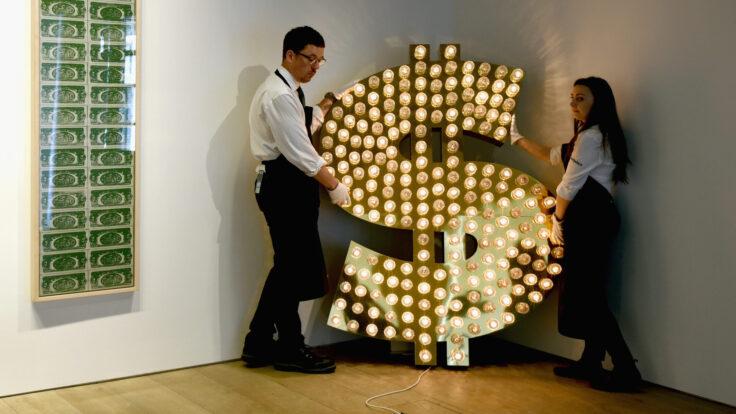
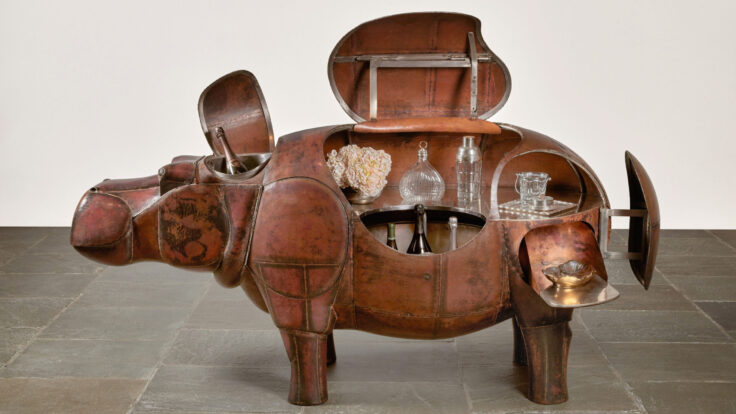
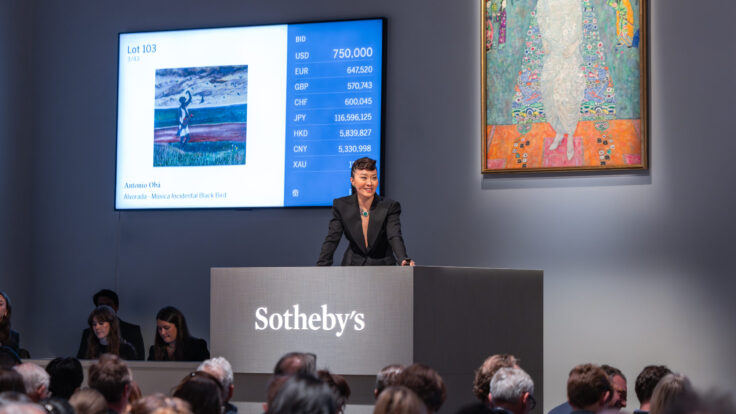
- Who bought the hippo?: François-Xavier Lalanne’s copper hippo bar sold for $31.4 million at Sotheby’s on Wednesday, a record for the artist and for a design work at auction. Naturally, attention quickly turned to the identity of the buyer. I heard all the usual suspects mentioned yesterday, but what was noteworthy was the consensus that the buyer was an American billionaire. Perhaps more important for the industry, one rival auctioneer was impressed
that there had been four different bidders still going at it above $20 million.
Of course, there was also speculation regarding the next major Lalanne work to come to market. My guess is we’ll see more works that previously made good prices come back to make better prices. For example, one of the edition of six ostrich bars, made in 1967, sold for $7.3 million in 2017; eight years later, another example sold in May for $12.6 million. If something like that happens, perhaps we will see another record. - Not your mother’s Tiffany…: The Schur family’s “magnolia” Tiffany floor lamp
sold for $4.4 million yesterday at Sotheby’s. The lamp was the top lot in Sotheby’s sale of Tiffany works, which totaled nearly $8.2 million. The “medallion” window from a church in Topeka, Kansas, failed to find a buyer, but other Tiffany Studios objects sold well against their
estimates.
- Bill Koch’s $50M Western art collection heads to Christie’s: Featuring paintings by Frederic Remington, Albert Bierstadt, N.C. Wyeth, and Charles Marion Russell, billionaire William Koch’s Western art collection will be sold at Christie’s with a January 20 evening sale, followed by a day sale on January 21. The combined low estimate is $50 million, which, according to
Christie’s, is twice the record for any previous American Western art auction.
|
Now, let’s get to Rauschenberg… |
|
|
In celebration of the centennial of Robert Rauschenberg’s birth, two
new museum shows in New York explore the work of an artist who always seemed both ubiquitous and somewhat forgotten. |
|
|
I’ve spent the past week trying to make sense of Robert
Rauschenberg. It wasn’t on my list of year-end projects, but I recently found myself looking at the artist’s work for the first time in a while on the very cold and windy upper stretches of Fifth Avenue. A few weeks earlier, one of the most perceptive and on-trend art advisors I know had posted images from the Museum of the City of New York’s show of Rauschenberg’s photography, and from a special exhibition at the Guggenheim drawn from the museum’s own collection. I had only been
vaguely aware that it was the centennial of Rauschenberg’s birth in Port Arthur, Texas—the same town that gave us Janis Joplin 18 years later.
I made a mental note that those might be good shows to see when things quieted down in early January. Then, somewhat out of the blue, I got a text from my friend Greg, an art world civilian who had read Hilton Als’s
appreciation of Rauschenberg in The New Yorker. Inspired by the piece, he was planning a trip to see both shows with his wife and adult daughters. First, he wanted advice on a company that provided docent tours of museum shows; then, when his wife and kids bailed, I volunteered to
go with him, half as a consolation to a fellow father whose wife and daughters often have better things to do, and half to share in the experience with someone who was becoming art-curious. |
|
|
A MESSAGE FROM OUR SPONSOR |
|
|
I wouldn’t call myself a huge fan of Rauschenberg’s work, but I am aware of some of
the high points. For some reason, something Jim Lewis wrote about the artist when he died, in 2008, has always stuck with me. “He was one of those people—quick as a comedian, deft, and knowing—who seem to be effortlessly inventive, spinning off ideas and techniques like droplets of water from a lawn sprinkler,” Lewis wrote
in Slate. “And there is hardly an artist working today who doesn’t owe him something.” |
Following Marcel Duchamp, who is soon to have a major retrospective in
New York and Philadelphia, Rauschenberg opened up what qualified as art. In his memorial essay, Lewis put it this way: “To Rauschenberg, almost anything could be art, and art could be almost anything. … [He] crossed media and created new ones as often as other artists clean their brushes.” Rauschenberg, whose work served as a precursor to pop art, confounded just about everyone when he asked Willem de Kooning for a drawing to erase, then presented the nearly effaced sheet as his
own work of art. This kind of conceptual leap often turns off the uninitiated, but the idea that an artist could paint with images—one of Rauschenberg’s next innovations—didn’t bother Greg. In fact, he was immediately captivated, and had a lot of questions.
As we walked through the Guggenheim show, we lingered over one of
Rauschenberg’s Red Paintings, from 1953-54, which he made after returning to New York from a second stint at the famed Black Mountain College. The painting features blocks of wood on the top and bottom, a gesture that allowed us to talk about the artist’s combines. Greg had read about Monogram—the goat with a tire around its middle standing on a painted, collaged surface—and he seemed to know about MoMA’s Bed, from 1955. The myth of that painting is that Rauschenberg
had been living hand to mouth and lacking in art supplies, and that he woke up and painted on his bed. He may have used his quilt and pillow in the combine, but the painting is only 6 feet and 3 inches tall, and less than 32 inches wide, which means either Rauschenberg slept on a cot, or the bed is meant to be another example of capturing life as it is lived in his art.
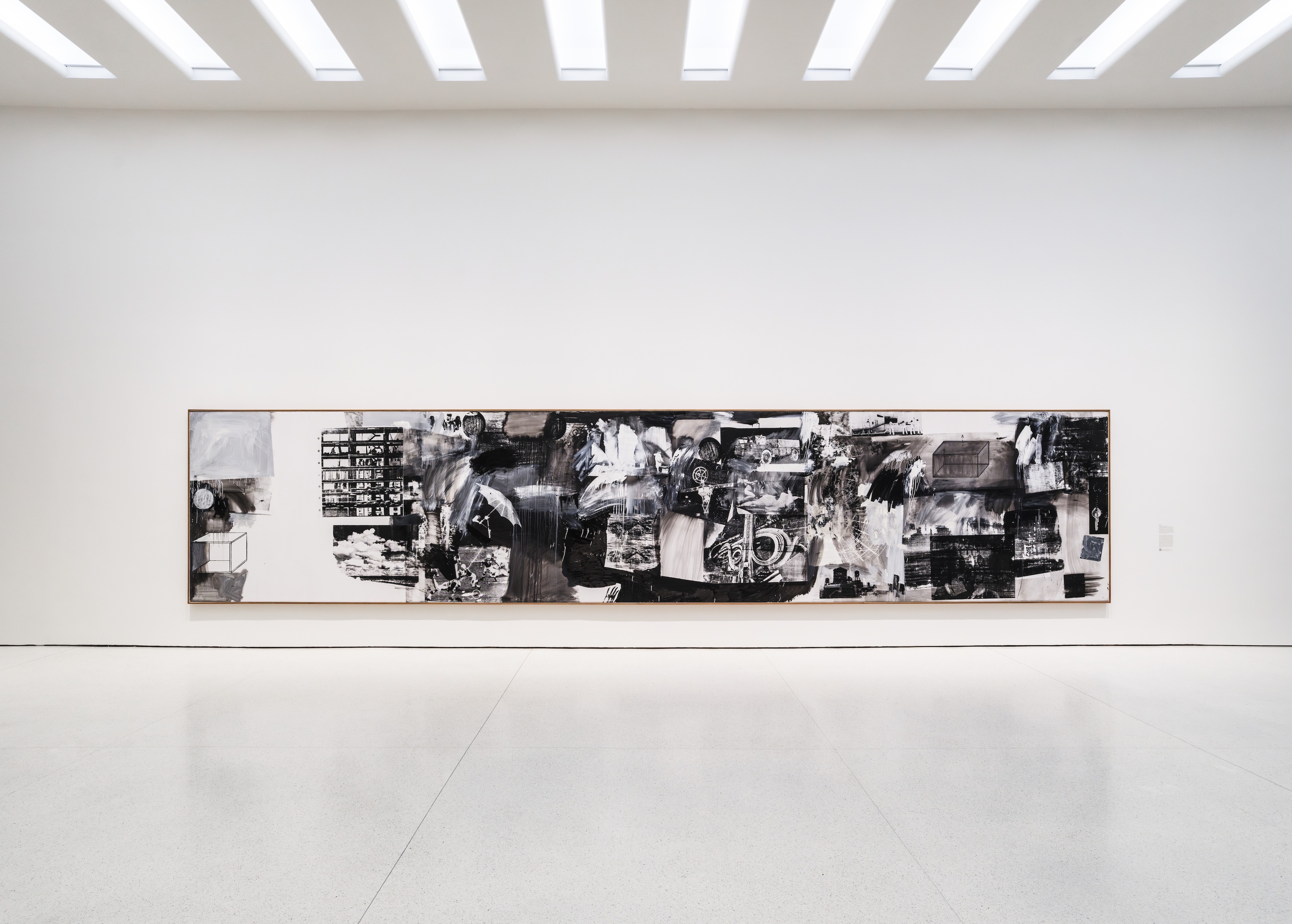
The centerpiece of the Guggenheim show is Barge, from 1962-63, a 32-foot-wide work of art with black-and-white
images silk-screened to the surface. Like many of the exhibition’s other works, it deals with Rauschenberg’s interest in found images. Barge itself is worth the trip to the Guggenheim, but the show also features a number of different ways in which Rauschenberg tried to adapt images from the “real” world into his art. There’s an example of one of his “revolvers”—a contraption holding five clear acrylic discs, printed with images in colors of cyan, yellow, and magenta. Although you’re not
allowed to touch it, the Guggenheim displays the work with a push-button control box that rotates the discs to create different arrangements of the layered images. |
Barge (1962-63), displayed at Robert Rauschenberg: Life Can’t Be
Stopped, Solomon Guggenheim Museum, New York. Photo: Ariel Ione Williams/Solomon R. Guggenheim Foundation |
Greg wasn’t as fascinated with that work as I was. He wanted to talk about
Rauschenberg’s process. Did he make sketches? What were the alternatives to the works we were seeing? I pointed out that the silk-screen technique Rauschenberg used—there’s a great example of a piece from when the artist switched to working in dye transfer—was also Andy Warhol’s signature style. And yet, the works look nothing like each other. |
|
|
That brings up another issue with Rauschenberg’s stature. His art doesn’t often sell
at auction, even if it sells very well in rare instances. Six years ago, Buffalo II, from 1964, was sold after 55 years in the same collection, for nearly $89 million. But that was an outlier. Most of Rauschenberg’s greatest works entered museum collections early. And a few works, like Rigger, from 1961, once owned by Sally and Victor Ganz, have seen their value slide: It was sold for nearly $12.3 million in 2017, but was
auctioned for $8 million earlier this year. |
Pictures of the Real World
|
In many ways, the Guggenheim show highlights one pole of Rauschenberg’s work—namely, the
many ways in which he assembled images. But a short walk uptown, to the Museum of the City of New York, provided a window into a very different aspect of the artist. Rauschenberg, after all, was also an accomplished photographer; his first works to enter MoMA were photographs, and he continued to take pictures and use them in his art throughout much of his working life.
Since New York City is the museum’s subject, the
exhibition, Robert Rauschenberg’s New York: Pictures of the Real World, focuses on his photography in the metropolis, although Rauschenberg took pictures everywhere. Greg, whose first love is music, noted how Rauschenberg riffed on his own images, spotting the way the artist scaled, flopped, and juxtaposed his work with familiar signs and symbols. Sometimes,
Rauschenberg printed these images on aluminum and copper (though we don’t see examples of the latter), and he created light boxes that allowed him to layer images on clear sheets that roll down like shades in front of a light source.
The light boxes are particularly interesting. There are a couple more of them on view at the Gemini G.E.L. studio, at Joni Moisant Weyl gallery in Chelsea, which is holding a show of prints, lithographs, and cardboard works. There, too, you can see many more
examples of the artist’s extraordinary range of ideas and experiments, including Booster, from 1967, a seminal collaboration between Rauschenberg and Gemini G.E.L.
I can’t think of another artist who seems to be both ubiquitous and somewhat forgotten. After touring these very different facets of Rauschenberg’s art and output, I came away conflicted. Was there no conventional retrospective because the artist had become less relevant or fallen out of favor? Or was this fragmented,
distributed tribute in keeping with Rauschenberg’s protean artworks? Greg didn’t care about any of that. The afternoon had opened up a new way of looking at the world. |
That will do it for today. On Sunday, we’ll have another great piece from our partners
at Air Mail—this one an appreciation of Frank Gehry by the great Paul Goldberger. Look for it in your inbox that evening.
Until then,
M |
|
|
The ultimate fashion industry bible, offering incisive reportage on all aspects of the business and its biggest
players. Anchored by preeminent fashion journalist Lauren Sherman, Line Sheet also features veteran reporter Rachel Strugatz, who delivers unparalleled intel on what’s happening in the beauty industry, and Sarah Shapiro, a longtime retail strategist who writes about e-commerce, brick-and-mortar, D.T.C., and more. |
|
|
Finally, a media podcast about what’s actually happening in the media—not the oversanitized,
legal-and-standards-approved version you read online. Join Dylan Byers, Puck’s veteran media reporter, and Julia Alexander, a longtime media analyst, as they sit down with TV personalities, moguls, pundits, and industry executives for raw, honest, sometimes salacious conversations about the business of media and its biggest egos. New episodes publish every Tuesday and Friday. |
|
|
Need help? Review our FAQ page or contact us for assistance. For brand partnerships, email ads@puck.news. You received this email
because you signed up to receive emails from Puck, or as part of your Puck account associated with {{customer.email}}. To stop receiving this newsletter and/or manage all your email preferences, click here. |
Puck is published by Heat Media LLC. 107 Greenwich St., New York, NY 10006 |
|
|
|