Welcome back to Wall Power. I’m Marion Maneker.
Glenn
Adamson is back with us today. He fills many roles professionally—author, curator, historian of craft and design—but he also has a remarkable track record for identifying talent early. In the past, Glenn has written about artists, artisans, and designers whom everyone else ends up talking about two to three years later. If he were a gambler or a basketball player, we would say he has a hot hand. That’s why I’ve asked him to keep an eye out, for a new column we’re calling the Hot Hand.
Tonight, Glenn writes about Rio Kobayashi, a fascinating Japanese designer who has a remarkable skill that Glenn calls “sympathetic invention.” I’ll let him explain what that is.
On our way there, I stopped by Maysha Mohamedi’s new show at Pace. Finally, at the bottom, Reuters ostensibly revealed Banksy’s identity on Friday. Now we’re passing it along to you.
Also mentioned in this issue: Jerry Garcia, Derek
Trucks, Jack Kerouac, George Harrison, Eddie Van Halen, Bob Dylan, Lou Reed, Neal Schon, Don McLean, John McVie, Marc Restellini, Agnes Martin, Mark Rothko, Dan Flavin, Christine Sun Kim, and more…
Let’s get into it… |
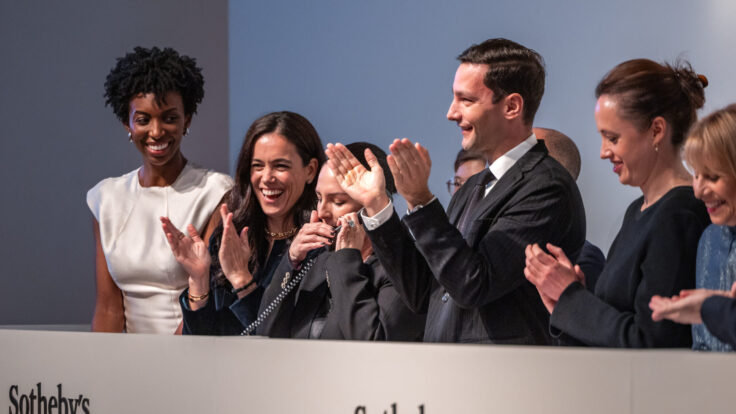
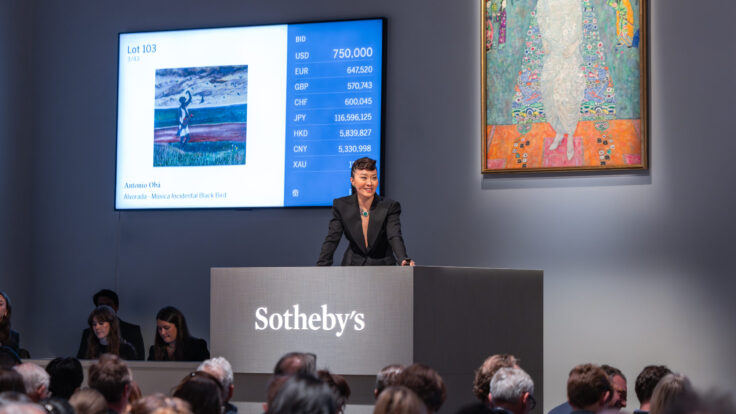
- Garcia, Trucks, and Shots: I wasn’t in the room at Christie’s during the Jim Irsay auction on Thursday, but I did tell you that auctioneer Tash Perrin couldn’t stop laughing after the hammer came down on Jerry Garcia’s “Tiger” guitar, which sold for $11.5 million. It turns out that the crew of guys surrounding the winning bidder started passing a bottle and taking celebratory shots—that’s what Perrin was referring to when
she called out from the rostrum that she’d never seen “that” before at an auction. One of the guys there with the buyer was guitarist Derek Trucks, who performed “Statesboro Blues,” “Angel from Montgomery,” and the Dead’s own “Sugaree” with the Tedeschi Trucks Band the next night at the Beacon Theater,
playing Tiger on stage. Also on Friday, the second round of Irsay’s sale hit more big numbers, with the typescript for Jack Kerouac’s Dharma Bums selling for $1.6 million—and
guitars played by George Harrison, Eddie Van Halen, Bob Dylan, Lou Reed, Neal Schon, Don McLean, and John McVie all making prices well above the estimates.
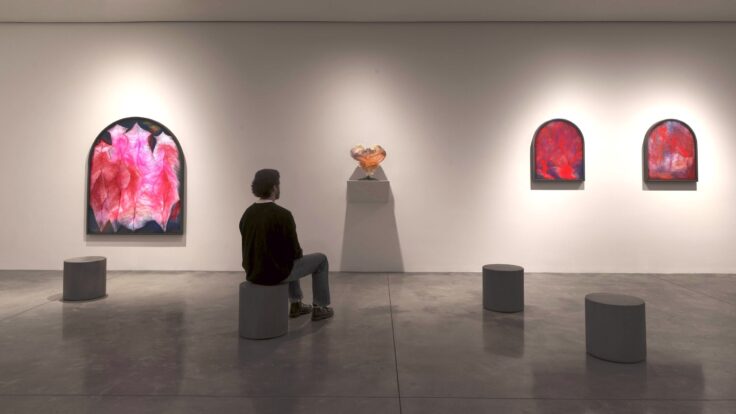
- Mohamedi at Pace: I went to Chelsea on Friday to see Maysha Mohamedi’s show of new paintings. I’d met Mohamedi a few weeks earlier and we bonded over her interest in
weightlifting. Or, to be more precise, Mohamedi was intrigued by Mrs. Wallpower’s own long strength-training journey. At the show at Pace’s flagship gallery on 25th Street, Mohamedi challenged me to identify the work titled Dead Lift.
Since her work is composed of abstract shapes of color that are sometimes punctuated with visible brushstrokes, the idea that I would be able to intuit a title seemed fanciful. The paintings are appealing, even soothing, but ultimately inscrutable. Nevertheless, through dumb luck I was able to suggest two paintings that might be called Dead Lift—and I was right about one of them.
Mohamedi, who is 46, came to painting a bit later in life than most, but that hasn’t stopped her from
getting work in the Met and LACMA. She recently took a year off from painting to dabble in a number of other creative endeavors, like acting and playwriting, as well as being a fellow traveler in other people’s spiritual pursuits: When we first met, she recounted how she’d spent time at a Christian retreat (she’s neither a Christian nor a practicing believer of any other kind) to push herself toward the final works in the show. Questhaven is the
result of that experience. The show closes on April 25. - Talking Modigliani: On a more personal note, I will be back at Pace on April 30 to moderate a panel during the gallery’s daylong
symposium on Amedeo Modigliani—organized to coincide with the publication of Marc Restellini’s long-gestating new catalogue raisonné of Modigliani’s work. The event will include authors of various catalogues raisonné for artists like Agnes Martin, Mark
Rothko, and Dan Flavin, as well as a number of other leading voices in the field.
|
|
|
|
At 27, the designer Rio Kobayashi has a far-flung sensibility, a Gen Z
restlessness, and an aesthetic wisdom beyond his years. And perhaps most importantly in this day and age, Kobayashi’s works are imbued with an infectious crossover appeal. |
|
|
|
For an artist of any era or background, “sympathetic invention” isn’t a sensibility that just
springs up overnight. But, even in his early career, Rio Kobayashi has shown an ability to adapt to and intuit different disciplines and aesthetics well beyond his years. Lineage and geography take some of the credit: Kobayashi is originally from Mashiko, Japan, a town famous for its ceramics, and his father, Shirobey, is a well-known potter and master of wood firing. His Austrian-Italian mother, Pia, meanwhile, is a skilled conservator and
master gilder. Though as Rio tells it, “There aren’t many baroque churches in Japan, so she grows vegetables and makes pickles for a living these days.”
With parents like that, it’s no surprise that he grew up making things, and it seems he never stopped. To this day, he remains blissfully innocent of conventional design training, though he did have a three-year apprenticeship at Einrichtungshaus Wetscher, the Austrian furniture company, where he picked up professional woodworking skills
as well as a knowledge of European decorative art history.
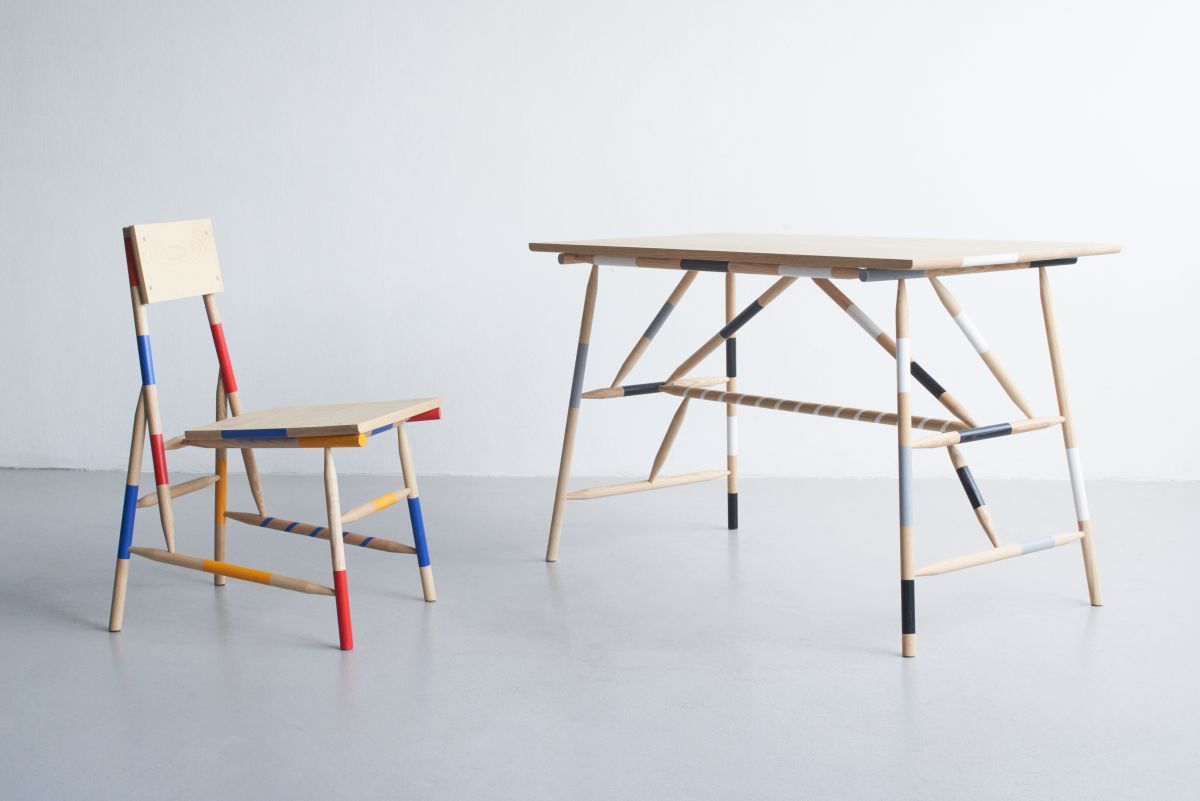
This unusual background has given Kobayashi a hybrid sensibility, equal parts Kinkaku-ji and Wiener Werkstätte. What’s more surprising, and more impressive, is his adroit manipulation of such aesthetic vocabularies; he’s like a standup comedian with a bilingual repertoire. His breakthrough collection Mikado, first shown at the London Design Fair in 2017, is a case in point. The title refers not to the
Gilbert and Sullivan operetta, but rather the popular game of pickup sticks, whose primary-colored stripes he emulated in the painted spindles of his furniture. Kobayashi was interested not just in the toy’s visual potential, but also its history; the game was apparently born in Japan and adapted in Europe, just like he was. |
Rio Kobayashi, Mikado (2017). Photo: Courtesy of Rio Kobayashi Studio |
Kobayashi’s star has been rising quickly, with his most recent blaze across the sky an exhibition
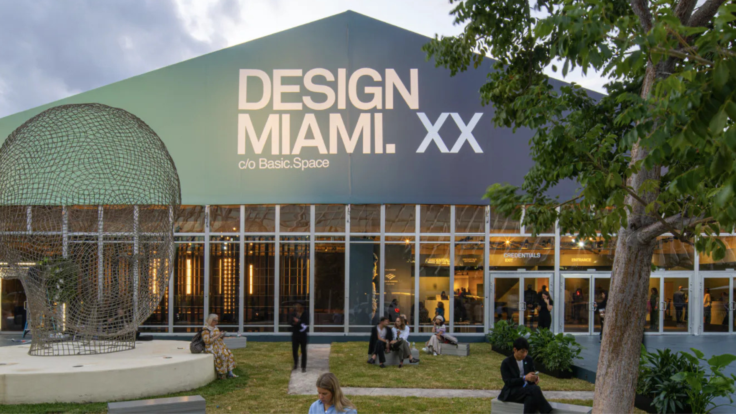
at Kate MacGarry’s well-regarded East London art gallery (more on that below). I myself first encountered him in 2024 at Design Miami. As curatorial director for the fair that year, I thought I knew where the action would be, but when I saw what he had made for Blunk Space, an up-and-coming gallery run by Mariah Nielson, I was floored. The booth was dominated by a beautifully articulated pair of redwood shelves, each of their hundred-odd asymmetrical elements
lovingly shaped by hand. They were masterworks, and what’s more, they perfectly conveyed the magic of where they’d been made: at the former home of Nielson’s father, J.B. Blunk, a paragon of countercultural creativity. Somehow, this young guy from Japan by way of Austria, now based in London, had tuned in perfectly to the earthen energies of 1960s California. |
You know a designer will go far when they pick up speed every time they bounce off something.
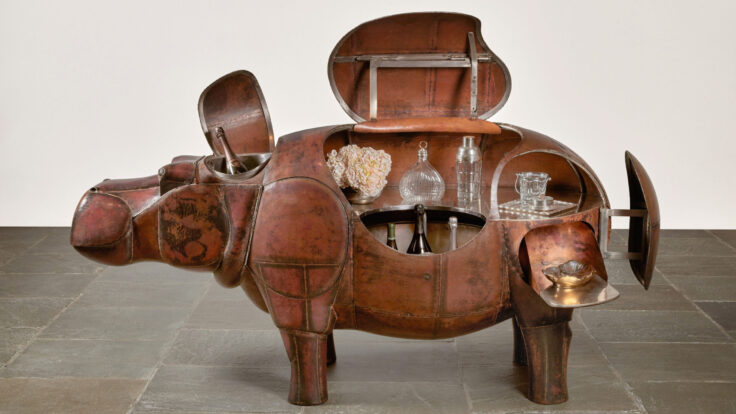
Since that promising debut, Kobayashi has zigged and zagged so many times that he seems almost to be eluding pursuit: wall shelves shaped like robots, a coffee table shaped (and realistically painted) like a giant tuna, a zebra-striped dresser for Dolce & Gabbana—these are just a few of his unlikely, unforgettable creations. “I have to keep myself excited,” he told me. “It’s economically inefficient, but I seem to reset my practice every project.” In this respect, he is a typical born-digital
Gen Zer; he moves easily from one frame of reference to the next, as if his brain were a web browser.
Generational attention span aside, it’s also true that Kobayashi is constantly reacting to new external stimuli. His business model, such as it is, has depended largely on private commissions, and his clients tend to give him a lot to react to. In one project, for the Berlin-based artist Christine Sun Kim, he transformed an apartment in a brutalist high-rise into an
elegant Asian-fusion interior, with sliding partitions inspired by shoji screens. He is currently building a listening room/broadcast studio for the Future Days Shop in Amsterdam, founded by musician Tomoyuki Katsurada, lately of the Japanese rock band Kikagaku Moyo. The plan is to fill the narrow, tight space with a riot of color and pattern, combining painted passages with cherry and walnut marquetry to psychedelic effect.
Kobayashi has also made one public
artwork, and it was a powerhouse. This was the Off the Shelf Pavilion (2024), built in London but inspired by Japanese and Austrian farmhouses, and filled with a collection of Portland stones, each tied with cord in the manner of tomeishi (literally “stop stones,” used to indicate walking paths in Japanese gardens). Horizontal beams of Douglas fir were finished at the ends with alternating touches of gilding and blue paint, a nod to the Viennese Secession. Kobayashi designed
the temporary pavilion with the engineering firm Webb Yates, and together they devised an ingenious system of clamped and wedged standardized—“off the shelf”—components so that the whole thing could be knocked down for later reuse.
If there is a consistent throughline across Kobayashi’s diverse projects, it is a strikingly graphic quality. This is again a generational affinity—his work always looks great on social media—with origins in his childhood in Japan. He grew up with anime
and manga, and admires the subculture they inspire; it’s a youthful, obsessive energy he tries to channel in his own designs. His recent exhibition with Kate MacGarry—a gallery that normally shows fine art, not design—was built entirely from old bits of Victorian woodwork and salvaged furniture, including a few broken Thonet chairs. Kobayashi cut up all this source material, reconfigured it, then added color and text in both English and Japanese. I went to the opening of the show
and it was packed, but it was the objects that were having the most brilliant conversation in the room, across culture, time, and space. |
For his next act, Kobayashi is participating in an ongoing project at Ginza Six, a Tokyo shopping
center and gallery complex. The premise is beautifully simple: Over three years, six designers are each given an entire Yoshino cedar, whose remarkably clear wood was often used to build historic temples. Applying his usual waste-not-want-not methodology, Kobayashi has designed a seating collection in which his entire tree is used, including the rounded exteriors, which would normally be sliced off and chipped. Some of the pieces are left natural, others stained in jewel-like blue, red, or
green. Following the presentation of the seating this spring, he will take what remains of the timber—mainly the cores of the logs—and construct another pavilion in the gallery space. |
Rio Kobayashi, A Tree at Ginza Six (2026). Photo: Daisuke Shima |
Kobayashi compares his Ginza Six concept to that of a California roll, which was developed in the
late 1970s—it was the first type of sushi maki to have rice on the outside, making it more palatable to Americans than traditional seaweed-wrapped cylinders. This is not the most obvious comparison, perhaps, but it’s characteristic of his associative thinking. The analogy also suggests that the project is another symbolic self-portrait, given his constant transformation and inversion of things Japanese. Even as he constantly reflects on his own cultural background, he’s making work of universal
appeal.
If you happen to know a lot about Japanese and European design history, you’ll be mightily impressed by his technically inventive bricolage. If not, that’s fine too, for his works have the infectious crossover potential of a pop song. Kobayashi says he wants to make “everything for everyone.” To a remarkable extent he has done that already, only a decade into his career—and he’s just getting started. |
Reuters has published a very long and somewhat tedious shaggy-dog
story about the true identity of Banksy. Charting their own investigation as if it were a John le Carré novel, the authors took two very well-known theories about Banksy and determined that, well, they’re right. Banksy was born Robin Gunningham and has had a long association with musician and artist Rob
Del Naja of the band Massive Attack, who seem to play in many places where Banksy murals appear. Although they try to set up Del Naja as the likely identity of Banksy for half the story, the truth is that Gunningham appears to be Banksy, but he’s now changed his name to the comically common English name of David Jones. Got that? Banksy lives his life as David Jones, and none of that has much to do with whether he’s a relevant or meaningful artist. (Talk amongst
yourselves on that one.)
When you’ve come up with an answer, let me know. I hope you’re enjoying the Oscars tonight. I’ll check back in with you on Tuesday.
Until then,
M |
|
|
|
Finally, a media podcast about what’s actually happening in the media—not the oversanitized,
legal-and-standards-approved version you read online. Join Dylan Byers, Puck’s veteran media reporter, and Julia Alexander, a longtime media analyst, as they sit down with TV personalities, moguls, pundits, and industry executives for raw, honest, sometimes salacious conversations about the business of media and its biggest egos. New episodes publish every Tuesday and Friday. |
|
|
|
A professional-grade rundown on the business of sports from John Ourand, the industry’s preeminent journalist,
covering the leagues, players, agencies, media deals, and the egos fueling it all. |
|
|
|
Need help? Review our
FAQ page or contact us for assistance. For brand partnerships, email ads@puck.news.
You received this email because you signed up to receive emails from Puck, or as part of your Puck account associated with {{customer.email}}. To stop receiving this newsletter and/or manage all your email preferences, click here. |
Puck is published by Heat Media LLC. 107 Greenwich St., New York, NY 10006 |
|
|
|
|