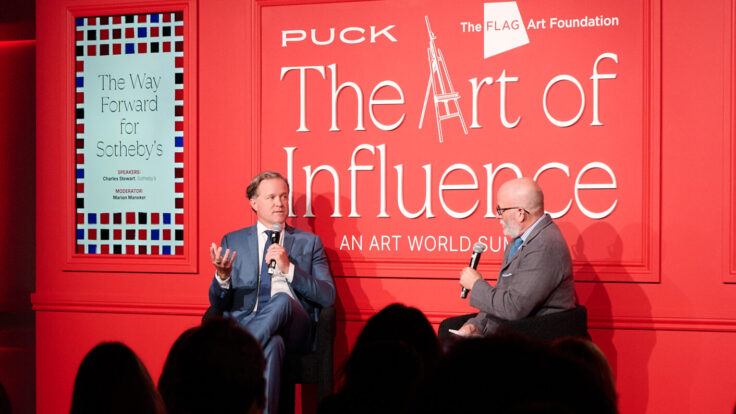
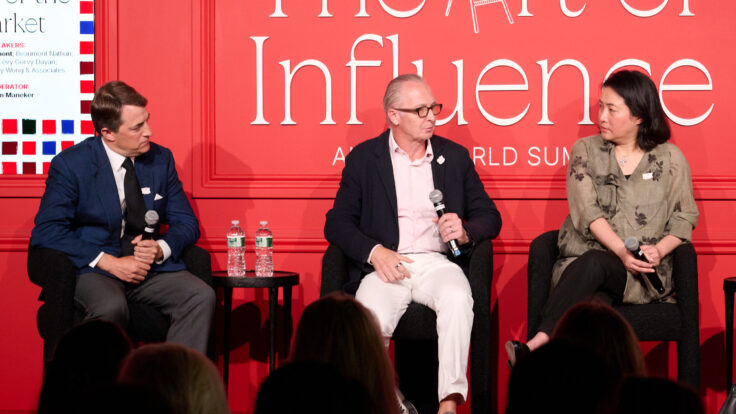
Welcome back to Wall Power. I’m Marion Maneker.
Tonight, we’re
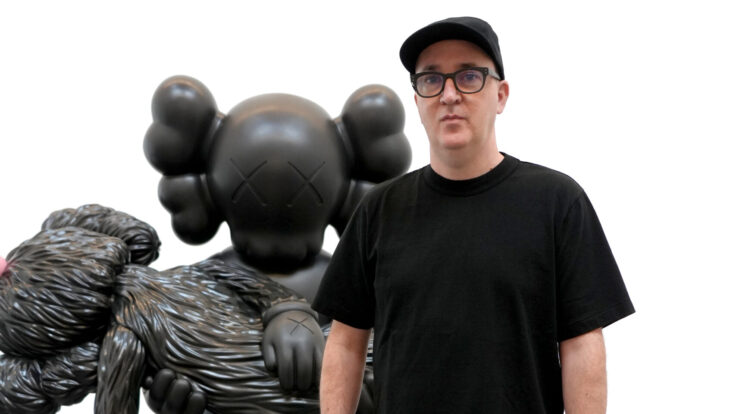
journeying to San Francisco, where Kaws has a big, successful show—a centerpiece of SFMOMA director Christopher Bedford’s long-term goal to increase community engagement and inclusion. I’ll explain below the fold.
🚨 Start the new year off on the right foot: If you’re still getting this private email forwarded to you, consider supporting our work by subscribing here. Or, if you’re already a subscriber, upgrade to the Inner Circle to receive the exclusive fourth day of Wall Power, filled with actionable data insights and interviews with key figures in the industry.
📲 Also, don’t forget that I’m always eager to hear from you. Got a tip, an idea, a complaint, or just want to vent? (Don’t worry, I have a thick skin and really
do like it when you tell me the things I’ve gotten wrong.) Feel free to respond to this email—it goes directly to my phone. Or send me a message on SMS, WhatsApp, or Signal at +1 917.825.1391.
Mentioned in this newsletter: Taylor Swift, Emilia Petrarca, Kindred Lubeck, Arthur Jafa, Christopher Bedford, Joan Mitchell, Amy Sherald, Ruth Asawa,
Kaws, Marcel Duchamp, Andy Warhol, Roy Lichtenstein, Cj Hendry, Matt DiGiacomo, and more…
Let’s get started… |
-
Kindred gems: I really enjoyed Emilia Petrarca’s New Yorker profile of Kindred Lubeck, the jewelry designer whose public standing was shot out of a cannon when Travis Kelce bought one of her diamond engagement rings for Taylor Swift. But
the article isn’t about celebrity weddings. Lubeck’s vaguely Victorian designs feature diamonds mined and cut in the 18th and 19th centuries. Their growing stature is a response to the expansion of lab-grown diamonds, which are devaluing stones whose rarity had depended on their clarity and lack of inclusions. Something similar happened to natural pearls a century ago, when cultivated pearls destroyed the appeal of their rare organic cousins.
- Arthur Jafa
curates MoMA: If you’re in Midtown Manhattan and have the time, I suggest you duck into MoMA’s latest Artist’s Choice exhibition—available even to visitors who don’t want to pay admission or enter the museum. The tight, single-gallery, ground-floor exhibition is a refreshing salon-style show of 80 objects culled from MoMA’s vast permanent collection by Arthur Jafa,
the installation artist known for his video montages.
What’s so compelling about these exhibitions is the ability to see one artist’s sensibility and interests evolve through the MoMA collection, creating a mashup of major and minor works. Here Jafa hangs a Cy Twombly, Leda and the Swan, from 1962, next to a
Jean-Michel Basquiat work on paper from 1981. On another wall is the massive Basquiat Glenn, from 1985, hanging beneath a Willem de Kooning painting from 1982. There’s Piet Mondrian’s
famous Broadway Boogie Woogie, from 1942-43, sitting nearby, along with a Gee’s Bend denim quilt by Lutisha Pettway. The exhibit can be absorbed quickly or lingered over. I’m guessing it will repay multiple visits, and the easy access means you can return whenever you’re in the neighborhood.
|
Now let’s get to the main event… |
|
|
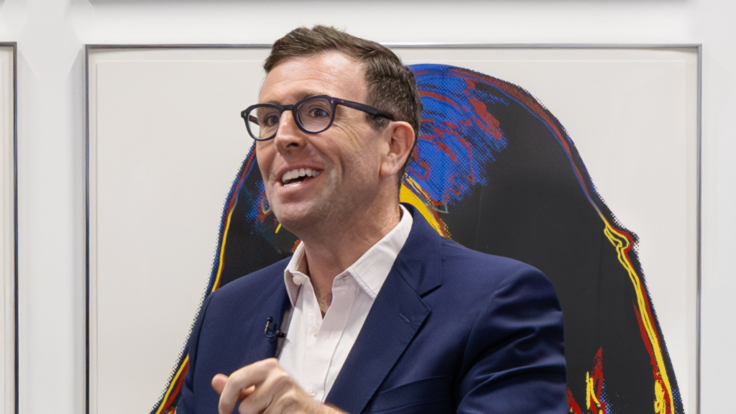
After Covid zombified downtown San Francisco, SFMOMA director Christopher Bedford
turned to an artist with a Warholian grasp of pop culture—and the ability to reengage both families and the tech set. |
|
|
When SFMOMA director Christopher Bedford was searching for a way to bring visitors
back to his museum years after the pandemic had reset attendance levels, he turned to Kaws, the artist also known as Brian Donnelly. It turned out to be a smart move: The current Kaws: Family show, with its images of off-kilter cartoon-inspired characters, has been a huge hit, achieving one of Bedford’s most important goals of bringing young professionals and families back to the museum. In fact, the show has been the most successful draw for families since its
Andy Warhol exhibition in 2019—before the shutdowns emptied out San Francisco’s downtown. But hold that thought. I’ll get back to it.
Bedford had inherited a “colossus of a museum,” he told me, including a massive new facility built in 2016. San Francisco was initially enchanted by its new gem: Attendance peaked at 1.1 million visitors in 2017. But by the time Bedford took over, in 2022, attendance had fallen sharply. In 2024, just 600,000 people visited SFMOMA.
Meanwhile, in the wake of George Floyd’s murder, museums were grappling with their responsibility to better represent the populations they serve—and few international-scale museums are embedded in communities as ethnically diverse as the Bay Area, where Asian American, Pacific Islander, Hispanic, and Black residents make up the majority of the population.
So, over the past three and a half years, Bedford set himself a dual mandate to improve both representation and
attendance. On the first front, SFMOMA has done an outstanding job of launching traveling exhibitions, such as the Joan Mitchell retrospective that eventually made its way to the Fondation Louis Vuitton in Paris. The museum also organized shows like Amy Sherald: American Sublime in the fall of 2024, which traveled to the Whitney before going to Baltimore, and will end up at the High Museum in Atlanta later this year. More recently, SFMOMA launched the Ruth
Asawa retrospective that’s now causing such a stir at New York’s MoMA.
But reversing the attendance slide has been a tougher battle. “We really, really need to diversify and grow our audience, which means having a kind of effervescent, highly diverse exhibition schedule,” Bedford told me last month, shortly after the Kaws exhibit opened. “Kaws is a really big
part of that,” he said, because his work “allows us to access the interests and predilections of a group that we captured pre-pandemic and have had trouble capturing since.”
That group, he continued, were young professionals ages 22 to 45—the kind of people tech companies employ. With office occupancy rates buoyed by the A.I. boom, Bedford needed a limited-run event that would draw those people back through the doors. |
It’s evident why Kaws is so valuable from Bedford’s perspective. As a museum director, he needs to
take visitors from the exhibition that brought them to the museum—say, the blue-chip Fisher collection, the 55,000-object permanent collection, or any one of the special exhibitions—and vector them into one of the other shows. “Every one of those exhibitions is calibrated to do a different thing, to meet a different audience,” Bedford explained. Kaws, he said, has been “extraordinary” not only in the sheer volume of people he attracts, but also in bringing in a “completely
different demographic.” Because let’s face it: In a place like San Francisco, a guy named Brian Donnelly can also qualify as a diverse voice.
I could also see why Kaws was a draw for the younger, educated tech types that power the city’s workforce. But it wasn’t clear to me what mechanism built his audience’s attachment. It wasn’t gallery shows and auctions. If you go by the auction market for Kaws, you would assume that the artist’s best days were behind him—his sales peaked in 2019,
when nearly $95 million worth of his artworks were resold on the public secondary markets. That year also saw all of his top 10 auction prices achieved, including the record price of nearly $15 million for The Kaws Album from 2005. Since then, though, his highest price at auction has only been around $1.9 million, with a couple of works selling for around $1.5 million in 2021, when $24 million worth of Kaws’s art sold. Otherwise, auction sales have dwindled to $7 million last
year.
Those numbers don’t really tell the story, however. Auction prices have come way down, although many works by Kaws have sold for prices between $300,000 and $1 million since 2022. Those sales are fewer and farther between, but they still take place above primary prices at Max Hetzler or Skarstedt, where a 3-foot-square canvas might set you back a quarter-million and a 5-foot-square work close to $700,000.
In 2021, a thousand Kaws lots sold on the auction market, according to
data from ARTDAI. In 2022, it was 900. Last year, it was 560, with works below $10,000 making up 504 of those lots. That’s a clue to what’s really going on here. There’s a lot of activity in the market for works priced below $10,000. These tend to be the toys and collectibles that Kaws makes and sells directly to his fan base via his website, Kawsone.com, where his drops are oversubscribed. These works filter out
into the auction market and onto resale sites. And so while Kaws’s fine-art auction numbers are fine, the real driver of his cultural relevance and recognizability lies beyond galleries and auction houses. |
One of the few
reviews of Kaws: Family I could find took issue with the lack of overt opposition to capitalism in the show. (This is San Francisco, after all.) “The work severs its connection to any signifiers of a specific locale or identity in service of commercial omnipotence,” the reviewer complained. “A Kaws object can be whatever you want it to be—except fine
art.”
But trying to read Kaws out of the canon because his art employs images inspired by popular culture—and he happily makes and sells collectible objects that many ordinary people consider works of art—is unsustainable after Warhol, Marcel Duchamp, Roy Lichtenstein, Jeff Koons, and dozens of other artists. In fact, turning the modes, methods, and events of the commercial world into art is slowly emerging as the 21st century’s most
idiosyncratic art form.
The Warhol parallel is particularly instructive given that the artist set SFMOMA’s most recent high for family visits. Both artists use bright colors and pop iconography. But more importantly, neither saw a boundary between the commercial world and fine art. More to the point, they viewed the commercial world as a place where culture plays out.
We live in an attention economy, of course, and garnering attention is itself a demonstration of demand and social
currency. That’s an insight other hybrid retail/influencer/event-maker/artists like Cj Hendry and Matt DiGiacomo have latched on to and made their own. Whether the art resides in the experience or in the object really doesn’t matter. There’s always something more—and more valuable—to collect. (That’s why I keep writing about these three
very different artists.)
When I asked someone close to Kaws how he remains so popular with such a broad swath of the public, he pointed to the artist’s many collabs with Uniqlo, the world’s third-largest retailer. “What he’s done with Uniqlo is insane,” this person said, and the projects have fueled what Bedford aptly described as a “really deeply resonant brand awareness.” If having a seemingly permanent presence in that store weren’t enough exposure, Kaws has also participated in drops
in Fortnite, the online video-game world with 650 million registered users. Indeed, Kaws’s confidant told me that Donnelly’s real innovation was perfecting the product drop as a form of public art. The clothing drops at Uniqlo and toy drops on his own site are important sources of revenue for the artist, but they’re also powerful branding exercises.
Let me give SFMOMA’s director the last word on the subject of Kaws’s fame and mass appeal: “His creative address very intentionally
spans so many areas of the mainstream,” Bedford told me. “It could be product design—t-shirts, hoodies, etcetera. It could be the wrapping of the Uniqlo store. It could be the collectibles… I mean, it’s sort of endless.” |
That will have to do for today. I’ll speak to you all again on Tuesday.
M |
|
|
Puck founding partner Matt Belloni takes you inside the business of Hollywood, using exclusive reporting and insight
to explain the backstories on everything from Marvel movies to the streaming wars. |
|
|
The ultimate fashion industry bible, offering incisive reportage on all aspects of the business and its biggest
players. Anchored by preeminent fashion journalist Lauren Sherman, Line Sheet also features veteran reporter Rachel Strugatz, who delivers unparalleled intel on what’s happening in the beauty industry, and Sarah Shapiro, a longtime retail strategist who writes about e-commerce, brick-and-mortar, D.T.C., and more. |
|
|
Need help? Review our FAQ page or contact us for assistance. For brand partnerships, email ads@puck.news. You received this email because you
signed up to receive emails from Puck, or as part of your Puck account associated with {{customer.email}}. To stop receiving this newsletter and/or manage all your email preferences, click here. |
Puck is published by Heat Media LLC. 107 Greenwich St., New York, NY 10006 |
|
|
|