Welcome back to Wall Power. I’m Marion Maneker, coming to you from
I-95, where we are slowly making our way home to New York after a weeklong gallery and museum tour of New England. I’ll share the details with you on Sunday.
Until then, Julie Davich has an early look at Christie’s Chinese furniture and works of art sale, including a 15-inch moon flask that could be yours for just half a million dollars. Below the fold, Julie examines the design offerings from Sotheby’s Pauline Karpidas auction series, which is expected
to bring more than $80 million.
Let’s get started… |
-
The Chinese delegation: September is upon us, and that means Asia Week, a series of auctions and gallery shows from September 11 to 19. The biggest auctions of the week are usually the Chinese art sales, which attract a flock of passionate collectors from China who spend hours poring over the offerings before decamping en masse to Peter Luger. In the 20th century, many of the best Chinese works of art ended up in the States, for various reasons, and now collectors in China are
“wanting to bring back things bought by their ancestors,” Asian art specialist Lark Mason said in a talk in Newport a few weeks ago. Of course, that doesn’t mean there aren’t American buyers, though most are of Chinese descent.
Previews don’t open for three more weeks, but I got an early sneak peek of some highlights from Christie’s Important Chinese Furniture and Works of Art sale. Unlike in the West, where furniture and porcelain are seen as less valuable in the art
hierarchy, in China they are considered the highest forms of expression. Since 2018, Christie’s and Sotheby’s have sold more than $330 million in Chinese furniture globally, about a fourth of that in New York. Senior specialist Michelle Cheng told me that some collectors are so fastidious about maintaining optimal conditions for their wood furniture that they won’t even go on a long vacation for fear of a humidifier malfunction.
One example at Christie’s this season is an
extremely rare huanghuali rectangular table, from the 16th-17th century, estimated to bring $200,000. (Huanghuali, a form of rosewood, is now an endangered species.) What makes this table unusual is the elaborate carving, featuring two phoenixes on the long sides—indicating noble provenance. The piece comes to auction from an American collector, who’d
loaned it to the MFA Boston for more than 20 years. Also on offer from the same collection is a rare, 6-foot-long, 17th century huanghuali corner-leg table with subtly upturned edges, estimated at $300,000. The top lot from the collection is a set of four 17th century huanghuali “official’s hat”
armchairs, estimated at $1.2 million, featuring the back splat that later influenced Western chair design.
The lot chosen for the cover of Christie’s sale catalogue this season is a 15-inch-tall, blue-and-white, “floral scroll” moon
flask, estimated at $500,000. Pro tip: The first thing to do when evaluating Chinese porcelain is to flip it over to check the bottom for its seal mark; in this case, it has the six-character mark of the Yongzheng Emperor’s reign, from 1723-1735, a brief period that produced fewer, but higher-quality, examples of porcelain. The color and shape of this flask are considered the pinnacle, with all-over floral decoration and a high-gloss finish.
Another porcelain highlight is an
exceptionally rare, Imperial ruby red-ground falangcai “Indian Lotus” wine cup, only 2.5 inches wide, also from the Yongzheng reign and estimated at $300,000. It’s one of 40 lots consigned by the heirs of Thomas Vaughan, a minerals company C.E.O. who assembled a collection of notably delicate objects. Specialist Rufus Chen is
also excited about an 8-inch-high vase in a meiping shape with clair-de-lune (or sky blue) glaze from the Kangxi period (1662-1722), estimated at $50,000. Heirs had emailed Chen about it without understanding its value, and he rushed to see it right away. “I thought it was too good to be true,” he told me.
|
|
|
A MESSAGE FROM OUR SPONSOR |
While many collectors dream of passing their art on to the next generation, tax implications, differing tastes
and the costs of maintaining a collection can complicate a well-intentioned — and sometimes emotionally charged — gift. Explore our guide for valuing, appraising and transferring your collection to ensure the pieces you spent decades collecting live on as you intended. Explore Our Guide |
|
|
-
Davis on the road again: The Noah Davis retrospective is adding one more early stop to its road trip next year: the Philadelphia Museum of Art. The exhibition started in Potsdam, before traveling to London’s Barbican Gallery, and is now at the Hammer Museum in L.A. It features 50 paintings and works on paper made before Davis’s death
from cancer at age 32, and consists mostly of poignant scenes from his Black community. “Given that Noah Davis lived and worked for some time in New York, it was a dream for the exhibition to have an East Coast venue,” the exhibition’s co-curator, Eleanor Nairne, told me. “Last autumn, a small number of his works were included in [a group exhibition of Black artists], and we were struck by the incredible response from visitors. That amplified our excitement to present a full
survey of his work at the PMA.”
|
|
|
Legendary collector Pauline Karpidas has a genius for bringing together the
fantastical and the surreal, and somehow making it work. The eclectic contents of her London flat, on offer at Sotheby’s next month, will feature a wide range of paintings and furniture. But for design collectors, the main draw is a rare, high-volume trove of Lalanne. |
|
|
The English collector and patron Pauline Karpidas doesn’t just decorate;
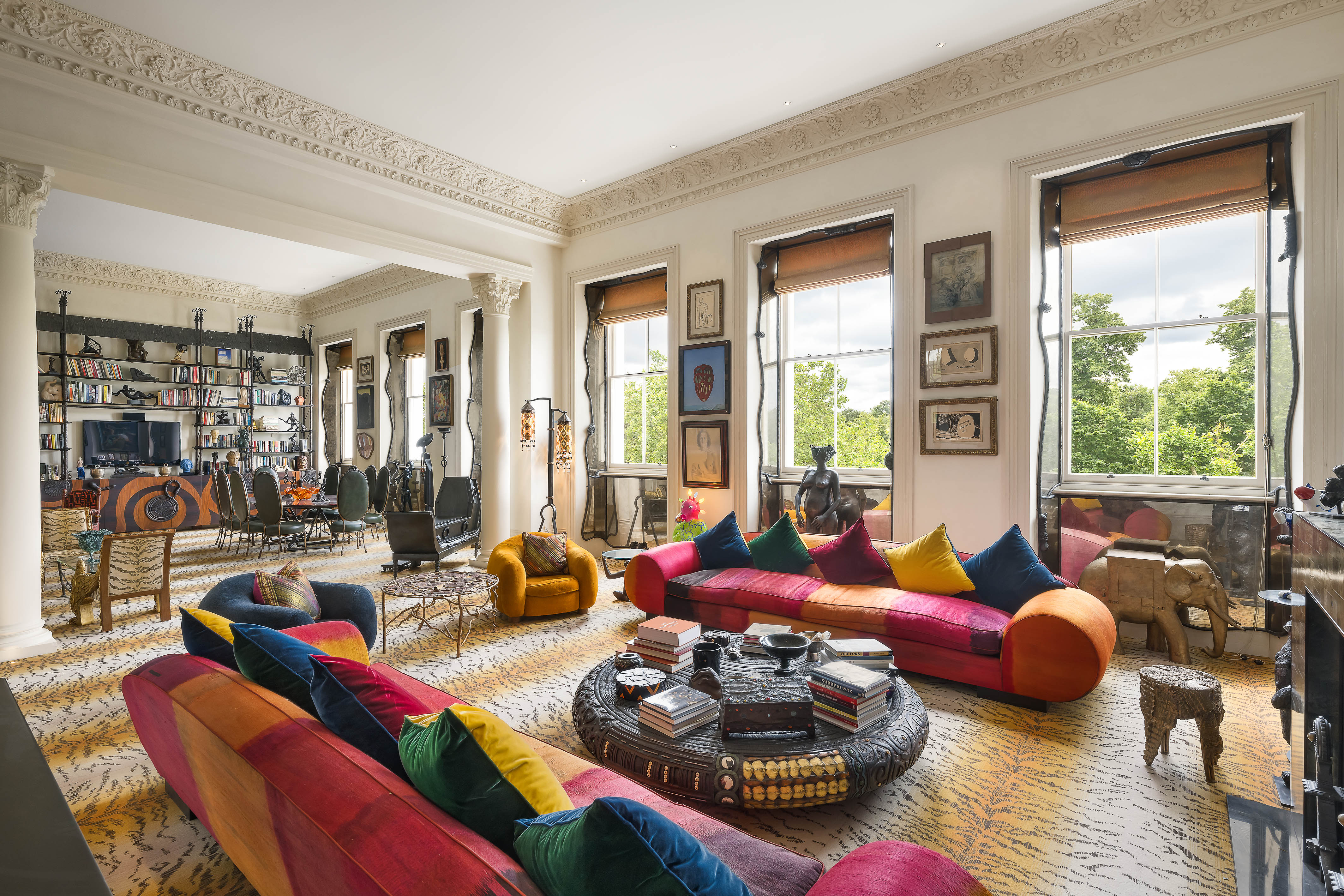
she creates worlds. Her spacious flat near London’s Hyde Park, where she lived for the past 15 years, was a surrealist dreamscape of clashing patterns and colors that somehow enhanced one another, with objects ranging from ancient to contemporary. It was a showplace for paintings by Magritte, de Chirico, Tanguy, and Carrington, hung salon-style above daring designs by Mattia
Bonetti, André Dubreuil, and about 35 pieces of furniture and sculptures by the husband/wife designers Claude and François-Xavier Lalanne. Grayson Perry ceramics sat atop a Bonetti
bookshelf. An ancient Roman marble head was displayed next to a blue
Magritte Tête that once belonged to the artist’s wife. |
The drawing room of Pauline Karpidas’s London flat. Photo: Barney
Hindle/Courtesy of Sotheby’s |
Next month, Sotheby’s London is selling the art and design from her flat in a
highly anticipated auction series that is expected to bring more than £60 million, or about $80 million—the highest-estimated single-owner collection ever at Sotheby’s Europe. (The all-time record is held by Christie’s, whose 2009 Yves Saint Laurent and Pierre Bergé sale made €374 million.)
Karpidas has sold the contents of her homes before: In 2023, Sotheby’s Paris auctioned 242 lots from her Greek manse on Hydra, where she used to host an artists’ salon, for €35.6 million, including 30 pieces by Les Lalanne that made €26.1 million, against an estimate of €7.6 million. The upcoming London sale, however, is considerably larger, with 348 lots, including 99 being offered online at estimates of £6,000 and below. |
Karpidas, the widow of the late shipping magnate Constantinos Karpidas, worked
with interior designer Jacques Grange and gallerist David Gill to bring her vision to life—but it was very much her vision. “Every piece, whether selected or commissioned, was a deliberate decision,” Sotheby’s global head of design, Jodi Pollack, told me. “That’s what makes the offering so singular, and deeply personalized.” |
|
|
A MESSAGE FROM OUR SPONSOR |
While many collectors dream of passing their art on to the next generation, tax implications, differing tastes
and the costs of maintaining a collection can complicate a well-intentioned — and sometimes emotionally charged — gift. Explore our guide for valuing, appraising and transferring your collection to ensure the pieces you spent decades collecting live on as you intended. Explore Our Guide |
|
|
Karpidas couldn’t get enough of Les Lalanne, and this London sale includes twice the number of
pieces by the artists as the Hydra sale, including 22 lots of jewelry. “I started off with Claude’s jewelry, and then her mirrors, chairs, and photo frames,” Karpidas told Sotheby’s back in 2019. (The chairs and frames are in the sale, too.) Karpidas was introduced to the design duo in 1978 by the Greek gallerist Alexander Iolas, who organized
the first U.S. exhibitions of Magritte and Max Ernst, yet another surrealist artist represented in the collection. She became an early and avid supporter of Les Lalanne, long before the 2009 Y.S.L. sale at Christie’s made them household names.
Karpidas ultimately invited Claude and François-Xavier Lalanne to design custom pieces for her, a creative collaboration that resulted in many iconic works, like Claude’s Très grand choupatte, a 4-foot-tall
bronze cabbage with chicken legs. Karpidas’s version was the genesis of a later edition of eight. “It’s the perfect example of something envisioned by Pauline that had direct impact and influence on later creations,” said Pollack. At $5.3 million, the Très grand choupatte was the top lot of the Hydra sale,
and set a record for the designer. The upcoming London sale features a smaller, unique, electroplated version of the choupatte, estimated to bring £300,000. Karpidas displayed it atop her Diego Giacometti Berceau Low Table,
estimated at £180,000. Pollack sequenced the two lots together in the Evening Sale.
The sheer volume and quality of jewelry on offer present a unique buying opportunity for an ambitious collector. “These pieces are exceptional examples of Claude’s early work,” said
Louisa Guinness, the eponymous gallery owner and gemologist. “They are small treasures and difficult to find.” The brooches, necklaces, and earrings featuring orchids, hydrangeas, and butterflies range in estimate from £1,500 to £5,000. Like the choupatte, they could be considered the prototypes for the jewelry Claude later made to sell, in the pink copper patina she became so well known for.
Les Lalanne were “like fairyland people,” Karpidas told Sotheby’s in
2019. They took a whimsical, surreal approach to flora and fauna: a monkey holding up a tabletop, for example, and bronze
stools that appear draped in crocodile skins. Two animal motifs central to the collection are the owl and the serpent, both Jungian symbols of the unconscious. “Pauline is very focused on the theme of the unconscious,” said Pollack, “and how the dreaming world impacts the waking world.”
Karpidas commissioned a gold patinated bronze bed from Claude, estimated at £200,000, with an owl perched on the headboard of branches, as if looking down on her as she slept. Serpents rarely appear in Claude’s larger body of work, but they are abundant in this collection, appearing on a
low table and an occasional table, estimated at £180,000 and £40,000,
respectively, as well as a copper brooch, estimated at £5,000. Karpidas added snake-themed sculptures by Jacques Lipchitz,
estimated at £800,000, and Niki de Saint Phalle, estimated at £20,000, to the eclectic
mix. |
Beyond Les Lalanne, the other pillars of the Karpidas collection are Dubreuil and Bonetti. The
Hydra sale was a huge market moment for Dubreuil, a French designer known for his fantastical creations in metal and glass, who died the year before the works went to auction. Usually there are no more than a few offerings by him in a design auction, but the Hydra sale had 31 pieces, which gave collectors an opportunity to see his output across multiple forms, as they would in a museum show. “His works are truly nonderivative,” said Pollack. “That resonated with Pauline.” |
|
|
There’s a strong market for Dubreuil, too. His pieces in the Hydra sale, estimated to bring
€441,000, ended up making €2.6 million, led by a pair of copper ceiling pendants that sold for a record €457,200, more than 15 times the €30,000 estimate. There are 11 works by the designer in the upcoming London sale, including five lamps. A standout is a copper table
lamp in a mushroom-like shape, estimated at just £10,000. The highest-estimated lot is a whimsical engraved copper desk that riffs on rococo style. “It is a super niche market, but the quality of the work and the rarity make it pretty special,” said a design expert not associated with the sale.
Meanwhile, the works from Swiss designer Bonetti, made from a variety of media including bronze, acrylic, marble, glass, and gemstones, also fit into Karpidas’s dreamscape. “It blurs the lines of utilitarian furniture and sculpture,” said Pollack. There are bulbous chests of drawers in
contrasting textures, and high-backed leather chairs that look as if they were made for Alice’s tea party.
Bonetti’s market, like his output, is uneven. His record was achieved in the Hydra sale by a throne-like
bench that he made with Elizabeth Garouste, his frequent collaborator. Estimated at €80,000, it sold for €444,500. The London offering is anchored by a floor-to-ceiling, wall-to-wall
bookcase, with cabinets crafted from mahogany and ebony, and ornamental bronze handles in indecipherable organic forms, estimated to bring £50,000. With 33 works by the designer, “it’s another opportunity for us to shape the design market,” said Pollack.
The Karpidas collection is about the
synchronicity of the paintings, sculpture, and furniture, and how all these seemingly disparate pieces worked together to create an immersive environment outside of time and place. “It is the rare collection that truly integrates decorative and fine art,” said the design expert. “It is refreshing to see someone collecting with courage.” |
|
|
The ultimate fashion industry bible, offering incisive reportage on all aspects of the business and its biggest
players. Anchored by preeminent fashion journalist Lauren Sherman, Line Sheet also features veteran reporter Rachel Strugatz, who delivers unparalleled intel on what’s happening in the beauty industry, and Sarah Shapiro, a longtime retail strategist who writes about e-commerce, brick-and-mortar, D.T.C., and more. |
|
|
Puck sports correspondent John Ourand and a rotating cast of industry insiders take you inside the executive suites
and owners boxes where the decisions that shape the entire sports business are made. You’ll hear interviews with players, network execs, and everyone in between. The Varsity is an extension of John’s private email for Puck by the same name. New episodes publish every Wednesday and Sunday. |
|
|
Need help? Review our FAQ page or contact us for assistance. For brand partnerships, email ads@puck.news. You received this email because you signed up to receive emails from Puck, or as part of your Puck account associated with {{customer.email}}. To stop receiving this newsletter and/or manage all your email preferences, click here. |
Puck is published by Heat Media LLC. 107 Greenwich St, New York, NY 10006
|
|
|
|