Welcome back to Wall Power. I’m Marion Maneker.
Happy annual Clare McAndrew Art Market Report Day. To no one’s surprise, McAndrew confirmed in her benchmark report that overall spending in the market was down in 2024 for the second year in a row. But the number of objects sold increased for the fourth consecutive year—a reminder that the art market continues to democratize, with more lower-value work selling, while the higher-value stuff just doesn’t come up as often. I’ll have more on that below.
By the way, if you’re getting this email forwarded to you, now would be an appropriate time to sign up for a subscription before we impose a tariff on you. Better yet, upgrade to Puck’s Inner Circle to get actionable content for serious art market players.
|
|
|
|
A MESSAGE FROM OUR SPONSOR
|
|
|
|
Now, here’s Julie on the big Amy Sherald show opening at the Whitney…
|
|
|
 |
Julie Brener Davich |
|
Amy Sherald: American Sublime at the Whitney Museum
|
|
Amy Sherald, A God Blessed Land (Empire of Dirt) (2022)
|
It didn’t take long—only nine years, really—for Amy Sherald to transform from an unknown, late-ish bloomer painter to the subject of a major traveling retrospective, which opens tomorrow at the Whitney. Her ascent was steady: In 2016, when she was living in Baltimore, she became the first Black woman to win the National Portrait Gallery’s Outwin Boochever Portrait Competition for Miss Everything (Unsuppressed Deliverance), out of 2,500 entrants. That led to the commission of her career-altering portrait of Michelle Obama, which paved the way for a $4.2 million auction record, a cover painting for Vanity Fair, and the current retrospective, organized by SFMOMA. The show, Amy Sherald: American Sublime, includes the award-winning painting and the Obama commission, along with about 50 other works.
Sherald, who is 51, grew up in Columbus, Georgia, and earned her M.F.A. from Maryland College of Art in 2004. She comes from the tradition of American realism, à la Edward Hopper and Barkley Hendricks. She depicts her subjects in searing detail; they stare out from the canvas thoughtfully, quizzically, or knowingly. She paints their Black skin tone in grisaille, or shades of grey, so the viewer can have an experience that is “not about race first,” as she put it in the 15-minute Art21-produced film that plays on a loop in the Whitney galleries. (Don’t skip it.) Candy-colored backgrounds and carefully chosen props and fashions—dolls, striped blazers, cowboy belt buckles, glittery nail polish—are used to explore the humanity of her subjects. In Miss Everything (Unsuppressed Deliverance), first shown in 2015 at Second Street Gallery in Charlottesville, her subject wears a red flowered hat and white tea gloves, and holds a comically oversize white tea cup and saucer.
Beneath Sherald’s compositions lurks an acknowledgement of violence. The earliest painting in the exhibition, Hangman, from 2007, which predates Sherald’s signature style, references lynching. “It bridges the idea of individuality and the history of racial violence in the U.S., which is only one facet of a Black person’s identity,” said Whitney curator Rujeko Hockley at the press preview. In some ways the painting is a precursor to Sherald’s 2020 portrait of Breonna Taylor, which appeared on the cover of VF.
On a practical level, Sherald’s later works are larger because the size of her Jersey City studio allows her to achieve the grand scale of her ambitions. With scale came more background detail—whether the exquisitely rendered tractor in A God Blessed Land (Empire of Dirt), or the gleaming playground slide in Kingdom, both from 2022. Sherald’s process starts with photographing her subjects and then focusing on a specific image as the basis for the composition. The works in the retrospective span 2007 to 2024, and include a couple monumental paintings—the triptych Ecclesia (The Meeting of Inheritance and Horizons) and the portrait Trans Forming Liberty—that she made just for the exhibition.
|
|
|
Remedios Varo, Revelación (1955) at Christie’s in May
|
|
Remedios Varo, Revelación (1955), estimated at $3.5 million
|
|
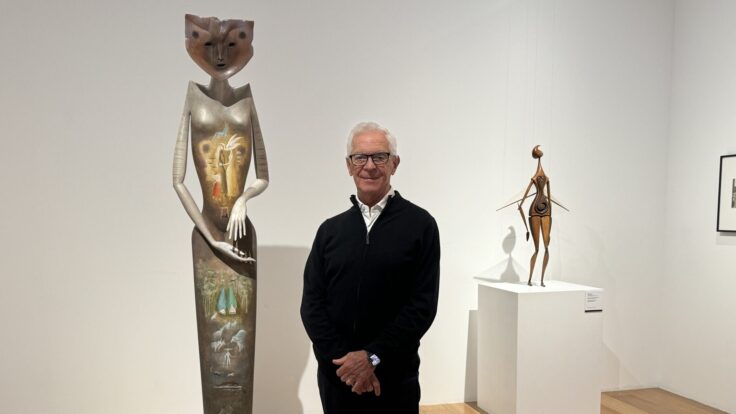
“We wanted to give this work its moment,” Kristen France, Christie’s head of Latin American art, told me yesterday shortly after announcing that the auction house would be offering Remedios Varo’s Revelación, from 1955, in its marquee May sales. It’s a seminal work that was included in the artist’s first solo exhibition held in 1956 in Mexico City.
That show launched the surrealist painter’s brief, shining career. In 1963, she tragically died of a heart attack at the age of 54. A posthumous tribute exhibition, also in Mexico City, enjoyed record attendance. In the brief period she was working, scholars have estimated that Varo made fewer than 200 paintings. “Works like this don’t come around very often,” France told me.
|
|
|
|
A MESSAGE FROM OUR SPONSOR
|
|
|
|
Varo was a meticulous painter, who built up thin glazes of oil and layers of varnish to create glowing colored surfaces, then dotted them with tiny details, often painted with a brush containing just a single hair. She also manipulated paint with her breath and blotting, sometimes creating highlights and textures by scratching the surface with fine crosshatching. All of this can be seen in Revelación, which depicts a clockmaker dumbstruck by the revelation of the concept of relativity.
The scene, modeled on an Old Master theme of the annunciation, shows the horologist in a room full of grandfather clocks, each one representing an epoch of the belief in linear time. Through the window floats the galactic evocation of relativity. The whole scene takes place in a room that mimics the dramatically raked set of a stage with a soft tent for a ceiling, all of it observed by a lone cat in the foreground—an avatar for Varo herself.
Born in Spain to an engineer and a devout Catholic, Varo combined an interest in science and scientific illustration with an attraction to mysticism. Throughout the 1920s and ’30s, she moved in surrealist circles in Spain and France. In 1941, fleeing the war in Europe, she migrated to Mexico, where she worked as a graphic designer and illustrator. But it was only by the mid-1950s that she felt financially comfortable enough to paint.
Varo’s most sought-after works come from 1955-56. Three of her four highest prices at auction have been achieved over the past five years, including the nearly $6.2 million paid for the 1956 painting Armonía in 2020. Revelación is estimated at $3.5 million, a number that would see this work among Varo’s top five prices, once the buyer’s premium is added. France is hoping for a larger number, but we’ll have to wait until closer to the May sales to see if we’re in that kind of environment.
And now, let’s dig into McAndrew’s report…
|
|
|
|
Clare McAndrew’s benchmark report on the health of the art market confirms that the value of transactions fell again in 2024 to $57.5 billion, the lowest level in four years. The number of transactions rose, though, and market activity at lower levels remains robust. This, in all its messiness, is what the democratization of the art market looks like.
|
|
|
|
The art market is an unlikely place to find signs of the vibrancy and persistence of democracy. After all, it’s a rich person’s game. Even if you look at the global oligarchs and skylords of finance as a different species, art buyers are definitionally wealthy enough to have met their material needs. They’re also rich in spirit. During the past two years, we’ve seen evidence in auction data, now backed up by Clare McAndrew’s definitive annual art market report, suggesting that there are more buyers for art—not just the wealthiest. And they’re buying art that is relatively cheap. Two cheers for democracy!
I’m not trying to be flippant here. In her Art Basel and UBS Global Art Market Report, using auction data and 1,600 surveys from dealers in 58 countries, McAndrew has concluded that the global art market fell 12 percent in 2024 to $57.5 billion in sales. That’s the lowest level since the pandemic shut down commerce in 2020. According to her methodology, this is one of the few times in the past 15 years—along with 2009, 2010, 2012, 2016, and 2020 itself—when sales fell below this threshold.
|
|
|
|
Of course, a number of those fallow years followed economic or political turmoil—the financial crisis, the Greek debt crisis, Brexit, etcetera. This time around, there were the headwinds caused by the wars in Ukraine and Gaza, the continuing economic slump in China, and inflation. In other words, the cause of the slump was overdetermined, as the Freudians used to say, rather than attributable to a single fixation.
|
The Rise of the Micro-Galleries
|
|
Whether the ultra-wealthy really take their spending cues from geopolitical events is hard to know. The sample size here is far too small. But the numbers suggest that a broader group of buyers is eager to participate in the art market. According to McAndrew, overall transactions rose 3 percent in 2024 to a level near the previous peak in 2019—a year in which she estimated that sales were $7 billion higher.
Some more outtakes: In 2024, dealer sales fell in value by 6 percent. Auctions dropped in value by 25 percent, but private sales at the auction houses were up 14 percent. Sales in the United States were down only 9 percent. And the U.S. and United Kingdom were once again the top two markets for art sales—at 43 percent and 18 percent, respectively. Transactions for works priced above $10 million fell last year by 39 percent. That’s on top of a 27 percent drop from 2022 to 2023. That doesn’t mean big-ticket items are not being sold. There are just fewer of those transactions, or they are becoming harder and harder to track.
Now here’s why I say the art market is democratizing. From her research, McAndrew concluded that dealer sales overall fell by 6 percent, to $34.1 billion globally. Galleries that sold more than $10 million worth of art during the year were down 9 percent; galleries selling $5 million to $10 million of art each year were down, but only by 3 percent. Meanwhile, micro-galleries with sales of less than $250,000 a year saw a 17 percent rise, and galleries that sold between $1 million and $5 million worth of art each year were up by 10 percent.
In the auction market, the number of lots sold below $5,000 rose by 13 percent. That’s a big jump. And while it may indicate more new buyers entering the market, it may also reflect the auction houses’ greater ability to sell lower-value works profitably. (The industry had previously been pushing these works, which require nearly the same amount of internal processing as higher-value works, to other sales channels.)
Until last week, one would have reasonably presumed that 2024 was a bottom and that animal spirits might return to the art market. How Donald Trump’s self-aggrandizing attempts to crash the world economy will play out—and play out for the art market—is anyone’s guess. But the prospects for an art market recovery presumably got a lot dimmer this past week.
McAndrew does have a chart of U.S. imports and exports of art over the past two decades. Since 2016, the U.S. has been a net exporter of art. In 2018, the gap was $2.7 billion more art exported than imported. In 2020, it was $3 billion. That number narrowed in 2021 but widened again over the past three years. In 2024, the U.S. exported $1.5 billion more art than it imported. As we discussed on Sunday, currently there is no tariff on art coming into the United States. Will the other countries that import art from us continue to buy?
|
|
That’s enough about tariffs. Tomorrow, I’ll be back with the Inner Circle.
M
|
|
|
|
The ultimate fashion industry bible, offering incisive reportage on all aspects of the business and its biggest players. Anchored by preeminent fashion journalist Lauren Sherman, Line Sheet also features veteran reporter Rachel Strugatz, who delivers unparalleled intel on what’s happening in the beauty industry, and Sarah Shapiro, a longtime retail strategist who writes about e-commerce, brick-and-mortar, D.T.C., and more.
|
|
|
|
Finally, a media podcast about what’s actually happening in the media—not the oversanitized, legal-and-standards-approved version you read online. Join Dylan Byers, Puck’s veteran media reporter, as he sits down with TV personalities, moguls, pundits, and industry executives for raw, honest, sometimes salacious conversations about the business of media and its biggest egos. New episodes publish every Tuesday and Friday.
|
|
|
Need help? Review our FAQ page or contact us for assistance. For brand partnerships, email ads@puck.news.
You received this email because you signed up to receive emails from Puck, or as part of your Puck account associated with . To stop receiving this newsletter and/or manage all your email preferences, click here.
|
|
Puck is published by Heat Media LLC. 107 Greenwich St, New York, NY 10006
|
|
|
|





_01JRBCKSJFT82HA780PAD2B24X.png)