Welcome back to Wall Power. I’m Marion Maneker.
Art Basel is on
the horizon. The apex art fair has faced some dilution with the launch of Art Basel Paris, but it remains the focal point of many secondary-market dealers’ programs. This year, Hauser & Wirth is bringing a painting by Francis Picabia to highlight its booth, while its London gallery is hosting a mini-retrospective of the artist’s work titled Expanding Horizons. In tonight’s issue, I’m taking a look at Picabia’s market, life, and career.
Up top, Pace gallery made a
big announcement Wednesday night with an astutely pitched New York Times story; Jennifer Rubell wants to help you with your texts; German auction house Grisebach sold a sculpture for much more than expected; and Sotheby’s revealed a few of the big lots it had been holding back for the Joe Lewis sale later this month.
Also mentioned in this issue: Arne Glimcher,
Marc Glimcher, Jennifer Rubell, Don Rubell, Mera Rubell, Georg Kolbe, Mohamed Nur, Joe Lewis, Amedeo Modigliani, Oliver Barker, Marcel Duchamp,
Guillaume Apollinaire, Camille Pissarro, Tristan Tzara, André Breton, Sigmar Polke, Pauline Karpidas, Sarah Allen, and more.
Let’s get into it… |
-
Pace pulls back: One year after Pace celebrated its 65th anniversary, the gallery’s father-and-son duo, Arne and Marc Glimcher, announced this week that the gallery would cut 50 artists from its roster of 135, a reduction of 37 percent. The workforce will also shrink by 50 employees, which is about 20 percent of its staff. The overhaul is being presented as a way to return to the gallery’s mission. “It’s the difference between a
corporation that uses art to expand,” the elder Glimcher told the Times, “and an art gallery that is only about art.”
The Times story contains the admission that Pace had tried a number of different strategies, and characterizes the move as “clearly a last resort.” In a follow-up email, the gallery emphasized the cuts were “a
reorientation, not simply a restructuring. We are prioritizing relationships above systems and focusing resources strategically on rebuilding a primary market gallery” that will continue to operate globally, but its approach “to each place will be driven by the character of the local collecting community.”
Notably, positioning the move as a reaction to the “mega-gallery” model—Pace is one of four firms, along with David Zwirner, Gagosian, and Hauser & Wirth that carry that
unofficial designation—cleverly puts the focus on the model, and the art press has already dutifully responded with a shrink-to-grow think piece. But it isn’t really clear that the four mega-galleries share much of a model beyond having multiple locations around the world. Smaller galleries also have multiple locations around the world, just fewer of them. That said, the move does acknowledge that there is a limit to the size a gallery can or should be.
|
|
|
|
A MESSAGE FROM OUR SPONSOR |
Inspired by football fandom and Britain’s love of the beautiful game, the campaign captures the anticipation and camaraderie
of match day – come rain or shine – with an all-star cast of familiar faces.
Learn More |
|
|
|
-
Jennifer Rubell is attuned to your texting anxiety: On Wednesday, I stopped by Meredith Rosen Gallery on West 36th Street to see an installation by conceptual artist Jennifer Rubell, who is also the daughter of collectors and private museum pioneers Don and Mera Rubell. The show is three separate works—a painting, a performance piece, and an installation of 250 beach balls, the latter a combination of merch and
collectible items—all in support of Rubell’s new app, Attune, which is meant to use A.I. to help you reorient your texts by identifying unconscious biases. The show brought to mind a quote I read in the New York Observer many years ago, where the speaker extolled the virtue of rotary phones—which, he said, gave you enough time while dialing to reconsider whether you needed to make the call at
all.
- The colonial dance: German auction house Grisebach had a surprising sale yesterday, in which a large stone and bronze fountain featuring a dancing figure, made in 1922 by artist Georg Kolbe, sold for €5 million ($5.8 million), or almost five times the estimate. The sculpture’s pedestal is made of stone and carved with
figures modeled from Mohamed Nur, a Somali intellectual who arrived in Germany in 1910 as a teacher for a group of Somalis featured in an ethnographic show.
|
Joe Lewis’s
£45M Modigliani
|
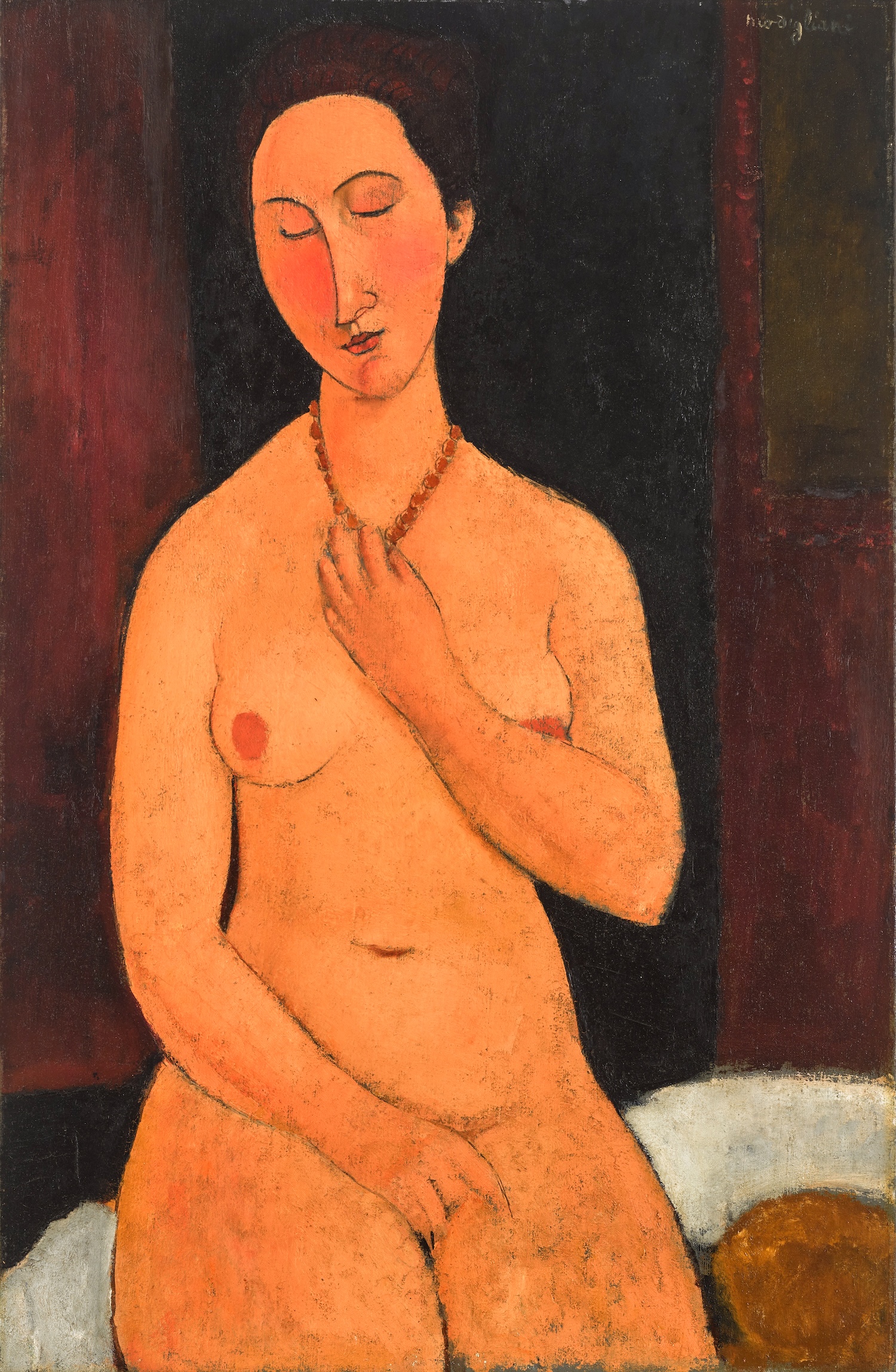
Amedeo Modigliani, Nu assis au collier (1917). Photo: Courtesy of Sotheby’s
|
The Joe Lewis collection
catalogue is now online, and I’m told there will be no more revelations before the sale on June 24 in London. Originally announced with a £150 million presale estimate, the sale has grown to £200 million (or nearly $270 million) with the inclusion of works by Degas, four Picassos, and now the
announcement of Amedeo Modigliani’s Nu assis au collier, from 1917, without an estimate but a whisper number of £45 million. Given the talk of two nine-figure Modigliani sales that recently took place in the private market, and the fact that the nudes sit at the top of the price structure for the artist’s work, £45 million sounds attractive.
All of this points to another interesting aspect of the Lewis sale: its timing. Normally, after a big season for high-value
lots—like the one we’ve just seen in New York—the market would have to wait six months before testing the depth of demand with a new supply of notable works at this level. Instead, we’re getting a one-two punch with Newhouse in New York and Lewis in London. “Lewis understands markets more than most,” Sotheby’s Oliver Barker told me earlier this week. In other words, he gets the timing, but he also has a high tolerance for risk. So don’t expect to see irrevocable
bids pop up on these works—he made the David Hockney painting he sold eight years ago into a no-reserve auction when there were doubts about demand. It sold for $90 million.
If the Lewis collection significantly outperforms estimates, the success should have two consequences. It will help bring attention back to London as a major sales center and establish the pattern of name collectors holding sales in Europe as we’ve become accustomed to seeing in New York. Barker told
me that European collectors are beginning to see the advantage of selling in their own lifetimes, as Pauline Karpidas and Lewis have both done. The collector gets to choose the most advantageous time to liquidate art assets, and also enjoys seeing the validation of strong bidding for works they loved. In three to four years’ time, Barker suggested, we could see a golden moment in the art market as more of these collections are sold in New York—and in London.
Speaking
of nudes, let’s look at Picabia… |
|
|
|
The yacht-owning, sports car–loving artist Francis Picabia defied the odds in
nearly all aspects of his life and career—and only now are his striking pinup works being taken seriously. |
|
|
|
If you happen to be in Europe for London Gallery Weekend or Art Basel, you might take some time to
indulge in the small Francis Picabia moment that seems to be taking place. As a close friend of Marcel Duchamp (whose MoMA retrospective is one of the current must-see shows in New York) and the poet Guillaume Apollinaire, Picabia knew, provoked, influenced, and was inspired by a range of figures, from Camille Pissarro, Alfred Stieglitz, Man Ray, and
Gertrude Stein to Tristan Tzara, André Breton, Sigmar Polke, and many others. |
|
|
|
A MESSAGE FROM OUR SPONSOR |
Inspired by football fandom and Britain’s love of the beautiful game, the campaign captures the anticipation and camaraderie
of match day – come rain or shine – with an all-star cast of familiar faces.
Learn More |
|
|
|
The recent New York auctions featured four Picabia works, including a rare pre-Cubist painting from
the artist’s youth that sold for three times the estimate, and a World War II–era “pinup” picture that sold for almost twice its estimate. In London, Hauser & Wirth is hosting a mini-retrospective of the artist’s long and varied career as a painter, with an emphasis on his later years, when the high-living artist returned to Paris after a 20-year absence, broke and somewhat dissolute.
Hauser is also bringing a striking pinup work to Art Basel with a $2.5 million price tag, which is
significant if only because these kitsch-flavored works were ignored until about a decade ago, even by the art historians who followed Picabia’s work intently. Last year, the value of these works got a real shot in the arm when Pauline Karpidas sold her very good example, Deux amies, from
1940-41, for nearly $4.5 million.
With all of that going on, I’ve been regretting my decision not to travel to Europe this month. To make up for it, I spoke to Hauser partner and the gallery’s head of research, Sarah Allen, about Picabia’s life and career. Among other things, she told me that Picabia’s public market is keeping up with his growing private secondary sales. |
The lore around Picabia is undeniably fascinating. The only child of a Spanish-Cuban father and
French mother who died when he was 5, Picabia, according to his first wife, had a youth “saturated with solitude and boredom.” He seemed to develop a taste for provocation at a young age that would characterize his art for the rest of his life. He was also born into enough affluence to indulge in a do-as-he-pleased sense of self-confidence, and over the course of his life owned more than a hundred sports cars and numerous yachts.
At the age of 18, he eloped to Switzerland with the
mistress of a well-known writer, causing his father to cut off his allowance for a time. Instead of caving to paternal authority, Picabia took up painting and was shockingly able to succeed. The former mistress introduced Picabia to Pissarro, who saw something in the boy. After some academic training, Picabia spent the first 10 years of his career as an able but not inspired post-impressionist. One of the
works from this period sold well in New York last month, and that success should bring out some more of these works. As a critic for the Times pointed out a quarter century ago, there were some thousand canvases that Picabia produced in this period. |
|
|
|
While never possessing Picasso’s fluid talent as a draftsman, Picabia rivals the
great 20th century master in his ability to switch styles so completely as to make the work from one period unrecognizable from the next. By 1909, he had become a convert to cubism and made friends with Duchamp. “There’s no easy throughline in the work,” Allen told me. “He tore everything up. It drove his dealers crazy.” |
Because Picabia had enough of his own money to indulge his whims and travel, he was one of the few
European artists who attended the famous 1913 Armory Show in New York. He was quoted in many of the disparaging stories about cubism—but that also gave him enough name recognition for Alfred Stieglitz to give him a number of shows, and thus a reason to travel to New York several times between 1913 and 1915. He spent the First World War stateside, where his wife said he indulged in “a constant tide of sexuality, jazz, and alcohol.” During this period, he also adopted the machine style of
depicting anthropomorphic images based on engineering drawings.
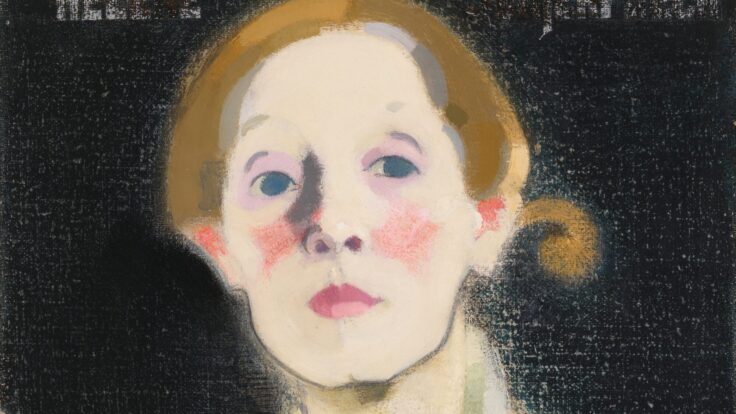
When he returned to Europe, Picabia first fell in with the Dadaists. Then he had a fight with the surrealists. In 1925, the artist returned to figurative work with a series of “monster” paintings, depicting faces with multiple sets of eyes, fantastic creatures, and garish portraits. These gave way to the transparencies, where he superimposed line drawings over neo-classical figurative images.
Picabia spent the Second
World War in the South of France, where he started painting from sexually suggestive photographs that appeared in racy magazines. (It would be prudish to call this stuff pornography.) Allen pointed out how revolutionary the pinup paintings were: Yes, Picabia was one of the first to paint from published images. But it appears he did this early in his career, too. So it’s not quite right to call him a proto-appropriationist, even if many more artists in the postwar period and beyond took the image
as a subject rather than real life.
If the pinups were only accepted after MoMA’s great Picabia retrospective in 2016, the current Hauser show is strongest in the works that Picabia made once he returned to Paris after the war’s end. There, everything changed again, from the imagery to the surface of the paintings, where Picabia played with the layering of impasto and the effects
of varnish. These late, late works may be the last new frontier of Picabia’s oeuvre to be rehabilitated, and they’re worth taking seriously, if only because the artist defied the odds in all other aspects of his life and career. |
That will have to do for today. I’ll be back on Sunday with more.
See you soon,
M
|
|
|
|
Puck founding partner Matt Belloni takes you inside the business of Hollywood, using exclusive reporting and insight
to explain the backstories on everything from Marvel movies to the streaming wars. |
|
|
|
Unique and privileged insight into the private conversations taking place inside boardrooms and corner offices up and
down Wall Street, relayed by best-selling author, journalist, and former M&A senior banker William D. Cohan. |
|
|
|
Need help? Review our FAQ page or contact us for assistance. For brand partnerships, email ads@puck.news. You received this email because you
signed up to receive emails from Puck, or as part of your Puck account associated with {{customer.email}}. To stop receiving this newsletter and/or manage all your email preferences, click here. |
Puck is published by Heat Media LLC. 107 Greenwich St., New York, NY 10006 |
|
|
|
|