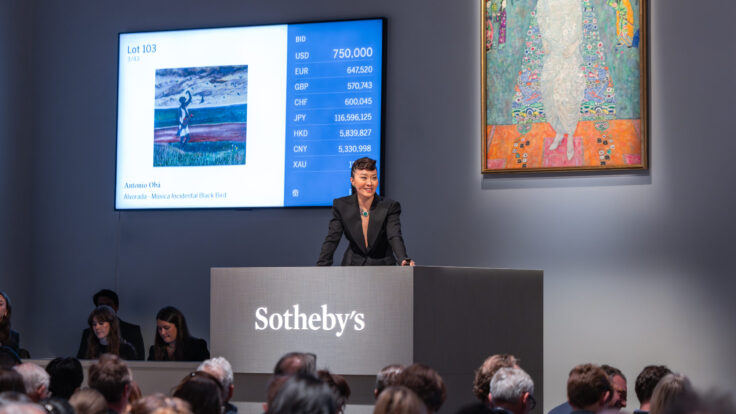
Welcome back to Wall Power. I’m Marion Maneker.
Gigaweek
starts tomorrow with the Weis sale at Christie’s and their 20th century evening sale. I’ll have a full report for you on Tuesday evening. Until then, look for updates on Instagram and X.
In the meantime, Julie takes the helm tonight with a report on the new Wifredo Lam retrospective at MoMA. Lam is a major figure in modern art—first as a protégé of Picasso in Paris in the late ’30s and then as a pioneer of
blending Europe’s modernism with African cultural heritage after he returned to Cuba. Julie has more below the fold. |
|
|
A MESSAGE FROM OUR SPONSOR |
|
|

| Julie Brener Davich
|
|
- Not everything came
up roses: The Christie’s, Sotheby’s, and Phillips live jewelry auctions this past week in Geneva totaled a combined CHF115.7 million, or $144 million—a 40 percent increase over the same sales’ results from last year. But, as always, there is a slightly more nuanced story beneath the superficial gloss of the top-line numbers. The top lot of the week was the Mellon Blue at Christie’s, which made CHF20.5 million ($26 million)—a very strong result, sure, but dampened by the fact that the
same stone had sold at the peak of the market, in 2014, for 25 percent more. “It’s the best blue diamond I’ve ever seen,” jewelry consultant Matthew Girling told me. “It just didn’t have that fresh-to-market luster that it had the first time around.”
The year-over-year increase in the overall sales totals is all the more remarkable considering that Phillips and Sotheby’s both withdrew their top lots. Phillips had a 6.95-carat fancy vivid purplish pink diamond, from
an unknown mine, estimated at a lofty $9 million. Meanwhile, Sotheby’s pulled their 10.08-carat fancy vivid pink diamond, mined just two years ago, that was estimated to bring about $20 million. Alas, both of the gems lacked the sort of provenance that collectors are drawn to at the highest levels of today’s market.
By juxtaposition, a 13.04-carat diamond
brooch that once belonged to Emperor Napoleon I and the House of Hohenzollern, made CHF3.5 million, or $4.3 million, against an estimate of CHF120,000, or $150,000, at Sotheby’s. Also at Sotheby’s, a 13.86-carat light pink diamond
ring that once belonged to Empress Catherine I of Russia, and most recently was owned by Princess Neslishah Sultan, made CHF2.9 million ($3.6 million) against an estimate of CHF240,000 ($300,000). At Phillips, a 42.68-carat Kashmir sapphire brooch formerly in the collection of
Gladys Moore Vanderbilt made CHF2.9 million ($3.6 million) against an estimate of CHF800,000 (around $1 million), though Girling surmises this price owed more to the gem’s size than its former owner. - New high for Geneva watch sales: Phillips, in association with Bacs & Russo, notched CHF66.6 million ($83 million) at its Geneva watches sale last week—the highest total ever for any auction in the category. Well, it was technically the
highest figure achieved in dollars, helped by the current exchange rate. The next-highest total was CHF68.2 million ($74.5 million), achieved in November 2021.
Was this a reliable indication that the market has returned to Covid-era highs? Let’s see: The 2021 sale had 248 lots at an average value of about $300,000; last week’s sale had only 207 lots, including a stainless-steel Patek Philippe Ref. 1518, which made $17.6 million, a
record for a vintage wristwatch from the brand. Even after eliminating this outlier price, the average lot value was $317,000—slightly higher than those frothy pandemic days. Altogether, Phillips sold 12 watches for more than $1 million, including a pink-on-pink version of the Ref. 1518 for CHF3.6 million, or $4.4 million.
Sotheby’s two watch
sales totaled CHF21.8 million ($27 million), their highest sum in a decade—with the 250th anniversary Breguet sale accounting for more than half that amount. According to Tony Traina of the Unpolished newsletter, F.P. Journe was the buyer of the four-minute tourbillon, from 1809, which inspired the brand’s recently released Ref. 7235. He paid CHF1.9 million ($2.38 million) against an estimate of CHF350,000 ($440,000), presumably for his new museum, set
to open next year in Geneva.
Meanwhile, surprises in the Breguet sale included a fresh-to-market and unique “tact” watch, originally sold by Breguet in 1802 to the Duke of Praslin, which made CHF838,200 ($1 million) against an estimate of just CHF26,000 ($33,000). There was also the three-wheel clock, originally sold in 1968 to esteemed watchmaker George Daniels. The last time it appeared at auction, in 2017, it went unsold at an estimate of £200,000
($270,000). This time it made CHF1.9 million, or $2.4 million, against an estimate of CHF200,000 ($230,000).
In Sotheby’s Important Watches sale, Mercedes Gleitze’s “Companion Oyster” Rolex, the world’s first practical waterproof watch, worn when she swam the English Channel in 1927, made CHF1.4 million, or $1.7 million. Another of Sotheby’s highly promoted items, a fresh-to-market Cartier Portico Mystery Clock from the collection of Gunter Sachs, did not
find a buyer at an estimate of CHF3 million—perhaps because Cartier itself already owns one. Meanwhile, over at Christie’s, the Rare Watches sale totaled CHF21.6 million, or $27 million. - A truly super Superman: The Lee brothers, now in their 50s and 60s, made a life-changing discovery last year in
their mother’s Northern California attic: six well-preserved comic books from 1939-1940. Now they are coming up for sale at Heritage Auctions this week. The most exciting of the bunch is a copy of Superman No. 1, which was given a grade of 9.0 out of 10 by the collective rating company CGC,
meaning it’s in near-mint condition. Only 200 copies of the issue have been submitted to CGC for grading since it was founded 25 years ago, and this one is the best-preserved. For pricing comparison, an 8.0-graded copy sold privately in 2022 for $5.3 million, and last year Heritage
sold a 7.5-graded copy for $2.3 million.
The Man of Steel first appeared in the inaugural issue of Action Comics, in June 1938, and became so popular that they gave him his own title the following year. The Lees’ copy is from the first print run of half a million
copies, further enhancing its value. (Two subsequent runs added another 400,000 to circulation). The other five comic books from the Lees’ collection are early issues of Action Comics, three of which are also unsurpassed in the CGC census. Jim Halperin, who launched the comic books category at Heritage 25 years ago, said in a statement, “A newly discovered, highest-graded copy of one of the greatest comic books in the history of the medium is the stuff dreams are made
of.” As of this writing, bidding on Superman No. 1 has already shot past $4 million, or $4.86 million including the buyer’s premium.
|
|
|
Now, let’s get to the main event… |
|
|
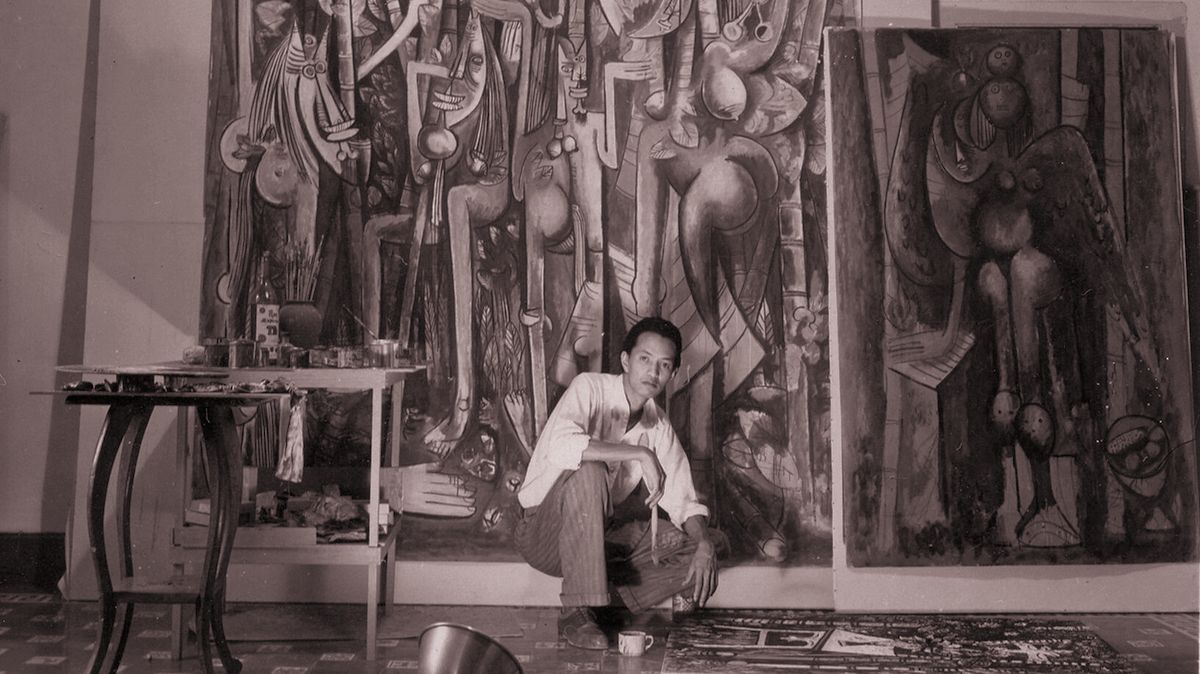
Wifredo Lam was born to a Chinese father and an Afro-Cuban mother, came
of age with Picasso in late 1930s Europe, and preferred painting on paper to canvas. Now, with a new MoMA retrospective, as well as nearly 20 works up for auction next week, the hard-to-categorize painter is finding global recognition. |
|
|
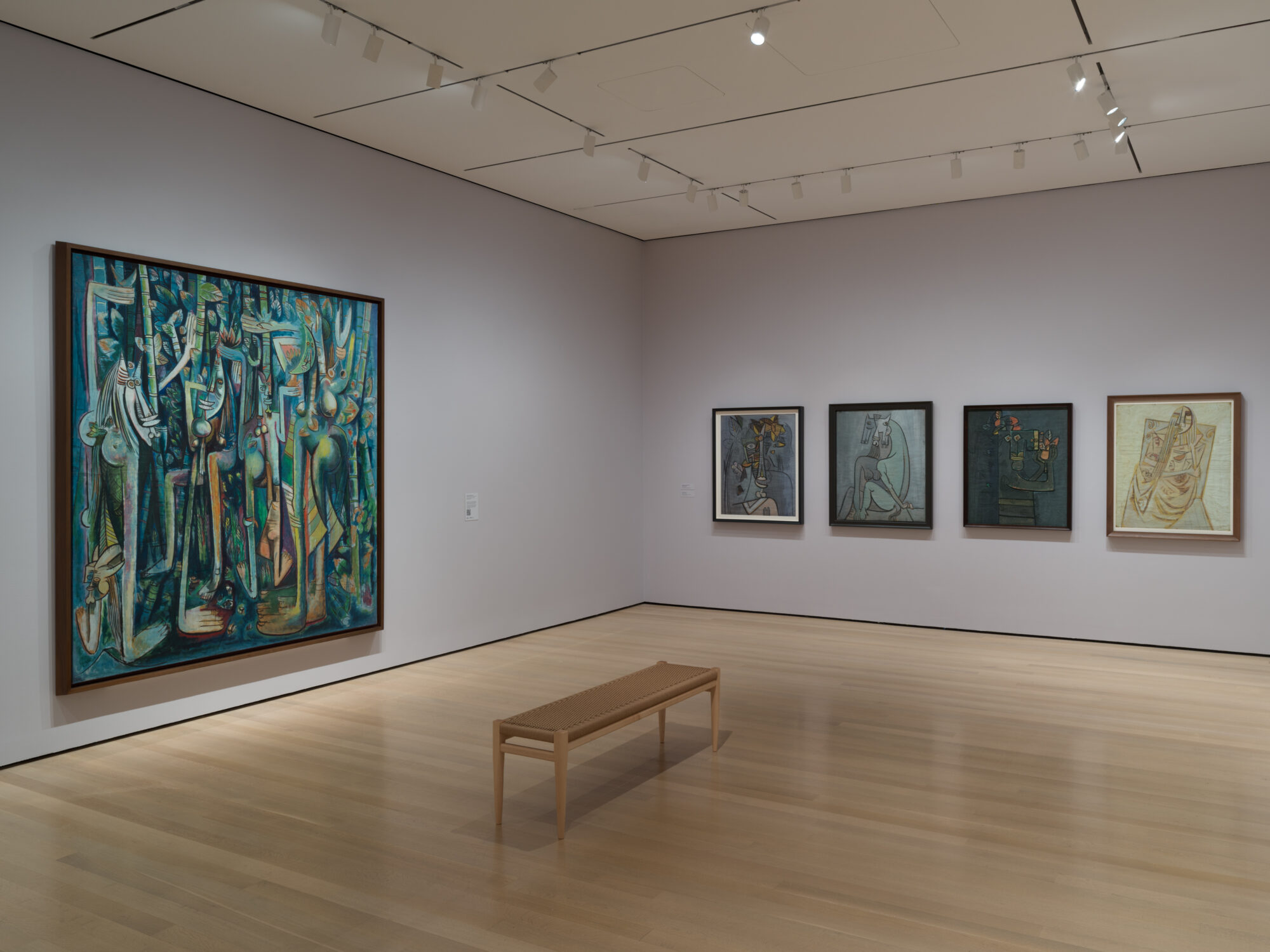
Wifredo Lam’s masterpiece La Jungla (The Jungle) has been a
centerpiece of MoMA’s collection since it was acquired from Pierre Matisse Gallery in 1945. The monumental work on paper, mounted on canvas, depicts elongated figures blending into Caribbean sugarcane stalks. It hung in the museum’s lobby on and off for decades, literally and figuratively removed from the narrative of modern art in the galleries—until 1988, that is, when critic John Yau called out the museum for isolating the painting as if it didn’t belong in the canon. The new
MoMA retrospective of Lam’s work, on view through April, more than compensates for that slight.
Lam doesn’t fit neatly into any art historical category. He was a painter, but mostly on paper; he was surrealist but also cubist; and he was born to an Afro-Cuban mother and a Chinese father but lived for much of his life in Western Europe. As the first retrospective of Lam’s work in the United States, this MoMA show looks at his art through a multicultural lens that simply wasn’t
possible during his lifetime. “We finally have the vocabulary to understand transnational artists,” said MoMA curator of Latin American art Beverly Adams. She organized the show with chief curator of prints and drawings Christophe Cherix, who was named director of MoMA earlier this year. Coincidentally, it’s the first show to open at the museum since he assumed his new role. |
|
|
A MESSAGE FROM OUR SPONSOR |
|
|
The exhibition is chronological and notably biographical, delving deeper into the
influences and circumstances of Lam’s evolving style than into the specifics of his compositions. Born in Cuba in 1902, he traveled to Spain in his early 20s to study painting but ended up joining the Republican forces against Franco. That’s when Lam, and his work, became more political, explained Adams, inspired by the notion that art can change society. He escaped to Paris in 1938 with a note of introduction to Picasso from Catalan sculptor Manolo Hugué.
Through Picasso, Lam met André Breton and other Surrealist artists and poets.
Picasso is credited with having outsize influence on Lam, somewhat stripping him of his own identity. In the exhibition catalogue, however, curator María Elena Ortiz makes the case that Lam also had an influence on Picasso. Their meeting “was an especially catalytic experience for Pablo Picasso, … who was forced to reconcile Lam’s presence with his own appropriations of African
art,” she wrote. The older artist arranged a studio for Lam in Paris and made introductions that led to a solo gallery show—where MoMA’s founding director, Alfred H. Barr Jr., first acquired one of his works, Mother and Child, from 1939. After Lam’s return to Cuba in 1941, following almost two decades abroad, Picasso’s overtly Cubist influence on his work lessened as he began exploring Afro-Cuban religious imagery, like birds, horned heads, and horseshoes. |
Wifredo Lam: When I Don’t Sleep, I Dream at The Museum of Modern Art, New York.
Photo: Jonathan Dorado/Courtesy of MoMA |
Given Cherix’s expertise in works on paper, the show also offers an occasion to
reconsider the materiality of Lam’s practice. He started using Kraft paper in lieu of canvas out of necessity during the Spanish Civil War, but continued to use it even in later years. “Lam is an enigma,” Cherix told me. “He made works on paper that behave like paintings.” And when he did use canvas, Adams and Cherix noted in the catalogue, he treated it like watercolor. In a major
coup, the museum didn’t just borrow Lam’s monumental 1949 work on paper, Grande Composition, for the retrospective. Cherix and Adams went to Paris, where the painting had been hanging in an apartment vestibule for 20 years, and acquired it for the permanent collection. |
International Man of
Mystery
|
While the MoMA show is raising awareness of Lam’s historical importance, his market
value will be tested just blocks away. There are 16 works by the artist coming up for auction at Sotheby’s and Christie’ next week in New York, ranging in estimate from $15,000 for a small drawing to $6 million for an oil and charcoal on canvas from 1944—the most sought-after period of Lam’s career. That painting, Ídolo
(Oyá/Divinité de l’air et de la mort), which combines elements of surrealism and Santería, last appeared at auction at Christie’s in 2012, after six decades in the same private collection. It sold to a South American collector for a then-record $4.5 million, doubling the previous record set just two years prior. |
|
|
The growth in Lam’s market is perhaps best exemplified by works that have sold and
resold at auction. A particularly interesting market case study is the artist’s 1959 oil on burlap painting Bonjour Monsieur Lam (Au commencement de la nuit), which appeared at auction five times between 1992 and 2019, increasing in price from $113,615 to $860,000.
Switzerland-based Galerie
Gmurzynska, which has represented Lam’s estate since 2010, has taken a global approach to his market, focusing especially on building up a buyer base in China. At some point, Lam was given a Chinese version of his name, Lin Fei Long, meaning “Flying Dragon,” which Gmurzynska has predictably promoted to curators in the region. When the gallery presented his work in 2012 at the Art Hong Kong fair (now Art Basel Hong Kong), they put Lam’s name on the wall in both English and Chinese. (One of the
paintings from that booth, an untitled 1958 oil and charcoal on paper mounted on canvas, is in the MoMA show.)
An exhibition last year of Lam’s work at the Asia Society in Hong Kong was dubbed Homecoming, a somewhat disingenuous moniker given that he never actually went to China, Lam’s son Eskil, who manages his father’s estate, told me. Lam’s Chinese heritage is also not particularly evident in his work—if anything, it’s merely a “sensibility” that he got from
his scribe father, said Adams, pointing to one of Lam’s pen-and-ink drawings as an example.
Gmurzynska’s efforts have helped to steadily expand the artist’s market, as did a major survey of Lam’s works that toured to the Pompidou, Reina Sofía, and Tate Modern in 2015-17. Around that time, the auction houses also started rethinking their approach to Latin American art—reducing dedicated sales in the category, which typically attracted only collectors focused on Latin American work, and
moving the most valuable examples to their higher-profile modern and contemporary art sales. In 2020, Sotheby’s set the world auction record for the artist by selling the 1943 oil on canvas Omi Obi— originally owned by Lam’s close friend, the Cuban writer Lydia Cabrera—for $9.6 million in a modern art evening sale.
That work, as it would happen, is part of the MoMA show, on loan from the collection of Argentine real estate developer Eduardo F.
Costantini. And while it’s too soon to tell if MoMA’s renewed embrace of Lam’s work will further amplify his market value, the effect on his historical value is unmistakable. As Mathias Rastorfer of Galerie Gmurzynska said, “Lam is a timely and timeless artist.” |
Thank you, Julie. See you on Tuesday, when we will know a whole lot more about the state
of the art market. I’m excited. I hope you are, too.
M |
|
|
The ultimate fashion industry bible, offering incisive reportage on all aspects of the business and its biggest
players. Anchored by preeminent fashion journalist Lauren Sherman, Line Sheet also features veteran reporter Rachel Strugatz, who delivers unparalleled intel on what’s happening in the beauty industry, and Sarah Shapiro, a longtime retail strategist who writes about e-commerce, brick-and-mortar, D.T.C., and more. |
|
|
Finally, a media podcast about what’s actually happening in the media—not the oversanitized,
legal-and-standards-approved version you read online. Join Dylan Byers, Puck’s veteran media reporter, and Julia Alexander, a longtime media analyst, as they sit down with TV personalities, moguls, pundits, and industry executives for raw, honest, sometimes salacious conversations about the business of media and its biggest egos. New episodes publish every Tuesday and Friday. |
|
|
Need help? Review our FAQ page or contact us for assistance. For brand partnerships, email ads@puck.news. You received this email
because you signed up to receive emails from Puck, or as part of your Puck account associated with {{customer.email}}. To stop receiving this newsletter and/or manage all your email preferences, click here. |
Puck is published by Heat Media LLC. 107 Greenwich St., New York, NY 10006 |
|
|
|