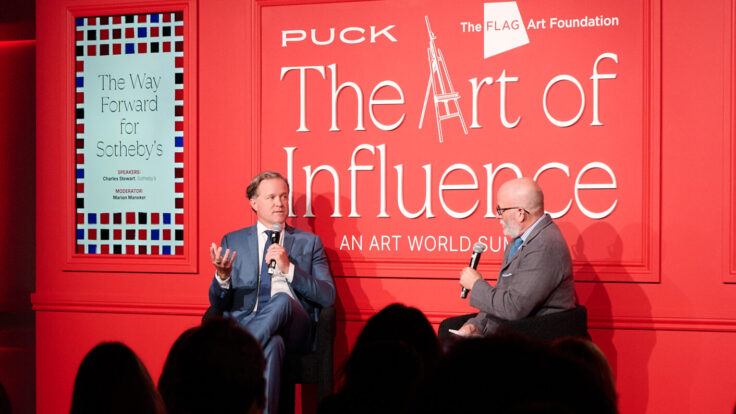
Welcome back to Wall Power. I’m Marion Maneker.
Gigaweek is
almost upon us. And the contracting market we’ve been suffering through for nearly three years appears to be turning the corner. The aggregate presale auction estimate for next week’s New York sales is up 49 percent from last year, boosted by the presence of a number of major collections from storied families like the Lauders and Pritzkers.
So, yes, there’s evidence of market momentum, but we’re going to have to see how those auctions play out
before we can really say the wind is at our backs. Let’s remember, this year’s presale estimate remains 9 percent below the applicable 2023 figure and just two-thirds of where it was during the boom times.
Tonight, I’ll look at some of the lots we may have overlooked in the lead-up to these sales. |
|
|
A MESSAGE FROM OUR SPONSOR |
|
|
- Sasha Suda goes nuclear: Now we’re getting the other story behind the dismissal of Philadelphia Art Museum director Sasha Suda. According to the lawsuit Suda filed yesterday in Pennsylvania state court, she and the board had agreed to part ways but had
reached an impasse in negotiations over her exit. Then she was abruptly fired. That explanation would appear to make more sense than the tough-to-swallow claim that her handling of the museum’s rebranding campaign was the cause of her departure. At issue, according to the complaint, was a dysfunctional board run by entitled and overbearing trustees. Suda claims that the board regularly interfered in the management of the museum and that members had the regrettable habit of behaving abusively
toward staff at museum events.
At some point, amid this strained relationship, a vocal faction of the 70-person board began an undermining campaign, including an investigation into her salary and expenses that concluded Suda had been “financially irresponsible.” For her part, Suda claims that the expenditures in question had all been approved in advance. Nevertheless, it was clear that her position was untenable. Instead of orchestrating an exit that would spare the museum embarrassment,
Suda maintains the board tried to “win” the negotiation by binding her to nondisparagement and confidentiality terms the board itself was not obliged to reciprocate, despite language in her contract stating that “the Museum, its officers and agents shall not, orally or in writing, intentionally disparage, belittle or seek to discredit the Director to third parties.” In frustration, the board seems to have acted rashly.
Now, the museum has a terrible publicity mess on its hands—and it
might only get worse. By requesting a jury trial, Suda has effectively previewed that she is prepared to go nuclear and expose the board to an extended discussion of trustees’ behavior and actions through depositions and discovery. I cannot imagine many of the trustees would choose to go to trial instead of paying Suda two years’ severance—and, maybe, keeping their mouths shut about her in the future. - Condo round trip: George Condo
revealed yesterday that he’s returning to Skarstedt gallery, which represented him from 2004 to 2019, though his relationship with Sprüth Magers continues. Condo’s secondary market remains strong, with annual auction turnover running about $40 million a year for the past four years. From 2018 to 2021, Condo’s auction sales averaged closer to $55 million. Of course, it was exactly during that period of explosive auction growth that Condo left Skarstedt for Hauser & Wirth, a gallery known for its
aggressive primary market pricing. Earlier this year, Sprüth Magers and Hauser & Wirth held concurrent shows of large Condo works on paper, priced between $800,000 and $1.2 million, that seemed to be aimed at buyers at a lower price point than his large canvases, which are priced around $3 million. Meanwhile, the number of Condo’s works selling at auction between $2 million and $4 million has slowed to a trickle compared to earlier periods.
|
Now, let’s get to the main event… |
|
|
On the eve of the November sales, a new optimism has returned to the
art market: Overall volume is up, estimates are set to be beaten, and great works are being offered at good prices. Next week’s New York sales results could confirm the new momentum. Or not. |
|
|
It seemed like someone threw a switch during the weekend between Frieze in London and
Art Basel in Paris. Because by the time the art world’s traveling circus had arrived in France, the mood in the market had shifted to optimism. Several art advisors told me they were looking at New York’s November auctions and seeing great works at good prices. That assessment was confirmed late last week when the auction houses unveiled their wares. According to the data gathered by ARTDAI, next week’s sales have a combined low estimate of $1.67 billion; that’s an average price of
$950,000.
A year ago, the comparable figure was $1.12 billion, with an average estimate of $860,000. The year before, it was $1.83 billion, according to numbers I published at the time. None of these numbers are anywhere near the boom year of 2022, when the combined low estimate was a very robust $2.5 billion, but the year-over-year rise in value marks an important step in the right direction. |
|
|
A MESSAGE FROM OUR SPONSOR |
|
|
While it’s tempting to dwell on the average estimate, the volume alone tells a
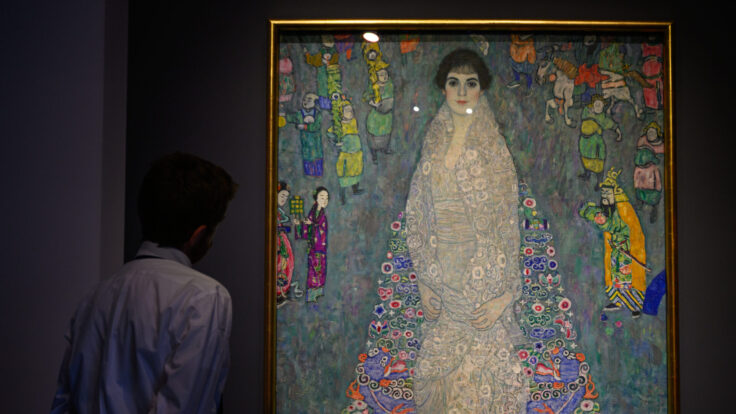
compelling story. Those numbers show, once again, the art market’s dependence on supply—which, of course, is a consequence of the perception of demand. Last year, the auctions comprised approximately 1,300 lots. This year, that number is up to 1,760, a 35 percent jump. And even though the top of the market has three works by Gustav Klimt from Leonard Lauder’s estate, which are being sold with a collective low estimate of $300 million,
there also seems to be a widening of the aperture in these sales. There are more works overall, and from more artists—13 percent more artists, to be exact.
Previously, I’ve tried to identify some of the reasons for this seemingly sudden turnaround. There appears to be pent-up cash on the demand side and a sense that social and political circumstances, while still deeply unpleasant, might be trending less cataclysmic. But the increased supply didn’t pop up overnight in response to any sort
of vibe shift. Instead, these works—some held over from last season; others being sold out of necessity, but with the sellers still having chosen this season over next—are the product of the complex calculations and undercurrents that make the art market so fascinating. Anything could happen next week, but all of this art is coming to market in anticipation of buyers. The auction houses have a lot riding on this, and they’ve all done their homework. Yet their strategies are quite different.
|
Estimates are much lower this season (even if the aggregate estimate is higher),
especially at Christie’s, where there are a number of works on offer at prices well under their previous auction sales. Christie’s global president Alex Rotter was forthright in explaining his strategy to attract bidders with low estimates. Four years ago, Elaine Wynn bought Richard Diebenkorn’s Ocean Park #40, from 1971, for a then-record price of $27 million. Next week, it will be offered with an estimate of just $15
million. (With an impressive provenance that includes Anne Marion and Si Newhouse, there’s no doubt the work is highly desirable.) Then there is Joan Mitchell’s Sunflower V, from 1969, also owned by Wynn. A comparable work was sold last year for nearly $23 million, but this painting is estimated at just about half of that, or $12 million. Christie’s isn’t taking any chances with these—and they’re also not taking third-party
guarantees for them as they have been with many other big-ticket works.
One work that does have a third-party guarantee is Max Ernst’s Le roi jouant avec la reine, a 1961 bronze cast of a 1944 sculpture made for an exhibition of chess-themed works by 31 artists. Three years ago, an example sold for $24 million. A decade before that, another version sold for almost $16 million. But this week, Robert and Patricia
Weis’s bronze is being offered with a $14 million estimate. A smart buyer wasn’t going to pass up that opportunity.
Perhaps the most eye-catching discount is for Christopher Wool’s painting RIOT, from 1990, which a decade ago set a record for the artist at nearly $30 million amid the frenzy of interest surrounding his Guggenheim retrospective. Now, Christie’s has brought to auction a version of the same painting, in the very desirable blue, at a
$15 million estimate backed with a third-party guarantee. We’ll soon discover whether that low price is a measure of the contracted Wool market, or just a starting bid for an artist whose show last year in New York stirred a lot of interest in his career. It can’t hurt that Gagosian followed up the New York show with an impressive London exhibition last month. |
That said, not everything offered in these sales is a bargain. Not long after Sotheby’s
announced it would sell a 1981 Jean-Michel Basquiat painting, Crowns (Peso Nesto), a prominent dealer told me that he thought the $35 million estimate was aggressive. A month later, Sotheby’s has an irrevocable bid for the work that might make that number more achievable next week—maybe even beatable.
During
the May sales, there was a fierce and somewhat perplexing bidding battle for Mark Tansey’s Study for the “Enunciation”, from 1992-93, depicting Marcel Duchamp’s first “encounter” with his alter ego, Rrose Selavy. The painting had been estimated at $300,000 but sold for nearly $3.2 million. The team at Sotheby’s didn’t sleep on this outcome. In response, they’ve brought two different high-value Tansey works to market. |
|
|
The more-expensive work is
Nature’s Ape, from 1984, which depicts a Tarzan-like figure and chimpanzee. That one is guaranteed and has a $4 million estimate. But the smaller and slightly less expensive work, at a $2.5 million estimate, is
The Myth of Depth, from 1984. That piece depicts Jackson Pollock walking on water, observed by Kenneth Noland, Helen Frankenthaler, Mark Rothko, Robert Motherwell, and Arshile Gorky, all standing in a boat with Clement
Greenberg, whose arm is outstretched toward the Christ-like Pollock. That painting has an irrevocable bid. Phillips also got into the act with Reveler, from 2012, which is likewise being offered for $2.5 million.
Even though the season is dominated by high-value collections, there are a number of discretionary sellers taking advantage of demand for specific artists. Sotheby’s has a major work by Barkley Hendricks that has never been at auction
before. Arriving Soon, from 1973, depicts a deflated woman surrounded by balloons and a Coca-Cola machine, clearly waiting for a guest of honor who may never arrive. Acquired directly from the artist in 2009, the painting is estimated at $9 million. That’s above the artist’s auction record, though some works have traded for more
privately.
Cecily Brown’s High Society, from 1998-99, is already getting boosted on Instagram. And why not? The piece is estimated at $4 million, while her works from this period are prized and have regularly sold at auction for 50 percent more. Along similar lines, Beauford Delaney’s portrait of his friend
James Baldwin, titled The Sage Black, from 1967, is estimated at $500,000. That’s not cheap for a Delaney, but another Baldwin portrait holds the auction record for the artist at $1.15 million.
There’s also another Agnes Pelton painting coming to market, Incarnation, from 1929, priced at $1.2 million, which is a
far cry from the record $3.4 million MoMA paid two and a half years ago for her work The Fountains. But it will also be more than triple the price paid for any other Pelton work at auction once fees are included—if it sells for that price.
At Phillips, there are two Ruth Asawa hanging forms, each conservatively estimated at $300,000–400,000, as well as
two Olga de Amaral works at the same price points. In general, Phillips is focused on markets where it can transact strategically, though the house has a high-value Francis Bacon diptych estimated at $13 million and a solid 1957 Joan
Mitchell estimated at $10 million.
This is just a smattering of the lots—and their stories—that will hit the block next week. There’s a whole collection of surrealist works at Sotheby’s that should generate strong bidding—and I’m sure there are many other works being secretly assessed by excited advisors and collectors. We’ll know much more about them once the bidders come out of stealth mode. |
Just one final observation: Ever since we’ve come down from the pandemic-era market
heights, I’ve been arguing that one of the prerequisites for a revival is a repudiation (at least for a significant cycle) of the idea that art is an opportunity to make a quick buck. For the market to rise, buyers need to see the value of art in the art itself.
Here’s an example: Maurizio Cattelan’s Comedian, the banana-and-duct-tape artwork, is a commentary on the value we place on art. By contrast, while Cattelan’s America is not a work of art about
the value of art, the conversation around it may point us to the end, for now, of the art-as-an-asset idea.
America cleverly exploits the public’s own cupidity to send up the emptiness of American culture. Look no further than the line to take a selfie with Cattelan’s gold toilet at the Breuer Building. The artwork is not the crass commode itself, but our fascination with it. In that sense, it doesn’t matter whether anyone buys the toilet or for how much: The artist’s point has
been made.
Of course, that hasn’t stopped the art press from speculating about the identity of the consignor or how much money they might make on the sale. Artnet’s market columnist went so far as to quote an auction house executive who joked about wishing they could melt down for sale some of the artwork they own. |
That’s all for now. See you Inner Circle members tomorrow (and you can always upgrade
here to join the fun).
M |
|
|
The ultimate fashion industry bible, offering incisive reportage on all aspects of the business and its biggest
players. Anchored by preeminent fashion journalist Lauren Sherman, Line Sheet also features veteran reporter Rachel Strugatz, who delivers unparalleled intel on what’s happening in the beauty industry, and Sarah Shapiro, a longtime retail strategist who writes about e-commerce, brick-and-mortar, D.T.C., and more. |
|
|
Finally, a media podcast about what’s actually happening in the media—not the oversanitized,
legal-and-standards-approved version you read online. Join Dylan Byers, Puck’s veteran media reporter, and Julia Alexander, a longtime media analyst, as they sit down with TV personalities, moguls, pundits, and industry executives for raw, honest, sometimes salacious conversations about the business of media and its biggest egos. New episodes publish every Tuesday and Friday. |
|
|
Need help? Review our FAQ page or contact us for assistance. For brand partnerships, email ads@puck.news. You received this email
because you signed up to receive emails from Puck, or as part of your Puck account associated with {{customer.email}}. To stop receiving this newsletter and/or manage all your email preferences, click here. |
Puck is published by Heat Media LLC. 107 Greenwich St., New York, NY 10006 |
|
|
|