Welcome back to the Wall Power Inner Circle. I’m Marion Maneker. Did you check to see if anyone followed you here?
Tonight, I’m going deep on the data from last week’s New York sales. Unfortunately, the market took a step back from last year (and from last November, too). That shouldn’t be a surprise, as the world slogs through a pointless trade war and too many real wars. But even though it’s bleak out there, there were bright spots, including the continuing scrum for work priced below $100,000. I’ll get into it more, below.
If you’re getting this email forwarded to you from a friend, think about signing up for Puck’s Inner Circle tier by clicking here.
|
|
|
|
A MESSAGE FROM OUR SPONSOR
|
The first steps towards a masterpiece starts with a dream. The all-electric BMW i7 – the evolution of brilliance. Learn more at
BMWUSA.com
|
|
|
- Mari-Claudia Jiménez lands at Withers: When Mari-Claudia Jiménez left Sotheby’s earlier this year after a decade, during which she became its top dealmaker, it seemed likely she would start a boutique firm representing estates in their dealings with auction houses. By her estimate, there are currently 250 art collections worth more than $50 million belonging to collectors over the age of 90, and a dozen held by collectors over the age of 100. Some of those collections are valued well into the nine figures. Barely out the door, Jiménez represented the estate of Joseph Hazen, whose single-owner sale saw aggressive bidding last week.Before Jiménez arrived at Sotheby’s, she was a partner in the art law group at Herrick Feinstein, where she worked on a number of high-value transactions, including for some important restituted works. Practicing art law isn’t all that different from negotiating the best deals for estate property. And that may explain why Withers, the international law firm, announced yesterday that Jiménez would be leading its art law practice, which has been without a lead partner in the United States for a year. For Withers, getting a former Sotheby’s chairman and president of the Americas is a coup—law firms sell their clients on the prestige and access of their partners. In the case of art law, there’s really no more prestigious place to have worked at than the two global auction houses.
Jiménez didn’t want to give up advising estates on their dispositions, so Withers created a new entity within the firm: Withers Art and Advisory. This structure allows the firm to leverage Jiménez’s broad commercial experience to get the best terms—she can easily hire art experts to work with her, and collaborate with the winning auction house to make sure the buyers show up and the best prices are achieved. At the same time, Jiménez is a rainmaker who can oversee the art law practice in New York—which includes specialists in finance, contracts, intellectual property, tax, charity law, estates administration, and art litigation—alongside co-head Sarah Barker in London.
|
Ishida Abides in Hong Kong
|
|
Tetsuya Ishida, General Manager's Chair in an Abandoned Building (1996), estimated at HK$5 million. Photo: Courtesy of Bonhams
|
|
Tetsuya Ishida, the bard of anxiety, who died in 2005, has been growing in prominence as a painter ever since his work appeared at the Venice Biennale in 2015 and a retrospective was held at the Reina Sofía in Madrid in 2019. In December, Bonhams achieved a record price for the artist when The Men on a Belt Conveyor sold for nearly $1.3 million in Hong Kong. The auction house has secured another work by the painter, General Manager’s Chair in an Abandoned Building, from 1996, which is being offered at Bonhams in Hong Kong on May 25 with an estimate of HK$5 million, or nearly $650,000.
|
|
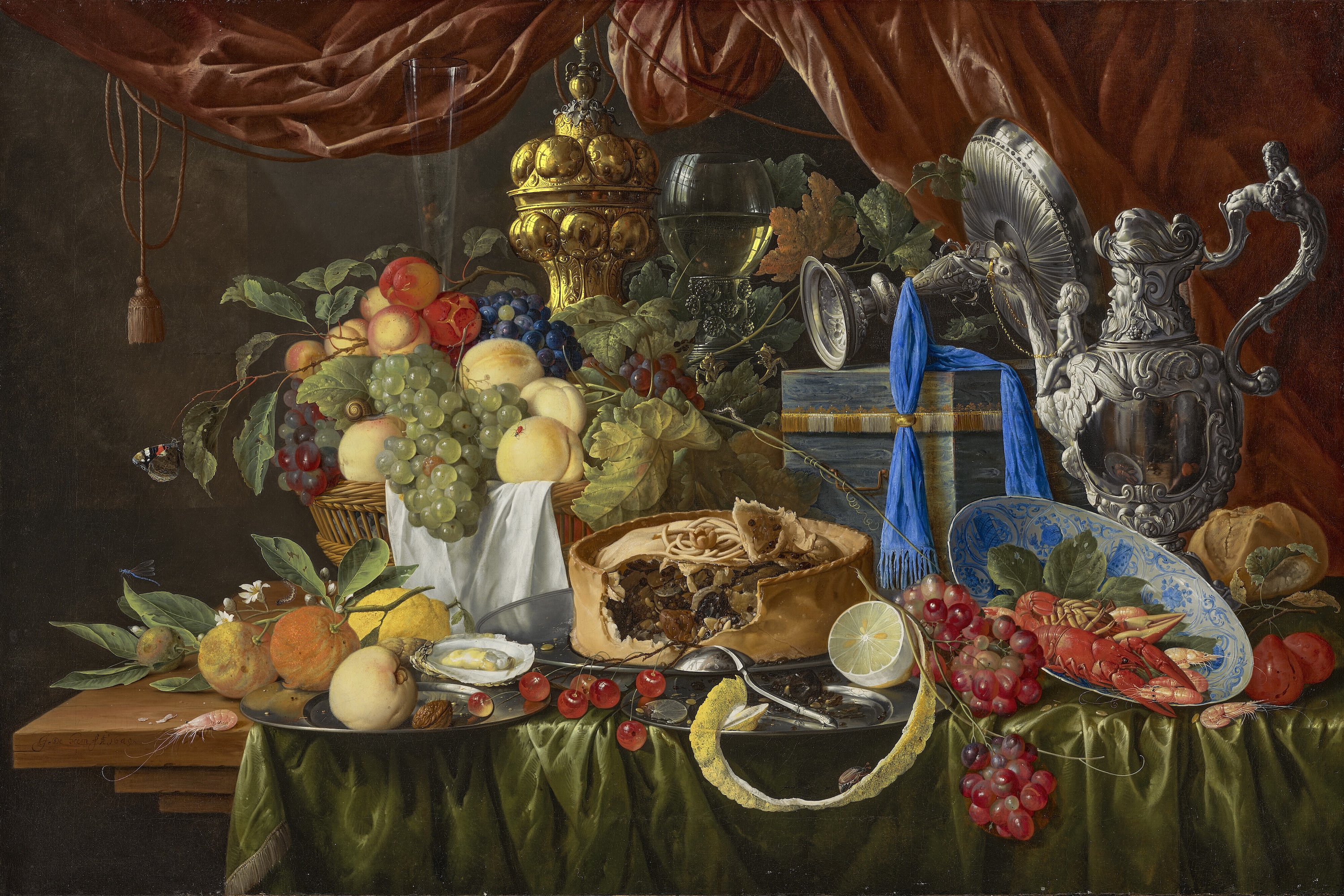
Jan Davidsz. de Heem, A Pie on a pewter Plate (1649), estimated at £3 million. Photo: Courtesy of Christie’s
|
|
Leading Christie’s July 1 sale of Old Masters paintings in London will be Jan Davidsz de Heem’s luxurious still life of a pie on a pewter plate surrounded by fruit, opulent gilt, and precious containers. De Heem painted it in 1649, at the peak of his production. According to Christie’s, the work reprises themes that the artist explored in four larger paintings he made earlier in the same decade. Two of those are in museums, including the Louvre, and one of the other two sold in 2020 for a record price of $7.7 million. This work is smaller in scale, but displays de Heem’s wide range of skills at depicting sumptuous goods. Christie’s believes this work is done with greater refinement than the larger-scale works. The painting will carry an estimate of £3 million, or around $4 million.
|
|
Now let’s get to the main event…
|
|
|
|
The May results were a disappointment after earlier signs of healing, with the market still shaking off the 2023 interest-rate hangover. Much of the grim news continues to concentrate at the top of the market.
|
|
|
I’m not going to lie to you: I was hoping for a lot more this season. After November’s positive print in the art market, I thought the healing would continue, bolstered by the Leonard and Louise Riggio estate. But the downturn that began in 2023, after interest rates rose so sharply in 2022, still hasn’t ended.
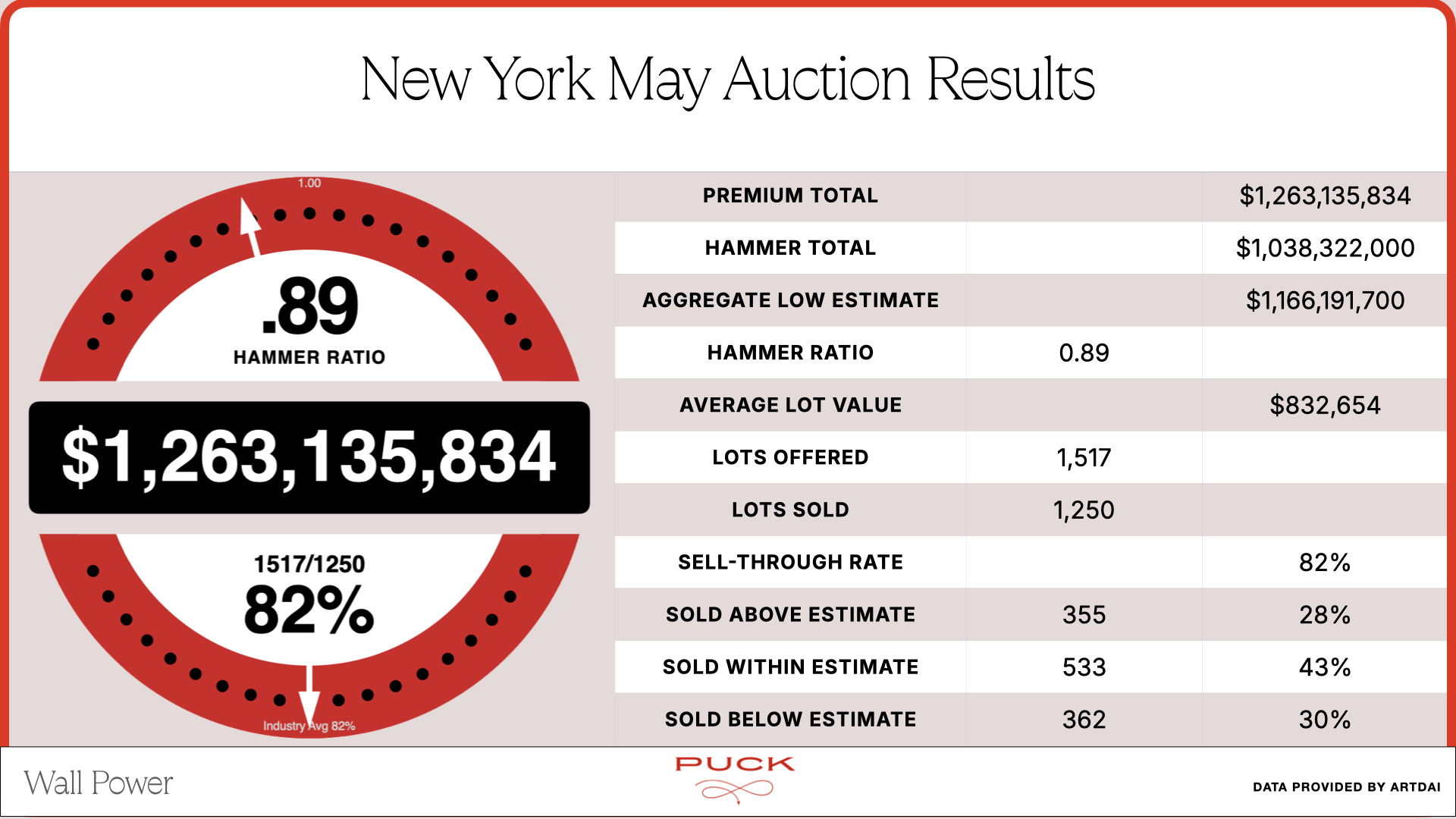
This season’s auction numbers, based on data provided to me by ARTDAI, show $1.26 billion in sales with a weak hammer ratio of .89. That’s below last year’s $1.39 billion in overall sales and .99 hammer ratio. Some, but not all, of the poor performance comes from the $70 million Giacometti that was bought in. But it is important to note that these numbers include withdrawn lots.
|
|
Almost the exact same number of lots were offered this season as a year ago: 1,517. And the sell-through rate in this period was only a tiny bit lower, at 82 percent, than the 83 percent in 2024. The average lot value for these sales was down from $924,698 last year to $832,654 this season. But a lower proportion of lots were sold at compromise prices below the low estimate. Only 30 percent were sacrificed by consignors this year, versus last year’s 35 percent.
|
|
|
|
A MESSAGE FROM OUR SPONSOR
|
The first steps towards a masterpiece starts with a dream. The all-electric BMW i7 – the evolution of brilliance. Learn more at
BMWUSA.com
|
|
|
|
That means the auction houses have got estimates closer to buyers’ expectations, and fewer sellers are going home bitter and disappointed. This year, 43 percent of the lots sold for prices within the estimates, and 28 percent saw aggressive bidding above the estimate range. That’s 71 percent of the lots making their consignors happy—a bump from 65 percent a year ago.
|
|
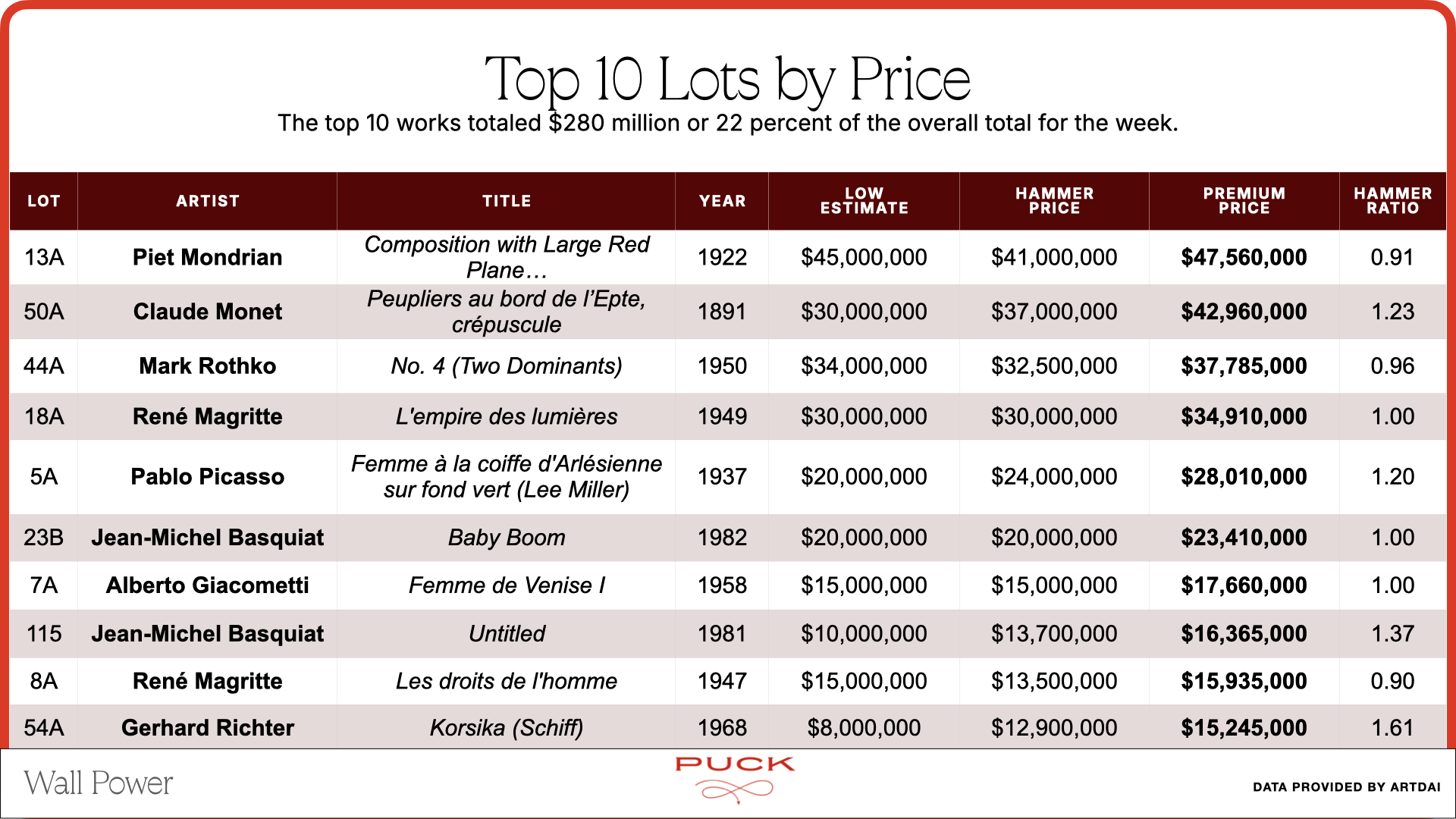
The top 10 lots in the sale were worth a combined $280 million, or only 22 percent of the total sale. That’s down another 1 percent from last year, which gives us a good sense of how much this market is skewed toward activity at lower levels. We’ll get into that more when we go through the bidding quintiles below. The top lots were also tightly grouped by price level. All 10 fell between $15 million and $48 million.
|
|
Only one work, Gerhard Richter’s romantic seascape, sold for a price above the estimate range. All of the works in the top 10 lots, including two Magrittes and two Basquiats, were by well-known and frequently traded high-value artists. Not one of the highest-value works from the week was made after 1982, more than 40 years ago.
|
|
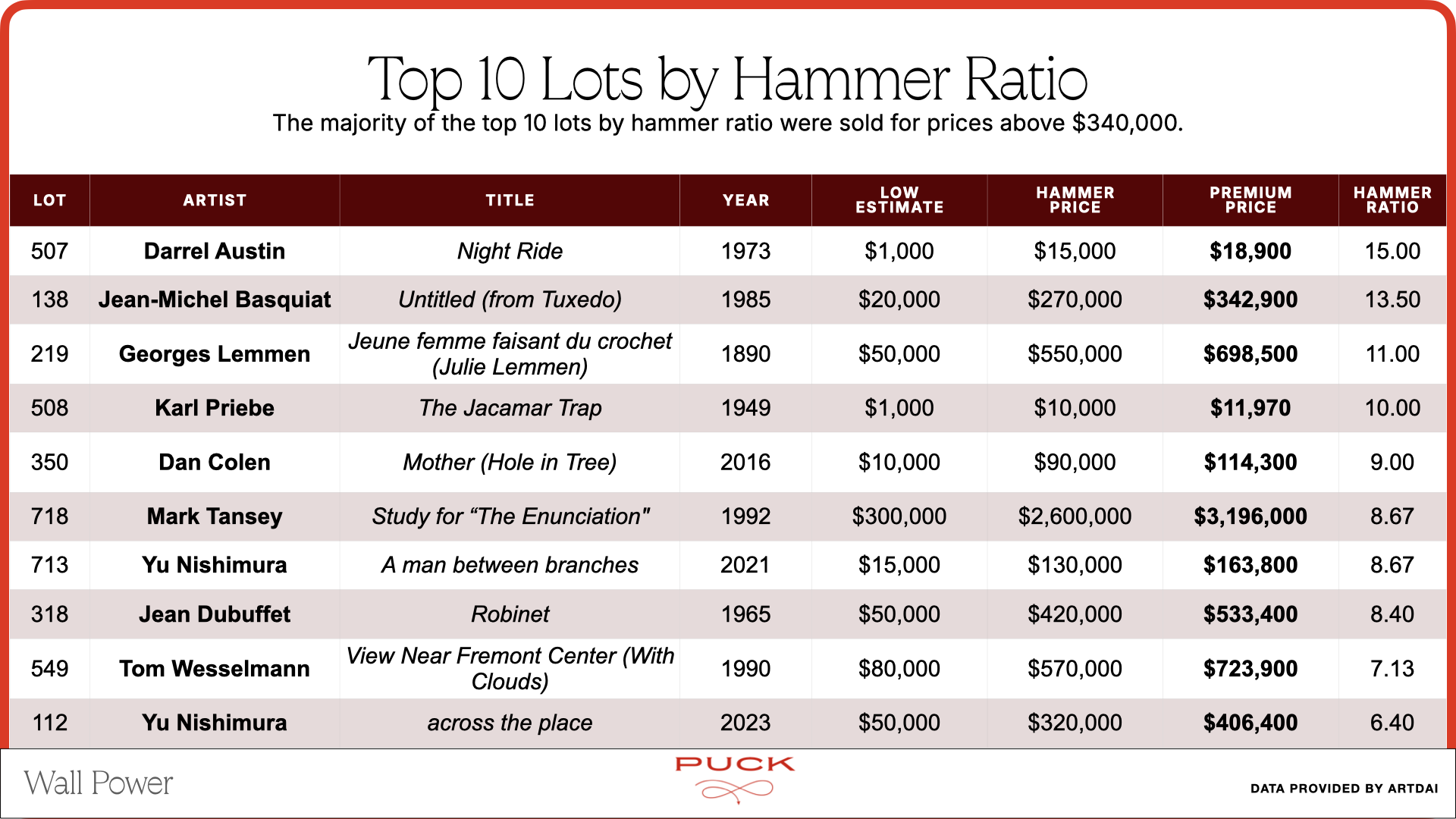
There’s positive news regarding the lots that attracted the most aggressive bidding. Only one lot had a six-figure estimate; the remainder were in the four and five figures. But the majority of prices paid were significant six-figure sums. In the case of Mark Tansey’s Study for “The Enunciation,” the ferocious bidding resulted in a price more than eight times the estimate. Yu Nishimura’s performance at auction, with two appearances on this list, backs up David Zwirner gallery’s decision to represent the artist. Seven of the 11 works by Jean-Michel Basquiat sold last week went for prices above the estimates. The most active bidding was on three small works on paper that made prices multiple times the estimates.
|
|
Six of the eight Tom Wesselmann paintings offered were sold for prices above the estimate, but none succeeded quite like the laser-cut steel work deaccessioned from the Walker Art Center in Minneapolis, which sold for nearly three-quarters of a million dollars, or more than nine times the estimate. Another deaccessioned work from the Walker, Jean Dubuffet’s Robinet, painted on glazed ceramic tiles, made more than $500,000, or 10 times the estimate.
The pointillist artist Georges Lemmen isn’t a common auction sight, but his painting of his sister doing needlework, which she herself first owned, was offered with a third-party guarantee, despite the modest estimate of $50,000. It didn’t take much for buyers to sniff out the work and bid it to 11 times that number as a hammer price. Another portrait of the artist’s sister hangs in the Art Institute of Chicago.
|
|
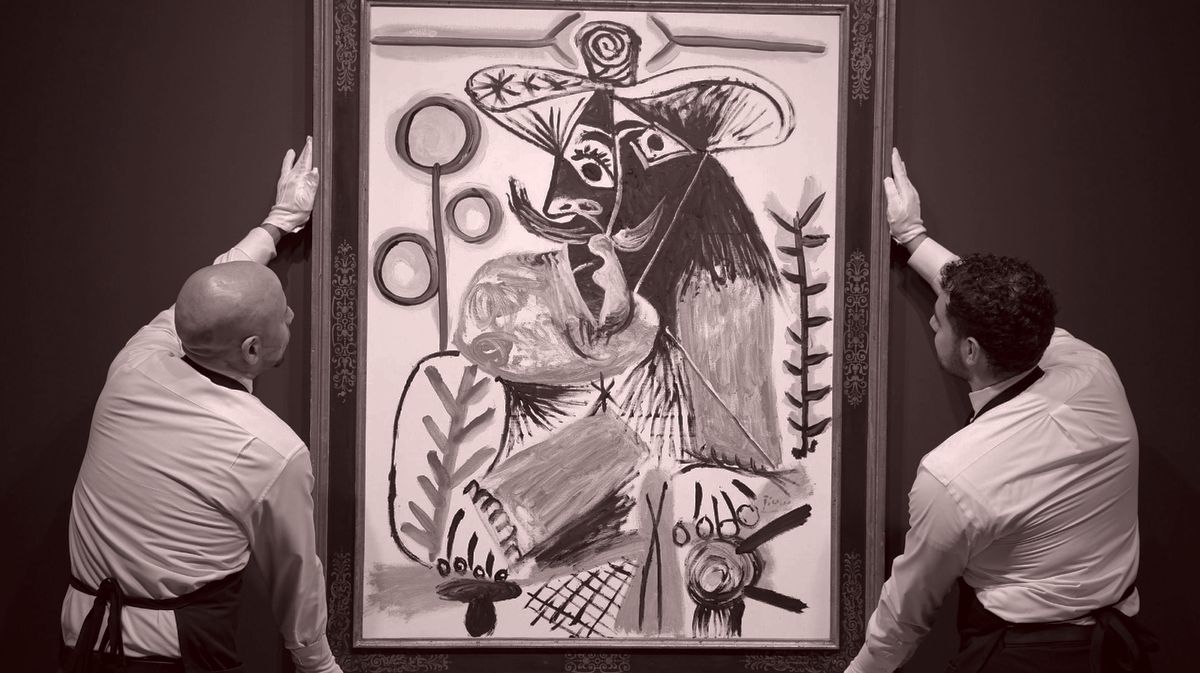
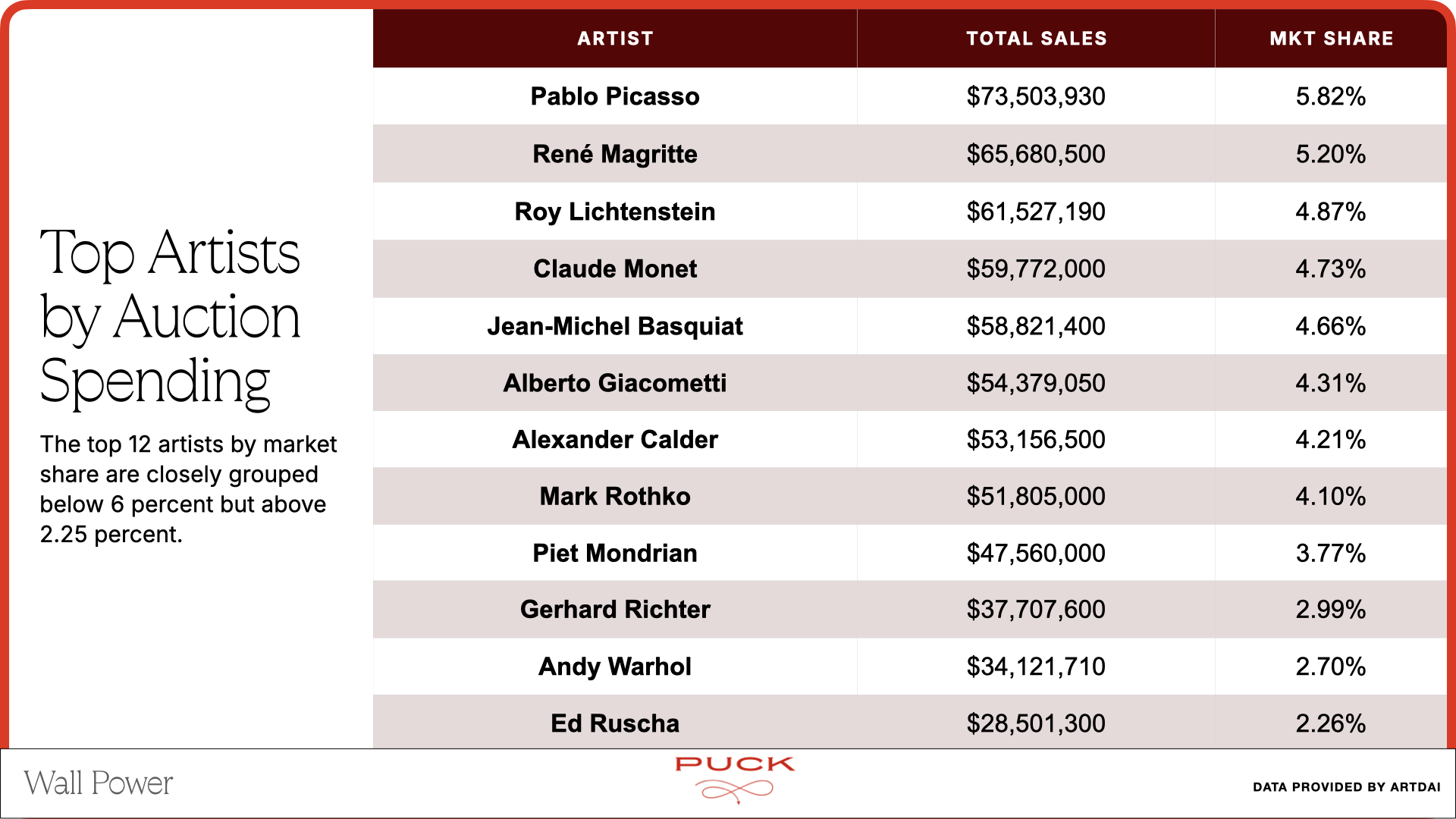
With so much work by Pablo Picasso on view in New York right now, it’s nice to see the artist reclaim his customary spot at the top of the market-share tables. There has been a drought of Picasso works available on the market, especially high-value ones. Despite 6 percent of the dollars spent in New York last week having gone toward works by the Spanish master, nearly a quarter of the 39 lots offered were bought in. Only three sold for prices above the estimates. That leaves us wondering whether the issue is supply, selective demand, or unrealistic expectations from consignors.
|
|
|
|
René Magritte works have, as you all know, been one of the primary drivers of the top of the market. This season, only seven works were auctioned; three achieved prices within the estimate range. Still, the artist’s work accounted for 5 percent of the market. Roy Lichtenstein’s upcoming retrospective at the Whitney, and the sale of works from the estate at Sotheby’s, brought 48 lots by the pop artist to market. All of those sold; 28 made prices above the (attractively set) estimate range, 15 sold within the estimate range, and only five were sacrificed below the estimate. The hammer ratio for all of the Lichtenstein works was 1.33, a strong number. Together, the works accounted for nearly 5 percent of the overall market.
|
|
Only three works by Claude Monet were offered, yet those still accounted for more than 4 percent of the spending, primarily as a result of the record price for a painting of poplars, nearly $43 million. We’ve already discussed the mixed performance of Basquiat works, and no one has to be told there was a problem selling the Alberto Giacometti bust from the Soloviev Foundation. Nevertheless, Giacometti’s work was well represented with 11 lots. Nine sold within the estimates, one saw aggressive bidding, and another was sold at a compromise price. Whatever choices were made by the bust’s consignor, the rest of the Giacometti market seems quite healthy, and accounted for more than 4 percent of the spending.
The Alexander Calder market also seems to be in solid health, with an overall hammer ratio of 1.18. Mark Rothko’s works did not have a great week, even though they accounted for more than 4 percent of the dollars spent. Four works were sold, three at compromise prices and one backed by a third party. A single work by Piet Mondrian earned the artist more than 3 percent market share. Three of the seven Gerhard Richter works sold at the estimated price, one went at a discount, one saw moderate bidding, and two saw aggressive bidding. The market share fell just short of 3 percent.
Andy Warhol, once a primary driver of the contemporary art market, saw six of his 29 works attract very strong bidding, including the two 24-inch Flowers paintings that sold for new high prices around the $4 million mark. Finally, the 17 Ed Ruscha works offered were evenly distributed between works that sold within estimates, at compromise prices, and those that were bought in.
|
|
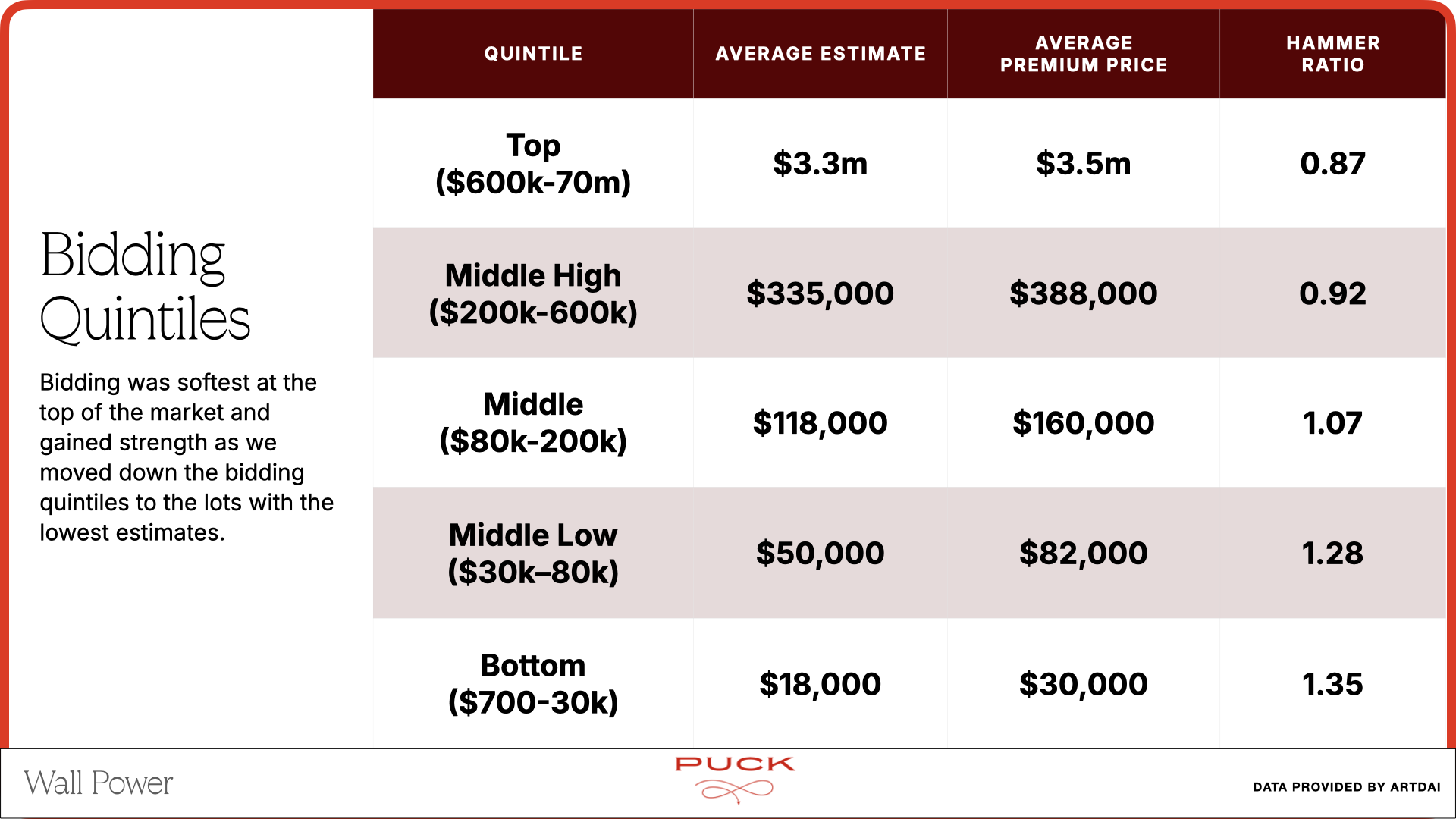
The bidding quintiles show us a pattern that’s becoming all too familiar. The top of the market has the weakest hammer ratio—a gasping 0.87—and the strength of the bidding increases as we go down the quintiles. The two lowest quintiles saw stronger hammer ratios this year than last year. That indicates the bidding pressure for lots estimated below $100,000 is continuing to build. Art buyers are very active in this range. Where they lose their nerve is when estimates move above $200,000. This is an auction danger zone.
|
|
These numbers may indicate that works above $200,000 are better sold at negotiated prices in private transactions. Or they may offer evidence that the market is simply starved for supply of work that buyers really want and are willing to compete for. My hunch is that we’re still waiting to see the effects of inflation work their way through the art market. Remember that asset prices rose dramatically more than a decade ago, when liquidity flooded the global economy in response to the credit crisis.
Now, for various political and economic reasons, interest rates are likely to remain moderately high, while inflation progresses through the wage and goods side of the economy. At some point, prices above $200,000 will not seem expensive to the kinds of people who can afford art. Alas, we haven’t reached that point yet.
|
|
|
|
The ultimate fashion industry bible, offering incisive reportage on all aspects of the business and its biggest players. Anchored by preeminent fashion journalist Lauren Sherman, Line Sheet also features veteran reporter Rachel Strugatz, who delivers unparalleled intel on what’s happening in the beauty industry, and Sarah Shapiro, a longtime retail strategist who writes about e-commerce, brick-and-mortar, D.T.C., and more.
|
|
|
|
Finally, a media podcast about what’s actually happening in the media—not the oversanitized, legal-and-standards-approved version you read online. Join Dylan Byers, Puck’s veteran media reporter, as he sits down with TV personalities, moguls, pundits, and industry executives for raw, honest, sometimes salacious conversations about the business of media and its biggest egos. New episodes publish every Tuesday and Friday.
|
|
|
Need help? Review our FAQ page or contact us for assistance. For brand partnerships, email ads@puck.news.
You received this email because you signed up to receive emails from Puck, or as part of your Puck account associated with . To stop receiving this newsletter and/or manage all your email preferences, click here.
|
|
Puck is published by Heat Media LLC. 107 Greenwich St, New York, NY 10006
|
|
|
|