 |
|
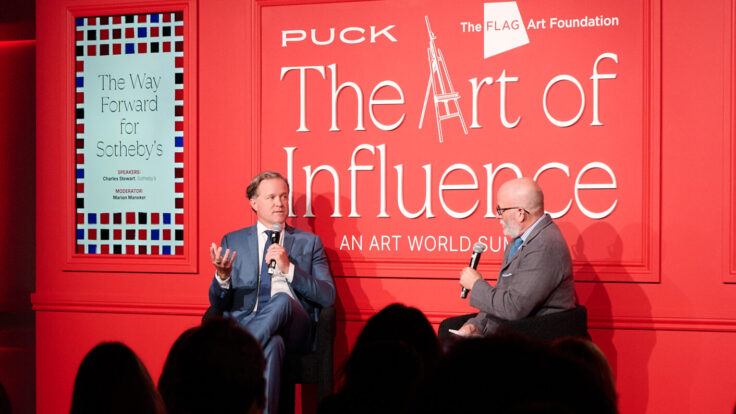
Welcome back to Wall Power, where we ask the crucial question: What will it take for the art market to recover its upward momentum? I’m Marion Maneker.
Yesterday evening’s sales of Contemporary art at Sotheby’s were up 30 percent from the same time last year. That should be cause to celebrate, but something important was missing from the room last night. After the sale, I spoke to a man who owns a shocking amount of art. He also buys and sells it on a regular basis. He gestured toward the saleroom and asked, “Have you seen a sale as dull as this? Everyone was sitting on their hands.”
The art market does seem to be suffering from a lack of confidence, although I couldn’t get the collector to answer whether the mostly full room was filled with potential buyers who didn’t want to venture bids, or spectators hoping someone would show them it was safe to get back in the water. I’ll try to answer that below.
But first…
- Some good news for once…: My friend, former colleague, and fellow auction data enthusiast Sophie V. Coco sent me her own auction analysis late last night. Focusing on the performance of male artists versus female artists, she uncovered some interesting numbers. In Sotheby’s The Now and Contemporary evening auction, a few women artists did very well. Lucy Bull’s 16:10, from 2020, set a new record price for the artist at $1.8 million, topping her previous high set in Hong Kong in October. Whether her market is driven by demand from end users or whether the buying still comes from middlemen is the big question. Toyin Ojih Odutola’s Representatives of State, from 2016-17, made her second-highest price at just a smidge under $1 million; and Takako Yamaguchi’s untitled work from 1998 sold for the same hammer ratio as Odutola’s, making her second-highest auction price at $825,500. Yamaguchi’s market has been expertly built by Ales Ortuzar.
Even with those solid numbers, women lagged men in The Now sale bidding. The hammer ratio for women in that sale was .79 against 1.03 for men. But in the Contemporary sale, where works are more historical, the hammer ratio for women was a robust 1.13 against .87 for men. The last lot of the sale—Yayoi Kusama’s The Pacific Ocean, from 1959—sparked a surprise bidding war, which swelled the selling price to $4.65 million with fees, from a $1 million estimate. Faith Ringgold’s Dinner at Gertrude Stein’s (1991) sold for a record $1.57 million (Ringgold died last month at 93 years old.) Howardena Pindell has seen her market grow to the point where her early 1970s abstract works regularly hit the seven-figure range. Last night’s untitled work made $1.39 million.
Other noteworthy sales last night included a protracted battle over Cy Twombly’s untitled 1959 work, which carried a $4 million estimate but ended up selling for nearly $7.5 million with fees. Justin Caguiat remains an artist very much in demand with little supply and a strong dealer managing his market. The $1.09 million selling price for his work was a record and advances him into the million-dollar category in only his third public sale.
Christina Quarles had a similar story two years ago, when Howard Rachofsky sold her work right after the Venice Biennale for $4.5 million. Last night, a smaller, lesser Quarles sold for $762,000, exactly at the estimate level. Hauser & Wirth had been selling later paintings for $1.2 million at retail. These prices suggest Quarles’s market is just fine, but demand is getting served with supply. The Jacqueline Humphries painting from 2016 sold at a slight bump above the estimate, but at a price in line with what her gallery would charge.
These are all signs that the art market is hardly in a funk—but it’s also not generating excitement and upward momentum. There was a Christopher Wool word painting offered last night that got bids up to $1.86 million, including from Skarstedt gallery, which would have held the work for later resale. That’s a sign of market confidence in the long term for an artist whose work has—with some exceptions—taken a market breather these last few years.
Along similar lines, Andy Warhol’s 48-inch square flowers painting got bid up nicely, from $7 million to a $9.5 million hammer. That makes an $11.25 million selling price, or $4,882 per square inch. In the day sale, a 5-inch square flowers sold for $254,000, or $10,160 per square inch. Tonight at Christie’s there’s an 80-inch square flowers estimated at $20 million. The price per square inch, however, seems to decline as the works scale up, leaving the biggest version potentially underpriced. But if it sells for the same price per square inch as last night’s flowers, it might come in at $30 million with the fees.
|
| Now, a note from the cyber trenches… |
| A Few Thoughts on the Christie’s Hack |
|
| Despite some heavy breathing in the media, there’s no indication so far that the cyberattack that took down Christie’s website last week is having an effect on sales. The art auction business, of course, remains high-touch, and there are few serious buyers who don’t have a contact at the auction house. Christie’s also rapidly set up an alternative sale infrastructure that ensured potential buyers had access to catalogs and last-minute information they might need before bidding.
Nevertheless, we still don’t know the extent of the Christie’s hack. Were the auction house’s internal systems compromised? Do the hackers have control of data they can use to demand a ransom? Have present or former Christie’s clients had their personal data exposed to outsiders?
These are legitimate questions, however intrusive, that Christie’s officials say they’ve been advised not to answer by cyber-crime professionals, as is standard protocol. Indeed, you can imagine that whatever is going on would be made orders of magnitude worse if Christie’s claimed one thing and another turned out to be true.
It’s hard to know whether Christie’s messaging could have been improved, or if the auction house’s Gallic corporate culture—including its owner, François Pinault’s Groupe Artemis—is a factor. Christie’s C.E.O. Guillaume Cerutti is very French, which is to say he is courtly and charming but keeps his emotions in check (publicly, at least). That may explain why there’s been no statement, either on the workaround website or to the press, to mollify the fears many people in the industry (and presumably clients) are feeling in the wake of this attack. One presumes that this is also how Pinault, who recently acquired CAA, wants the crisis managed.
I’ve been getting incoming traffic, myself, from frustrated clients and intermediaries who are concerned about the extent of exposure. Customers provide K.Y.C. data that includes passport and social security numbers as well as banking information. This is usually stored in siloed databases that are not accessible through the website, but… who knows. In the U.S., there is also a legal responsibility to disclose whether personal information has been exposed in a hack. So does the lack of disclosure mean the data was not hacked? One would hope.
Another looming question is whether the attack and its aftermath will impact the competition between Sotheby’s and Christie’s—especially given Sotheby’s new fee structure. On Sunday night, I was getting messages anticipating how clients might respond to Christie’s handling of the hacking incident, and whether it would provoke some customers to demand concessions, like more points on enhanced hammer deals or sweeter guarantees. Indeed, one can imagine this unfortunate incident being leveraged by extremely wealthy and cranky collectors: If Christie’s has a very bad sales cycle because of the hack, there will be complaints and even lawsuits (lots and lots of lawsuits). What will Christie’s need to do after that? Buy back market share with money? Or will they have lost so much client trust that Sotheby’s will have the negotiating leverage they need to put their new fee structure in place? None of this is knowable right now, but it’s worth thinking through. |
 |
| Sotheby’s Case of the Mondays |
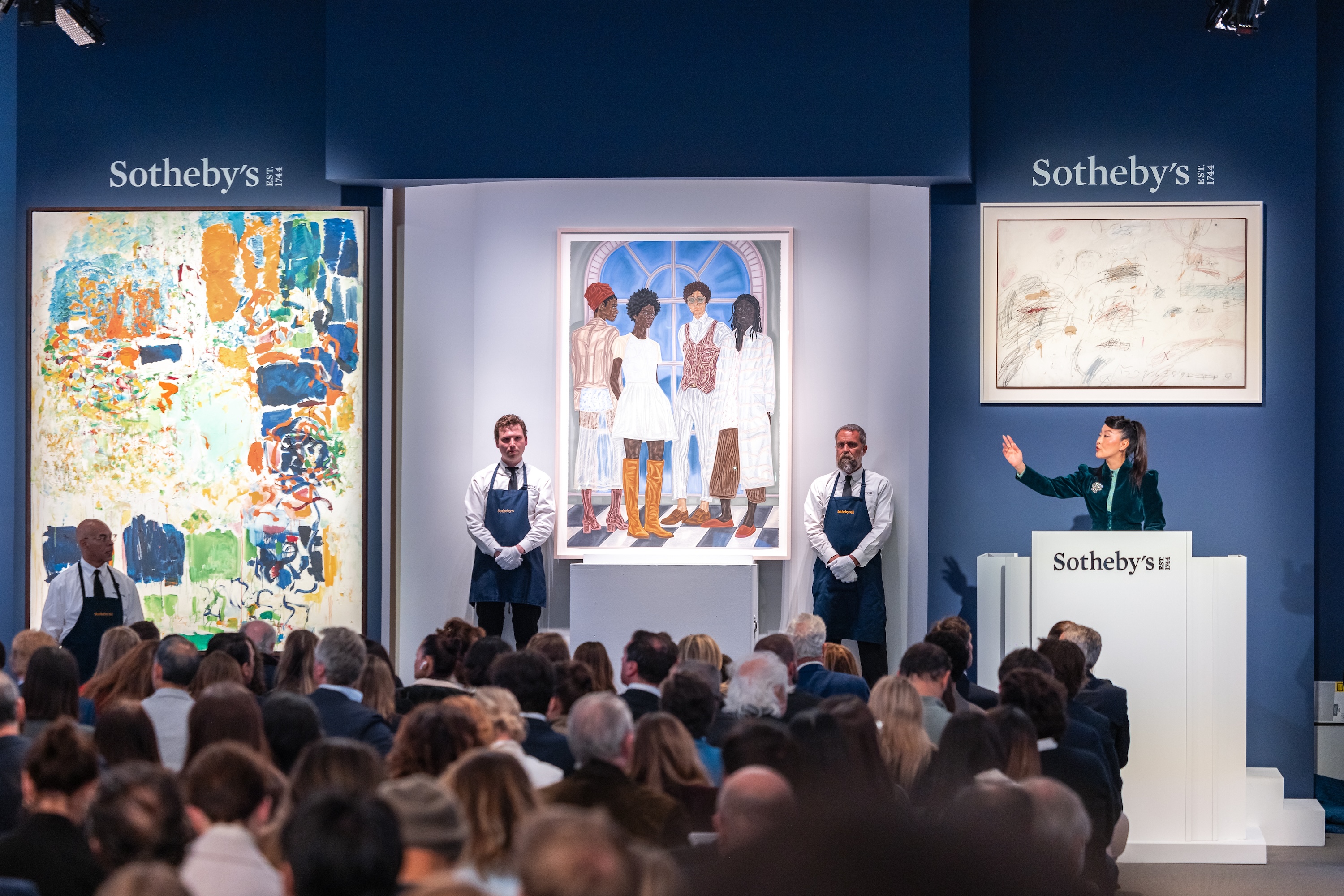
| On Monday night, Sotheby’s posted a strong $267 million sale, up 30 percent year over year, including a record price for Joan Mitchell’s ‘Noon.’ So why did it all seem so depressing? |
|
|
|
| Let’s start with the good news: Sotheby’s, the global art auction powerhouse, made just over $267 million last night, with very strong sell-through on the lots offered and only one lot withdrawn due to lack of interest. (In this case, the work was said to have been shopped around privately long enough to alienate potential bidders.) The lone withdrawal—even if the lot had been estimated at $6 million—was an encouraging sign that sellers’ expectations are getting back in line with buyers’ appetites.
The hammer ratio for the evening tells a different story, however. Calculated by dividing the aggregate hammer price of all the sold lots against the aggregate estimate, the hammer ratio shows us the strength of bidding, and measures whether the estimate level was too high or too low. At .94, the hammer ratio signals estimates are still too high.
Of course, you wouldn’t have needed an abacus to determine that something was off in the auction room last night. Almost from the beginning of the evening, the Sotheby’s staff seemed somber. One bidder who spoke to me afterward pointed to the very thin bidding as the cause. On most lots, there was only a single bidder, possibly two. That doesn’t give the staff much to do but stand there and stare off into the distance.
The most obvious signal of the depressed market were the hammer prices of the top two lots, which came in below the estimate level. Francis Bacon’s portrait of his former lover George Dyer, from 1966, sold for a negotiated price of $27.7 million with fees, or 18 percent below the asking price (more if you include the expected fees). Speculation in my channels is that the buyer was Turkish collector Halit Cingillioglu—and Sotheby’s did say the work ended up in a very good collection, yada yada, which would fit the theory.
The other top lot, Howard Rachofsky’s bright yellow Lucio Fontana painting, came very close to the asking price of $20 million, but still got hammered down at $19.7 million after desultory bidding. The first bid, of $19.5 million, was presumably the third-party guarantor. The second bid, just a sliver more at $19.7 million, should have provoked a response. It didn’t. Clearly, the guarantor was happy to take their fee instead of taking home the painting.
The work with the third-highest estimate for the evening, at $18 million, was a Richard Diebenkorn painting from the famed and sought-after Ocean Park series. The painting, Ocean Park #126, had been purchased from the Zucker collection (the New York real estate family, not the former CNN chief) during their sale of nearly two dozen Diebenkorns six years ago. Presumably, the sellers had been encouraged by the sale of a Diebenkorn last season for a record $46.4 million. Anticipating a new price structure for the artist, the sellers may have thought they were putting an attractive estimate on the work. Sotheby’s must have thought they had a bidder who would take the work somewhere near the discount price because the auctioneer, Oliver Barker, held the bidding open long past the point when it was obvious the buyers had voted with their feet. Not one bid was made for the work.
That’s the kind of market we’re in, where clever participants are getting caught unawares. It’s probably best for the Diebenkorn that it was bought in. In a different market environment, that painting will sell. Unless the collectors need the money—and, trust me, they don’t—all this misadventure cost them was time. |
|
|
Sotheby's The Now and Contemporary Evening auction on May 13 totaled $267 million.
|
|
|
| High Noon for Joan Mitchell |
|
| A slightly more successful gamble than the Diebenkorn was a group of four Joan Mitchell paintings that were offered together, one after the other. It’s highly unusual to have four paintings by one artist from one collection in a various owners sale lined up one after the other. Just before the sale, you could see by the number of irrevocable bids that the market was tentative. But the first of the four lots got several bids above the I.B., and sold for $2 million hammer, or twice the estimate.
Noon, painted in 1969, is a former record-setting work that one Mitchell expert described as both a prime example of her mature style and domestic in size (meaning you can hang it in a normal home or apartment). And it might have set a new record price for the artist if the consignors had chosen to only offer that work. There was an I.B. and an estimate at $15 million. By the time it reached $19 million, Barker still had three bidders. And that carried the final hammer price to $20.5 million. With fees, the selling price was $22.6 million, which means that three Joan Mitchell paintings have sold for more than $20 million in the last six months. Impressive.
The strong-ish price for Noon should have carried through to good prices for the remaining two Mitchells. But the next lot, Ground (1989), was badly overpriced at $12 million. It sold for $8.5 million hammer, or 70 percent of the asking price. The final picture, in many ways the gem of the group, an untitled work from 1955, had an I.B. executed at $8 million. A bidder came in at $8.5 million. But the guarantor didn’t have a passion for the painting and decided to take the fee instead. That was kind of the theme of the evening.
The same consignor also had two Wayne Thiebaud paintings in the sale. Both works sold for within $100,000 of each other, though they had been priced at very different levels. A Thiebaud painting of two lollipops called Suckers, from 1970—a good year for the artist and a prime subject—sold for $1.3 million hammer, while Watermelon and Knife (1989), less desirable in date and subject matter, hammered for $1.2 million.
Altogether, the consignor had just under $50 million in total sales. That was a good number for the collection, but the mystery lies in how much Sotheby’s offered as a guarantee to get it. I’m told the guarantee on these works (there’s a bit more in other sales) worked out to around $45 million. After paying fees to irrevocable bidders, Sotheby’s probably made half-decent money on the sales. |
|
|
| That’s all for now. If you want to keep up with the auction action between today and my next email on Sunday, you can get up-to-the-minute texts by subscribing to Wall Power SMS, where I’ll be commenting on the sales from the auctions themselves.
Also, follow my Instagram @ArtMarketMonitor where I post recaps and reels.
See you there!
Marion |
|
|
|
| FOUR STORIES WE’RE TALKING ABOUT |
 |
|
 |
|
 |
| Pleading the 6th |
| A bracing chat with the filmmakers behind ‘The Sixth.’ |
| PETER HAMBY |
|
 |
|
|
|
|
|
 |
|
|
|
Need help? Review our FAQs
page or contact
us for assistance. For brand partnerships, email ads@puck.news.
|
|
You received this email because you signed up to receive emails from Puck, or as part of your Puck account associated with . To stop receiving this newsletter and/or manage all your email preferences, click here.
|
|
Puck is published by Heat Media LLC. 227 W 17th St New York, NY 10011.
|
|
|
|