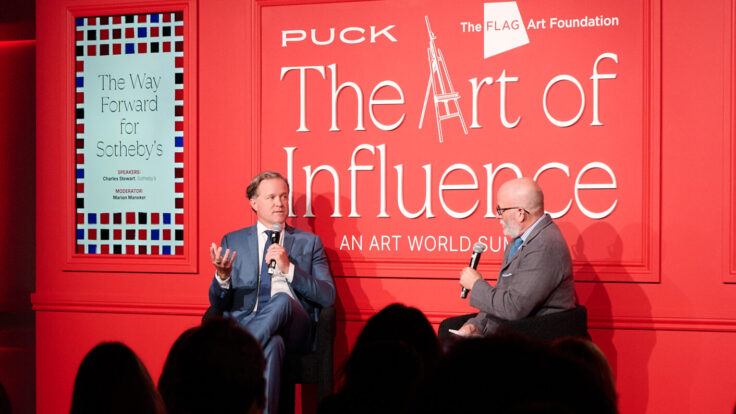
Welcome back to Wall Power. I’m Marion Maneker.
The luxury
business has been a strategic pillar for Sotheby’s ever since Patrick Drahi bought the company in 2019. Tonight, George Nelson joins us to describe three programs at the firm that seek to provide luxury services that pay close attention to their clients’ needs. Speaking of clients, you should be one of ours. That means having a subscription, especially those of you getting a
copy forwarded from a colleague or family member.
Up top, Jennifer Rubio writes checks to the Met; Pace held a symposium to help launch Marc Restellini’s new catalogue raisonné for Amedeo Modigliani, a project that has taken decades to come to fruition; and the jury for the Venice Biennale has walked out—will anyone notice? And it was a frenzied week around town, even as many of you prepared to head out to Venice next
week.
Also mentioned in this newsletter: Gord Duff, Morgan Aguiar-Lucander, Paul Redmayne, Sarah Harrelson, Orlando Whitfield, Melissa Biggs Bradley, Gareth Jones, Josh Pullan, Eric Crosby, Kim Manocherian, Lorenzo Rebecchini, Massimo Bottura, and many more…
Up
first… |
-
The Venice jury quits: I’ve spoken to a number of people who are heading to Venice later this weekend or early next week. The weekend will be filled with lunches and off-site exhibitions, but the actual biennale is running into a wall of dysfunction. The jury has now resigned after announcing it would not give awards to countries whose leaders were being investigated by the International Criminal Court—i.e., Israel and Russia. In response, the biennale has said it will
let visitors vote on the best national pavilion and artists from the main exhibition, with the results announced on the final day in November.
The question is whether any of this really matters. The idea of a critical jury judging artists against one another seems antiquated at best. The curator of the main exhibition has long since replaced the juried competition as a way to focus attention on artists and their work. It will be interesting to see whether a plebiscite among
visitors can generate prestige for a previously unrecognized artist. But I doubt anyone who has decided to go to Venice this year to see the official exhibitions, visit the off-site events, or discover new artists—not to mention, those just attending for the social swirl—will notice the jury’s absence. - Jen Rubio writes a check to the Met: The Metropolitan Museum of Art announced this morning that recently appointed trustee Jennifer
Rubio, the co-founder of Away and wife of billionaire Stewart Butterfield, is endowing internships for college students through her Rubio Butterfield Foundation. The $23 million gift will allow the Met to “offer 100 percent paid internships” in “perpetuity.” The foundation also made “an additional pledge to the museum’s new Tang Wing for modern and contemporary art,” opening in 2030.
- The Restellini reset: Yesterday at
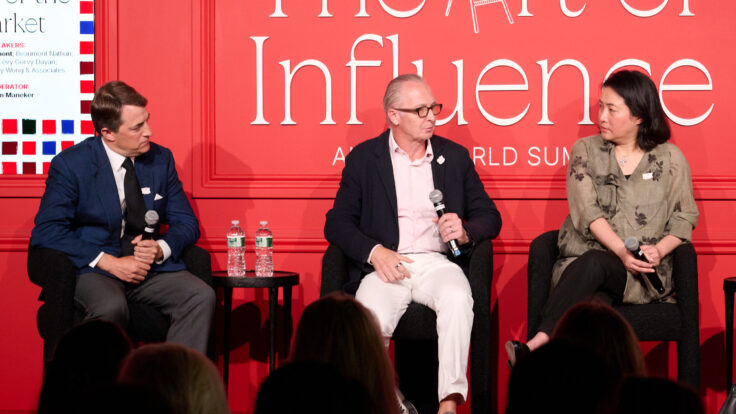
Pace’s 25th Street headquarters, I moderated a conversation between Marc Glimcher, the C.E.O. of Pace Gallery, and Marc Restellini, the author of the new catalogue raisonné of Amedeo Modigliani’s oil paintings, which was just published by Yale University Press. Restellini gave a fascinating talk on the genesis of his
impressive compendium and the scientific basis for his judgments on each work, and Glimcher discussed the process by which authority is established in the art market. One of the myths of the art market is that it is unregulated. But the truth is that it’s self-regulating. It will be interesting to see what happens next.
- Goings-on about town: There’s a lot of talk about younger people in their 30s and 40s being more interested in experiences
than acquiring things like art. But I was at Morgan Aguiar-Lucander’s party Wednesday night for the fifth anniversary of his 27th Street gallery, Morgan Presents, and the room was filled with dealers, advisors, and collectors all in their 30s and 40s. Morgan himself started the gallery when he was 24 years old, which suggests there might be more life left in this art-collecting thing than many are expecting.
On Thursday, I stopped by the home of Kim
Manocherian, where she showed me her collection, including works by Marcel Dzama, Paula Rego, and Hernan Bas, and one of the best Sasha Gordon paintings from her recent show at David Zwirner. There I finally met
Orlando Whitfield, the author of All That Glitters, a well-written memoir about coming of age in the art world. Whitfield’s father worked at Christie’s, but of course the reason it got published is because he was sidekick to Inigo Philbrick, the art dealer who defrauded a number of partners. The producers of HBO’s Industry are now developing the book into a series, even though Philbrick is only a secondary character in it. Whitfield told me
that investigative reporter Patrick Radden Keefe is tackling the script, which may mean more revelations but certainly increases the chances the series will eventually get made.
Finally, I went from Manocherian’s to Sarah Harrelson’s second Cult 100 party at the Guggenheim. This year they cut the guest list to make the event more manageable, but the museum was still packed with all sorts of characters from Harrelson’s demimonde.
|
Now, let’s talk about Sotheby’s bespoke services… |
|
|
|
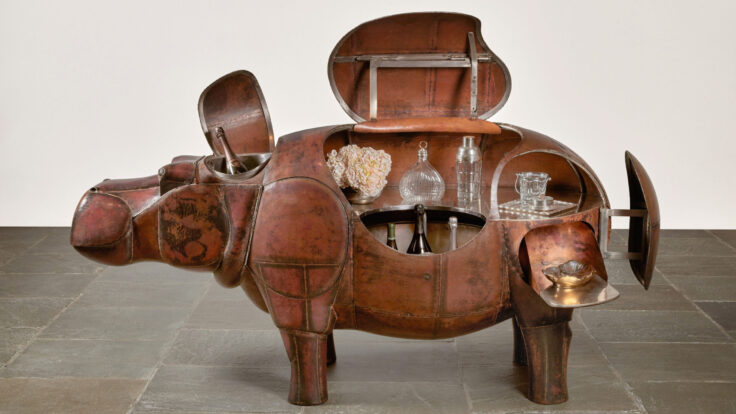
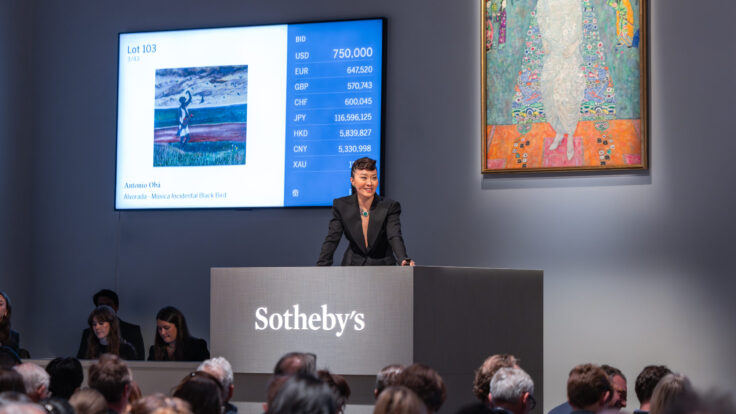
The auction house is now publicly touting previously unlisted, personalized luxury
services. Sotheby’s will help you design a “push present” diamond ring for your wife or plan an ultra-exclusive holiday. You can even reupholster your car’s interior in ostrich leather. |
|
|
|
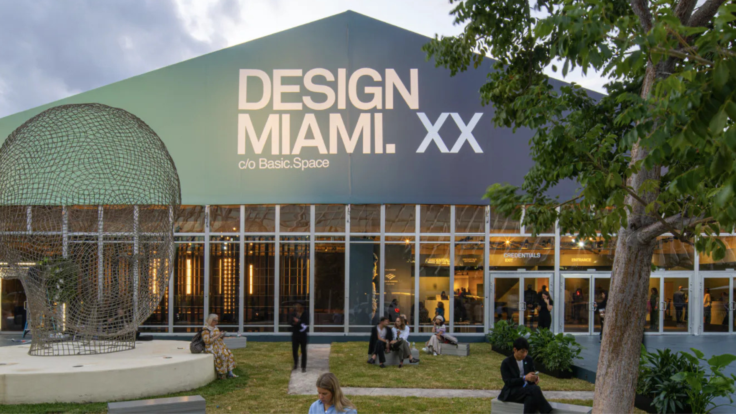
Last December, at a series of luxury outdoor auctions in Abu Dhabi that Sotheby’s calls
“Collectors’ Week,” I spotted Paul Redmayne, senior vice president for luxury sales, quietly manning a booth at the St. Regis on Saadiyat Island. The hotel’s restaurant had been repurposed into a Sotheby’s department store with booths selling handbags and diamonds. Laid out in front of Redmayne were tools of the trade—pliers, a magnifying glass, and a nylon hammer for artisanal effect, while some sketched designs were pinned to a board.
The display marked the soft launch
of Sotheby’s Bespoke, the new jewelry operation that the auction house is rolling out this year. It is one of two previously off-menu, relationship-building services—the other is “curated art journeys”—designed to make Sotheby’s into a one-stop shop for high-net-worth individuals craving unique objects and experiences. As with RM Sotheby’s, the house’s restoration shop that will hunt down the classic car of your dreams and reupholster it in crocodile or ostrich, the name of the game is keeping
existing clients close and the touchpoints frequent, even if the profit margins are thin.
Until December, the service had been an unofficial extra, available to top-tier Sotheby’s clients who had bought big rocks at auction and wanted them set. The commissions are mostly coordinated on WhatsApp directly with the client, Dubai-based Redmayne told me. “I might source a stone from Europe, send it to a workshop in Asia—say Hong Kong—and then the finished piece is delivered to the Middle
East,” he said. “Or we might use a workshop in France and ship the piece elsewhere.”
Bespoke is Redmayne’s baby. He started taking by-request commissions soon after joining Sotheby’s in 2022. Before that, he’d spent 20 years in luxury retail with the likes of Cartier, building a network that now helps him undercut the top maisons and get the job done faster. “One of the key advantages we have is speed,” he said. “For example, we recently created a necklace where all the stones
were D flawless. From design sign-off to delivery—sourcing the stones, manufacturing, shipping—it was done within 30 days. A larger maison might take three to six months just for the design phase, and another three to six months for production.”
The minimum budget he works with is around $100,000. Redmayne admitted that Bespoke’s profits “are generally lower than auction margins,” but pushed back when I suggested the service was designed to curry favor with existing clients or to
engage potential buyers. “Some clients have moved from Bespoke to buying at auction, but it wasn’t set up with that intention,” he said. “The service is not a funnel… it’s all very organic.”
His most memorable side commissions include a ring he was asked to design for a client’s wife to celebrate her 40th birthday and the birth of their second child (a “push present”). Because the husband wanted it to be a surprise, Redmayne used photos to “guesstimate” her finger size and her tastes. “I
looked through the photos, and realized she wears all white—platinum or white gold—so we went in that direction.” The finished piece was a white gold ring set with a rare Golconda diamond, discreetly personalized with two tiny diamonds hidden inside the band to represent the couple’s children. Another commission came from a “high-value client” who had been quoted $7 million by a major jewelry house for a ring. Redmayne says he made it for half the price, sourcing a 20-plus carat D flawless
diamond and designing a fully custom setting.
He said Bespoke is largely being marketed through word-of-mouth, but there’s now a dedicated page on Sotheby’s website. “The service reflects a wider shift in the luxury market toward individualization,” Redmayne told me. “Clients today want pieces that express who they are, rather than something recognizable that others might also own.” |
I’ve been told many tales by auction insiders about the lengths Sotheby’s and the other big houses
will go to impress well-heeled collectors, including flying them into major sales in New York, London, or Hong Kong, putting them up in luxury hotels, and even organizing private tours and lavish dinners. At the end of last year, Sotheby’s formalized—and outsourced—this behind-closed-doors, ad hoc client schmoozing by announcing a partnership with Indagare, a membership-based luxury travel agency. Together, they are offering “V.I.P. itineraries where fine art, world-class cuisine, and insider
cultural access meet—whether in a Ferrari factory in Modena or at a private dinner in the Louvre Abu Dhabi,” the house’s website reads.
A selection of group trips is currently being advertised online, from “Sotheby’s Venice: Inside the Biennale” to “Sotheby’s Modena: Slow Food, Fast Cars with Massimo Bottura.” The former will set you back $17,900, and includes three nights at the five-star Gritti Palace and out-of-hours visits to the Peggy Guggenheim Collection and
Gallerie dell’Accademia. Trippers can also expect “an insider perspective” on the biennale from Lorenzo Rebecchini, Sotheby’s managing director for Italy. The Modena trip costs up to $21,900 per person, and includes “exclusive-access tasting experiences” at three of Bottura’s restaurants, one of which has a Michelin star.
Melissa Biggs Bradley, a former editor of Town & Country, founded Indagare in 2007. She told me that Sotheby’s has also asked
her to curate trips for individual clients, but kept the specifics under wraps. “Sotheby’s clients have requested a range of travel experiences, from a relaxing time in the South of France to hiking in Scandinavia and trips focused on history in the Middle East,” she told me. “In some cases there may be an art focus, but not always. The common denominator is best-in-class experiences and local expertise.”
On Sotheby’s website, it states that the house “receives a financial incentive for
trips booked through this collaboration.” Both the house and Biggs Bradley, however, refused to disclose the cut. Sotheby’s chief marketing officer, Gareth Jones, told me the main purpose of the partnership “is to connect collectors with the ideas, art, and destinations shaping global culture. These artfully designed experiences build on Sotheby’s tradition of creating access to the rare and remarkable.” |
In many ways, the new services build on the work that Sotheby’s has been doing since 2015, when it
took a 25 percent stake in the car auctioneer RM Auctions and became the first and only auction house with a restoration shop. The operation was ahead of the luxury personalization curve, and for the last 11 years, Gord Duff, RM’s president, has been taking outlandish requests from car buyers. “We just did a 1924 Hispano-Suiza with a wood body and spent 12,000 hours restoring it,” he told me. “It had an alligator interior, so we had to go out and buy 50 hides to do two seats
with. They came from Louisiana, where Hermès sources its leather. That’s what the car had in it when it was new, in 1924, and the client wanted that. That’s $100,000 in hides for a couple of seats.”
Duff, who spearheads a team of 45 mechanics and restorers out of Ontario, Canada, has also been asked to upholster a car’s interior with ostrich leather. “Sometimes we do small extra projects, like if we have leftover interior material, we might make a matching purse for a client’s wife,” he
said. “We once had a client bring in his favorite tie and ask us to match the car’s paint to it—it was orange and red. That car was an Auburn Speedster.”
As Sotheby’s continues pushing for new ways to personalize experiences and rare objects for clients, I asked Josh Pullan, Sotheby’s global head of luxury, what else the house is prepared to customize. “The expansion into new services and new categories is part of our ongoing commitment to innovation and growing our
audiences,” he told me, a smooth nonanswer that still signaled their focus on meeting clients’ desires. But one decent bet might be road bikes, which are highly customizable—and the hype around a quartet of ultrarare Colnago road bikes at Collectors’ Week in Abu Dhabi, one of which sold for over $190,000, may suggest Sotheby’s is looking to go further into this niche, enthusiast-filled space. |
Thanks, George. I’ll be back on Sunday with an interview with Eric Crosby, the
Henry J. Heinz II director of the Carnegie Museum in Pittsburgh. The quadrennial Carnegie International opens this weekend. I look forward to seeing you then.
M |
|
|
|
Puck founding partner Matt Belloni takes you inside the business of Hollywood, using exclusive reporting and insight
to explain the backstories on everything from Marvel movies to the streaming wars. |
|
|
|
Unique and privileged insight into the private conversations taking place inside boardrooms and corner offices up and
down Wall Street, relayed by best-selling author, journalist, and former M&A senior banker William D. Cohan. |
|
|
|
Need help? Review our FAQ page or contact us for assistance. For brand partnerships, email ads@puck.news. You received this email because you
signed up to receive emails from Puck, or as part of your Puck account associated with {{customer.email}}. To stop receiving this newsletter and/or manage all your email preferences, click here. |
Puck is published by Heat Media LLC. 107 Greenwich St., New York, NY 10006 |
|
|
|
|