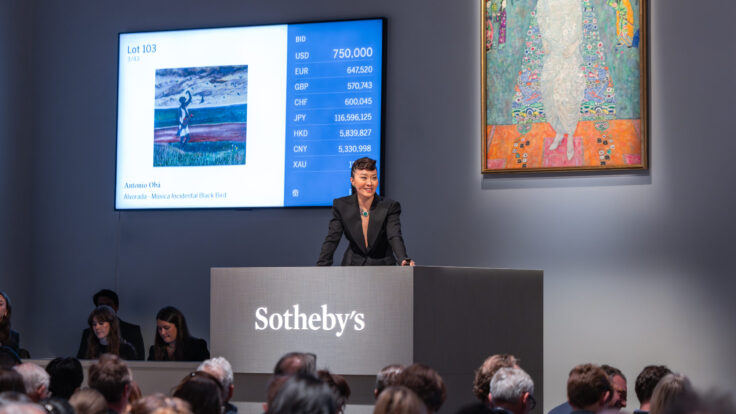
Welcome back to Wall Power, Las Vegas edition. I’m Marion
Maneker.
First, congratulations to gallerist Brigitte Schenk, who sold a work by Ilya Kabakov, The Colorful Noise #2, for $650,000 at Independent 20th Century fair last week.
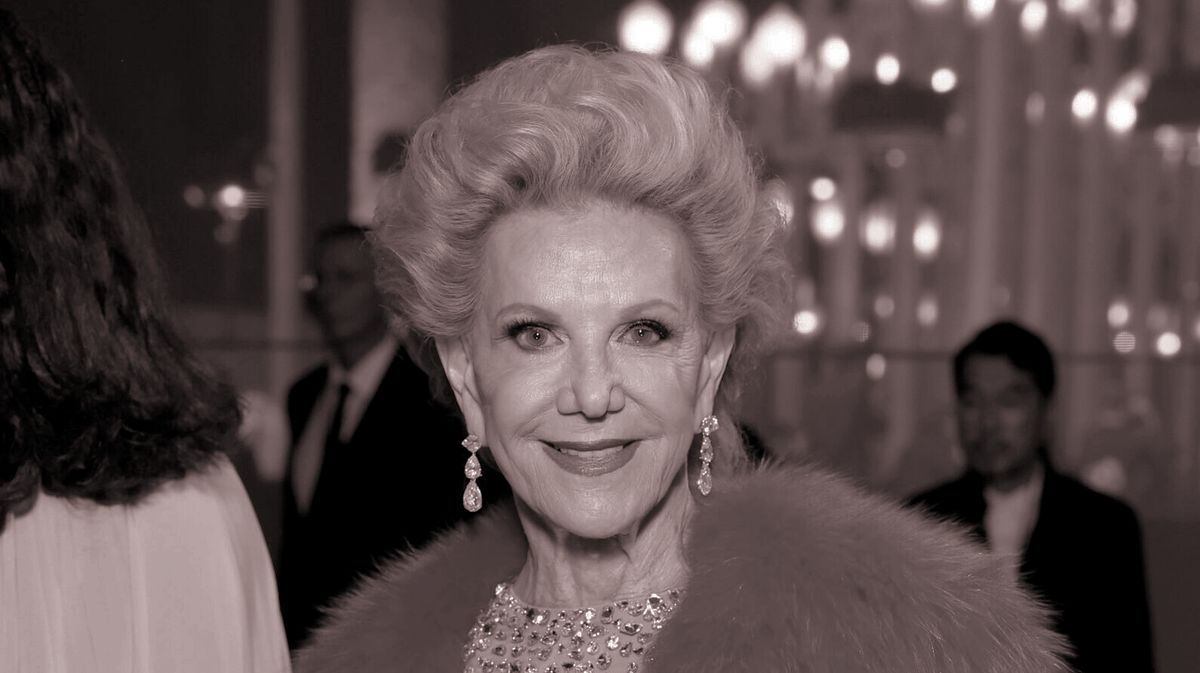
Elaine Wynn was always happy to stay in the background while growing the casino empire she built with her ex-husband, Steve. But even after trophy art became a marketing tool for their hotels, Elaine’s collecting remained
highly personal. Now, after donating the record-setting Francis Bacon triptych of Lucian Freud that she bought at auction for $142 million a dozen years ago, Wynn’s estate is selling all but one of her 20-odd artworks at Christie’s in November. Below, I take a look at that sale, which could provide an important benchmark for the art market. |
|
|
A MESSAGE FROM OUR SPONSOR |
Greatness isn't achieved in an instant. It's tested until there is no question — only performance.
|
|
|
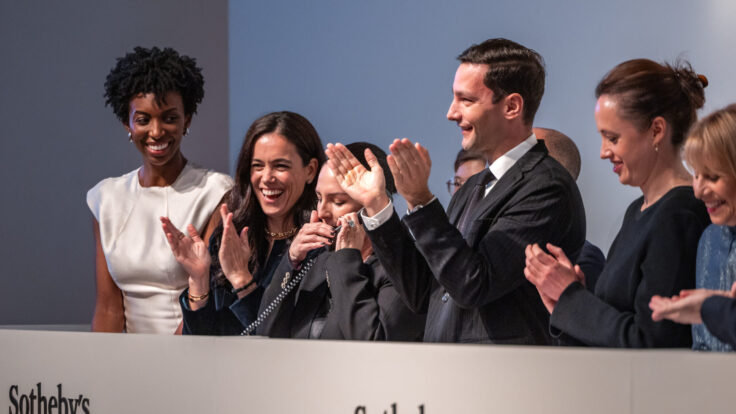
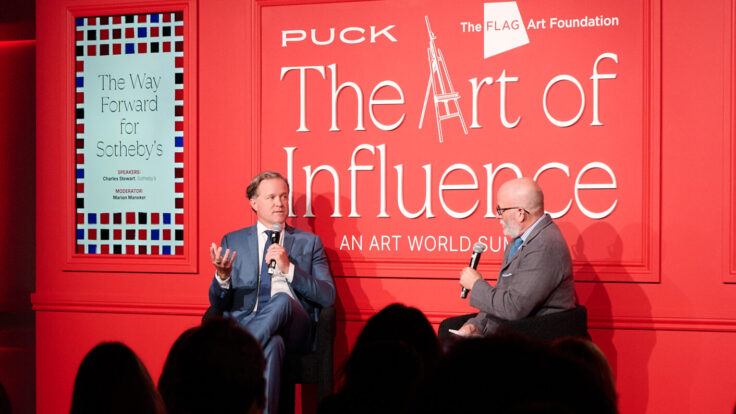
- The Sotheby’s financial guessing game: The Financial Times set off more speculation about Sotheby’s financial health yesterday with a story based on the Luxembourg filings for Patrick Drahi’s holding company, Bidfair. The headline was that Sotheby’s losses more than doubled from 2023 to 2024, from $106 million to $248
million. Interestingly, Sotheby’s revenue from commissions and fees fell only 18 percent, from $994 million to $813 million. (Meanwhile, Bloomberg reports—presumably from the same documents—that total revenues fell from $1.36 billion to $1.13 billion.)
I would caution readers that these filings may
not contain the entire story. Those additional losses may be connected to Sotheby’s significant recent real estate investments and/or its late-2024 staff restructure. The FT’s report contains some details that don’t quite jibe with what’s been reported over the past year, particularly a headcount number of 2,218 that may include seasonal employees or contractors. The paper reports that only 24 positions were lost in 2024, when in fact 100 were let go in a single day last December, as I
reported here.
The documents that the FT reviewed also provided some clues about the deal that Sotheby’s C.E.O. Charles Stewart made with Abu Dhabi’s ADQ sovereign wealth fund. According to the report, ADQ bought a 24 percent stake in Sotheby’s U.K., “as well as additional preferred stock and warrants,” for $909 million. It’s
unlikely that ADQ paid that much for just a quarter of a business unit that made only $27 million in profit last year. But it does seem likely that the number speaks to ADQ’s investment across all of Sotheby’s geographical operating companies. If so, Stewart seems to have struck a very good deal for Sotheby’s and Drahi with the Emiratis. Our initial calculations had ADQ acquiring a much larger share of the equity up front, though there is a payment-in-kind dividend on some portion of that
stake. - No Wave New York reunites at Pace: On Wednesday night, a throng of grey-haired former bohemians flooded Pace’s elevators en route to the seventh floor. There, the gallery space had been set up, amphitheater style, for a performance of Rhys Chatham’s “Guitar Trio,” a seminal guitar orchestra piece that debuted in 1978 and was featured at the No Wave festival co-organized by artist Robert Longo. Like his peer
Glenn Branca, Chatham inspired noise bands like Sonic Youth that have provided the soundtrack to the art world for at least two generations. A mashup of classical composition and punk rock enthusiasm, the work now known as “G3” has grown into a performance piece for as many as eight guitarists.
The Pace performance kicked off Longo’s new show of work titled The Weight of Hope, and the band included Longo and former Modern Lovers bassist
Ernie Brooks, plus No Wave guitarist-turned-doctor Karen Haglof and Pace’s Marc Glimcher among the seven guitarists. I just barely got in to catch the show before the room overflowed its capacity and Pace shut down access to the seventh floor. It made for a loud but epic evening.
|
|
|
The estate of Elaine Wynn, a savvy collector and even savvier investor,
is donating its most spectacular painting for a sweet tax break rather than selling it for a potential loss. Meanwhile, Christie’s is prepping an auction of 20 works from the Wynn collection that could illuminate whether the current market malaise is a function of poor supply or just limited demand. |
|
|
It probably won’t surprise you to learn that I am not a tax lawyer. But I do think
that the late Elaine Wynn, who died in April at the age of 82, was very savvy in making the most effective use of the art in her estate. Judging from her obituaries, Wynn was happy to play a long game to advance her interests, whether that was the gambling empire she worked behind the scenes to build with Steve Wynn—whom she married and divorced twice—or her goal of building a major museum in Las Vegas in partnership with Michael
Govan’s Los Angeles County Museum of Art. Now comes the news that her estate has donated Francis
Bacon’s Three Studies of Lucian Freud, which she bought for $142 million in 2013, to LACMA.
The triptych, which had been painstakingly reunited after being broken up among individual collectors, will become an anchor attraction at the museum. This fulfills Wynn’s philanthropic goals and commitments to Los Angeles and its future art-sharing alliance with a new institution in Las Vegas, but it also gives her estate a significant tax credit. When Wynn bought
the triptych, it was the most expensive work of art ever sold at auction. But even though Bacon’s estate continues to manage his reputation well, the artist’s market has settled into fairly steady price bands since his work first exploded in value in 2007. So the triptych would be unlikely to exceed its price of a dozen years ago if offered publicly now, and the donation will do more over the long term than another $100 million or so in cash might contribute to Wynn’s estate. |
|
|
A MESSAGE FROM OUR SPONSOR |
Greatness isn't achieved in an instant. It's tested until there is no question — only performance.
|
|
|
Elaine was, by all accounts, the original collector among the Wynns, but her husband
made art-buying a huge part of his personality—even building trophy art into his casino projects. You might remember, he bought 11 Picasso paintings to decorate a Picasso-themed restaurant in the Bellagio; Sotheby’s sold them in 2021 for $108 million, a solid success for the auction house and an indication of the interest in art as an event. Of course, not all of the art Steve Wynn collected in recent years has increased in value or been easy to sell. A noted buyer of trophy
works, he owns hundreds of millions of dollars of paintings that were featured lots in marquee sales over the last decade. But there have also been reports that Wynn is stuck with trophy properties in Los Angeles and New York that have proved hard to move in today’s more cautious market.
Although Elaine wasn’t afraid to spend money for the art she really wanted, her collection is much more personal and idiosyncratic. Her estate is run by four co-executors including her two daughters,
Kevyn and Gillian, as well as Andrew Pascal, the C.E.O. of Playstudios, and Bobby Kotick, the former C.E.O. of Activision Blizzard, a company Elaine invested in. They’re also showing good sense and foresight by allowing 20 works—all but one or two of her collection—to be sold in Christie’s evening and day sales with estimates that pay no heed to the prices Elaine originally paid. |
The top lots in Elaine’s collection are works by Richard Diebenkorn and
Lucian Freud, each estimated at $15 million. Diebenkorn’s Ocean Park #40 was owned for nearly 20 years by Si Newhouse, who parted with the work in the fall of 1990, just as the art market was sobering up from a multiyear bender. Anne Marion paid $1.76 million for the picture, which was a record for the artist, and owned it for the rest of her life. Wynn then bought it at the Sotheby’s sale of her estate in 2021 for more than $27
million, setting another record price for Diebenkorn in the process. The record toppled again two years later when Diebenkorn’s Recollections of a Visit to Leningrad, a Matissean mixture of abstraction, landscape, and interior from 1965, fetched more than $46 million. Prices may not be where they were in 2023, but this is not a picture that trades on price trends.
The Freud painting, The Painter Surprised by a Naked Admirer, was finished in 2005, just weeks before it
debuted in a show of Freud’s work at the National Portrait Gallery in London. A self-portrait painted as if viewed by Freud in a mirror, it’s an interesting counterpart to Bacon’s Three Studies. With only one owner and few high-quality works by Freud coming to market, the $15 million estimate would appear to be calibrated to draw a lot of interest. Not only was a new record set for Freud’s work in 2022, when Paul Allen’s Large Interior, W11 (After Watteau) was
sold for just above $86 million, but last fall in London a nude that many felt wasn’t his most appealing work was sold at Christie’s for nearly $16 million. Also in the last four years, two small Freud portraits, one of David Hockney and another of a nude girl, sold for $20 million at auction, and a larger painting of the artist’s daughter Isobel also sold in the same price band. Wynn’s Freud would appear to be a more appealing work to collectors than those.
|
|
|
The next rung down in Wynn’s collection features two very different works estimated
at $12 million. The first is Sunflower V, a tall Joan Mitchell painting from her Sunflower series made in 1969, which Wynn bought at auction in 2005 for a smidge more than $1.5 million—six years after the previous owner bought it for one-sixth that price. In 2008, another painting in the series, Sunflower IV, sold for just below $2 million, or 16 times what it had sold for 15 years prior.
Then in 2018, Blueberry, also from 1969,
sold at auction for almost $17 million, setting off another chain of strong Mitchell sales. A major retrospective that toured the U.S. and Europe after that helped drive prices up further. Another 1969 work called Noon, which sold in 2016 for nearly $9.8 million, sold again last May for $22.6 million—the artist’s third-highest price at auction. Sunflower V bears some similarities in composition, size, and orientation to these other works. “It’s a humdinger in person,”
Christie’s Max Carter told me yesterday, breaking the adjective into two words for emphasis. “It’s electric.”
The other painting estimated at only $12 million is J.M.W. Turner’s Ehrenbreitstein, or the The Bright Stone of Honour and Tomb of Marceau from Byron’s ‘Childe Harold’, painted in 1835 by a favorite artist of Wynn’s daughter Gillian. Elaine Wynn gave the painting pride of place in her Beverly Hills dining room, having bought it in 2017
for just under $24 million, three years after Turner set his auction record at $47 million. Another Turner sold in 2022 at a price halfway between the two works, or $33.6 million. These kinds of price patterns suggest the Turner should still have buyers well above the estimate Christie’s and the estate have chosen.
A few other works are being offered with estimates at steep discounts from where Wynn bought the works or where the market trades. One is an Adrian Ghenie,
according to the Journal, that was bought for $6.3 million in 2018 and is now estimated at $2.5 million. A Wayne Thiebaud landscape from 2000, River Stretch, is being offered at $3 million, even though a similar but wider work sold in 2021 for almost $10 million. And a Fernand Léger painting from 1921, Les Confidences, is estimated at $6 million, right where a smaller but similar work, also from 1921, sold last year.
We all know
the overall auction market is way down. But that’s primarily in terms of market volume. For those who maintain that the current malaise is a function of a lack of supply and not limited demand or price inelasticity, the Wynn sale is going to offer ample evidence one way or another. If these low estimates bring many bidders hoping to capture a bargain, we may end up with selling prices at or above recent benchmarks of what Wynn paid. That will prove the supply-drought camp correct. If these works
sell at prices near the estimates, we will know there has been a significant market reset. Either scenario will be a good step toward generating more sales in the future. |
With that, I will leave you to your weekend. I’ll be back on Sunday.
M |
|
|
The ultimate fashion industry bible, offering incisive reportage on all aspects of the business and its biggest
players. Anchored by preeminent fashion journalist Lauren Sherman, Line Sheet also features veteran reporter Rachel Strugatz, who delivers unparalleled intel on what’s happening in the beauty industry, and Sarah Shapiro, a longtime retail strategist who writes about e-commerce, brick-and-mortar, D.T.C., and more. |
|
|
Finally, a media podcast about what’s actually happening in the media—not the oversanitized,
legal-and-standards-approved version you read online. Join Dylan Byers, Puck’s veteran media reporter, as he sits down with TV personalities, moguls, pundits, and industry executives for raw, honest, sometimes salacious conversations about the business of media and its biggest egos. New episodes publish every Tuesday and Friday. |
|
|
Need help? Review our FAQ page or contact us for assistance. For brand partnerships, email ads@puck.news. You received this email because you signed up to receive emails from Puck, or as part of your Puck account associated with {{customer.email}}. To stop receiving this newsletter and/or manage all your email preferences, click here. |
Puck is published by Heat Media LLC. 107 Greenwich St, New York, NY 10006
|
|
|
|