 |
|
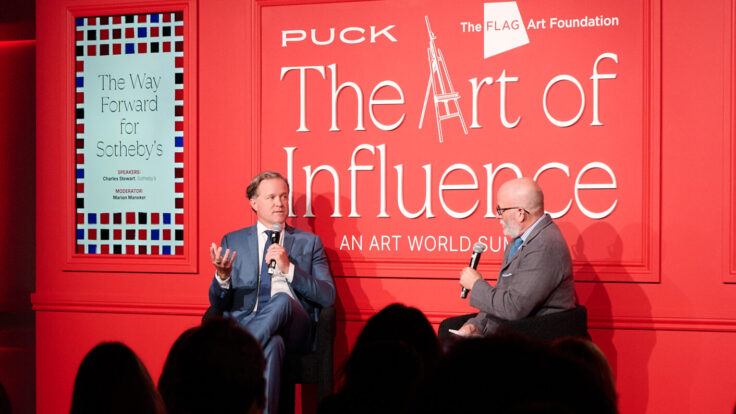
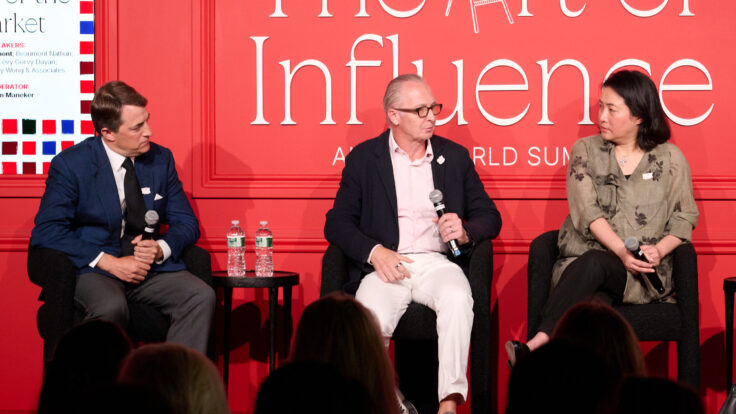
Welcome back to Wall Power, I’m Marion Maneker. If you’re on my private text channel, you already know that Hans Hartung, Jonas Wood, and KAWS works had to be sold at significant discounts in Hong Kong last week. It looks like the Asian market is experiencing the same slump that I wrote about last month in New York. (If you’re in the U.K., you can now join the SMS channel here.)
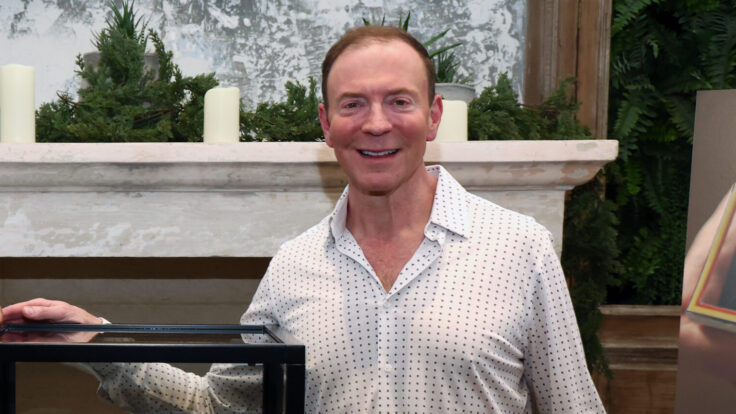
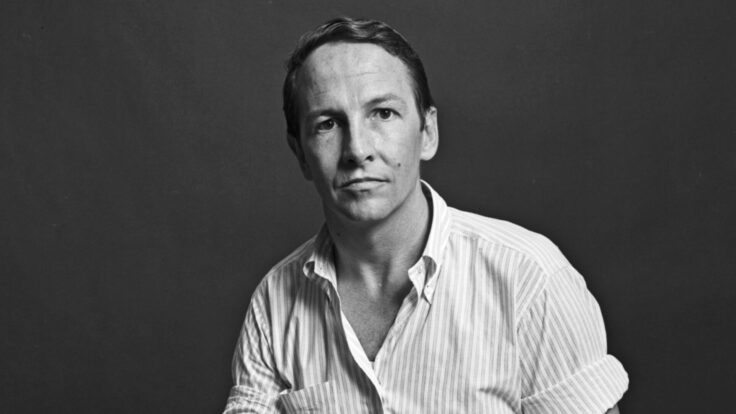
In tonight’s issue, notes on Tamotsu Yagi, the former Esprit art director who later worked closely with Steve Jobs, whose art and design collection (Twombly, On Kawara, Jean Prouvé, Charlotte Perriand, and more) is being sold at Sotheby’s on Wednesday.
Plus, a closer look at Christopher Wool, whose word paintings have been a mainstay of the Contemporary art world for 30 years. (One of his early canvases can be seen repeatedly in Morley Safer’s infamous and cheeky 1993 60 minutes essay about the insanity of the art market. Safer’s view, not mine.) Wool’s prices have fluctuated over the years; at his peak, one of his works fetched nearly $30 million. Now, he’s mounting a comeback of sorts with a show in Lower Manhattan (around the corner from Puck’s office), which has become a necessary pilgrimage for the art cognoscenti.
But first…
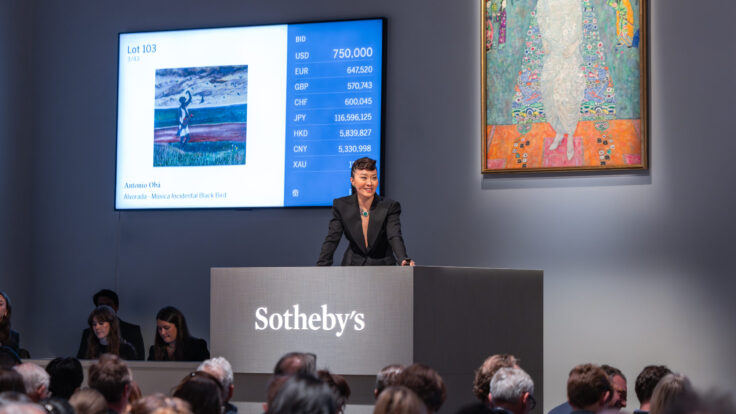
- Sotheby’s layoff fears: The esteemed auction house has been trying to keep a lid on its impending job cuts ever since the May sales ended. The chatter in the art world is that 25 percent of the London staff could be exited, eventually. But that may just be nerves running through the industry as the European market rebalances between London and Paris, as I wrote about last week. There’s also talk of a few layoffs in New York. But in truth, nobody but the top brass at Sotheby’s knows the extent of the reported restructuring. Even they don’t really know because, in the U.K., Sotheby’s must engage in collective consultation with employee representatives on how to achieve the efficiencies that the company needs. That means Sotheby’s has not made decisions yet about individual roles or total numbers. “London is, and will continue to be, our largest and most important center for sales, exhibitions, and talent in Europe,” the auction house said in a statement.
Of course, there’s nothing unusual about the seasonal rebalancing of headcount, and Sotheby’s is not alone in that regard. Few people left the auction houses—voluntarily or otherwise—last winter, which is a traditional period for employee turnover. All three major houses are making personnel changes this summer, I’m told. And galleries have been holding off cutting staff too. There may have been some hope in the auction business that May would show an uptick and justify some of the now-superfluous bodies. Now, it seems, many are simply hanging on until after Art Basel next week to make those hard decisions.
When it comes, the gallery rebalancing will involve new hires as well as layoffs, according to Field Recruitment’s Ines de Seroux, who told me that galleries and museums remain in the market for revenue producing sales and development staff. “Galleries are being very thoughtful about hiring right now—and, more generally speaking, how work is divided between roles,” added her partner, Megan ODell. “We are very interested in helping our clients build sustainable staff structures that are optimal regardless of the market outlook.”
- Christie’s hack drama, cont’d: Speaking of difficult messaging, I heard that Christie’s began to contact clients in earnest late last week with the news that their identification data—often passport information, including the number but not photographs or signatures—had been exposed in last month’s hack. Alas, at least one victim has already discovered—via a monitoring service being provided by Christie’s—that their personal information is on the dark web. That puts a different gloss on the news last Monday that hackers were still holding off in the hopes that Christie’s might meet their ransom demands.
- The Fotografiska hibernation: Private photography museum Fotografiska has outgrown its New York space. The Vivian Maier exhibition that opened on Thursday will be the museum’s last in the Gramercy location, which will close at the end of September. Yoram Roth, the C.E.O. of the company that owns Fotografiska and the co-working space NeueHouse, says the museum will look for a new space and be up and running in a “New York minute.” (It’s a buyer’s market these days.) But it is also interesting to note that Fotografiska was in the middle of a 15-year lease. The building’s owner, real estate mogul Aby Rosen, has already put it up for sale.
- Zwirner bets on Kahn: David Zwirner’s gallery announced late last week that it would represent artist Scott Kahn globally, marking another twist in the Contemporary artist’s unusual career. The 78-year-old Kahn went nearly 40 years surviving on a few grants and occasional gallery exposure until he befriended the artist Matthew Wong on Facebook. In 2018, Wong—who died by his own hand in 2019 before becoming a market sensation himself—posted a picture of Kahn’s work, and described him as an important influence. That was enough to bring gallery, art fair and, eventually, auction attention. In November of 2021, Khan’s first work ever to be sold at auction hit the block at Phillips in Hong Kong, where it made just shy of $1 million. Another painting later sold for $1.4 million. The market for his work has cooled since then, leading Kahn to climb the ladder of gallery representation to Zwirner’s door.
|
| Inside the Auction Lot: Tamotsu Yagi |
|
|
|
Courtesy of Sotheby’s
|
|
|
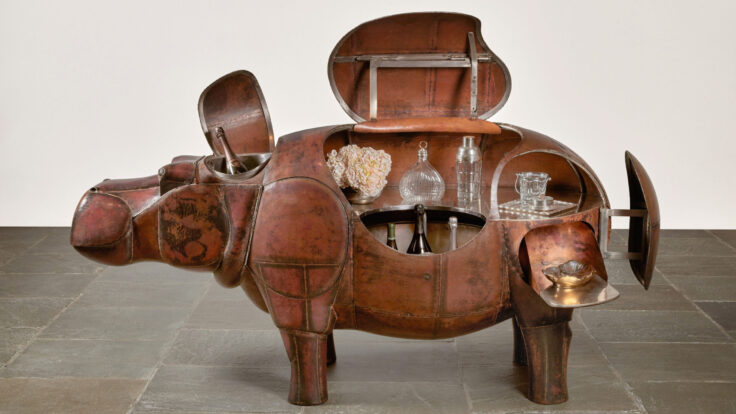
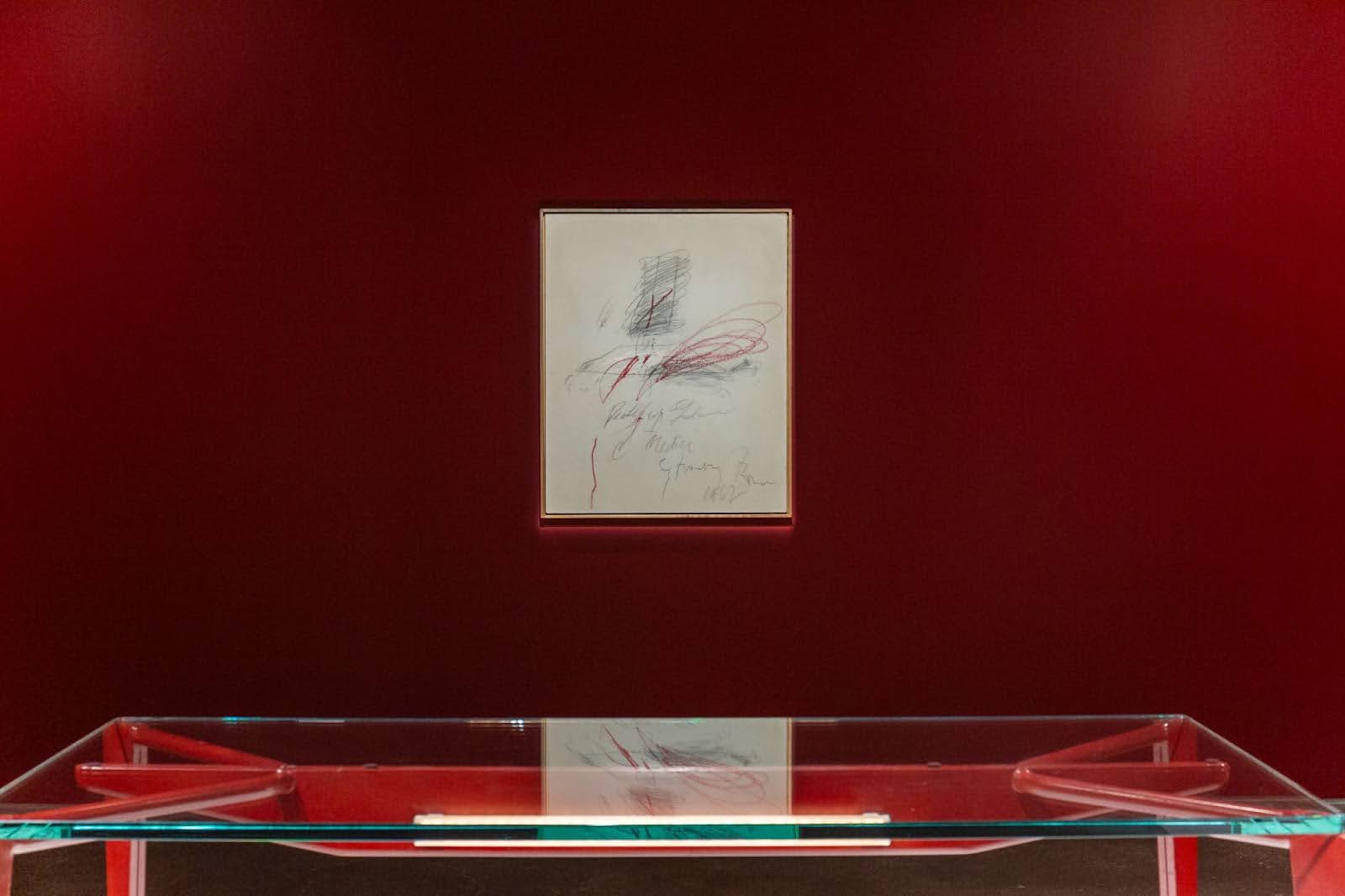
| This week, Sotheby’s will auction the art collection of Tamotsu Yagi, the former Esprit art director who later became a branding guru for Steve Jobs. The Yagi sale is only 39 lots, mostly design pieces by Charlotte Perriand and Jean Prouvé that were in his home and studio in Los Angeles. A few, like the Prouvé lighted table made as a custom design for a doctor, will bring out the design cognoscenti looking for a rare opportunity. Others will likely be of interest because of Yagi’s influence… as well as the fame of his clients.
Yagi, after all, had a major impact on the design world upon arriving in the United States, at the age of 35, to work for Esprit. In its heyday, the clothing brand was world-renowned for its distinctive image and philosophy. Yagi went on to work for Benetton, Pixar and, eventually, Steve Jobs, with whom he collaborated on the design philosophy of Apple’s retail business.
At the moment in his career when he was doing his best work, Sotheby’s Jodi Pollack told me, Yagi was collecting important design works by Perriand, Prouvé, Serge Mouille, and Sori Yanagi, as well as artworks by On Kawara, Cy Twombly, George Rickey, and Richard Long. When Pollack met Yagi, she asked if his own groundbreaking work—Esprit’s graphic design was its brand identity—informed his collecting or vice versa. Yagi paused. He couldn’t disentangle one from the other, Pollack said.
Indeed, the art and design worlds have been converging in recent years, and Yagi, in many ways, was ahead of the curve. Kawara’s interest in the passage of time influenced Yagi’s collecting; from Twombly, Yagi was inspired by hand work and the idea of an artistic language. In Long, Yagi was attracted to the recurrent references to nature, which informed his own design principles, especially Long’s belief that “good design is in the nature of things.”
At Esprit, founder Douglas Tompkins hung a sign in the graphic department that read “No Detail Is Small.” Yagi extended that philosophy to every facet of his work, including his collecting. And there is nothing small about the result: The low estimate for the lots is $4 million. |
 |
| Wool Beyond Words |
| An unconventionally staged show of Christopher Wool’s work may reset the market for the artist and better frame his career in the contemporary marketplace. |
|
|
|
| All throughout the spring, and especially as the art tribes converged in New York for the May auctions and gallery shows, a steady stream of pilgrims made their way to an unremarkable office building in Lower Manhattan to view what was perhaps the most important show of the season: Christopher Wool’s See Stop Run.
Wool, of course, is best known for his word paintings, those confusing sign-like images of giant letters stenciled on white backgrounds that test our perception of whatever art looks like. Originally inspired by the words “Sex” and “Luv” painted on a white delivery truck, Wool’s paintings evolved into a complex exploration of language, imagery, and composition. They also soared in value, commensurate with Wool’s fame; just after his 2013 Guggenheim retrospective, which drove demand to unsustainable levels, a 9-foot-tall Wool canvas with the word “riot” sold for nearly $30 million at auction.
A decade ago, I recall standing at a Sotheby’s preview with an Impressionist and Modern art specialist who asked me sheepishly how one was supposed to discriminate between a good and a better word painting. I later put a similar question to a powerful art advisor to hedge fund managers, after a giant, 6-foot-tall Wool featuring the word “Hypocrite” failed to find a buyer at auction. “C’mon, Marion,” he responded. “Who wants to look at that every day?!”
Ten years later, the See Stop Run show offers a decidedly more complex and considered snapshot of the 68-year-old artist, beyond the gritty work that first made him famous. In fact, you won’t find a single word painting on the 19th floor at 101 Greenwich Street. Wool stopped making those decades ago, and this is a show of his recent work. Moreover, the show’s purpose isn’t to sell art: It’s to recenter the popular image of Wool as an artist. A bulk of what’s on view are sculptures that Wool has made over the last decade, often inspired by objects he finds in the desert landscape near his home in Marfa, Texas.
The Lower Manhattan show will be familiar to anyone who saw Wool’s work on display at Xavier Hufkens’s gallery in Brussels, during the summer of 2022, but takes a step forward by presenting the art in an “urban,” non-gallery setting. Much has been made, often by the artist himself, of the choice to take a floor in one of the city’s more antiquated office buildings, in a raw space that highlights Wool’s distinctive sculptures, photographs, and art works—especially as they rely so heavily on the idea of transposing imagery from one medium to another.
“The show is in an unusual space,” Wool agreed in an email. “That is what the show is about, in part. Much of the work is new and mostly unseen, so the main idea was to find a space that was somehow a more ‘real’ environment than the generic gallery or museum spaces in order to have something for the work to play off.” |
|
|
| See Stop Run is an important moment to reassess Wool’s legacy, and may revitalize the market for his work, as well. For all of the money and attention his word paintings have attracted, they also had the effect of limiting the public’s understanding of Wool’s interests and talents. One of the original post-punk artists who came out of the East Village of the 1970s and ’80s, Wool was prominently featured in Morley Safer’s infamous 60 Minutes attack on Contemporary art, wherein Safer rolled his eyes at Wool’s Rat Rat Rat selling for five figures. As it turned out, Safer was inadvertently prescient when he joked, in 1993, that $30,000 was a bargain for the painting. Just last year, an untitled painting with the words “Please Please Please” was sold for nearly $8.4 million.
The frenzy didn’t make Wool very happy. “It sometimes feels not only like you’re in a car that you’re not driving,” Wool told The New York Times in 2022. “It feels as if you’re tied up in the back of the car and no one is even telling you where you’re going.”
The new gallery show at 101 Greenwich is a departure from all that. In addition to his large-scale silkscreen paintings, which continue to explore his interest in transposition, there are also smaller, more intimate works on paper that highlight erasure as a way of making marks on an abstract composition. Messing with the viewer’s head a little more, there’s a very large mosaic on display that replicates those erasures in a way that would scarcely have seemed plausible without seeing it.
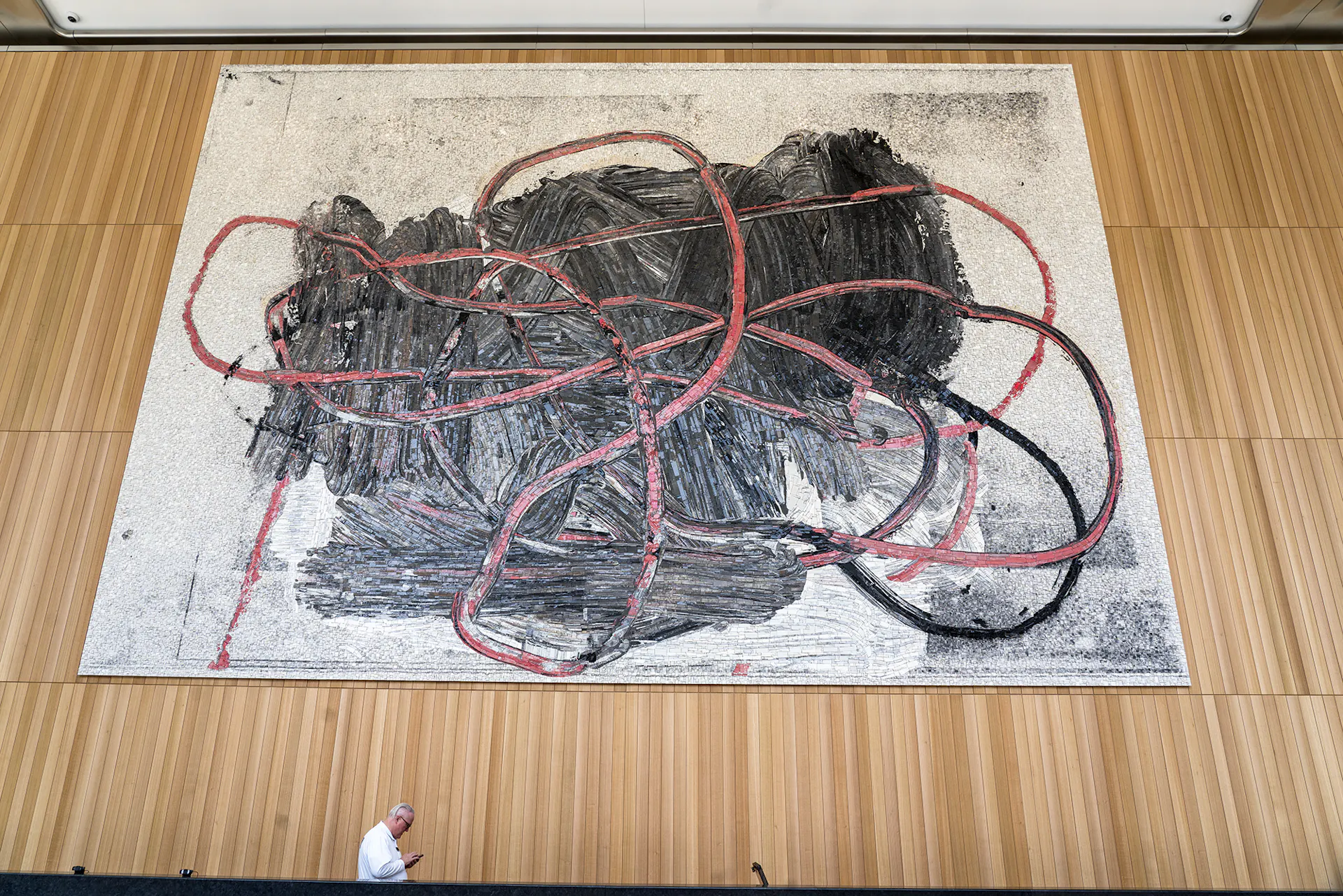
The mosaic work in See Stop Run is, in fact, an entirely new medium for the artist, only the second example since the rare public commission, Crosstown Traffic (2023), that Wool undertook for Brookfield properties, an enormous work that currently dominates the lobby of Two Manhattan West, their development behind Moynihan Train Hall at Penn Station. “I knew from the start that I could not produce a painting that large in my studio nor on site,” Wool told me in an email. “A mosaic made sense because of the way the image can be reduced to a dot pattern and enlarged. I’ve been able to change the scale in my paintings by working with silk screen, where the image is similarly reduced to a dot matrix. I had a sense that mosaic could work this way as well.” |
|
|
Christopher Wool, Crosstown Traffic (2023)
|
|
|
| The impressive 28-by-39-foot mosaic on Ninth Avenue, like the Wool show in Lower Manhattan, is worth the trek. It is large enough to be seen across the street—Wool thinks of the work as public art for that reason—but is best appreciated up close (or, at least, as close as one can get from the reception desk). There, one can see how the mosaic fabricators were able to replicate elements of Wool’s distinctive smearing. “The fabricators were quite excited to work on this for that very reason,” he told me. “The brushstrokes really let them strut their stuff.”
If the point of Wool’s exhibition is to remind the public—not just his collectors—that his work is always evolving, then the mosaics may be a hint of what’s to come. “I'm not yet on to new work,” Wool wrote to me recently, “but I feel I’ve only had a small taste of what mosaic can offer.” |
|
|
|
| FOUR STORIES WE’RE TALKING ABOUT |
|
|
|
|
|
 |
|
|
|
Need help? Review our FAQs
page or contact
us for assistance. For brand partnerships, email ads@puck.news.
|
|
You received this email because you signed up to receive emails from Puck, or as part of your Puck account associated with . To stop receiving this newsletter and/or manage all your email preferences, click here.
|
|
Puck is published by Heat Media LLC. 227 W 17th St New York, NY 10011.
|
|
|
|