Welcome back to Wall Power. I’m Marion Maneker, still grateful to
everyone who came by Christie’s and Sotheby’s on Friday for coffee and ice cream. Thanks to Sotheby’s Oliver Barker for taking a picture with me in front of the Puck Airstream; to the entire street team who flawlessly executed a fun marketing campaign; and to everyone who seemed to enjoy it as much as we did.
We’re all in this together, folks. For me, the big point of the promotion was to let everyone who is invested in the art market know that Wall Power and Puck are
here right beside you.
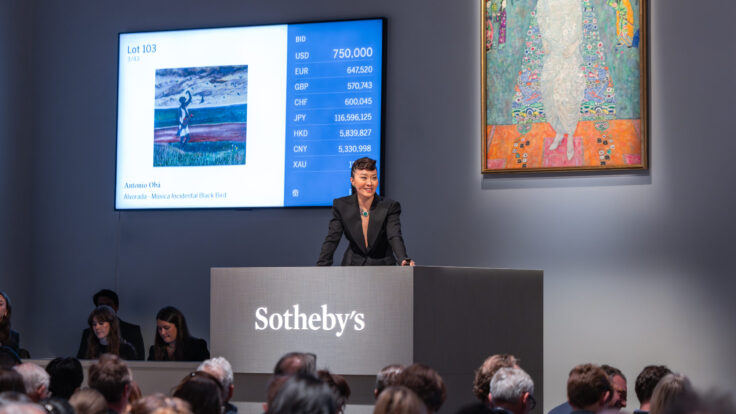
On to the newsletter: It’s a cliché that the true measure of the art market is in the days. But clichés are clichés because they’re truisms. So tonight, I’m going to look closely at Sotheby’s contemporary day sale, which took place on Friday and totaled $102.5 million—a nice sum that exceeded last year’s $97.3 million mark. The figure indicates a hot market, especially given that the low estimate was under $69 million.
Up top, more
observations on TEFAF; Dane Jensen has a new business devoted to helping divest collections; and a non-update update on Lévy Gorvy Dayan’s de Kooning sale.
Also mentioned in this newsletter: Ernie Barnes, George Braque, Maurice Vlaminck, Alexej von Jawlensky, Paul
Thek, Emil Nolde, Gabriele Münter, Karl Schmidt-Rottluff, Robert Mnuchin, Jean and Terry de Gunzburg, Roy Lichtenstein, Wayne Thiebaud, Helen Frankenthaler,
Elaine de Kooning, Esteban Vicente, Antonio Lopez Garcia, Agnes Gund, and more… |
-
Always be marketing…: Advisor Dane Jensen sent out a press release on Friday publicizing the $24 million worth of art that his clients have on offer this weekend. Jensen is launching a new company, La Finca Collection Strategies, devoted largely to advising Boomer collectors who have reached the divesting stage of the journey. Jensen is behind Ernie Barnes’s Study of the Sugar Shack (4th Point of View), from 1976-81,
that’s being offered in Christie’s postwar and contemporary day sale on Thursday. The release also tells us that Jensen has works by George Braque, Maurice Vlaminck, and Alexej von Jawlensky with Eykyn Maclean; never-before-seen-by-the-public works by Paul Thek as part of his new show on view now at Pace; and four works from Emil Nolde, Gabriele Münter, and Karl
Schmidt-Rottluff that are being offered through Christie’s private sales arm.
- TEFAF takes: Pace Di Donna Schrader made its debut at TEFAF on Thursday. The secondary-market dealership had an impressive booth featuring a piece by Amedeo Modigliani; a bright yellow Mark Rothko; strong works by Willem de Kooning, Jean Arp, Alexander Calder, Cecily
Brown, and Ed Ruscha; plus a rare Eugene Delacroix. The fair reported sales of an Andy Warhol Mao painting at ML Fine Art, and Mennour sold Lucio Fontana’s Concetto Spaziale for $2.3 million.
Meanwhile, Lévy Gorvy Dayan, Gagosian, and Thaddaeus Ropac all said they sold out their stands during the collector’s preview on Thursday. Gagosian had a show of Kathleen Ryan’s
work, while Ropac placed three paintings by Eva Helene Pade with institutions. David Aaron sold a 3,300-year-old Egyptian stele for $600,000, and Galerie Chenel sold a Roman torso from the 1st/2nd century. - Lévy Gorvy Dayan results… or lack thereof: I was trying to follow the auction of Willem de Kooning’s Milkmaid (untitled X), from 1984, which was being offered with a $10 million estimate. The firm insisted that the
auction result would be available online but did not provide details. This morning, there is no mention of the auction on the Lévy Gorvy Dayan website; nor is there a post on Instagram. I’ve tried to contact the gallery and publicist directly, to no avail. I hope to follow this non-update update with an actual update soon.
|
Now, let’s dig into the day sales… |
|
|
|
News and notes on the revealing trends surrounding Sotheby’s latest round of day
sales, in which 93 percent of the 350 lots found buyers. Is this another sign of a market boom? |
|
|
|
I know one secondary-market dealer who spent nine hours at Sotheby’s day sale on Friday and ended
up bringing home nothing. That tells you a little bit about the state of the art market right now. The big-money, attention-soaked evening sales at Sotheby’s last week had plenty of strong performances, but a number of observers attending the live auction complained to me that the room felt dead. That dichotomy—strong performance on
paper but mixed vibes in person—was likely the result of two different factors.
First, even though more market participants are attending the sales in person again, after so many began following online during the pandemic, there still isn’t that much bidding in the room. Fewer market stalwarts show up to bid, leaving those of us who attend to amuse ourselves with speculation about the identities of the new faces in the room. For example, a man in his 30s with long brown hair and a
matching beard bid up to $10 million on one of the lots Thursday night. No one had ever seen him before. When the auctioneer queried him about bidding past $10 million, one observer suggested there was panic in his eyes, and another assured me he was only executing bids—that the decision-maker was the woman seated at his side.
The second reason for the low-energy saleroom on Thursday was the fact that most of the top lots had already been on the market, in one way or another, for some
time. Buyers were familiar with the works, and the process of shopping irrevocable bids was essentially an auction before the auction.
In contrast, there were 350 lots on offer in the day sales, many of which had not been seen on the public or private markets in decades. At Sotheby’s on Friday, 93 percent of the lots found buyers. While some of those lots had guarantees and irrevocable bids, it was, by and large, a less managed market. With so many lots, it’s hard for the sales force to
fully cover all potential buyers, so when we see near-record sales totals and a sell-through rate in the 90s, it’s worth taking notice. Those figures are usually a sign of a market boom.
In the past, the day sales have been where the discretionary selling has taken place. They provided a measure of what sellers believe is going to perform well. There was surely some of that on Friday, but the great wealth transfer isn’t only among lots worth seven figures and more. Ten different
collections were represented in these sales, including lots from Robert Mnuchin and Jean and Terry de Gunzburg. Indeed, if the art media was worried that younger collectors would not be interested in art bought by their Baby Boomer and Silent Generation predecessors, these sales largely suggested otherwise. |
The
Lichtenstein Paradigm
|
The next set of buyers (who may still be Boomers) are not yet ready to pay prices well above what
these works have cost in the past—at least not on an inflation-adjusted basis. The top lot in the day sale was Roy Lichtenstein’s Girl in Mirror, from 1964. Estimated at $5 million, the work is one of an edition of 10; one other of the edition was sold for a price close to $6.9 million. Given the overall rise in inflation, and enthusiasm for Lichtenstein’s work ahead of his upcoming retrospective, the $6.2 million selling price has to be a bit of a disappointment, even
though the work was purchased for $3.7 million in 2012.
Adjusted for inflation, that comes out to $5.4 million in today’s dollars, which means the consignor got a little bit less back once Sotheby’s fees are subtracted. Another way to look at it is that someone was able to enjoy a great Lichtenstein image for 14 years—and it cost them less than $30,000 a year to rent.
The next-most-valuable lot was Wayne Thiebaud’s Various Cakes, from 1981. It sold at
auction in 2011 for just under $3 million and returned to auction in 2023 to make under $2.7 million. On Friday, it sold again for under $2.7 million. Recently sold works rarely do well at auction, so the steady pricing is a good sign for the work and the Theibaud market as a whole.
There are also a lot of Helen Frankenthaler works on the market, and most of them are doing quite well. Perseus, from 1983—owned by one collector since 1984—sold for $2.8 million, a
healthy bump from the $2 million estimate. And St. John, from 1971, which had been owned by architect Gerald Mallon McCue since 1980, made $2.1 million. It was backed by an irrevocable bid and estimated at $1.5 million.
Meanwhile, a group of six 5-by-5-inch Flowers, from Andy Warhol, was estimated just above the $1.1 million price they sold for in 2008 (which would be $1.75 million adjusted for inflation). On Friday, the assembled work sold for a little more than
$2.2 million. Subtract Sotheby’s fees, and the consignor just got their money back after 18 years of ownership. |
$750,000
Is the New $500,000
|
The seven Alexander Calder works from various consignors showed where the market
could be very interesting. Sotheby’s got the consignors to accept unrealistically low estimates, and the tactic worked for all but one lot. Six Red Polygons, from circa 1950, made $2 million against an estimate of $800,000. One untitled tabletop work was
estimated at $700,000 but sold for $2 million, and another estimated at $600,000 wound up selling for $1.2 million.
A group of Alma Thomas works all followed the
success in the evening sale the night before. An untitled work from around 1972, estimated at $600,000, sold for nearly $1.8 million. Three other works estimated in the five figures all sold for solid six-figure numbers.
In my notebook, I scrawled a number of works estimated at prices in the $200,000 to $400,000 range that sold for
prices in the high six figures. The margins on works by Grace Hartigan, Frank Stella, Alex Katz, Lee Bontecou, Ed Ruscha, Fernando Botero, Mark Tansey, George Condo, Elaine de Kooning, and
Esteban Vicente, among others, were where Sotheby’s really made its money in this day sale. They’re also a measure of demand and interest for historical artists with good track records. Buyers are still seeking out value, but they’re willing to pay more for those works. To give it a high-concept slogan: $750,000 is the new $500,000.
One final lot to focus on: Enrico Donati’s collection contained a striking painting by Antonio
López Garcia, a Spanish nonagenarian realist painter. Last year in London, a 1968 López Garcia painting of a woman in a bath sold for a surprising $650,000, even though it was estimated at $135,000. The artist’s trompe l’oeil El Cuarto de Bano, from 1966, showed very well at Sotheby’s exhibition, and the $200,000 estimate
seemed conservative at best. Nevertheless, it sold for nearly $2 million, a price that more than doubles López Garcia’s previous auction record. |
That does it for today. I hope you got some rest this weekend—we have a lot to get through in the
next few days. Tomorrow night should be pivotal given the sales of the Newhouse collection and Agnes Gund’s sublime Rothko painting. I’ll be back on Tuesday with all of the action from Christie’s saleroom.
Until then,
M |
|
|
|
Puck founding partner Matt Belloni takes you inside the business of Hollywood, using exclusive reporting and insight
to explain the backstories on everything from Marvel movies to the streaming wars. |
|
|
|
Unique and privileged insight into the private conversations taking place inside boardrooms and corner offices up and
down Wall Street, relayed by best-selling author, journalist, and former M&A senior banker William D. Cohan. |
|
|
|
Need help? Review our FAQ page or contact us for assistance. For brand partnerships, email ads@puck.news. You received this email because you
signed up to receive emails from Puck, or as part of your Puck account associated with {{customer.email}}. To stop receiving this newsletter and/or manage all your email preferences, click here. |
Puck is published by Heat Media LLC. 107 Greenwich St., New York, NY 10006 |
|
|
|
|