Welcome back to Wall Power. I’m Marion
Maneker.
Late last week, I happened upon a great show of work by Beauford Delaney, the Harlem Renaissance artist perhaps best known for his 1941 portrait of a young James Baldwin. Tonight, I’m going to tell you more about him and the show. I also have Sotheby’s numbers from the first half of the year, and some notes on the “lost” Rosebud sled from Citizen Kane that sold for $14.75 million at Heritage. Meanwhile,
Julie has a report on the very strong results from Sotheby’s Natural History sale.
Let’s get started…
|
|
|
 |
Julie Brener Davich |
|
- Sotheby’s Natural
History sale = $45 million: Sotheby’s Natural History sale on Wednesday—featuring fossils, meteorites, and minerals—totaled $45 million, with fees, against an estimate of $9.4 million without fees. Ninety-six percent of the 122 lots were sold, with participation from 37 countries. There was a lot of interest in this sale, with twice as many registrants as last year.Three quarters of the overage came from the juvenile Ceratosaurus, which sold to a phone bidder for
$30.5 million against an estimate of $4 million. Incredibly, an online competitor went as high as $21 million—one of Sotheby’s highest-ever online bids. After the hammer came down, the auctioneer looked over at global department head Cassandra Hatton and asked jokingly, “Do you need a cigarette?”
Other strong prices for dinosaur fossils included $1.76 million for a skull of a Pachycephalosaurus, and $1.76 million for an articulated T. rex foot. Another fossil, a
6-foot-high, multi-fish triptych mural from the early Eocene epoch, estimated at $12,000, sold for $279,400 after being chased by 18 bidders. “These fossils come from Fossil Lake, one of the richest prehistoric sites in the world,” Hatton told me. “It’s not just a beautiful tableau, it’s an entire 50-million-year-old ecosystem captured in stone.”
Also sold were the first- and second-most-expensive meteorites at auction. A 54-pound Martian meteorite—the largest single piece of
Mars on Earth—sold for $5.3 million. The direct underbidder was competing online. The largest known lunar sphere, at 4¾ inches in diameter and estimated at $300,000, sold for $825,500. In Tuesday’s online sale dedicated to space exploration, a 4-by-6-inch flag that Buzz Aldrin carried to the moon on Apollo 11 sold for $444,500 against an estimate of $15,000.
|
|
|
A MESSAGE FROM OUR SPONSOR
|
The first steps towards a masterpiece starts with a dream. The all-electric BMW i7 – the
evolution of brilliance. Learn more at
BMWUSA.com
|
|
|
Now, a few other notable things…
|
- A Rosebud is a Rosebud is a Rosebud: Heritage Auctions made another big movie memorabilia sale this week. Billed as a “lost” Rosebud sled from Citizen Kane, Heritage estimated the object at $250,000, but it sold for a stunning $14.75 million. That number comes less than a year after Heritage sold a pair of Judy Garland’s ruby slippers from The Wizard of Oz for more than $32 million.There are only two other surviving examples of the
totemic movie prop: a balsa wood sled, fabricated for the scene where Charles Foster Kane’s childhood talisman is burned (bought in 1982 by Steven Spielberg for $60,000), and another made of sturdier pine to be ridden by a child actor. (The latter sold at Christie’s in 1996 for $233,000.) The latest sled to emerge has been owned by director Joe Dante since 1984, which he used as an “Easter egg” in several movies, notably Explorers and
Gremlins 2. Dante had the sled’s pine wood carbon dated to offer further proof that the object was fabricated prior to World War II.
- Heritage’s new hire: Heritage also announced yesterday that it had hired Michael Plummer, a former executive at both Sotheby’s and Christie’s and a former co-managing director of TEFAF New York, as chief marketing officer. He will work out of both Dallas and New York.
- Sotheby’s $2.2 billion haul: Sotheby’s isn’t doing a press conference on their first-half results, but they were generous enough to share a fact sheet that shows $2.2 billion in auction sales, not including real estate. That’s down from $2.3 billion in the same period the year before. The overall sell-through rate was 85 percent, a 4 percentage point increase from the first half of 2024. In addition, there were 4.6 bidders per lot at Sotheby’s, up 4 percent from the same period
last year. That’s an all-time high for average bidders per lot.
|
Now, let’s get to the main event…
|
|
|
Beauford Delaney’s big, brightly colored works forged his identity as
an artist, and not just another expat friend of James Baldwin and Georgia O’Keeffe. Now, a sweeping exhibition of his work at the Drawing Center shows the remarkable range of an underappreciated great American artist.
|
|
|
A decade ago, Alex Katz, a painter known for his large and vivid
portraits, had a show of his early paintings from the 1950s called Brand New and Terrific. During the many appearances he made for the show as it moved from museum to museum, Katz often told a story that explained how his early work had morphed into his mature, muscular style: In the 1950s, in a group show in New York, one of his paintings was hung next to a work by Beauford Delaney, an artist who came to the city as part of the Harlem Renaissance, and eventually moved
to Paris after the war. Katz, still smarting at the memory, told interviewers that Delaney’s brightly colored painting had blown his painting off the wall. He was so frustrated that he vowed never to let it happen again. (The result was a quantum leap for Katz.)
I won’t say that was the first time I heard of Beauford Delaney. But it was the first time I really took notice of the name (pronounced Bew-ferd). After that, I began to see works by Delaney pop up at art fairs, mostly in
the booth of the Michael Rosenfeld Gallery, which represents his estate. But others were also happy to show Delaney’s subtle late abstractions—often in lemon yellow tones, made after the period when Katz found him so overpowering. Last year, during the Met’s Harlem Renaissance and Transatlantic Modernism show, I saw Delaney’s oft-exhibited 1941 portrait of a young James Baldwin, his longtime friend. The painting, titled Dark Rapture (James Baldwin), is mottled
with blues, yellows, pinks, and ochres. It was certainly appealing, but still not quite the dominating work that cowed Katz.
|
|
|
A MESSAGE FROM OUR SPONSOR
|
The first steps towards a masterpiece starts with a dream. The all-electric BMW i7 – the
evolution of brilliance. Learn more at
BMWUSA.com
|
|
|
Earlier this year, I learned that curator Adrienne L. Childs, a
fellow at the Met, was giving a lecture titled Navigating Modernism: Beauford Delaney, 1940-1965. Sadly, I was out of town, but the good news is that Childs is curating a big show at the Phillips Collection called Beauford Delaney: So Much Love and Beauty in 2027. I assumed I would have to wait, until I stumbled across the Drawing Center’s
show, In the Medium of Life: The Drawings of Beauford Delaney, late last week. Despite its title and venue, the show at the Drawing Center includes a handful of paintings. It also functions as a pocket retrospective of the artist’s career. There, I finally understood why Katz gnashed his teeth at Delaney, even 70-some-odd years later.
|
The Drawing Center, on Wooster Street in Soho, isn’t a very large exhibition space. But
Laura Hoptman, the Delaney show’s director and curator, found a way to cram in more than 90 images, including a handful of works on canvas and an equal number of painted notebook pages. “I’ve never seen an exhibition like that,” said gallerist Michael Rosenfeld, who not only represents the Delaney estate but is a major Delaney collector himself, having bought his first work 40 years ago. “I’ve never seen so many works installed.”
In The New
Yorker, Hilton Als rightly lamented that the show feels cramped, and that it’s hard to make connections between “these mostly lesser works and Delaney’s stronger paintings.” But that doesn’t detract from Als’s deep appreciation for, and familiarity with, Delaney’s work. The show, itself, is divided into four packed rooms. One
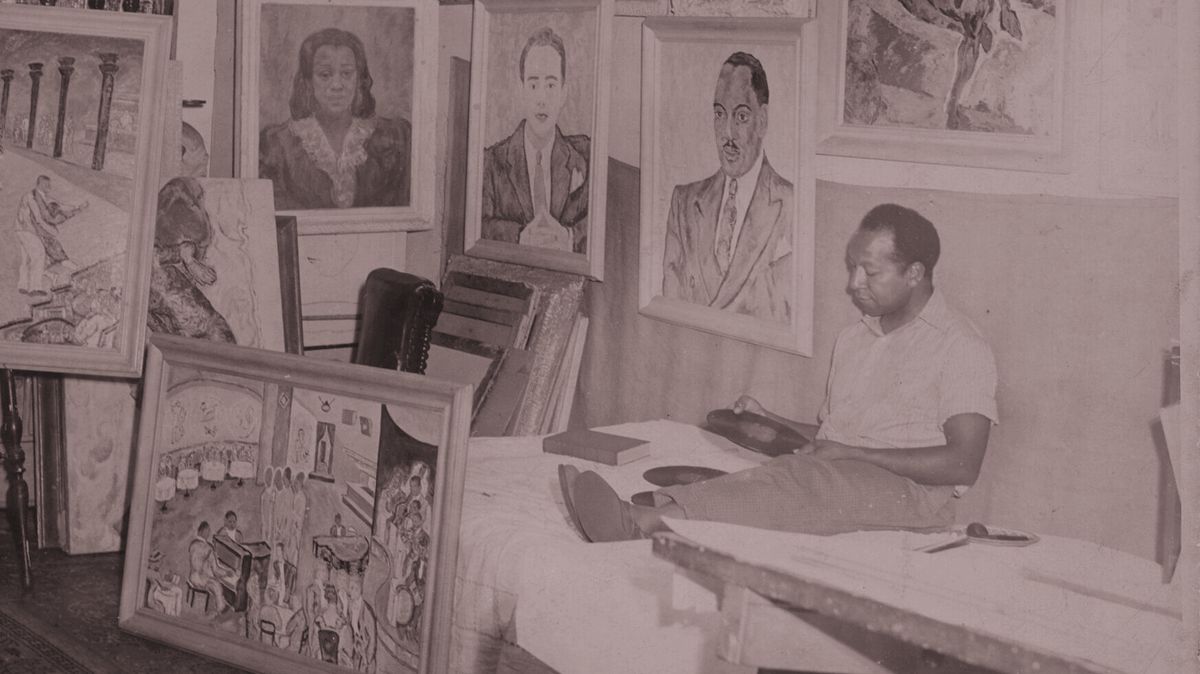
contains notebooks, letters, and sketches that chart Delaney’s path from Knoxville, Tennessee, to New York by way of Boston. The son of an itinerant churchman and barber, Delaney was discovered as a talent by a local painter and Confederate sympathizer named Lloyd Branson, who instructed him and eventually helped him to move to Boston. That’s where Delaney cobbled together an art education before moving to New York during the Harlem Renaissance. “People don’t think of him as a
Harlem Renaissance artist, but he was,” Rosenfeld told me. “They don’t understand the depth of his career.”
|
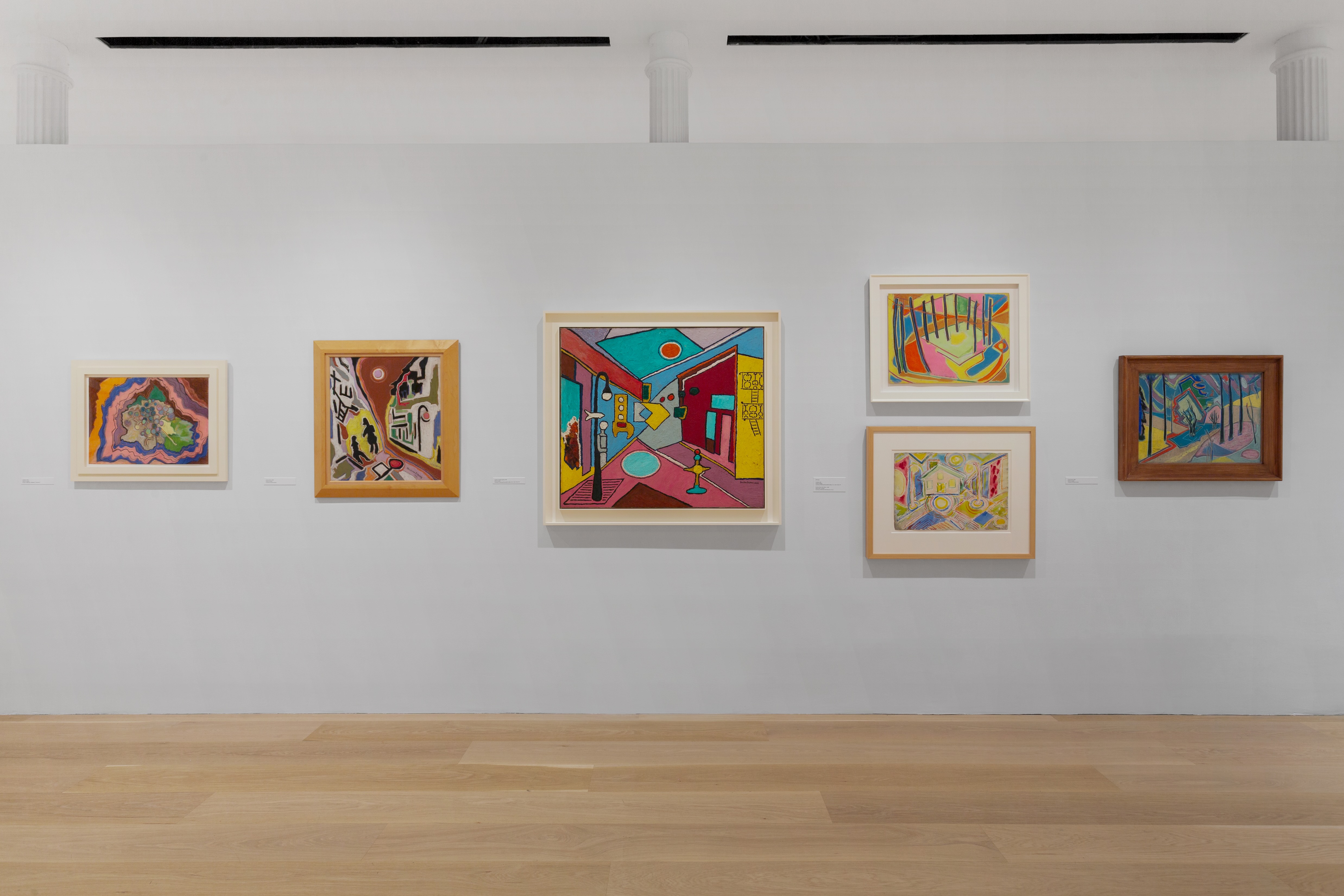
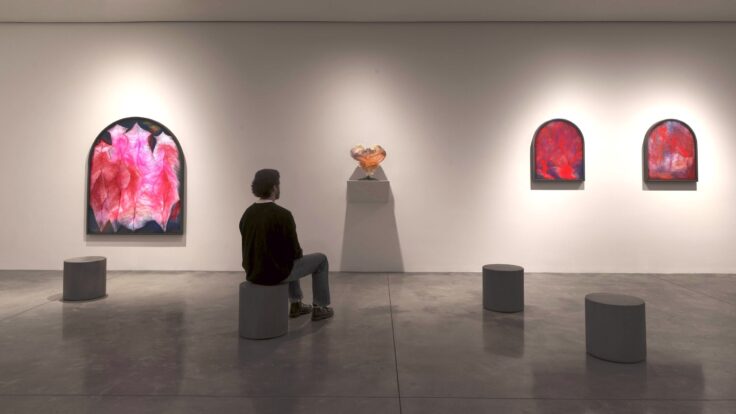
Installation view of In the Medium of Life: The Drawings of Beauford Delaney,
The Drawing Center, New York. Photo: Daniel Terna and Estate of Beauford Delaney, by permission of Derek L. Spratley, Esquire, Court Appointed Administrator, Courtesy of Michael Rosenfeld Gallery LLC, New York, NY
|
The next 50 years of Delaney works are roughly divided into three groups. The first are
the Greene Street works, which were made when he lived in Greenwich Village for more than 20 years through the 1930s and ’40s. These are a range of realist paintings, often depicting fire escapes, lampposts, and fire hydrants, that grow increasingly colorful over time. It’s not clear whether Delaney, who was well versed in art history, was synthesizing previous movements that emphasized the bold use of color or simply following his own path. But it was likely one of these works that upset Alex
Katz—and they still have wall power today.
|
|
|
When Delaney moved to France, in 1953, he joined a community of American expatriates,
including Baldwin, but also became engaged in the aesthetic questions that prevailed in postwar Paris. “Delaney was an influential person,” Hoptman said, reminding me of his friendships with Henry Miller, Stuart Davis, and Georgia O’Keeffe, who painted him five times. “People sought him out for his intellect and compelling personality.” As he became ensconced in the cultural life of Paris, his work turned to abstraction—the second group—but
unlike the American version developed by the abstract expressionists in New York. Along with expatriates like Mark Tobey and Paul Jenkins, Delaney pursued a different path. As Hoptman told me: “His painting after he went to Paris is very French and very abstract.”
|
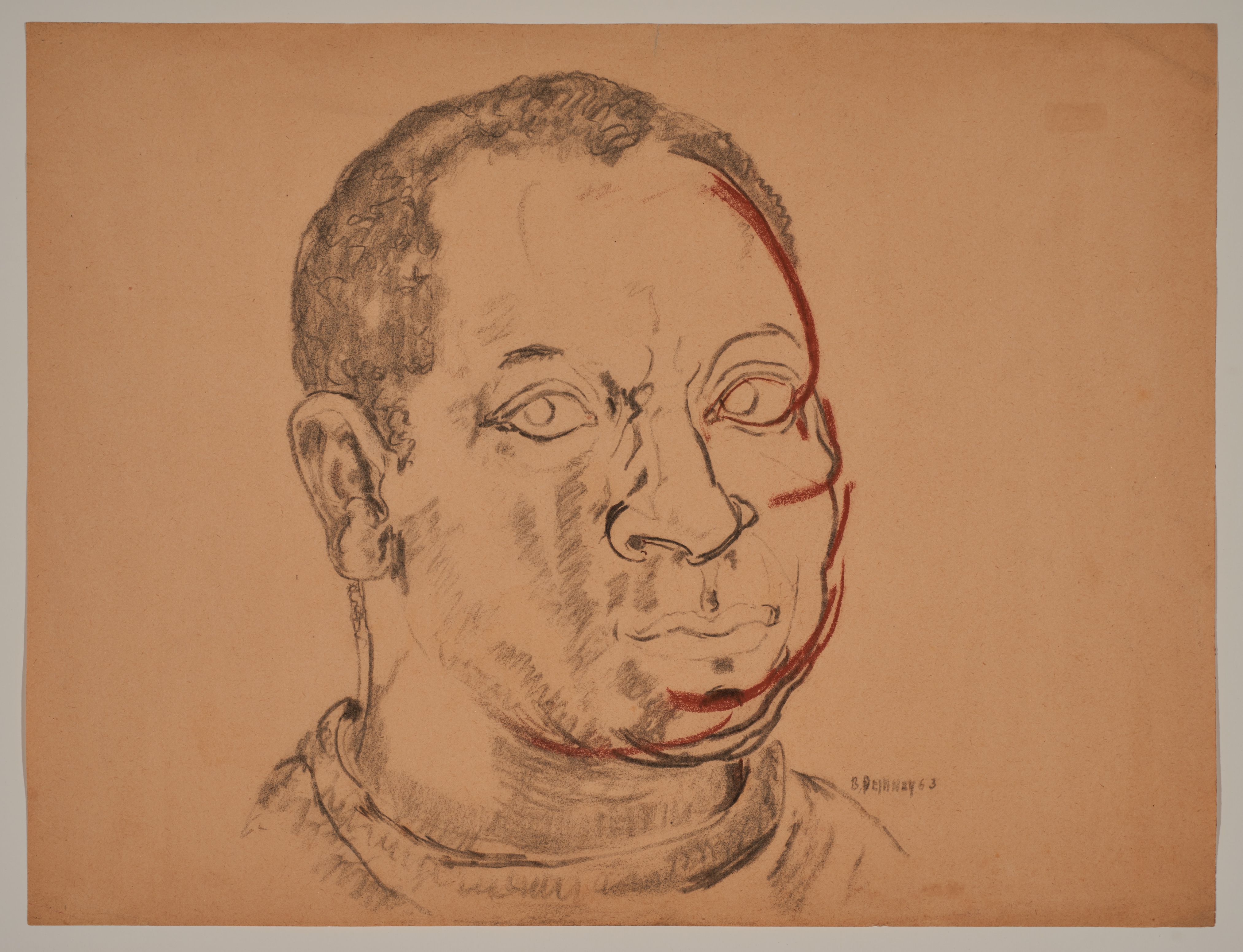
Beauford Delaney, Self Portrait (1963). Photo: Estate of Beauford Delaney, by permission of Derek L. Spratley, Esquire, Court Appointed Administrator, Courtesy of Michael Rosenfeld Gallery LLC, New York, NY
|
Even with this evolution, Delaney never stopped painting portraits, which are
represented in the third group. There are several astute and unnerving renderings here of figures like Delaney’s brother and mother, Baldwin, and several self-portraits, along with a number of portraits of unknowns. According to Rosenfeld, major museums in the United States have come to recognize that they need to acquire examples of each of these bodies of Delaney’s work: abstracts, Greene Street paintings, and portraits. For my part, I can’t help but think it would be great to see a full-on
Delaney retrospective. This show fills in a lot of gaps for someone just trying to get a better understanding of his work, but it still doesn’t show us the best of what he did as an artist. (And it’s not clear that the Phillips Collection show is meant to do that, either.) I hope the Drawing Center exhibition will motivate some institution to mount a major show spanning Delaney’s career.
|
With that, I’m going to call it quits for today. Have a great weekend wherever you
weekend. We will be back on Sunday.
M
|
|
|
The industry's go-to source for unflinching reporting on the trillion-dollar business of artificial intelligence -
perhaps the single most important technology of our time. Ian Krietzberg, the powerhouse journalist behind The Deep View, delivers twice-weekly insights into the latest dealmaking and breakthroughs in A.I., and how the intersecting worlds of finance, entertainment, media, and politics are being transformed in its wake.
|
|
|
Finally, a media podcast about what’s actually happening in the media—not the oversanitized,
legal-and-standards-approved version you read online. Join Dylan Byers, Puck’s veteran media reporter, as he sits down with TV personalities, moguls, pundits, and industry executives for raw, honest, sometimes salacious conversations about the business of media and its biggest egos. New episodes publish every Tuesday and Friday.
|
|
|
Need help? Review our FAQ page or contact us for assistance. For brand partnerships, email ads@puck.news.
You received this email because you signed up to receive emails from Puck, or as part of your Puck account associated with {{customer.email}}. To stop receiving this newsletter and/or manage all your email preferences, click here.
|
Puck is published by Heat Media LLC. 107 Greenwich St, New York, NY 10006
|
|
|
|