Welcome back to Wall Power, your haven in a heartless world of government shutdowns.
I’m Marion Maneker.
Tonight, I’m going to take you to last Thursday’s Sasha Gordon opening at David Zwirner. Chelsea openings are usually crowded, but this one had a thrum you don’t normally feel. Also, Julie Davich has the details on a “golden age” memorabilia auction that Christie’s and Hunt Auctions are collaborating on.
Elsewhere, Sotheby’s sold its headquarters building, Swann is holding an African American art sale,
and Bonhams is featuring Nigerian modernism in its African art sale next week in London. Finally, there’s going to be a show of Jean-Michel Basquiat’s drawings of heads at the Louisiana Museum in Denmark. All of that below.
🚨 But first: Last chance to take advantage of our very rare fourth-anniversary deal for new subscribers: You’ll get 30 percent off your first year of Puck if you subscribe by tomorrow, October 4.
Join our community yourself, buy a gift subscription for a friend, or even upgrade to Wall Power’s Inner Circle (we’re offering 20 percent off there).
Let’s get started… |
|
|

| Julie Brener Davich
|
|
- Today, I consider
myself…: Dr. Goodman Basil “G.B.” Espy, known simply as “Doc Espy,” was a beloved Atlanta-area obstetrician and an avid collector of sports and entertainment memorabilia. Born in 1935, Espy bought up the nostalgia of his youth, acquiring over 1,000 items from the “golden age” of Joe DiMaggio, Marilyn Monroe, and their contemporaries, like “Shoeless” Joe Jackson, Clark Gable,
Elvis Presley, and Katharine Hepburn. Following his death last fall, Christie’s and Hunt Auctions, a dedicated sports memorabilia auction house, are offering 174 lots from his collection in a live auction on October 22, with an accompanying online auction of 252 lots that closes two days later.
Estimated at $2 million,
the top lot in the sale is the jersey that Lou Gehrig wore during game two of the 1939 World Series against the Cincinnati Reds. This would be the last home game Gehrig ever attended in uniform at Yankee Stadium, though he was no longer in the lineup as he had already been diagnosed with A.L.S. At the time, major league jerseys were sent down to the
minors for reuse, but an enterprising and/or sentimental dry cleaner pulled this one from circulation and saved it for five decades. Espy purchased it in 1991 from a dealer for $115,000. (Babe Ruth’s 1932 “called shot” jersey, which sold last year for $24 million at Heritage Auctions, holds the record for the most expensive piece of sports memorabilia ever sold.) Other items in next month’s Espy sale range from Jackie Robinson’s Hall of Fame
ring, estimated at $250,000, to Monroe’s marked-up 1960 script from her then-husband Arthur Miller’s The Misfits, estimated at $20,000.
Espy started downsizing in 2019, when he offered 623
items from his collection at Julien’s Auctions. Ruth’s 1938 Brooklyn Dodgers coaching uniform brought the highest price of $187,500 against an estimate of $200,000. Other items included a baseball signed by both Monroe and DiMaggio during their brief
marriage ($137,500), and Monroe’s signed model release for her famous nude calendar ($37,500). A pair of 1980 Muhammad Ali autographed satin boxing shorts, likely worn in training sessions, failed to sell at an estimate of $20,000; Christie’s is reoffering them at an estimate of $4,000.
|
|
|
A MESSAGE FROM OUR SPONSOR |
Greatness isn't achieved in an instant. It's tested until there is no question — only performance.
|
|
|
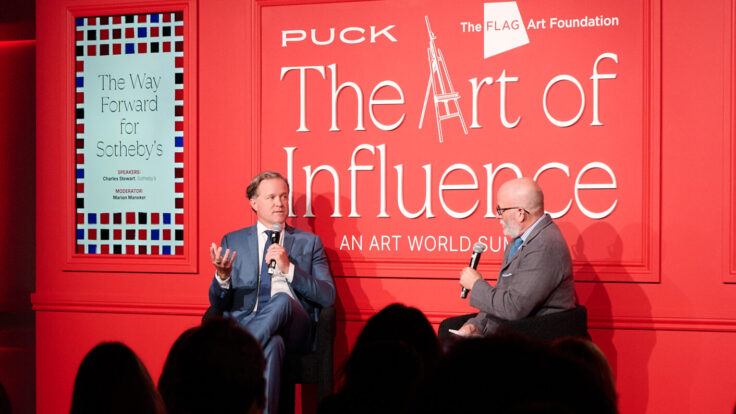
- Sotheby’s surprise $510 million sale: Moments after I hit send on Wednesday’s Inner Circle email, I got a note from Sotheby’s informing me that the company had made a deal to sell its York Avenue headquarters to Weill Cornell Medicine, the hospital next door. Sotheby’s C.E.O. Charlie Stewart called the deal “the logical and final step in our New York real estate transformation.” By that he meant that Sotheby’s has moved its back-office functions to Gantry
Point in Long Island City, and its front-of-house exhibition and auction space to the Breuer Building on Madison Avenue, the former home of the Whitney Museum. And since there is no permanent office space within the Breuer Building, Sotheby’s will retain a long-term lease on floors 7-10 of the York Avenue building, meaning most of Sotheby’s staff will remain working where they have been.
Bloomberg reported that the $510 million price tag exceeds the $484 million five-year mortgage
Sotheby’s took out on the building in 2020. Sotheby’s told Bloomberg that the proceeds of the sale would be used to pay down debt and renovate the leased office space that the auction house retains. For its part, Weill Cornell gets a real estate asset that expands its ability to provide clinical services at “materially the same net cost as leasing.” - Basquiat heads debut at Louisiana: This upcoming January, the Louisiana Museum, the contemporary art
museum outside of Copenhagen, will open Headstrong—Basquiat on Paper, a show of 45 works on paper by Jean-Michel Basquiat depicting human heads, a striking feature of the artist’s work. The show will be the first institutional survey to focus on the subject, with the works all coming from the artist’s prolific period of 1981-83. But if you caught the international Basquiat survey show, whether at the Fondation Louis Vuitton in Paris in 2018 or the Brant Foundation in New
York in 2019, you’ll remember a display devoted to the works on paper showing heads.
- Nigerian moderns come to Bonhams: One of the more exciting museum shows of the season is Nigerian Modernism, which opens October 8 at the Tate Modern in time for London’s Frieze week. This movement emerged in the decade before and after 1960, as Nigeria’s disparate ethnic groups combined into a colonial independence movement that “fused Nigerian, African, and
European techniques and traditions to create vibrant, multidimensional works.” On the same day, Bonhams will hold its Modern & Contemporary African Art sale containing works by some of the leading names of the movement, including Benedict Chukwukadibia Enwonwu, Uzo Egonu, and Clara Etso Ugbodaga-Ngu. From Enwonwu’s Africa Dances series, the auction house will sell Negritude,
estimated at £150,000. Egonu’s Coffee House at Bad Orb is estimated at £25,000, and Ugbodaga-Ngu’s The labourer’s song is
estimated at £100,000.
- African American moderns at Swann: Swann’s Nigel Freeman will soon kick off his semiannual sale of African American art, which features works by three members of the activist Spiral group: Norman Lewis, Hale
Woodruff, and Charles Henry Alston. Lewis’s nocturne painting Untitled (Exaltation), from 1951, is the most valuable piece in the sale, with an estimate of $700,000. But most of the works on offer come with much more modest estimates. Woodruff’s Primeval Image, from 1970, is
estimated at $120,000, and Lewis’s transitional work, The Dishwasher, from 1944, carries the same estimate. Alston’s Blue Haze, from 1959, a lyrical abstract
that mimics the conventions of a landscape, is estimated at $100,000. There are also two rare prints by Harlem Renaissance figure William H. Johnson, and works by Noah Purifoy, who has two paintings in the Whitney’s Sixties Surreal show (one of which was acquired at Swann) and a work by
Ebony G. Patterson. These kinds of five-figure works are Swann’s bread and butter, Freeman tells me, a reminder of the amount of art-buying activity taking place below $100,000 or $50,000. That buying seems to also be pointing to new collectors entering the market. “We’re seeing some generational change,” Freeman said.
|
Now, let’s get to the main event… |
|
|
An otherworldly new show by Gen Z surrealist Sasha Gordon, at David
Zwirner, offers all the elements for success: hypnotic new works, and a compelling personal narrative, that are on trend but entirely new. |
|
|
When I walked into David Zwirner’s gallery last Thursday night for
the opening of Sasha Gordon’s new show, Haze, I was struck by not only the size of the crowd, but also its intensity. “The opening was packed,” Marlene Zwirner, a senior director at the gallery, told me via email today. The combination of Zwirner’s regular audience and Gordon’s Instagram following and fans meant there was a line around the block to get into the gallery by 7 p.m. “We haven’t seen anything like this since our last Kusama
exhibition,” Zwirner said.
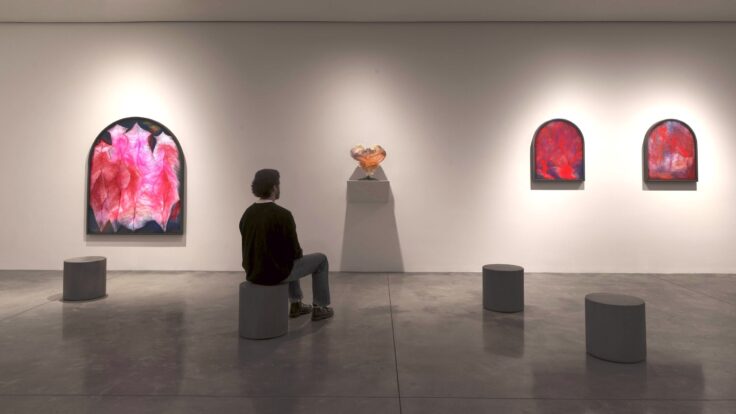
The excitement was justified. In the first gallery, where a small painting had been hung at eye level, onlookers were clustered four deep around the work. When I finally got close enough to get a good look, I was confronted by a painting that was both familiar and radically different from anything I had seen by the artist before. |
|
|
A MESSAGE FROM OUR SPONSOR |
Greatness isn't achieved in an instant. It's tested until there is no question — only performance.
|
|
|
The 27-year-old Gordon is known for her otherworldly paintings depicting herself in
various forms, often multiple figures (all her) in the same painting, engaged in a recondite narrative. The first work in the show reminded me of an image from a decades-old music video. Three faces are arrayed across the small canvas—one in profile, one in three-quarters view, the last facing the viewer directly but obscured by the other two figures. A spotlight illuminates the closely aligned eyes of all three figures. “People are drawn to her work like a magical phenomenon,” ICA Miami
director Alex Gartenfeld told me when I called him, hoping to get a handle on what makes Gordon’s work so appealing and confusing at the same time.
For his part, Gartenfeld recounted how excited visitors became when he escorted them through her first museum show, Surrogate Self, which he had mounted in December 2023, just three years after Gordon graduated from the Rhode Island School of Design. A year or two before that, Gartenfeld’s ICA Miami had been among the
first museums to acquire Gordon’s work.
Since then, more than a dozen museums have followed Gartenfeld’s lead. Gordon’s work was featured the next year in the Jewish Museum’s Overflow, Afterglow: New Work in Chromatic Figuration. She’s deeply wired into the heart of the collector community, too. Since 2021, Gordon has been represented by Matthew Brown, the breakout Los Angeles gallerist who expanded to New York and recently married Marlene,
David’s daughter. Zwirner and Brown now share in Gordon’s representation. |
The appeal of Sasha Gordon’s art traces a few of the shifting preoccupations of
collectors during the last several years. The daughter of a Korea-born mother and Polish-Jewish-American father, as one early profile described her parents, Gordon grew up in Somers, New York, an exurban town in the periphery of New York City. It wasn’t until Gordon got to RISD, where she found a diverse community of friends and professors, that she felt
liberated from the “dissociative” effects of her “heteronormative” environment. She describes feeling embarrassed by her mother’s vintage dresses and furs, wondering why she could not dress in jeans and a Michael Kors bag like the other moms. But judging from her art, the otherness of her upbringing had a more fundamental effect on the way she sees and processes the world as an artist.
As Gartenfeld sees it, Gordon’s entry into the art world coincided with two different trends:
She was a figurative painter right when collecting interest in figuration was hitting its stride, and an artist of Asian descent amid what Gartenfeld called an “incredible breakthrough” for AAPI artists over the past five years. Collectors’ interest in, and emphasis on, an artist’s identity has since waned, allowing a greater focus on the work itself. But Gordon, Gartenfeld told me, remains “deeply immersed in a peer group” of artists like Oscar Yi Hou and
Dominique Fung, among others who have different styles but are engaged in a common project—or, at least, a sustained conversation.
Perhaps most importantly, however, Gordon’s work has become even more relevant for its deeply surrealist vibe. Surrealism has become such a selling point these days that almost anything vaguely uncanny can be pitched as surreal, but Gordon’s work really does hit the key themes of an unconscious counternarrative to everyday life. Her
ability to update surrealism to be both more specific and more universal is a testimony to her imaginative vision. Her ICA Miami show featured images of her in various stages of morphological transition between the human and the natural world—imagery that called to mind the work of surrealist godmothers like Leonora Carrington. |
|
|
In Haze, the work is different but still focused on Gordon’s alter egos.
It Was Still Far Away, a painting from 2024, shows Gordon clipping her toenails, shoes removed, on a blanket in a bucolic landscape, with a large red mushroom explosion in the distance that evokes a plotline from disaster movies. This trope seems to echo in the blood-red, close-up image of Flame Like Blush, from 2024. There’s also Whores in the Attic, from 2024, in which Gordon seems to check in on three high-heeled but otherwise naked versions of herself—a work that
recalls both a Brassaï photograph and the famous image from Cafe Luxembourg on the Upper West Side.
Pruning, from 2025, and A Visitation, from the same year, continue this theme of walking in on a horror movie with
no narrative cues. The figure in Pruning is being held underwater by another figure standing behind her, but it’s impossible to tell whether she is being drowned or performing some kind of a magic trick. In A Visitation, Gordon’s doppelgänger stands above her lifeless body slumped in a chair. Again, the relation between the two figures is ambiguous, at best. A single knee-high stocking on the otherwise nude standing figure hints at a different interpretation entirely. |
Sasha Gordon, Husbandry Heaven (2025). Photo: Courtesy of David
Zwirner |
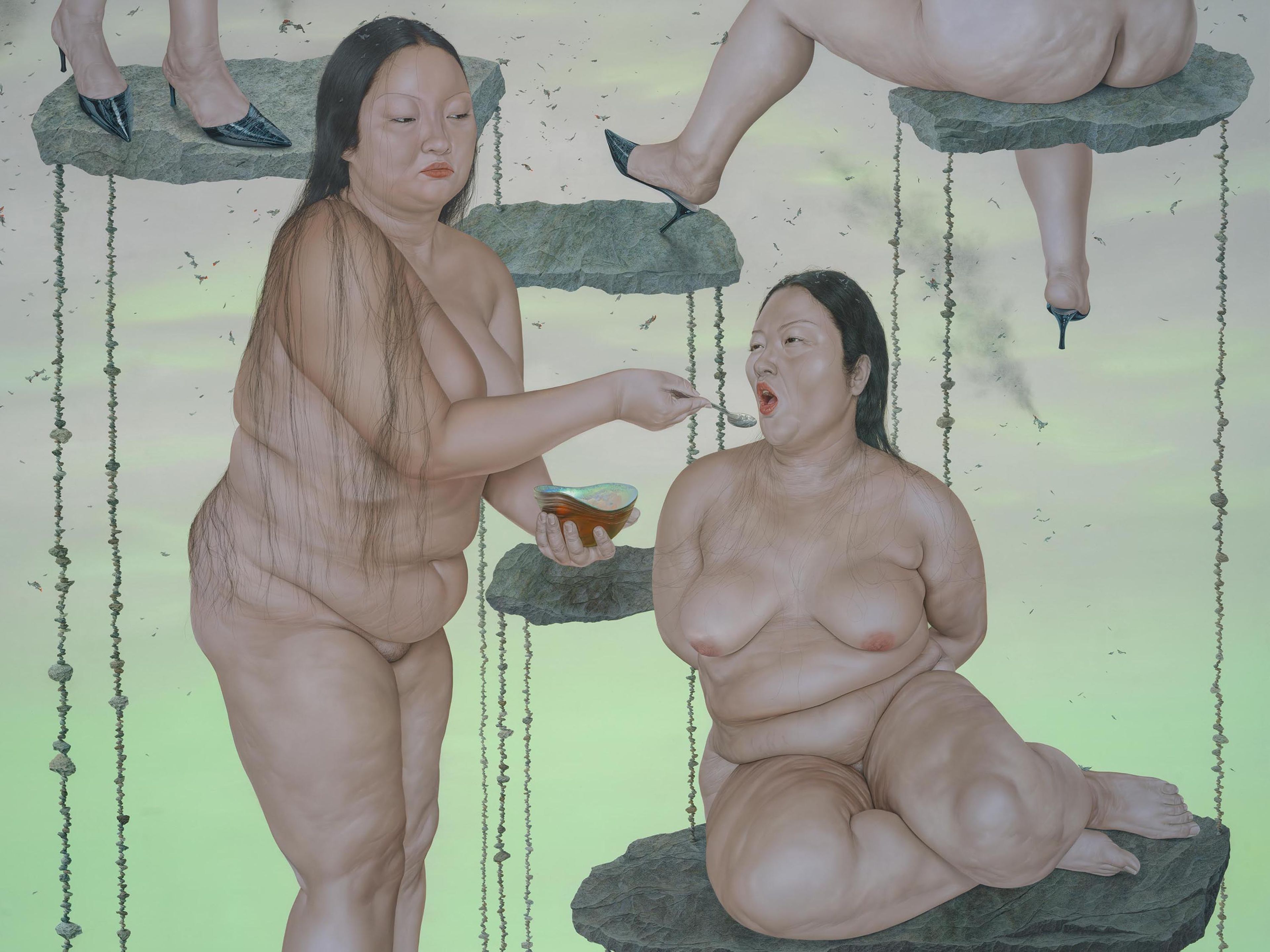
Finally, in Husbandry Heaven, from 2025, we can see the “delight and pleasure”
Gordon takes in “narrating through the details,” as Gartenfeld put it. It’s Gordon’s technical skill as a painter and attention to detail, especially “errant details,” Gartenfeld elaborated, that gives her work such “historical profundity.” Marlene Zwirner concurred. “Her technical skill is beyond anything I’ve ever seen,” she told me. “And in some cases, it can’t even be fully captured in photographs. You truly have to walk up and stand in front of the work to appreciate every bubble, strand of
hair, blade of grass, and more."
All of that is visible in Husbandry Heaven, which shows Gordon seated on rocks atop pillars of piled stones that cannot possibly support them, let alone the seated figures. Stray strands of hair fall down the front of two of the figure’s chests, while hands and flesh painted with Old Masterly authority and facial expressions that contain worlds all mark this painting as a masterpiece. But if you asked me what it was about, I couldn’t possibly tell
you. |
We’re going to have to leave it there. Hope everyone has good plans for the weekend. I’m
going to a pig roast in the Catskill Mountains. Will report back next week.
’Til soon,
M |
|
|
The ultimate fashion industry bible, offering incisive reportage on all aspects of the business and its biggest
players. Anchored by preeminent fashion journalist Lauren Sherman, Line Sheet also features veteran reporter Rachel Strugatz, who delivers unparalleled intel on what’s happening in the beauty industry, and Sarah Shapiro, a longtime retail strategist who writes about e-commerce, brick-and-mortar, D.T.C., and more. |
|
|
Finally, a media podcast about what’s actually happening in the media—not the oversanitized,
legal-and-standards-approved version you read online. Join Dylan Byers, Puck’s veteran media reporter, as he sits down with TV personalities, moguls, pundits, and industry executives for raw, honest, sometimes salacious conversations about the business of media and its biggest egos. New episodes publish every Tuesday and Friday. |
|
|
Need help? Review our FAQ page or contact us for assistance. For brand partnerships, email ads@puck.news. You received this email because you signed up to receive emails from Puck, or as part of your Puck account associated with {{customer.email}}. To stop receiving this newsletter and/or manage all your email preferences, click here. |
Puck is published by Heat Media LLC. 107 Greenwich St, New York, NY 10006
|
|
|
|