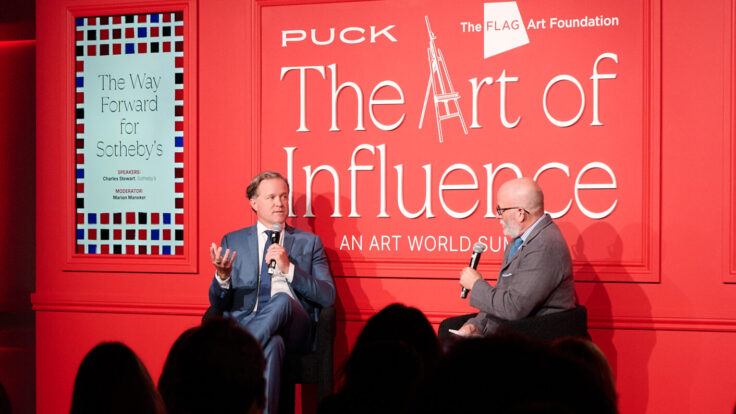
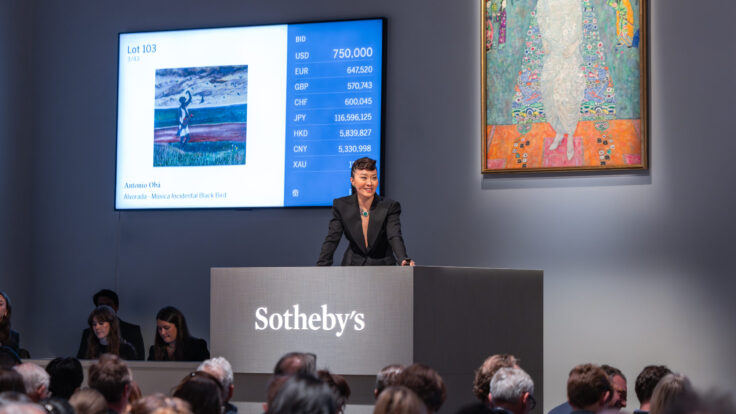
Welcome back to Wall Power. I’m Marion Maneker.
Tonight, Julie Davich is taking you to England to see five shows, all featuring female artists, that have opened in London and Leeds. Also, while I have you, just a reminder that if you’re receiving this email because a friend, colleague, or snarky client forwarded it to you, you might just want to sign up for yourself. That way you won’t get left behind.
|
|
|
|
A MESSAGE FROM OUR SPONSOR
|
A new campaign starring Julia Garner celebrates the House’s storied silk scarves and their enduring legacy within the House’s design codes.
DISCOVER MORE
|
|
|
 |
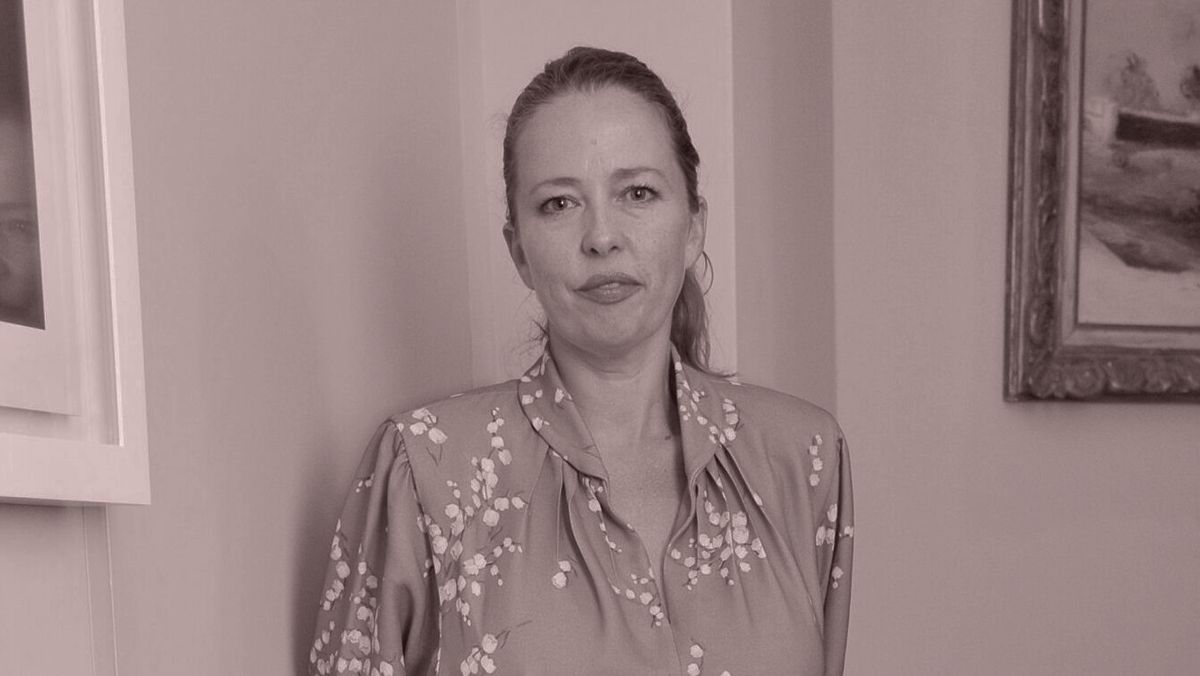
Julie Brener Davich |
|
- Remember her well, at the Chelsea Hotel: Last week, the Hotel Chelsea soft-launched its fourth and final dining concept, Teruko—a Japanese restaurant named for the late artist Teruko Yokoi, who lived and worked in a penthouse apartment at the hotel from 1958-1960 with her then-husband, the abstract expressionist painter Sam Francis, and their newborn daughter, Kayo. (This was before the gritty years documented in Patti Smith’s Just Kids, and well before the hotel’s Sid Vicious–era decline.)
BD Hotels, which bought the iconic Manhattan property in 2016, and reopened it in 2022, had long planned to open a Japanese restaurant in the barrel-vaulted underground space that used to be the Serena bar. For the revamp, the developers stayed true to the hotel’s legacy as a bohemian hangout for pretty much every major artist, writer, and musician in New York during the 1950s and 1960s, from Jackson Pollock to Bob Dylan to Dylan Thomas. So it makes sense that they would name the restaurant after Yokoi, who has two museums dedicated to her work in Japan.
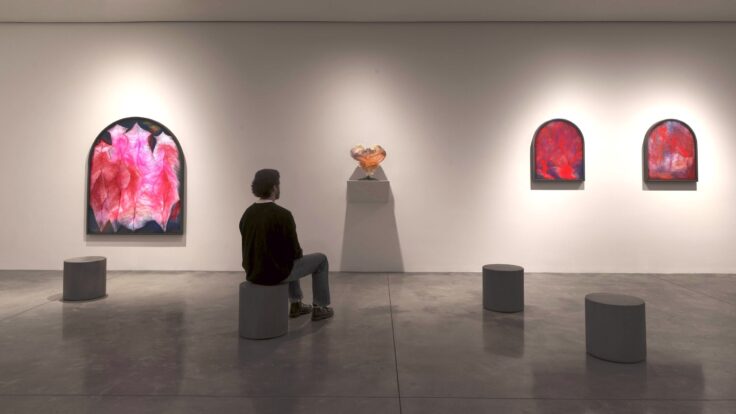
Adorning the restaurant’s blue fabric-paneled walls are eight paintings by Yokoi. They are typical of her abstract style, which merges east and west, and makes allusions to the natural environment, like snow, grass, flowers, trees, the night sky, and red poppies. Hotel Chelsea worked with Kayo and her son, Tai Francis Wallace, who together have run the artist’s estate since she died in 2020. The estate also collaborated with Hollis Taggart Gallery on a simultaneous exhibition of 20 works by Yokoi at its Chelsea location, on view for another couple of weeks.The dual openings are bringing much-deserved attention to Yokoi, who is less known in the United States. (After she left New York in 1960, she moved to Switzerland and never returned.) Marlborough Gallery staged the first solo presentation of her work in New York last year, two months before the gallery closed. The current exhibition at Hollis Taggart is anchored by her 1957 painting, Herbstlandschaft, which hints at her AbEx associations, while the focal point is her collage works from the 1980s and 2000s, which incorporate the mulberry washi paper used in tea ceremonies. “She wanted her works to be in places people hung out,” said Severin Delfs, director of development for Hollis Taggart. “She would have loved Teruko.”
- You’re gonna make it after all: On the wall of Mary Richards’ apartment on The Mary Tyler Moore Show was a prominent gold M, recognizable to any fans of the pioneering 1970s series. That M is on offer in a sale this week of about 300 items from the estate of Mary Tyler Moore at Doyle, including artwork; memorabilia like scripts, awards, and photographs; Tiffany and Cartier jewelry; and decorative objects like silver, Baccarat glassware, and Limoges porcelain. Most lots are estimated at a few hundred or a few thousand dollars. But, as always, the celebrity factor can’t be quantified—it adds emotional value for buyers that’s far beyond market value. The items are predominantly from the Greenwich, Connecticut, home that her widower, Robert Levine, sold this past March for $16.9 million. Moore has no other surviving heirs—she outlived both her siblings, and her son died tragically in a gun accident in 1980.
|
|
|
|
And now for the main event…
|
|
|
|
Jolly old England is getting a jolt this summer from five provocative shows featuring female artists whose works challenge conventional notions of beauty and put womanhood on full display in all its unidealized glory.
|
|
|
|
The summer season in England is upon us, with Royal Ascot, Wimbledon, and the Henley Royal Regatta interspersed with opportunities to enjoy a bit of higher art. Indeed, if you’re in the country and looking for a break from competitive athletics and equally competitive day-drinking, there are five shows well worth considering—all featuring female artists whose works defy conventional beauty in favor of rawness.
The National Portrait Gallery, off Trafalgar Square, is mounting a comprehensive show of 45 paintings by English painter Jenny Saville. The Courtauld Institute of Art has brought together works by Louise Bourgeois, Eva Hesse, and Alice Adams in an exhibition called Abstract Erotic. Across town, the Barbican is launching a three-part series of intimate exhibitions pairing Giacometti sculptures with works by contemporary artists, starting with Huma Bhabha. And far north, in Yorkshire, The Hepworth Wakefield has a show of paintings by market darling Caroline Walker and a retrospective of the visceral works of the late Helen Chadwick.
|
|
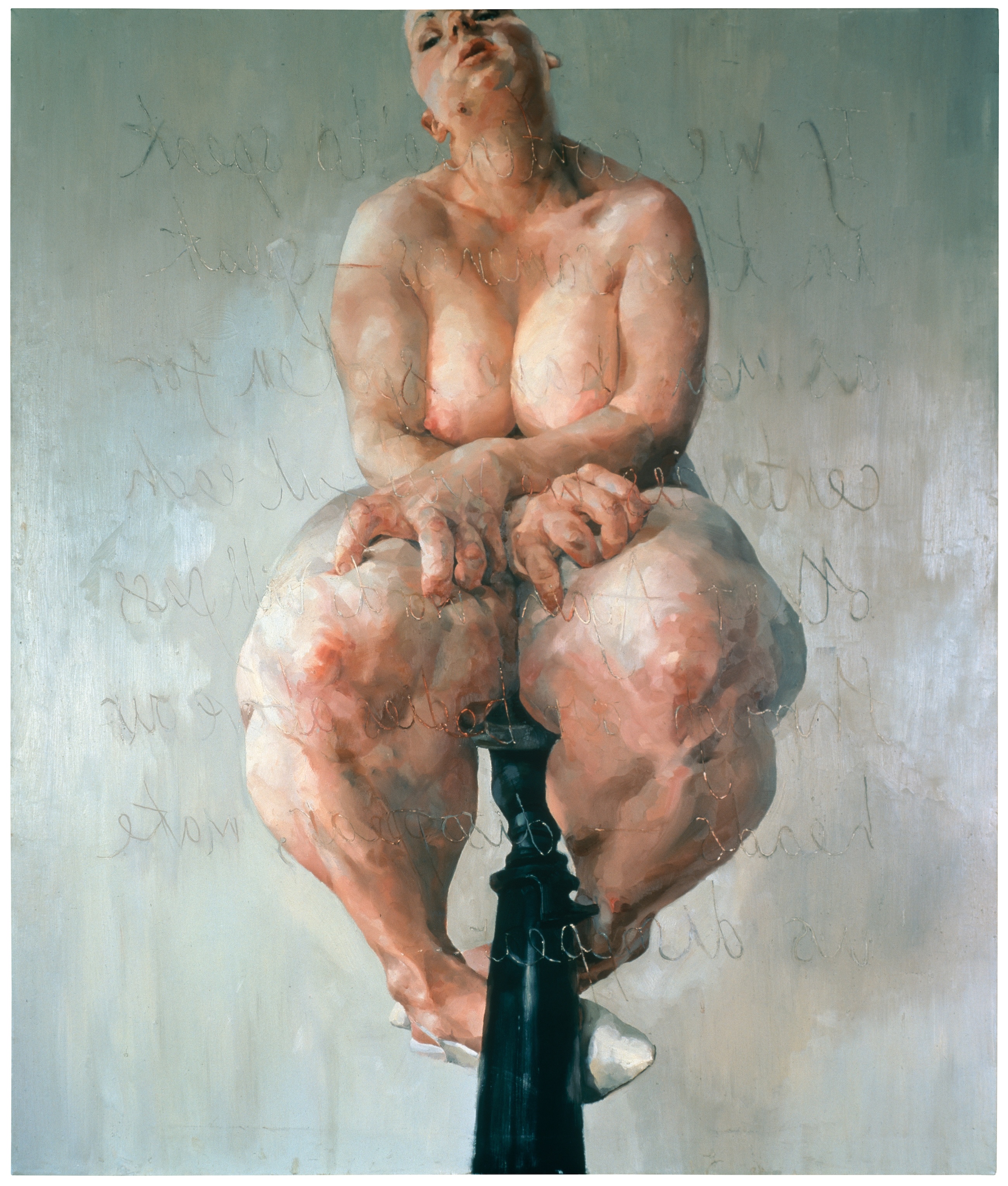
Jenny Saville, Propped (1992). Photo: Courtesy of Gagosian Gallery
|
|
The current frontrunner for London’s show of the summer is the Saville exhibition, opening June 20. Saville’s subject, at its core, is flesh. In a painterly style that invites comparisons to Gustave Courbet and Lucian Freud, she questions accepted notions of idealized female beauty. The show starts with her breakthrough 1992 painting, Propped, a self-portrait that is all breasts and thighs, sitting nude atop what appears to be a bedpost. At 7-feet-tall, it’s “both monumental and intimate,” said Tom Eddison, head of contemporary art at Sotheby’s London.
|
|
|
|
A MESSAGE FROM OUR SPONSOR
|
A new campaign starring Julia Garner celebrates the House’s storied silk scarves and their enduring legacy within the House’s design codes.
DISCOVER MORE
|
|
|
|
When the painting appeared on the cover of the Times Saturday Review in 1992, it brought Saville international acclaim, and the attention of Charles Saatchi, who bought as many of her paintings as he could. That led to her inclusion in the infamous 1997 exhibition Sensation, where Larry Gagosian scooped her up and has represented her ever since. In 2018, Propped sold at Sotheby’s for a record-setting £9.5 million.
The show is the largest of Saville’s work ever in her home country, and it’s somewhat surprising that it’s happening at the staid National Portrait Gallery. The exhibition was conceived during the leadership of Nicholas Cullinan, but came to fruition under Victoria Siddall, the institution’s first female director. Tracing the arc of Saville’s 40-year career, the show ranges from her small charcoal drawings, focusing on pregnancy and motherhood, to monumental oil paintings, including her most recent, more colorful series of heads that explore the idea of the physical in the digital age. In October, the show will travel to the Modern Art Museum of Fort Worth.
|
|
Walk about 15 minutes east on the Strand, past the Savoy, and you’ll find yourself at the Courtauld. Opening there, also on June 20, is an exhibition that brings together sculptures by Bourgeois, Hesse, and Adams for the first time since the 1966 group exhibition Eccentric Abstraction at Fischbach Gallery in New York.
Their works share a similar aesthetic, utilizing humor and materials like latex, foam, and string to create sculptures that are subtly erotic. Hesse died in 1970 at age 34, and Bourgeois died in 2010 at age 98; Adams, who is significantly lesser-known than her counterparts, is still alive at age 94. She studied tapestry-making, a background evident in works like Sheath (1964), made from linen cord and included in the Whitney’s 2019 craft exhibition, as well as Threaded Drain Plate (1964). Coinciding with the group show is a presentation of Bourgeois’ drawings from the 1960s.
|
|
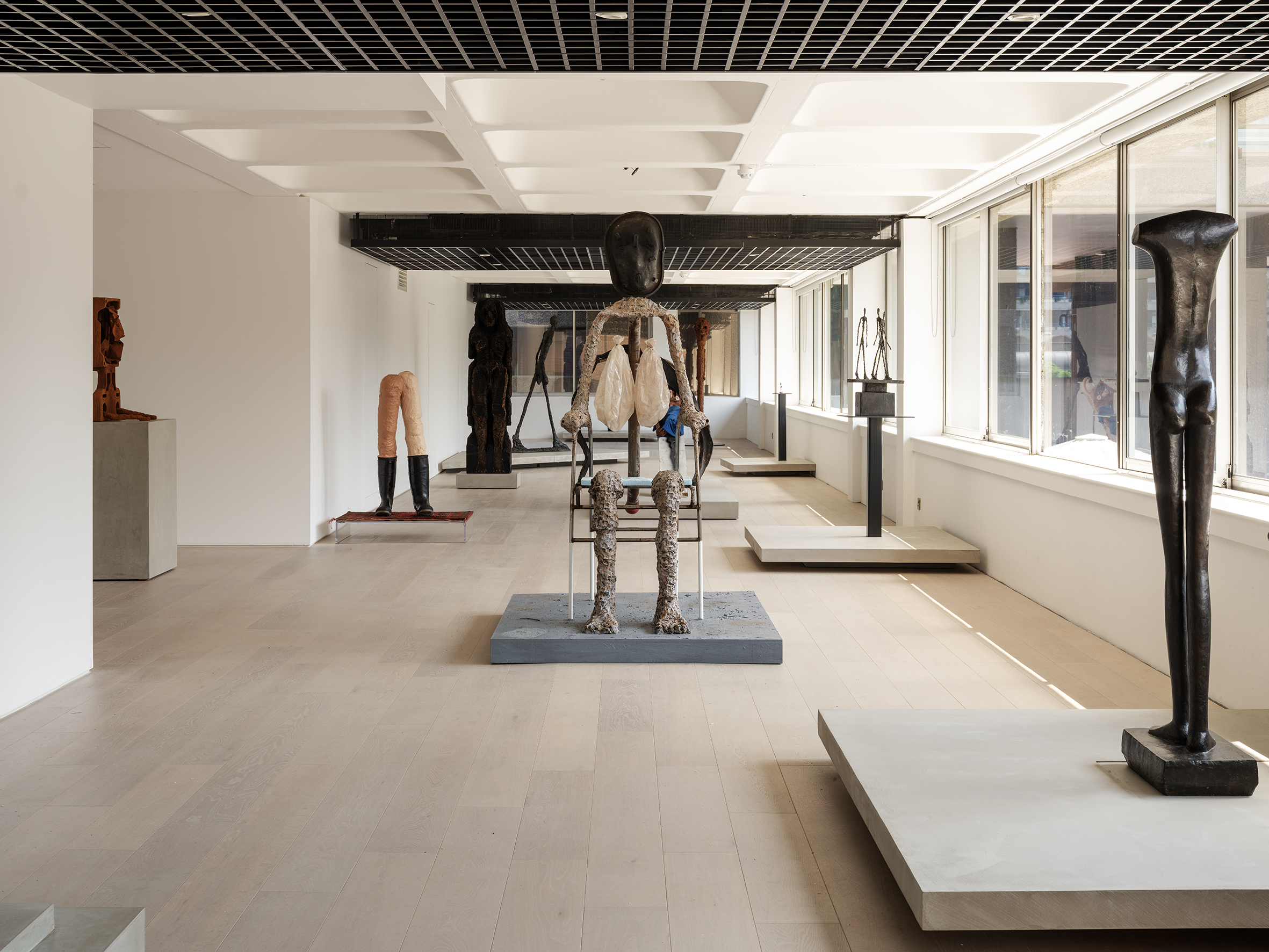
Installation view of Encounters: Giacometti x Huma Bhabha (2025), Barbican Centre, London. Photo: Max Creasy/Barbican Art Gallery
|
|
Over at the Barbican Centre is the first in a three-part, yearlong series of exhibitions of contemporary female artists paired with works by Alberto Giacometti, organized in partnership with Fondation Giacometti and staged in a new, intimate gallery space. The first artist is Huma Bhabha, on view through August 10, followed by Mona Hatoum in the fall, then Lynda Benglis in the new year.
Giacometti’s bronze sculptures evoke the sense of ruin and devastation in post-World War II Europe. Bhabha, a Pakistan-born artist, creates figures that similarly convey a sense of global violence as perpetrated on the body, through roughly worked materials like bronze and plaster paired with found objects.
|
|
|
|
The Barbican show features eight sculptures by Giacometti and 14 by Bhabha, courtesy of David Zwirner (who has repped her since 2022) and David Kordansky Gallery, or otherwise loaned from the Kiran Nadar Museum of Art in New Delhi. The most illustrative pairing is the Swiss sculptor’s Standing Woman (1957) and Bhabha’s fragmented seated figure, Mask of Dimitrios (2019), with textured clay legs that closely resemble Giacometti’s, a spine made from a metal pipe, and deflated plastic bags for either breasts or lungs.
|
|
Installation view of Caroline Walker: Mothering (2025), The Hepworth Wakefield, England. Photo: Michael Pollard/Courtesy of Grimm Gallery
|
|
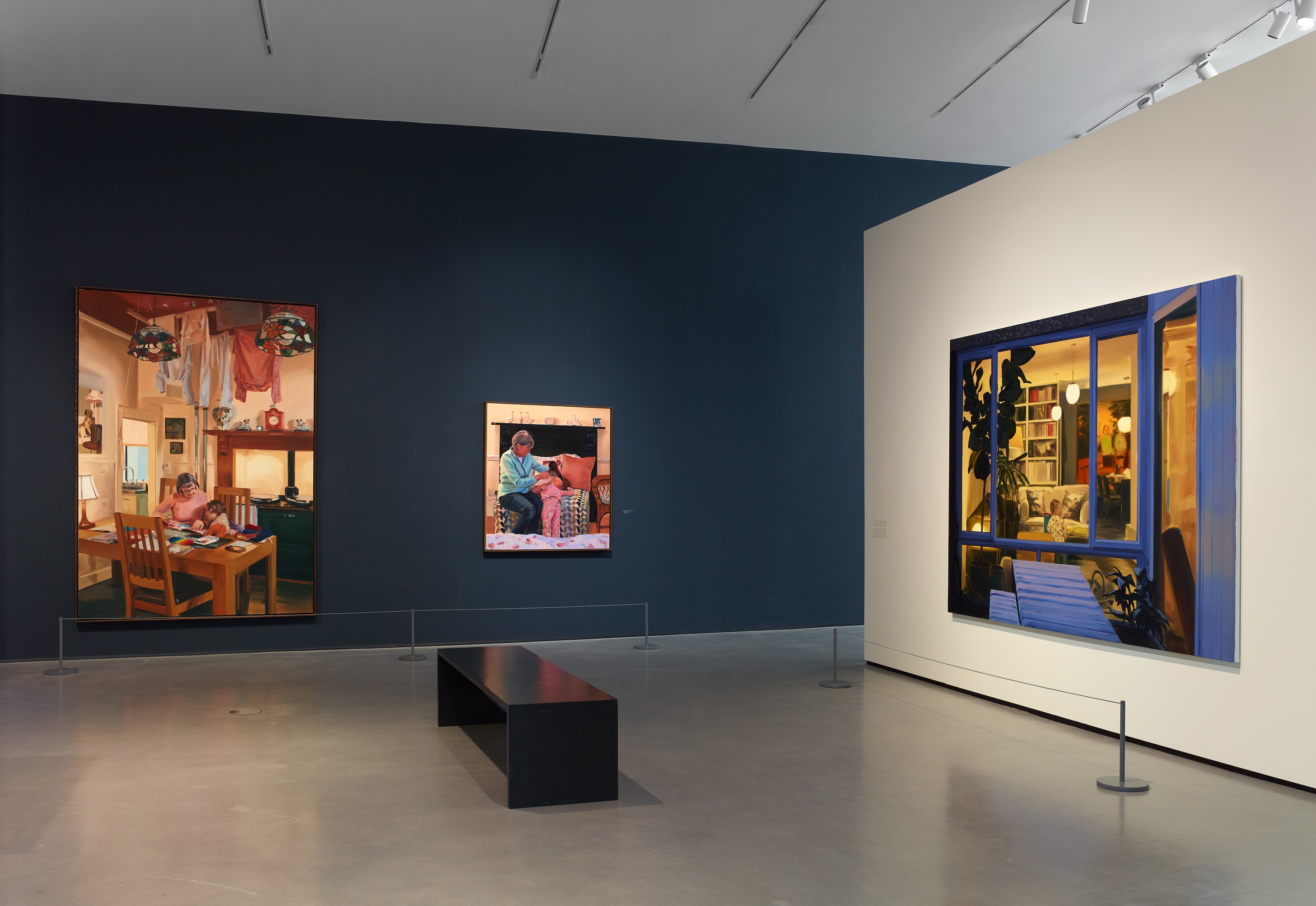
Finally, for those headed north, there is The Hepworth Wakefield museum, named for hometown hero Barbara Hepworth, located on the outskirts of Leeds, about a four-hour drive north of London. Currently on view is a small exhibition, Mothering, of paintings by Scottish artist Caroline Walker, who just had a sold-out show at Grimm Gallery in New York. Created over the past five years, the paintings depict the strain of contemporary childcare—not just on mothers, but also babysitters, nurses, and teachers. In her compositions, Walker elevates their overlooked labor, like the comforting of a baby in the middle of the night, and the trappings of domesticity, like laundry. She often backgrounds her subjects to highlight how truly unseen their contributions are, like the view through the window in Daphne (2021).
The Hepworth Wakefield is also showing the first retrospective in 25 years of British artist Helen Chadwick, who died in 1996 at age 42. Her challenging depictions and grotesque materials, like sausages intertwined with blonde locks of hair in Loop My Loop (1991-92), fit squarely in the trajectory from Hesse to Bhabha. All of it ensures that this will be the most graphic, carnal summer that proper ol’ England has seen in ages.
|
|
That’s all for today folks. Let’s gather here again on Tuesday.
M
|
|
|
|
The ultimate fashion industry bible, offering incisive reportage on all aspects of the business and its biggest players. Anchored by preeminent fashion journalist Lauren Sherman, Line Sheet also features veteran reporter Rachel Strugatz, who delivers unparalleled intel on what’s happening in the beauty industry, and Sarah Shapiro, a longtime retail strategist who writes about e-commerce, brick-and-mortar, D.T.C., and more.
|
|
|
|
Finally, a media podcast about what’s actually happening in the media—not the oversanitized, legal-and-standards-approved version you read online. Join Dylan Byers, Puck’s veteran media reporter, as he sits down with TV personalities, moguls, pundits, and industry executives for raw, honest, sometimes salacious conversations about the business of media and its biggest egos. New episodes publish every Tuesday and Friday.
|
|
|
Need help? Review our FAQ page or contact us for assistance. For brand partnerships, email ads@puck.news.
You received this email because you signed up to receive emails from Puck, or as part of your Puck account associated with . To stop receiving this newsletter and/or manage all your email preferences, click here.
|
|
Puck is published by Heat Media LLC. 107 Greenwich St, New York, NY 10006
|
|
|
|