{{ 'now' | timezone: 'America/New_York' | date: '%b %d, %Y' }} |
|
|
Hi, and welcome back to Line Sheet. We are in it! If someone says, “Don’t hug me, I have the
sniffles,” definitely listen to them. I’ve got a report from the first spate of Paris shows, plus some thoughts on Virgil Abloh: The Codes, the first major exhibition from the Virgil Abloh Archive, a collection of 20,000 objects that tell the story of his life and pop culture more broadly over the past 25 years. For the main event, we’re taking a break from capital-F Fashion to give retail correspondent Sarah “SShapiro@puck.news” Shapiro a chance to answer some of your existential questions.
And don’t forget, this is the last week that you can take advantage of Puck’s four-year anniversary special. (We rarely go on sale because the demand is greater than the supply, but once a year we like to provide a little treat.) You can subscribe here, or upgrade to the Inner Circle here. (This Thursday’s I.C. topic will most likely start with a D and end with an R.)
Mentioned in this issue: Virgil Abloh, Robin Givhan, Off-White, Colette, LVMH, Selfridges, Harrods, Hollister, Abercrombie, Saint Laurent, Anthony Vaccarello, Francesca Bellettini, pussy bow blouses, Peter
Copping, Lanvin, Dries Van Noten, Julian Klausner, Travis Scott, and many more… |
|
|
Two Things You Should Know…
|
- Paris,
here we go: Every single fashion week, I ask myself the same question: What do women want from this industry? What does anyone want from this industry? The answer is consequential. Fashion is no longer at the center of the culture as it was even three or four years ago, and designers and executives must now figure out what role it plays in the lives of those who consume it.
One designer who seems to have some answers is Saint Laurent’s Anthony Vaccarello.
When he first joined the business nearly a decade ago, his then-C.E.O., Francesca Bellettini, liked using the phrase “evolution, not revolution” to describe his brief. In the end, the evolution did become a revolution, albeit gradually, as Vaccarello leaned into the grandness of the house and its history.
|
Photos: Antoine Flament/Getty Images |
- Is there
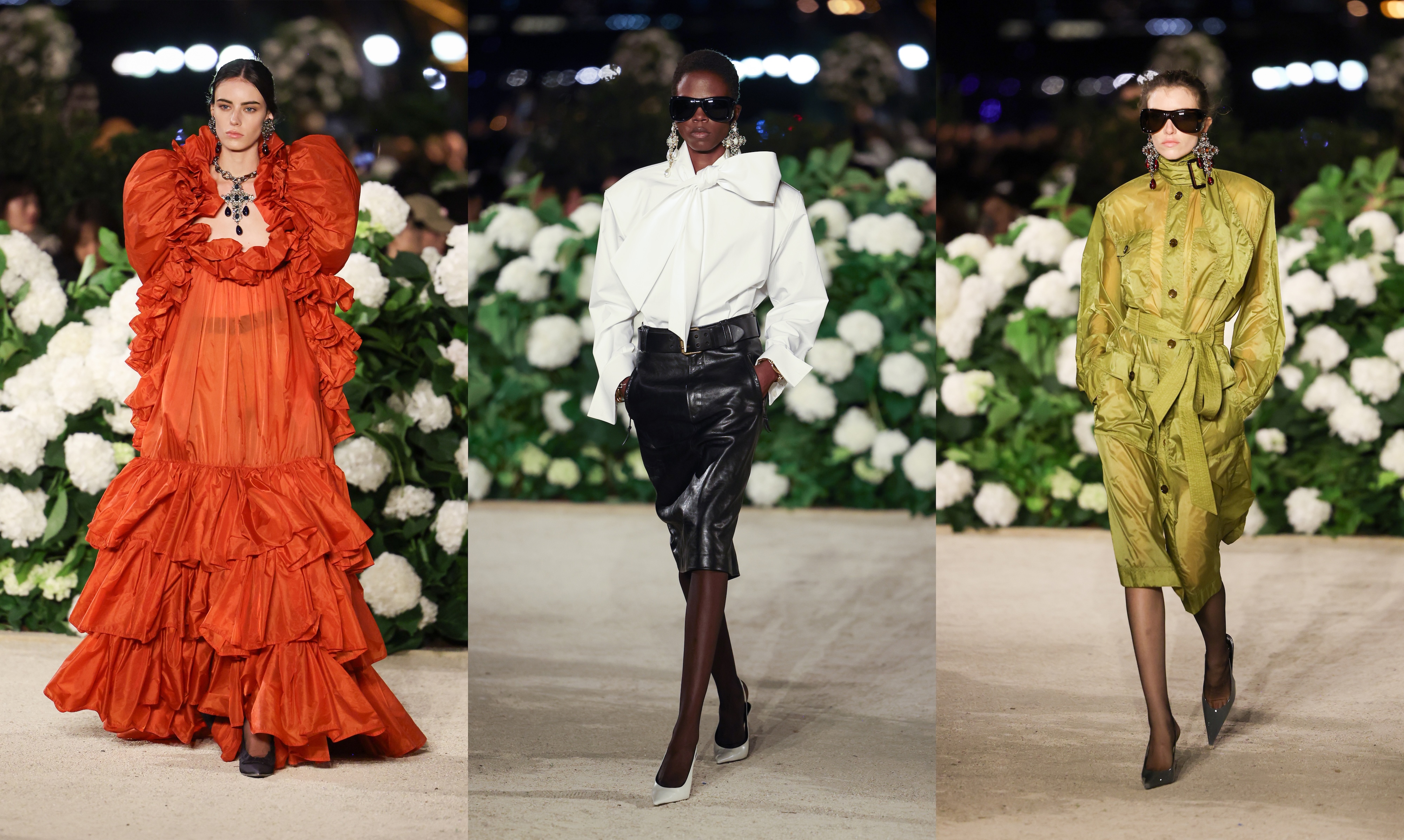
anything more Parisian than Saint Laurent? It didn’t feel that way on Monday night, as larger-than-life models paraded through a garden maze with the Eiffel Tower glittering in the background. Each season, Vaccarello creates a real, definitive look; he wants the fantasy and the reality to be one and the same. I’m not sure there’s another designer who achieves that so consistently. The white pussy bow blouses will be the defining piece in stores next season, worn with a requisite black leather
jacket, but I was most impressed by the tissue-thin nylon dresses that skimmed the body in all those rich, sensual colors. It’s the kind of stuff you just don’t see on a runway these days—pure fashion, zero trickery—and yet, it’s become a go-to for a certain set of wealthy women who love getting dressed up and are still paying full price. There was something final about this collection, a feeling that Vaccarello had closed a chapter. Perhaps he’s ready for another revolution.
|
Photos: Victor Virgile/Gamma-Rapho/Getty Images |
- Peter
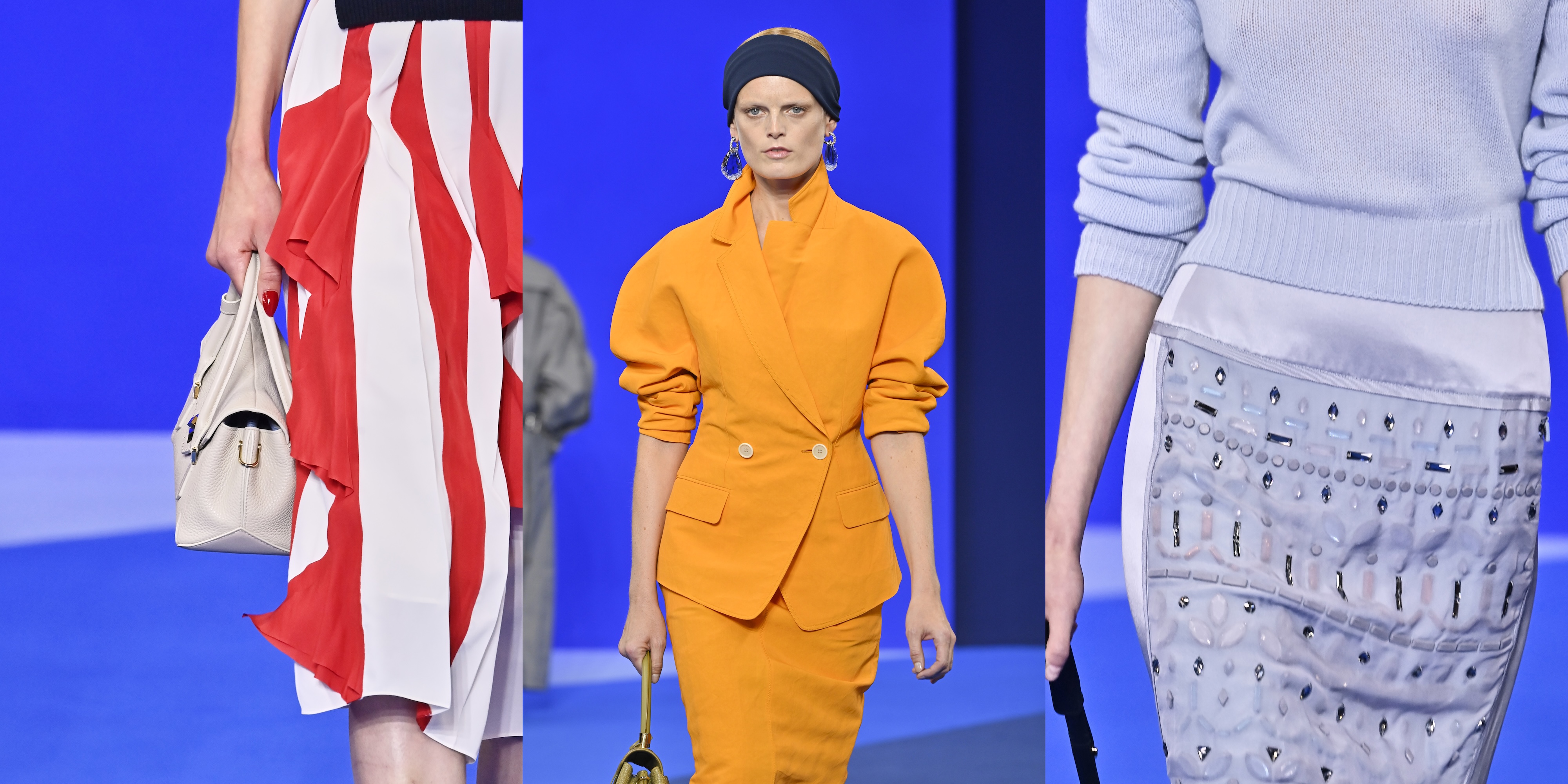
Copping’s second collection for Lanvin once again reminded everyone of what beautiful clothes he can make. And yet, Lanvin, owned by the Fosun-backed Lanvin Group, which has become something of a penny stock since its Covid-era I.P.O., is heavy with history these days. Backstage, Copping mentioned looking at dresses designed by Geoffrey Beene, where longtime Lanvin creative director Alber Elbaz once worked. He has the right idea, and the cocktail-hour collection—all the
beaded pieces, the dress rendered in the newly conceived shade of Lanvin blue, and even the marigold-colored, double-breasted skirt suit—has a place on the shop floor. Let’s hope retailers make room.
|
Photo: Victor Virgile/Gamma-Rapho/Getty Images |
- As we
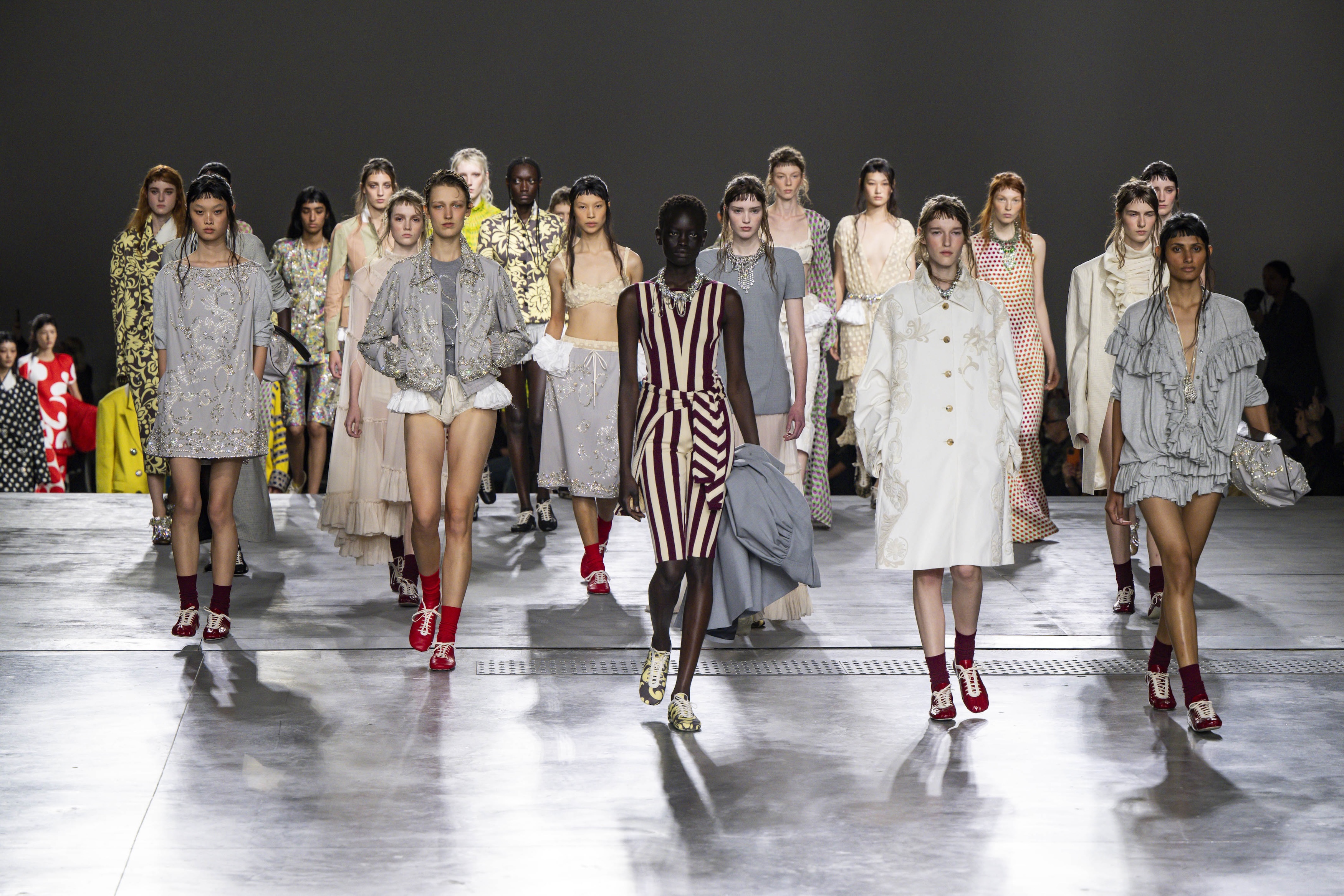
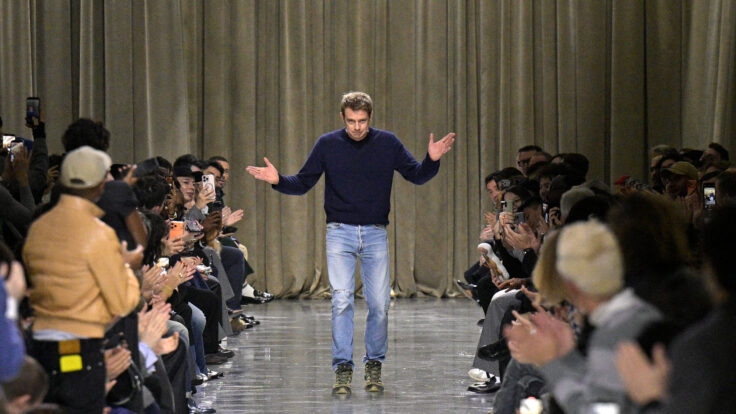
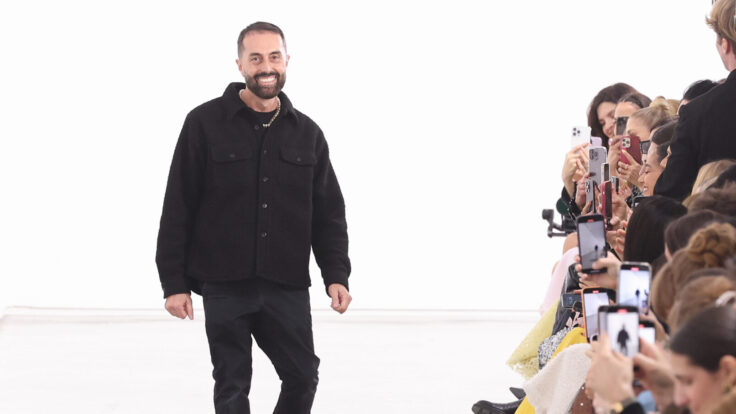
are witnessing this fashion month, amid more than a dozen designer runway debuts, transitions are hard and unpredictable. It’s been fascinating to watch the gentle handover of Dries Van Noten to Julian Klausner. Dries was at the show today, which was staged in the blank space of the Palais du Tokyo, quietly conversing with friends—no pomp or circumstance. He was there to support, not to distract. Klausner, for his part, has become confident fast. I
managed to catch the menswear show in June, where people left shaking with joy. They cried. I thought this was an equally determined collection, if not more so, delivered with an arresting Philip Glass score playing in the background. (A soundtrack can really spur emotion in films, but also on runways.) What differentiates Klausner from Van Noten, himself, is something deeper than their shared sense of color or print or material. It’s his life view. There’s a steampunk
thing bubbling up in fashion right now that’s coming hard for us, and Klausner tapped into it today in the jacket silhouettes and all the ruffles. The grey jersey, the psychedelic prints, and the gems all felt very Dries. But only Klausner would have seen them like that.
|
- The
codes of Virgil Abloh: The meaning of Virgil Abloh’s legacy is only starting to be considered, nearly four years after his death from a rare form of cancer at 41. Robin Givhan’s book, Make It Ours, released this summer, started the conversation. But Givhan was an outsider to Abloh’s world: She covered him at arm’s length when he was alive, and took a near-academic approach to analyzing his influence on the culture. Everything about Abloh was very
personal; he was a walking DM. So it’s fitting that the next phase of this movement should be from the people who knew him best: those behind the Virgil Abloh Archive, a collection of 20,000 objects that tell the story of his life, including his personal clothes, his furniture, his art, his sneakers, and the things he designed from prototype up to finished piece.
About 5 percent of that collection is on display at the Grand Palais through October 9. (You can buy tickets
here.) This is the first of what is destined to be many exhibitions dedicated to his life and work, staged by Virgil Abloh Securities founder and C.E.O. Shannon Abloh, the designer’s wife, in collaboration with the archive’s directors and the exhibition’s curators, Chloe and Mahfuz Sultan, with support from his longtime right hand, Athiththan
Selvendran. The gift shop is a revival of Colette, which founder (and concept shop savant) Sarah Andelman populated with new and revived pieces from Cactus Plant Flea Market, Stray Rats, and Travis Scott, among a handful of other Friends of V.A. (I bought my son a t-shirt, and my husband the reissue of Abloh’s take on the Braun BC02 alarm clock.)
If you’re in Paris, I do think you should go see it, whether or not you connected with Abloh’s work.
For me, Abloh wasn’t about the end result. He was about the process—his desire to just put a lot of stuff out into the world, whether it was perfect or not. It’s a very American, entrepreneurial way of doing things, and so reflective of our time. There will be a series of happenings, let’s call them, over the next 10 days, some conceived in collaboration with GQ, which is smartly serving as a sort of unofficial-official media partner on this—including a party at LVMH’s canteen,
L’Avenue, on Tuesday night.
It’s worth noting that the exhibition is not sponsored by Louis Vuitton, where Abloh designed the menswear collection for many years, or Off-White, the company he founded that is now owned by Bluestar Alliance after LVMH discarded it last year. Perhaps it’s fitting that they weren’t involved with this one. What Abloh’s history shows is that the most important thing to him was to keep propelling forward.
|
|
|
A punchy guide to all your burning retail questions: the curious crowd sizes at U.K.
department stores, the explanation for the booming kids’ retail market, why seasonless resort-style wear has taken over runways, and much more. |
|
|
Over the past few weeks, I asked Line Sheet readers to send me their most burning questions about this
particularly challenging moment for the retail landscape. Between shifting consumer habits and tariff anxieties, it seems like everyone—from shoppers to brands to department stores—is looking for signs about when the current malaise will end. |
|
|
With Lauren in Europe, covering the runways in Milan and Paris, this seemed like a perfect window to crack open the always-overflowing Line Sheet mailbag to answer your burning questions. We’ll do this again soon, but in today’s issue, I throw some data behind one reader’s poignant observation that U.K. high street department stores seem to be
bustling, while the same can’t be said of their U.S. counterparts. I’ll also tackle similar conundrums: what’s behind the rising trend of seasonless fashion; when it’s prudent to buy something new versus hunt for the item via resale; and more. Let’s get started… |
U.K.
Tourists & Booming Foot Traffic
|
I keep hearing that department stores are dying, but when I was overseas this summer, I witnessed
packed floors at Harrods and Selfridges in London. Why is that?
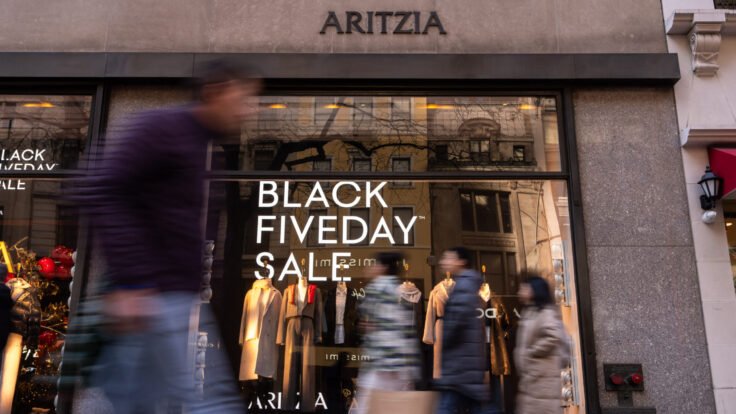
There are likely a few reasons, but your observation of bustling crowds at London’s flagship department stores actually runs counter to broader U.K. retail trends. Based on a British Retail Consortium survey, overall U.K. retail foot traffic has been
declining—down 1.8 percent in June 2025 versus the previous year—with high street stores down 3 percent. Similar to the U.S., European retail is struggling with shifting consumer habits and economic headwinds, and inflation lingering as a top concern for consumers, according to a recent McKinsey
survey on European shoppers.
But there’s a silver lining for U.K. department stores. Unlike similar stores in North America, businesses like
Selfridges and Harrods promote experiential retail and function as tourism magnets, even if they’re not what they used to be. Also, European department stores benefit from dense urban centers with strong public transportation in walkable cities. Meanwhile, many American department stores are stuck in antiquated malls, and compete primarily on convenience rather than experience.
I’d love your P.O.V. on the kids’ market category.
According to Future Market Insights,
the global kids apparel market is set to nearly double from $228 billion in 2025 to $420 billion by 2035. There’s a few reasons for this—not least because, obviously, kids keep growing, and a given year’s winter coat is lucky to last a season. Right now, the market is hottest in the Asia-Pacific region, where casualwear and girls’ segments are seeing a lot of
action. And a recent study found that Gen Alpha shopping behaviors represented $28 billion in direct spending power in 2024.
You can see this influence whenever you step onto a schoolyard, with select brands popping up everywhere. Every tween and teen girl from Virginia to New York to California seemed to own at least one White Fox sweatshirt, and my
local elementary school copied the aesthetic for its school spirit wear. Dandy road-trip pop-ups also seem ubiquitous these days, and certain incumbents, like Hollister, are performing well: The company just had its second-best quarter ever, with 19 percent growth spurred by back-to-school shopping and nailing the trendy babydoll tops and denim
skirts. |
|
|
But the real opportunity isn’t just in the replacement cycle—it’s about brands keeping mindshare with kids as
they grow. Hollister’s tweens and teens would ideally move on to Abercrombie—their net sales were down 5 percent, but that was on 26 percent growth from the previous year—which keeps customers and sales in the Abercrombie & Fitch parentco family. As always, moving fast matters, but longevity is more important. |
Runway Mysteries & The Resale
Calculus
|
I’m very curious about the proliferation of seasonless, resort-style pieces on runways, instead of
true seasonal collections. Why is it suddenly so hard to tell what season it is when I look at a collection? There are coats available on the spring runways, etcetera.
This is mostly about how we actually shop and wear clothes now. During the D.T.C. boom, companies relied heavily on their own retail and e-commerce channels, which pushed brands toward “buy now, wear now.” This includes wholesale-heavy brands, which are investing
in pieces that work for global consumers across different climates.
In short, there’s just not the same pressure to buy your winter coat in August across the U.S. like there was 20 years ago. People want versatile pieces they can layer and wear in multiple ways, and weather patterns have gotten unpredictable enough that rigid seasonal dressing feels outdated. Brands are responding to real consumer behavior.
How do you decide whether to buy something new or hunt for the
same item via resale?
I love the psychology behind this decision. For me, if I can find the item resale and trust the source—meaning it’s verified authentic or from a good reseller—I go for it! As I reported earlier this month, we’re in the middle of a resale boom, which Lauren and I discussed during our recent
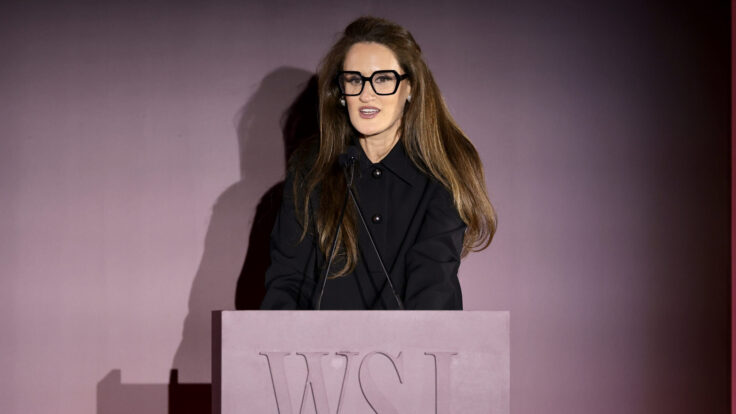
WSA chat with The RealReal’s Kristen Naiman, Marisa Meltzer, and Erika Veurink.
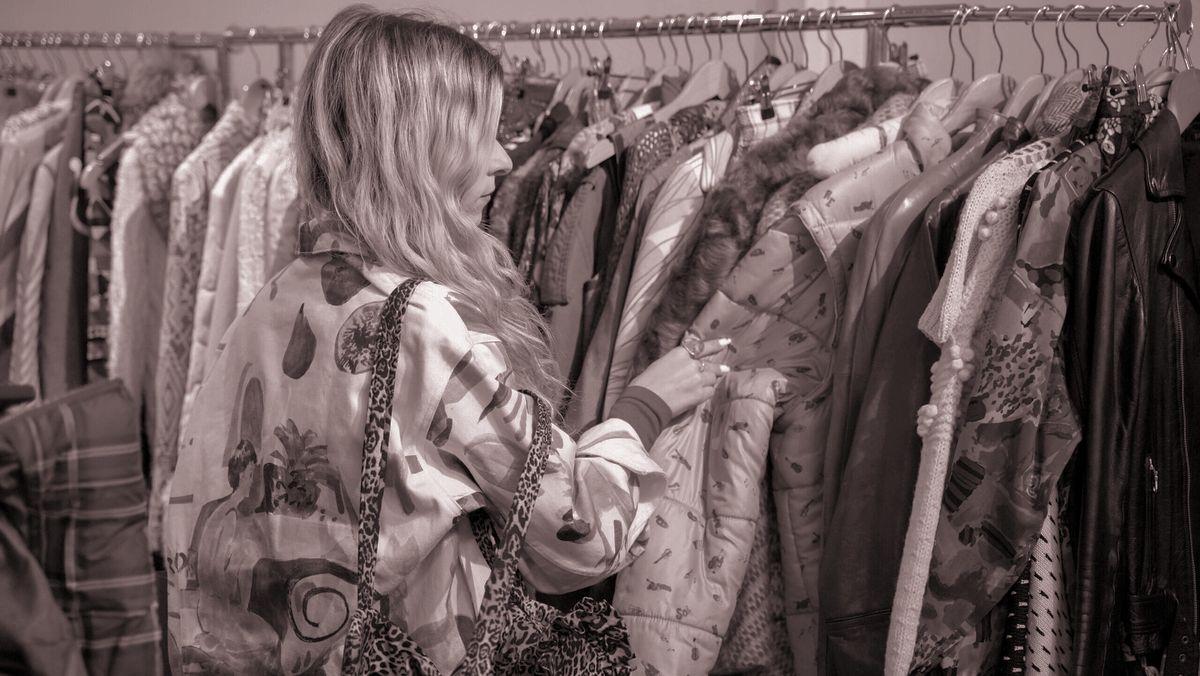
But I also genuinely love the hunt, even if it’s just searching through online listings. There’s something more exciting about scoring a gently worn piece in great condition than buying something brand new, and there’s also less pressure to keep it
pristine. As for pricing, I’ll compare other resale prices for that brand and check the percentage off retail. But honestly, it often comes down to how much I want the item—where I personally place its value—and whether I’m ready to finally pull the trigger. |
Emilie Meinadier, who manages European runway show ticket requests for me, you, and everyone
we know, is no longer a secret. [WWD]
Ralph Lauren is opening a Polo Bar in London. Sure, there’s nothing like the original, but this is certainly a replicable product. [Inbox]
I would have had Gwyneth Paltrow and Apple Martin do a full-on campaign for Gap, not only Gap Studio,
but that’s just me. [Adweek]
Do consumers care about who is designing their clothes? Intrepid reporter Emilia Petrarca asks them. [NYT]
The Prada Group
received E.U. approval for its Versace acquisition. It’s likely to close by the end of October. [Reuters]
My friends Mattie Kahn and Sierra Tishgart started a naming agency. Collectively, they’ve already named “startups, resorts, some of ‘the internet’s favorite’ products, V.C. funds, foundations,
developments, streets, and one entire metropolitan district.” What! “We’ll be naming companies, hero products, diffusion lines, colors, It bags, prestige T.V. shows, buildings, restaurants, books, hotels, and secret projects,” Mattie said. “If it’s a thing or being that needs to be christened, we’re available to name it. We are mostly doing this because we think it will be fun.” If you hire them, I want credit. [Big Name] |
Until tomorrow,
Lauren
P.S.: We use affiliate links because we are a business. We may make
a couple bucks off them. |
|
|
Puck fashion correspondent Lauren Sherman and a rotating cast of industry insiders take you deep behind the scenes of this
multitrillion-dollar biz, from creative director switcheroos to M&A drama, D.T.C. downfalls, and magazine mishaps. Fashion People is an extension of Line Sheet, Lauren’s private email for Puck, where she tracks what’s happening beyond the press releases in fashion, beauty, and media. New episodes publish every Tuesday and Friday. |
|
|
Puck’s daily art market email, anchored by industry expert Marion Maneker, offers unparalleled access to the mega-auctions and
galleries, elite buyers and sellers, and the power players who run this opaque world. Wall Power also features Julie Brener Davich, a veteran of Christie’s and Sotheby’s, who provides unique insights into how the business really works. |
|
|
Need help? Review our FAQ page or contact us for assistance. For brand partnerships, email ads@puck.news. You received this email because you signed up to receive emails from Puck, or as part of your Puck account associated with {{customer.email}}. To stop receiving this newsletter and/or manage all your email preferences, click here. |
Puck is published by Heat Media LLC. 107 Greenwich St, New York, NY 10006 |
|
|
|