Welcome back to Wall Power. I’m Marion Maneker, back in New York and
enjoying this autumn splendor.
The first thing I did after a weekend of unpacking was go see the long-awaited Ruth Asawa show at the Museum of Modern Art. I’ve been trying to think of another artist who came to prominence in such a surprising way, but am coming up empty. The MoMA show is equal parts fascinating in its egghead complexity and moving in its testimony to an artist who was more committed to her work and community than to her own fame and aggrandizement. I’ll
get into that below the fold.
But first… |
|
|

| Julie Brener Davich
|
|
- Sargent and
candlesticks in the Manny Davidson estate: You may recognize the name Davidson from the sad legal dispute that exploded in 2018 when two adult siblings kicked their parents out of their own Cotswolds estate and laid claim to its valuable contents under the terms of their trust.
The parents wrote a book about the ordeal, To Trust or Not to Trust, ostensibly as a cautionary tale about not spoiling one’s children.
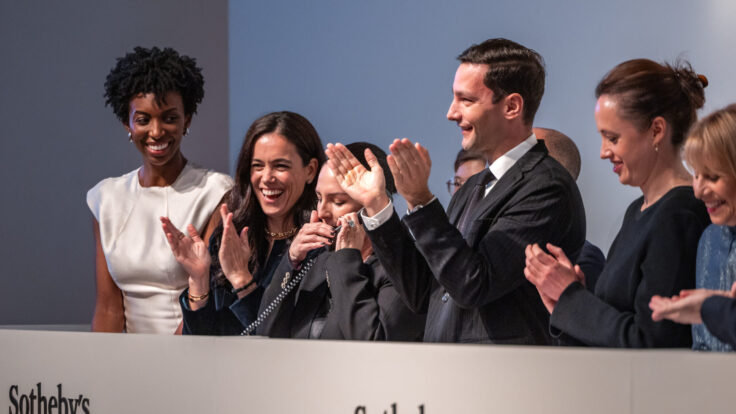
Next week in Paris, Sotheby’s is offering some of the couple’s remaining treasures. The collection of Emanuel “Manny” Davidson, a British real estate entrepreneur who died last year, spans antiquity through the 1900s and was consigned by his widow, Brigitta. The proceeds from the sale, estimated to bring about
€15 million, will benefit their charitable foundation.
Manny formed the collection over many decades, gravitating toward items by revered makers, noteworthy owners, or both. There are paintings by Salomon van Ruysdael, Joshua Reynolds, and John Singer Sargent; Chippendale chairs; 17th century Thomas Tompion clocks; gold snuffboxes by Jean Moynat and Jean Formey; 18th century silver
by Paul de Lamerie; and Renaissance majolica. Provenance includes a who’s who of European royals and notables, from Baron Gustave de Rothschild to Colonel John Ramsey.
Sotheby’s chairman of Old Masters paintings, George Wachter, recounts how Manny came across a small painting “attributed to” Peter Paul Rubens, circa 1614, at Simon Dickinson’s booth at TEFAF Maastricht in 2007. Manny saw something special
in it and took a gamble that it had, in fact, been painted by the Flemish master. It was later authenticated by scholars at Rubenshuis and even matched with its other half in the Louvre. Sotheby’s has estimated it at €500,000.
Davidson also owned 12 of the 100 candlesticks commissioned by Polish King Augustus III for the 1747 wedding of Maria Josepha of Saxony and Louis, Dauphin of France—believed to be the largest assemblage in private
hands. The 12 candlesticks are estimated at €200,000 and were acquired through various purchases, including a pair from Christie’s 1999 sale of the collection of Marilyn Monroe.
|
|
|
A MESSAGE FROM OUR SPONSOR |
|
|
- “Lost” Picasso Dora Maar painting makes $37 million in Paris: Over the weekend, Drouot auctioned one of the last depictions by Pablo Picasso of his lover and muse Dora Maar, in a flowered hat. The piece had been held by a French family for more than 80 years after being bought directly from the artist in 1944; it was only previously known in the Zervos catalogue raisonné through a black-and-white photograph. An art
advisor who had gone to see the painting in France raved about the work’s quality and condition. This person, along with most of the other market participants I spoke to in the run-up to the sale, did not think the work would sell anywhere near its under-$10 million estimate, which had been set to maximize consideration among advisors who scour the Picasso market.
My interlocutors were right: The painting ultimately sold for $37 million, a price slightly higher than those for
comparable Dora Maar works sold in recent years, and even similar buste de femme compositions sold recently. The direct-from-Picasso provenance likely played an important role. - Christie’s announces $30 million Canaletto for next year: One of the primary tools that auction houses have to secure property for their sales is demonstrating evidence of demand for an artist’s work. In July, Christie’s sold Canaletto’s first painting
of Venice’s Ascension Day pageantry for nearly $44 million. The painting had been commissioned in the 1730s by Robert Walpole, Britain’s first prime minister. On the success of that sale, Christie’s was able to go to the owner of the last version of that series—one depicting the same event from the same point of view—and secure that painting for their Old Masters sale next February, with an estimate “in excess of $30 million.” The work last sold 20 years ago for just under $20
million.
- Sotheby’s withdraws film memorabilia sale: Sotheby’s withdrew its film memorabilia sale—which was to include items like an Iron Man helmet, lightsabers from Star Wars movies, and a wand from Lord Voldemort—originally slated for today. I’m told by someone familiar with the situation that concerns were raised about some of the items, and Sotheby’s decided that they couldn’t proceed. A costume from the Superman films is
still expected to be sold in a single-lot online auction in December.
|
Now, let’s get to the main event… |
|
|
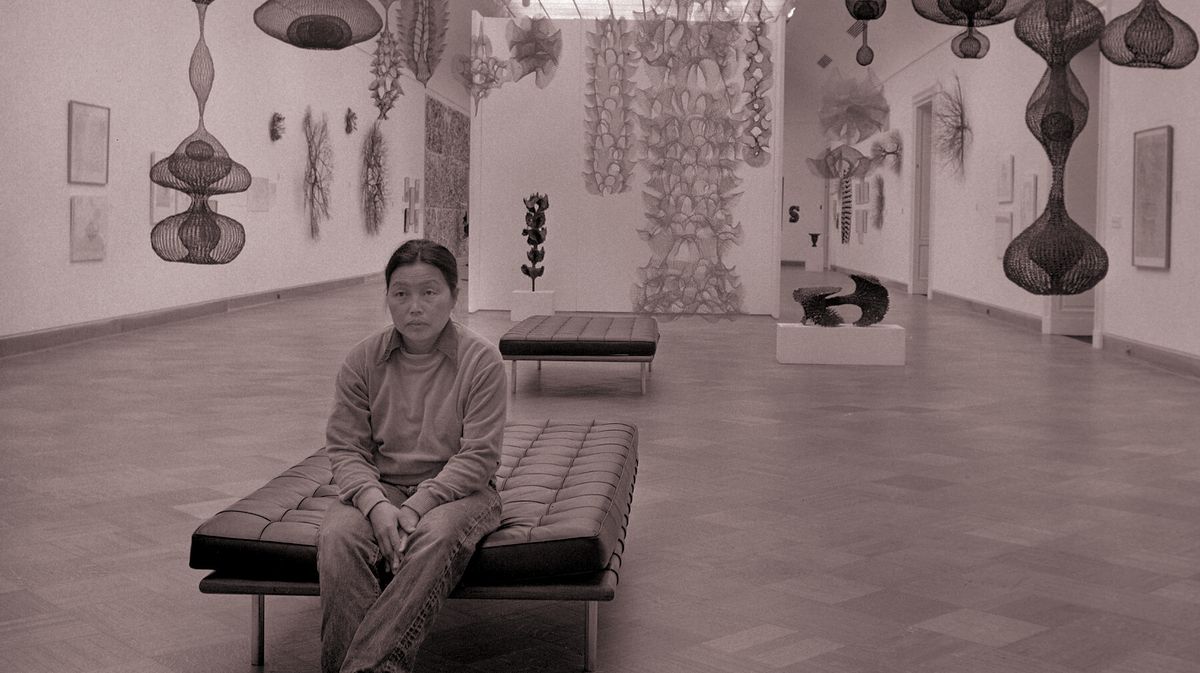
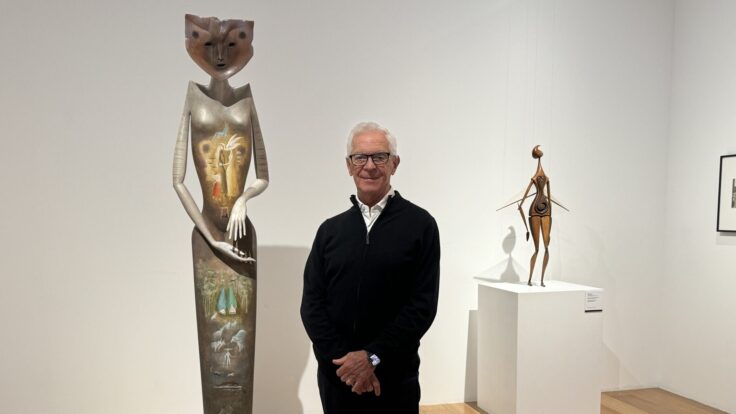
A sweeping MoMA retrospective shows the full scope and ambition of Ruth
Asawa, a titanic talent who studied with luminaries like Buckminster Fuller and Josef Albers, yet wasn’t fully discovered until her death in 2013. As the art world approaches her centennial, the appreciation is still growing. |
|
|
It’s been only a dozen years since Ruth Asawa’s radical art was
recovered from near-obscurity, but the new comprehensive retrospective that just opened at the Museum of Modern Art makes it feel like she’s been at the center of the art world forever. With 15 different examples of her ineffable, crocheted-wire hanging sculptures having achieved auction prices over $1 million—including one that sold for nearly $5.4 million and three others that hit prices above $4 million—it can be easy to forget that as recently as 2013, the artist’s work had not broken
through to most art world denizens.
Through the efforts of Jonathan Laib, then working at Christie’s before moving to David Zwirner gallery, a market was built, almost top down, for Asawa’s Möbius-like wire objects, which create forms with both positive and negative space. (It’s almost impossible to tell where the insides begin and the outsides end.) But, it turns out, there was a great deal more to Asawa than the hanging sculptures the market discovered. |
|
|
A MESSAGE FROM OUR SPONSOR |
|
|
In 2023, the Whitney mounted a show of
Asawa’s drawings that revealed both her intense interest in organic forms, which fit with the structures we had come to know from the market, and her somewhat uncharacteristic attraction to flora. This new retrospective brings together the many different sides of Asawa’s art and reveals a unity of purpose expressed in seemingly different forms. Here we can see how the structures
reflect patterns inherent in nature, as expressed in both her drawings and her abstract sculptures. |
You can easily understand how Ruth Asawa’s biography made her very attractive as a
rediscovered artist more than a decade ago. Just about everything in her experience—as a child of immigrants, a woman creating art from nontraditional materials, and a wife and mother, community organizer, and arts educator—militated against her becoming a recognized artist. But her limited success selling her art during her lifetime in no way prevented her from producing it. Her family had a substantial body of work when she died in 2013, a time when there happened to be a great deal of
interest in discovering overlooked artists, especially women who worked in abstraction.
Born in 1926 to issei parents, Asawa was raised on a truck farm in Norwalk, California, before the family was sent to an internment camp in Arkansas during the Second World War. She had already learned traditional Japanese calligraphy, and other internees taught her to draw. Later on, she made her way to Black Mountain College in North Carolina, where Josef and Anni
Albers had brought their Bauhaus teaching methods in the late 1930s after escaping Nazi Germany. Asawa quickly became one of Josef Albers’s most prized and promising students. Indeed, what the show, and especially the catalogue, explains is how fundamental his ideas were to Asawa’s art. “It has gone unremarked, by Asawa and others,” Jeffrey Saletnik writes in the catalogue essay, “that she enrolled in a class called Structural Sculpture at Black Mountain—the only one
of its kind Albers ever offered—the aim of which was to develop means for achieving ‘sculptural effect’ using ‘non-voluminous material.’” |
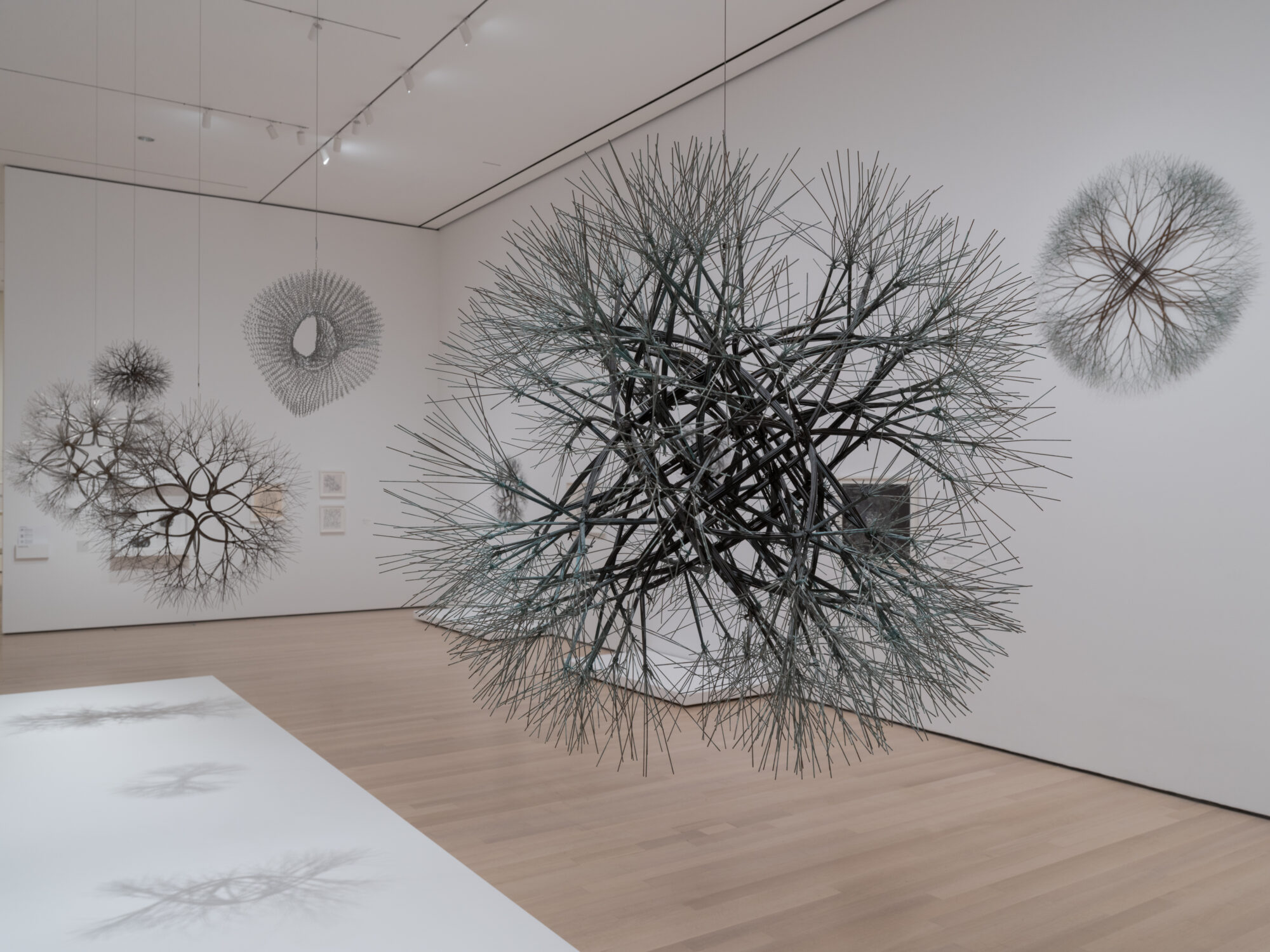
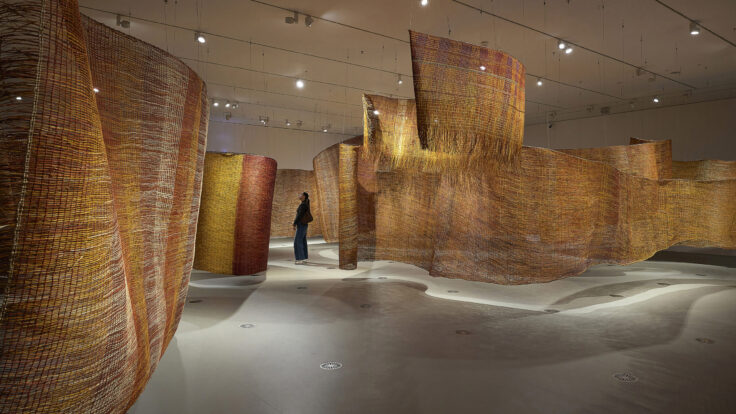
Ruth Asawa: A Retrospective, The Museum of Modern Art,
New York. Photo: Jonathan Dorado/Courtesy of MoMA |
That’s the great discovery of this show and Asawa’s work in general. Her sui
generis undulating orbs, fashioned from open mesh, turn out to be a synthesis of ideas about art, nature, and mathematics that she’d discovered working with Albers and Buckminster Fuller at Black Mountain. Asawa claims she did not understand the complex mathematics Fuller was teaching, but it’s clear she had an intuitive understanding. More to the point, both the Alberses and Fuller became so enmeshed in her life that, when she married the architect Albert
Lanier, a fellow Black Mountain student, she asked Fuller to design her wedding ring. |
The show follows a strictly chronological approach to Asawa’s art making. It begins with
student work at Black Mountain, where we can see her ability to engage with Albers’s ideas about color, along with her own use of repeating forms—sometimes drawn by hand, other times created through mechanical means like a stamp. While still at Black Mountain in 1948 and 1949, she started looping wire into her first open forms. |
|
|
By late 1949, things at Black Mountain had begun to deteriorate, with the Alberses
and other teachers resigning. Asawa joined her soon-to-be husband in San Francisco, and in the 1950s, even while she was having six children, her sculptures attracted institutional, gallery, and commercial interest, though she decided against mass-producing “looped-wire baskets” for decorators in favor of exploring the possibilities of her art. Asawa’s work was shown at the Whitney Museum in New York in 1955, ’56, and ’58, then in a solo show at San Francisco’s de Young Museum in 1960. But her
interest in drawing and moving beyond the looped-wire sculptures caused a rift with her gallery, which she left in 1961.
The sheer variety of forms that Asawa was able to imagine and execute is beguiling in its own right. But the fact that she found this seemingly endless realm of possibilities to be confining is just a hint at what the MoMA show has been able to gather. In addition to numerous drawings of flowers and plants, there are cast sculptures and masks, as well as the carved
redwood doors from the Lanier family home in Noe Valley.
In the late 1960s, Asawa’s work shifted in two different directions. For one, she began to develop a “tied-wire” method of bundling and dividing wire strands into snowflake-like forms; in what to me is the most gratifying room in the exhibition, the resulting sculptures fuse Asawa’s fractal replication of nature into a form that’s both aesthetically exciting and seems to have near-infinite possibilities for expression. Also, in
1968, Asawa created the Alvarado School Arts Workshop in her children’s elementary school, which eventually expanded to multiple San Francisco schools, where Asawa and her friend Buckminster Fuller collaborated again. For the rest of her career, Asawa would spend more and more of her time engaged in community art projects and education.
Even with the great variety of work presented in the MoMA show, one still gets the sense that there is more to Ruth Asawa’s art than can be absorbed in a major museum retrospective. It will be interesting to see whether the substantial space and emphasis this show places on the tied-wire works will lead her market to revalue examples of them, or whether interest might gravitate toward some of the other bodies of her work displayed here. In the meantime, the complexity and subtlety of Asawa’s creations make this the kind of exhibition you will want to visit more than once. Each time, you are sure to see something new. I know I will be back.
|
Okay, that’s it for today. More in the Inner Circle tomorrow.
M |
|
|
The ultimate fashion industry bible, offering incisive reportage on all aspects of the business and its biggest
players. Anchored by preeminent fashion journalist Lauren Sherman, Line Sheet also features veteran reporter Rachel Strugatz, who delivers unparalleled intel on what’s happening in the beauty industry, and Sarah Shapiro, a longtime retail strategist who writes about e-commerce, brick-and-mortar, D.T.C., and more. |
|
|
Finally, a media podcast about what’s actually happening in the media—not the oversanitized,
legal-and-standards-approved version you read online. Join Dylan Byers, Puck’s veteran media reporter, and Julia Alexander, a longtime media analyst, as they sit down with TV personalities, moguls, pundits, and industry executives for raw, honest, sometimes salacious conversations about the business of media and its biggest egos. New episodes publish every Tuesday and Friday. |
|
|
Need help? Review our FAQ page or contact us for assistance. For brand partnerships, email ads@puck.news. You received this email
because you signed up to receive emails from Puck, or as part of your Puck account associated with {{customer.email}}. To stop receiving this newsletter and/or manage all your email preferences, click here. |
Puck is published by Heat Media LLC. 107 Greenwich St., New York, NY 10006 |
|
|
|