|
Welcome back to Wall Power. I’m Marion Maneker.
Tonight, we’re talking about the reopening of the Met’s Rockefeller Wing. When it opened 43 years ago, it was a groundbreaking achievement that brought Indigenous art into the pantheon of art history. Before the wing reopened, it was hard to envision how the Met would improve upon the original. But now that we’ve seen the new version, with its profusion of small groupings, galleries, and vitrines (still only a small fraction of the Met’s full collection)—which allows the museum to show far more of the works it owns—it’s hard to imagine that the old Rockefeller Wing was ever sufficient. More on all of this below.
|
|
|
|
A MESSAGE FROM OUR SPONSOR
|
A new campaign starring Julia Garner celebrates the House’s storied silk scarves and their enduring legacy within the House’s design codes.
DISCOVER MORE
|
|
|
 |
Julie Brener Davich |
|
- Karman’s Frieze-out: This week, Frieze announced that Expo Chicago founder Tony Karman is stepping down as director to assume an advisory role. That’s not necessarily surprising: I had heard Karman signed a two-year deal when he sold the fair to Frieze in July 2023, which means that contract would be up now.Karman is credited with rescuing the Art Chicago fair and rebooting it as Expo Chicago after the previous owner, Merchandise Mart Properties, cancelled the 2012 iteration due to financial troubles. But with the proliferation of fairs, it was getting harder for Chicago to stay relevant. So Karman had to get creative—accepting, for instance, 20 South Korean gallery booths at this spring's fair that felt very out of place. “I think Expo and Tony are indicative of the inevitable results: a consolidation of fairs where many galleries are squeezed by the increased costs of participating,” local collector Larry Fields explained. “There is a ‘corporateness’ to the ownership of almost all aspects of the art world now. Tony personifies the interpersonal interactions of the art world. He is, and always will be, a respected art hero of the Chicago cultural community.” What Karman’s exit means for the Expo’s future remains to be seen.
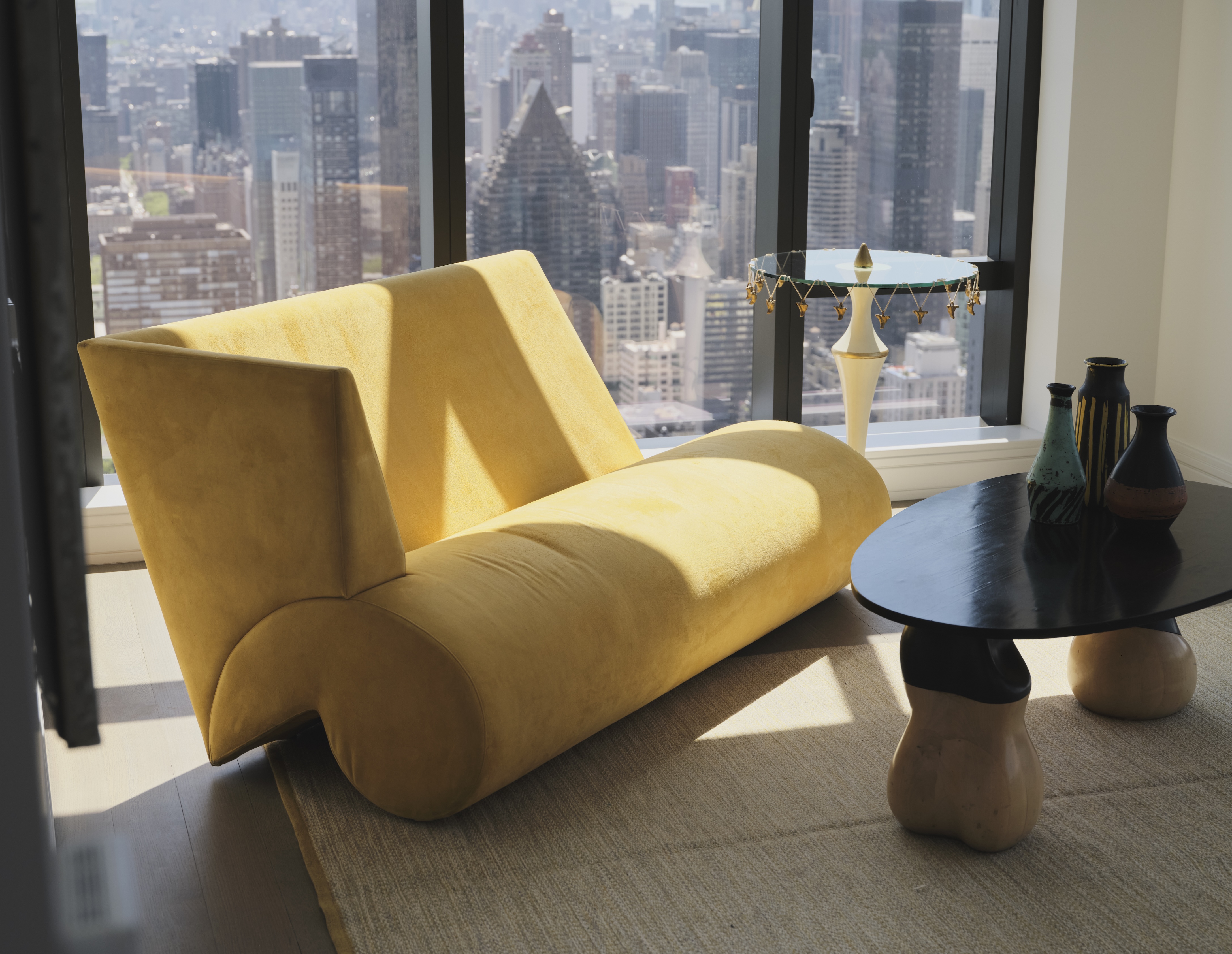
- Design at the top: For the next five months, a $20 million apartment on the 72nd floor of Sutton Tower will be home to Nancy Gabriel’s roving design gallery. For this iteration, Gabriel collaborated with Paris-based Mouvements Modernes on an exhibition of works from the pioneering Galerie Néotù, which was among the first dealers to produce limited-edition furniture, and recognize then-unknown 1980s and 1990s European designers like the duo Élizabeth Garouste and Mattia Bonetti.
|
|
Martin Szekely, Stoléru sofa. Installation view of Néotù: The Visionary Years. Photo: Matt Harrington
|
- The building’s expansive Manhattan views—the kind you only get when the developer has won a zoning exception—provide a jaw-dropping background for the objects. The whimsical designs, predominantly from the 1980s, include an oak desk ($150,000)—one of only two ever made by Martin Szekely—as well as one of his iconic, comma-shaped Stoléru sofas, in its original yellow fabric, priced at $140,000. Pucci de Rossi is represented with a tall Alice in Wonderland–like wardrobe shaped as an armchair ($60,000), and the surrealist Veneziana chair made from imitation marble wood, cowhide, and mirror ($35,000).
|
- The Met’s hot wing: This week, the Met is celebrating the reopening of its 40,000-square-foot Rockefeller Wing—housing the Arts of Africa, Oceania, and the Ancient Americas galleries—after a four-year, $70 million renovation. The architecture of Kulapat Yantrasast—especially the barrel-vaulted Oceania gallery—is striking. Equally monumental: the reinstallation of the collection, with 1,726 works on view spanning five continents, hundreds of cultures, and thousands of years—only about 16
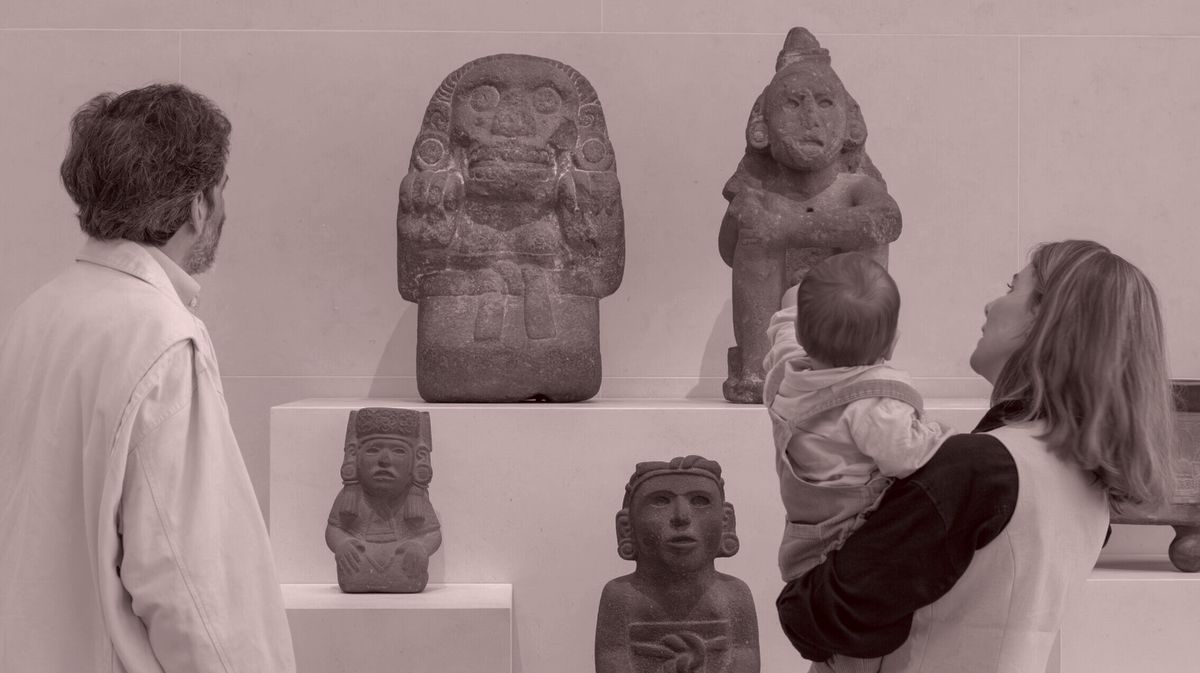
percent of the museum’s holdings in this category. There are carved-wood tools from Sub-Saharan Africa, stone sculptures from Oceania, and gold regalia from South America, some of which is on view for the first time. A gallery dedicated to light-sensitive Andean textiles—including a wall-length blue-and-yellow Peruvian macaw feather textile from the 1st century—is the first of its kind in the United States.
The original wing opened in 1982 with funding from Nelson Rockefeller, who named it after his son, Michael, who went missing in New Guinea in 1961 at age 23. (In fact, the most striking pieces in the exhibition are the nine 15-foot-tall carved funerary poles that Michael collected on that expedition.) Alisa LaGamma, the curator in charge, recently suggested that the wing’s global focus was, at the time, a “watershed moment that was a prequel to this one.”
The museum collaborated with international experts—30 of them attended the preview—who advised on the reinstallation and contributed content, such as adding the names of previously unidentified makers. There are also audiovisual enhancements that provide cultural context, like video footage from the ceremonies where the objects were utilized. Meanwhile, the wing is split into three sections for Africa, Oceania, and the Ancient Americas, but offers sight lines between some of the galleries. The original galleries were siloed and dark. Now, the glass curtain wall—a mirror of the one on the north side of the building that protects the Temple of Dendur—has been updated to better filter the sun, and some of the galleries have been divided by glass to allow sunlight to reach farther into the interior.
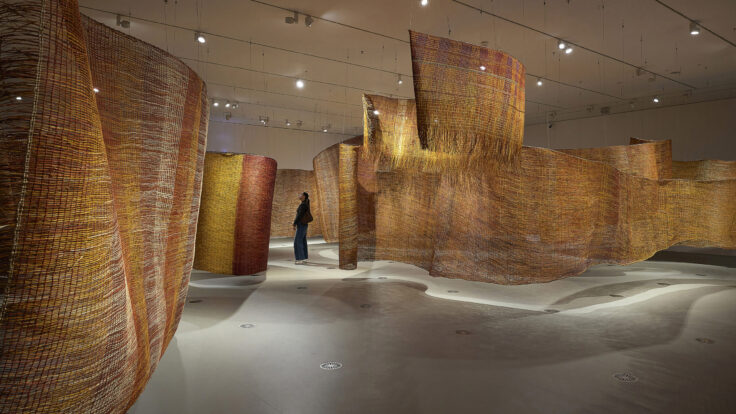
The Africa galleries feature 500 works from the Sub-Saharan region, one-fourth of which are new acquisitions. There are the best examples of the most recognizable forms, like a nail-studded Kongolese power figure and a Baga shoulder mask. A 2006 work by Ghanian artist El Anatsui ushers in the 21st century. The Ancient Americas galleries feature 700 works from Latin America and the Caribbean, including items of gold regalia, like beakers, pendants, and funerary masks. In the Oceanic galleries, the 53-by-27-foot painted Kwoma ceremonial house ceiling is suspended over 650 works—including turtle shell masks, pearl pendants, and woven baskets—from 140 cultures in a region that covers one-third of the Earth’s surface. The flexibility of the new galleries and casework allows for rotation to show more of what’s in storage. “The power of art is that it brings us all together,” said Munyaradzi Manyanga, an archaeologist visiting from Great Zimbabwe University. “That’s what’s so great about this reopening.”
|
|
|
|
Speaking of the Rockefeller wing…
|
|
|
|
When it opened more than 40 years ago, the Rockefeller Wing was a seismic event in the acceptance of Indigenous art’s place in the great museums of the world. Its reopening today marks a transformation in the tribal category—and an excuse to revisit an increasingly lucrative market.
|
|
|
|
As I walked through the Met’s new, light-filled Rockefeller Wing early Wednesday morning just before the press preview—one of several events welcoming press, donors, and the many representatives of Indigenous groups whose artworks are on display in the wing—I could not help but notice all the people, often wearing some form of ceremonial or native dress, having their pictures taken next to the wall text and vitrines. Postured up with big smiles, they looked exactly like people do in graduation photographs. And in a way, this reopening felt like a graduation of sorts, with the various representatives the Met had included as co-hosts taking justifiable pride in their inclusion in the revamped wing.
Nelson Rockefeller was a pioneering collector of African and Oceanic art, and his family was intimately connected to the founding and expansion of the Museum of Modern Art. In the 1950s and ’60s, he faced resistance in having his collection, which was greatly enhanced by his son Michael’s expeditions to Papua New Guinea, included in an art museum. Much of the African art collected and displayed in Europe is found in natural history museums.
|
|
|
|
A MESSAGE FROM OUR SPONSOR
|
A new campaign starring Julia Garner celebrates the House’s storied silk scarves and their enduring legacy within the House’s design codes.
DISCOVER MORE
|
|
|
|
When you visit the Rockefeller Wing, yourself—and I do hope you will, because it seems as fundamental to any understanding of art as the Greek and Roman galleries that precede it in the Met floor plan—try to remember that the wing was an achievement in recognizing the value of Indigenous art as art… rather than as objects that defined the ethnography of premodern groups.
|
|
Installation view, Arts of Oceania, The Metropolitan Museum of Art, New York. Photo: Bridgit Beyer
|
|
The reopening of the Rockefeller Wing made me curious about the state of the tribal and Oceanic art markets. Not surprisingly, there were a number of different events taking place in New York to coincide with the week of events at the Met. To get my bearings, I asked Christie’s chairman Guillaume Cerutti to remind me of the tribal and Oceanic art dealer that he had once introduced me to in the auction house’s lobby. Instead, I was surprised to learn that Cerutti was deeply committed to the field. “I have always considered the African and Oceanic art department at Christie's as one of our priorities,” he wrote me in an email that included introductions to several important figures in the field. “That is a category where one finds fabulous objects, with great provenance and power, and clients who are either very sophisticated and have built great collections, or collectors of masterpieces across categories.”
|
My first conversation was with Heinrich Schweizer, who normally trades privately out of his gallery, Schweizer Premodern. In recognition of the traffic the Met is generating among collectors, Schweizer had set up shop a few blocks north of his usual home, in the basement gallery space of 5 East 82nd Street. There, he’s showing four works by Aboriginal artist Mirdidingkingathi Juwarnda Sally Gabori alongside some of African and Pacific works, until June 7—a rare opportunity to see his inventory, since he usually only shows by appointment. Among the many objects on display, he pointed me to an ancient flat river stone from Australia carved into a tjurunga with some of the circular patterns familiar from Aboriginal art; a male Kongolese power figure festooned with the nails that were used to activate it, but missing the elements that would have made the object sacred; an extraordinarily well-preserved warup (or hand drum) from the Torres Strait Islands decorated with feathers and shells in the shape of a whale; and a livika, a sound-making statue used in funerary rites that looks like a hornbill bird.
Schweizer isn’t alone in opening his doors. Auctions, especially for single-owner collections, are bringing in new buyers. And online auctions are further democratizing the field. According to a report on the current market from Artkhade, fewer galleries in this field are attending art fairs. More galleries are functioning by appointment, but there is a synergy between the auctions and the private dealers. Alexis Maggiar, who runs Christie’s department from Paris, said of the private dealers: “I need them; they need us.”
And that’s because Maggiar has found success by narrowing the number of works he sells. Last year, Christie’s was able to jolt the tribal and Oceanic market awake with the sale of works from the Barbier-Mueller Museum. The deaccessioning raised €73 million and helped triple the auction turnover in the field, making 2024 a record year. Even without the Barbier-Mueller sale, Artkhade says auction totals would have been up 20 percent from 2023. Maggiar attributes this to his having cultivated new buyers through online sales and dedicated follow-up. It appears that buyers are quite willing to bid on and buy works that they only see through photographs.
|
|
|
|
That does not mean these sales are going downmarket. According to Schweizer, who used to run Sotheby’s department from New York, the number of buyers who are willing to transact above $1 million has greatly increased over the past 20 years. But those collectors are very choosy. And though the collector base is now global, at least half of the buyers for this kind of art are in the United States—that’s just where the money is. The top-end collectors who drive this market do not start out buying tribal and Oceanic art. They usually come from other collecting categories. And these days, they mostly buy works that fit into their collections in personal and idiosyncratic ways. That can make selling to these collectors difficult. They don’t necessarily respond to either the wealth of detail on provenance and cultural background that dealers provide, or to art-historical arguments about the quality of the work. The buyers are looking for work that speaks to them, and only they know it when they see it.
|
After I left the Met’s press preview, I had an appointment to visit Adam Lindemann’s exhibition Urhobo & Abstraction, which was a perfect example of how collectors are pairing African art with contemporary art. With the help of Bernard de Grunne, a leading dealer in African art from Paris, Lindemann had gathered five life-size, or nearly so, Urhobo carved wooden figures and another five Igbo figures, and surrounded them with works of African American abstract artists. It all culminates in an El Anatsui piece that acts almost like a map of the Niger River that divided these two groups.
According to Lindemann and de Grunne, who have known each other for decades, the grouping of Urhobo figures is the largest to be assembled outside of their original context in the Niger River delta. Cleverly, de Grunne and Lindemann paired an image of similar carved figures lined up along a large structure in Africa with a photograph of the statues of prophets thresholding the central portal of the cathedral at Chartres. How’s that for context?
But Lindemann wanted to go a step further. He included in his show works by Sam Gilliam, Richard Mayhew, Alma Thomas, Jack Whitten, and Ed Clark—all very different African American abstract painters. The juxtaposition of the two types of artworks reminds us that while the combination may be novel for galleries, collectors have been combining tribal art with other works for generations, ever since the cubists and surrealists became infatuated with African art.
Standing in front of the Ed Clark painting, Lindemann mentioned that Steve Martin—you know him as the actor and comedian, but the art world knows him as an influential and groundbreaking collector—had shown him how well Clark’s abstract work showed with premodern art. In Martin’s case, Clark’s work was shown alongside Aboriginal art. The night before, I had been to the Asia Society to see a panel of curators and collectors, including Martin, discuss Aboriginal art. Both Martin and Lindemann were lending works by Emily Kam Kngwarray to the Tate’s upcoming retrospective curated by Kelli Cole, who also appeared on the panel, as did Mayatili Marika, one of the Met’s co-hosts, and Aboriginal art collector John Wilkerson. One of the main topics discussed was how to collect Aboriginal art ethically.
As Marika pointed out, though Aboriginal art draws on cultural traditions and symbols that are tens of thousands of years old, most of the art made by Indigenous peoples of Australia and New Guinea was ephemeral—body painting and sand images. It was only 80 years ago that artists started making portable Aboriginal art, first on eucalyptus bark and then on boards, eventually on canvas. Starting in the 1970s, materials were provided as a way to record this heritage, but also to make objects that could be sold to support these Indigenous groups.
It took many years, and some serious swings in the Aboriginal art market, before the art world recognized that buying works that had passed through reputable dealers—who made sure much of the value of the artwork ended up in the hands of the producers and their communities—was the best way to go about collecting. Dealer D’lan Davidson told the audience that once he began donating 30 percent of his net profits to the communities where the art originated—in excess of the resale royalty the Australian government created for all Aboriginal art more than a decade ago—his business began to grow dramatically.
Finally, art advisor Jean Fritts reminded me that, although these works are sometimes quite old, the collecting field is still very young. Unlike Old Masters, which is similar to tribal and Oceanic art in that we often don’t know who the maker was and must attempt to identify works through connoisseurship and an eye for detail, few art museums collect in the category. That’s why the Met’s reopening is so important. It should inspire more collectors to get involved. And the good news is, there’s still a lot of very high-quality works of art left in private hands.
|
|
That’s it for today. Enjoy your weekend, everyone.
M
|
|
|
|
The ultimate fashion industry bible, offering incisive reportage on all aspects of the business and its biggest players. Anchored by preeminent fashion journalist Lauren Sherman, Line Sheet also features veteran reporter Rachel Strugatz, who delivers unparalleled intel on what’s happening in the beauty industry, and Sarah Shapiro, a longtime retail strategist who writes about e-commerce, brick-and-mortar, D.T.C., and more.
|
|
|
Need help? Review our FAQ page or contact us for assistance. For brand partnerships, email ads@puck.news.
You received this email because you signed up to receive emails from Puck, or as part of your Puck account associated with . To stop receiving this newsletter and/or manage all your email preferences, click here.
|
|
Puck is published by Heat Media LLC. 107 Greenwich St, New York, NY 10006
|
|
|
|





_01JWHEJR5JNRYST1GBC5MH8GJE.jpg)