Hello, sports fans. Welcome back to Wall Power. I’m Marion
Maneker. I’m excited to share that Puck has closed its acquisition of Air Mail, the inimitable digital media company founded by Graydon Carter. I’m sure there will be a lot more Air Mail and Puck can do together. And I’m eager to get started.
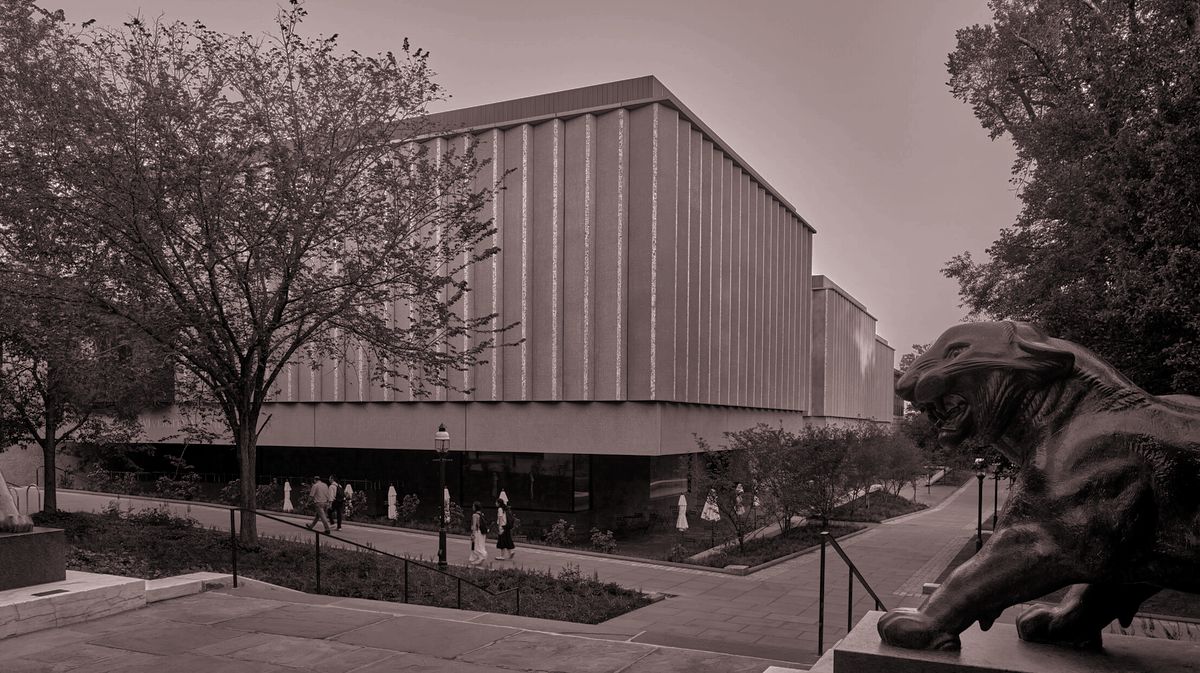
While we wait, let’s go to New Jersey, where the Princeton University Art Museum is reopening after four years of construction. The completely new facility doubles the size of the museum and situates art and art
history at the heart of campus life. I don’t think anyone believes there’s going to be an explosion of art history majors at Princeton (though wouldn’t that be cool?), but the museum does show the power of art as a tool for cultivating development dollars and campus amenities.
Anyway, I toured the museum this summer, and I’ll share my excitement and impressions with you below the fold.
But first… |
-
Yes, but is it good for art?: This morning, Sotheby’s announced one of the final lots for its November sales: Maurizio Cattelan’s America, from 2016. The solid gold working toilet—an edition of three, but only two were fabricated—was once installed at the Guggenheim Museum, where art lovers could line up for “an intimate experience with art.” Then it was displayed at Blenheim Palace in the U.K., where it was famously stolen and presumably melted down for the
value of its gold. (The Louvre isn’t the only fancy old place with a security problem.)
In a clever stunt, Sotheby’s announced that the opening bid for the work will be that day’s spot price on the gold market. There are more than 100 kilos of 18-karat gold in the toilet, which should amount to around $10 million. Any bids above that, Sotheby’s suggests, should be considered the art value of the work, as opposed to the commodity value. But as we saw with Comedian, from 2019, the
banana-and-duct-tape work that was sold last year to crypto bro Justin Sun, the hoopla doesn’t necessarily translate to the value of the art.
After all, the Comedian (BAN) memecoin still trades at a market cap of nearly $68 million, with daily trading volume of $10 million, even though the artwork itself was bought for only $6.2 million.
Perhaps more to the point, Comedian’s resale has yet to have a visible effect on Cattelan’s secondary market, even though the artist seems to be doing quite well in the primary market.
|
|
|
A MESSAGE FROM OUR SPONSOR |
|
|
- Matthew Wong Foundation flexes: Since his suicide in 2019, more than $110 million of Matthew Wong’s art has traded hands on the auction market, and the artist has had shows at major museums around the world, including the Van Gogh museum in the Netherlands. Now, Wong’s foundation is announcing that it has opened a permanent headquarters in Edmonton, where his archives and a study center will be housed. There’s also going to be a show at next year’s Venice Biennale,
titled Matthew Wong: Interiors, curated by former dealer John Cheim. It will feature 35 works, some never shown before, presented at the Palazzo Tiepolo Passi and opening May 9.
- Still more Lichtenstein from the estate: Sotheby’s says it has already sold $128 million in art from the estate of Roy and Dorothy Lichtenstein since this time last year. But if you
thought that exhausted the family’s holdings, guess again. The house just announced another $30 million tranche of works, led by two sculptures and three paintings with a combined estimate of more than $13 million.
The group includes Cubist Still Life with Vase and Flowers, from 1973, estimated at $4 million; Brushstrokes, a 1996 monumental sculpture cast in 2001, also estimated at $4 million; Modern Painting Triptych II, from 1967, estimated at $3.5 million;
Reflections on Brushstrokes, from 1990, estimated at $1.2 million; and, finally, the bronze Archaic Head, from 1988, estimated at $600,000.
|
Now, let’s get to the main event… |
|
|
With its striking new David Adjaye–designed museum, Princeton is
signaling that art and the humanities still matter—not just as a subject of study, but as a core part of campus life, community, and institutional identity. Plus, it should help in the escalating battle to attract new students and cultivate alumni gifts… |
|
|
In celebration of its official opening today, the newly rebuilt Princeton University
Art Museum will stay open all night. Of course, spending Halloween in a museum might not sound terribly scary or exciting or even cool to you. (Although, there is a Halloween dance party from 5 to 10 p.m. on the West Terraces, evening collection tours, and a silent disco from 9 to midnight.) But that doesn’t mean the opening isn’t an important event. At a time when the humanities are actively under attack, one of America’s most exclusive undergraduate institutions is embedding art and art
history at the center of not only its mission and identity, but also its social life.
Designed by British architect Sir David Adjaye to unite Princeton’s art history and archaeology departments with the museum and the Marquand Library, the new building will be partly accessible to students from 8 a.m. to 10:45 p.m. most of the rest of the school year—a signal of what the museum, which doubled its previous size to 146,000 square feet, is meant to accomplish. Its larger
elite peers, Harvard and Yale, both have multiple world-class museums on campus in starchitect buildings (by Renzo Piano and Louis Kahn, respectively). But Princeton, an institution that has been collecting art and artifacts of other cultures and civilizations since before the Revolutionary War, did not have a statement structure—or, to be honest, a museum that reflected the massive change in attitudes and approaches toward art and art history in the academic
and cultural worlds over the last 50 years. |
|
|
A MESSAGE FROM OUR SPONSOR |
|
|
The museum will serve another purpose, too. Over the past two decades, colleges and
universities have shifted from viewing donated art as high-value assets to seeing their museums as anchor amenities in the escalating battle to attract students, tuition dollars, and alumni donations. Not every school uses sports to enhance its reputation and cultivate gifts. Around the country, many elite universities have been investing in their museums. |
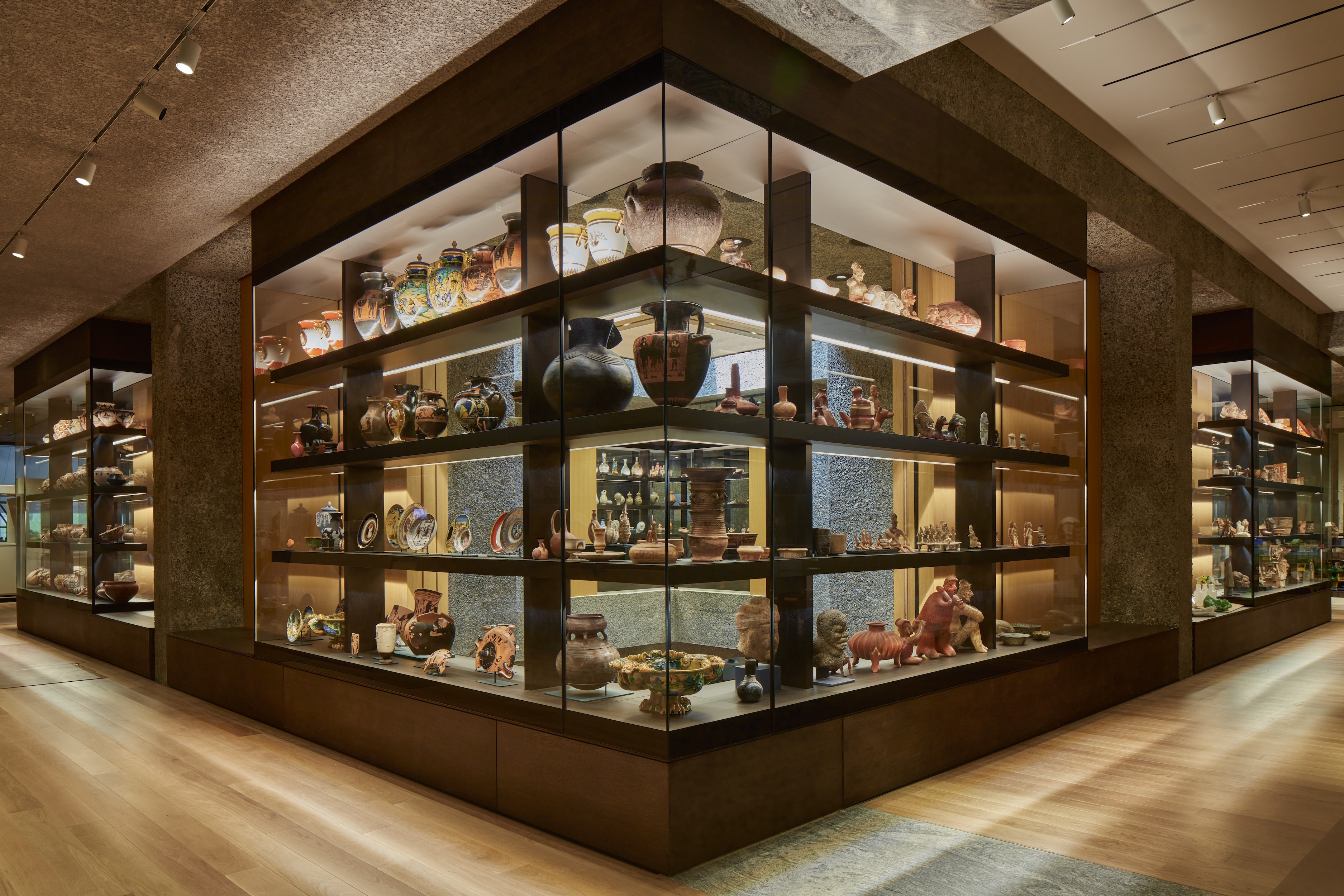
The dense object display vitrines allow the museum to present a broad range of art in an
innovative setting. Photo: Richard Barnes/Courtesy of the Princeton University Art Museum |
That wasn’t always the case. The most visible controversies came 15 years ago, after the
dramatic run-up in art prices in the aughts was followed by the financial crisis, and art bounced back in value faster than many other assets. This dynamic created some extraordinary and not unreasonable temptations. In 2009, Brandeis announced it was closing the Rose Art Museum, and would sell the art to cover its financial problems. In 2011, the University of Iowa was tempted to sell its massive Jackson Pollock, Mural, painted in 1943, because the nine-figure
appraisals seemed like an obvious way to spare taxpayers the cost of catastrophic flooding at the school in 2008.
In the end, neither school went through with the art sales. And today, both institutions have embraced their museums as points of pride. |
Given Princeton’s $36 billion endowment, there was never any danger of anyone at the
university eyeing its own art for sale. But just because you have a lot of important works accumulated since 1755 doesn’t mean you’re making the most of the art as an institutional asset. In part, that’s why I made the trek to Princeton over the summer: I wanted to see firsthand what the university and James Steward, the museum’s director who led the four-year project to rebuild it, had accomplished. I can’t say that I’ve seen a more impressive purpose-built museum.
The
university’s 117,000-work collection is relatively small but encyclopedic, with holdings that span African, Greek and Roman, pre-Columbian and Indigenous American art, along with Asian, European, and modern and contemporary artworks. That’s a lot of art and civilizations to cover. And yet, as Steward told me, he wanted a museum that would serve multiple functions: attract students; present the world-class collection in a manner that highlights the artists but also creates dialogue between
cultures, classes, and eras; become a free regional resource; and create a campus center that could be a hub of entertainment.
As such, the building is situated at a heavily trafficked crossroads between residential colleges and academic buildings, and is raised up to create nine cantilevered pavilions so its mass does not block sight lines up and down the campus. It’s approachable and inviting, with four facades and no real back, and is surrounded by terraces sprinkled with tables and
chairs. I asked whether they planned to have a food concession out there, and Steward told me that they had purposefully placed the museum’s restaurant at the top of the building to draw visitors through its halls. |
|
|
His response demonstrated the thought and planning that had gone into this project,
but I also bet Steward he would have a coffee cart out on the terraces within six months. Standing there, I could easily see the crowds that will gather around day to day—the museum is woven that deeply into the campus byways, and offers such an obvious and pleasant place to gather and linger. More diligent students who want to avoid social distraction can enter through the art history department side of the building, which has direct access to lecture spaces and seminar rooms, as well as the
“object study rooms” where students can be in direct, unmediated presence of a work from the museum’s collection. Just outside of these rooms there are vitrines, where a professor can request an array of objects be put on protected display throughout the semester, so students can engage with them at their convenience. |
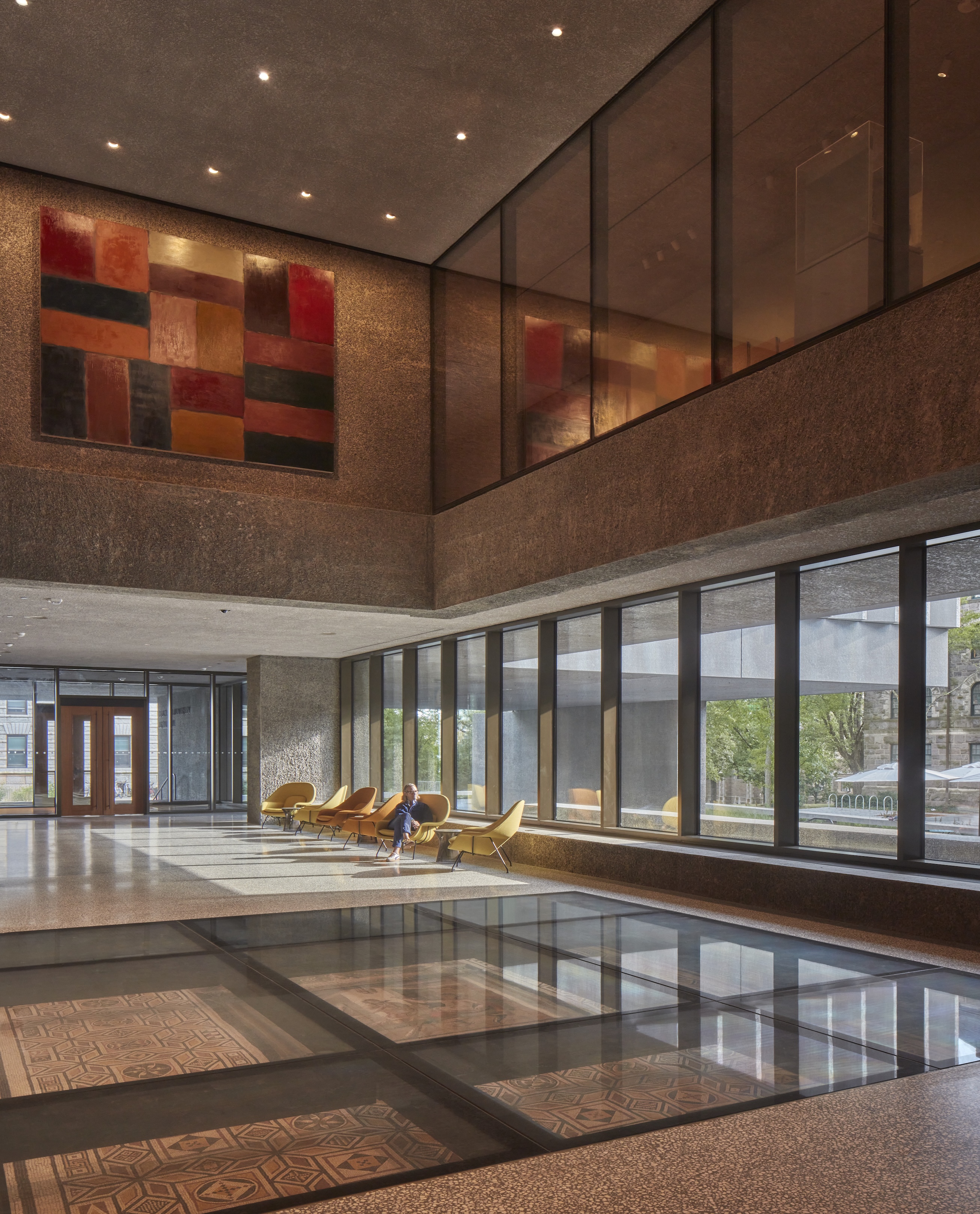
A passageway connects the campus through the museum, with a Sean Scully painting above
and a Roman mosaic embedded in the floor below. Photo: Richard Barnes/Courtesy of the Princeton University Art Museum |
Just off a third entrance is a large atrium, reminiscent of the one Louis
Kahn built into the Yale Center for British Art. Steward explained that Adjaye was clearly in deep dialogue with Kahn in designing the building, which uses v-shaped Glulam beams, some as long as 66 feet, to house its mechanicals and support the pavilion galleries. These mass timber beams give the museum long sight lines and large open spaces. The Grand Hall, as the atrium is called, has flexible stadium-style seating, and can hold as many as 235 people seated for performances and
lectures, or 400 standing for receptions.
In the actual galleries, upstairs, the open sight lines help break down barriers between collections. And the “dense display” approach that Princeton has adopted for their collections, using custom casework designed in Milan, allows the curators to pack a large number of examples from the collection into a contained and well-organized space that looks out across a gallery or hallway toward another equally compelling collection. This is what museum
viewing should be—a visual adventure that allows for serendipitous connections, but is also structured for focused and sustained viewing.
I often complain to people that museums are some of the worst places to spend time with art. But after spending an hour or two strolling through Princeton’s museum, I am not sure that’s true. And, for the students and faculty who are on campus primarily or just often, the museum somewhat replicates the luxury of living with art. (You would have to be a
billionaire to have daily access to this kind of art.)
This is no accident. The building is meant to be a haven and refuge that might, in Steward’s most optimistic vision, see a first-year engineering student wander through the doors at one end looking for a direct route to class, and wind up intrigued by a Roman mosaic or a Sean Scully painting. Perhaps that’s enough to make a habit of passing through on a regular basis. And, just maybe, that
student will develop a lifelong interest in art, or the past, or perhaps just get an inkling of the value of the humanities. |
That’s enough for today. Happy Halloween. We will have more for you on
Sunday.
M
|
|
|
The ultimate fashion industry bible, offering incisive reportage on all aspects of the business and its biggest
players. Anchored by preeminent fashion journalist Lauren Sherman, Line Sheet also features veteran reporter Rachel Strugatz, who delivers unparalleled intel on what’s happening in the beauty industry, and Sarah Shapiro, a longtime retail strategist who writes about e-commerce, brick-and-mortar, D.T.C., and more. |
|
|
Finally, a media podcast about what’s actually happening in the media—not the oversanitized,
legal-and-standards-approved version you read online. Join Dylan Byers, Puck’s veteran media reporter, and Julia Alexander, a longtime media analyst, as they sit down with TV personalities, moguls, pundits, and industry executives for raw, honest, sometimes salacious conversations about the business of media and its biggest egos. New episodes publish every Tuesday and Friday. |
|
|
Need help? Review our FAQ page or contact us for assistance. For brand partnerships, email ads@puck.news. You received this email
because you signed up to receive emails from Puck, or as part of your Puck account associated with {{customer.email}}. To stop receiving this newsletter and/or manage all your email preferences, click here. |
Puck is published by Heat Media LLC. 107 Greenwich St., New York, NY 10006 |
|
|
|