{{ 'now' | timezone: 'America/New_York' | date: '%b %d, %Y' }} |
|
|
Hi, and welcome back to Line Sheet. What a week. As a reprieve from
Missoni takeover rumors, magazine cover wars, and Phoebe Philo will she or won’t she return
to the runway debates, Sarah “SShapiro@puck.news” Shapiro is here with a look at the rise of the celebrity clothing sell-off, from Chloë Sevigny’s closet dump to Emily Weiss’s garage-sale extravaganza: why it’s happening, who benefits, and what it says about the state of our closets.
Up top, we’ve got a real candy bowl of
things people were laughing about—and contemplating—this week, including the sheer ridiculousness of Alice + Olivia’s Grateful Dead collaboration, the super-dumb controversy over J.Crew’s pink Fair Isle sweater, and TikTok’s sneaky-big apparel business. And finally, we answer a burning reader question: What is up with jewelry designer Jessica McCormack, and how is she managing to get all these red carpet placements when that category is known for being almost
purely pay-to-play?
Mentioned in this issue: Emily Weiss, Jenna Lyons, Stacey Bendet Eisner, Deadheads, Alice + Olivia, Emma Stone, Zendaya, Maharishi, The Row, Bulgari, Zoë Kravitz, Jessie Buckley, the Grateful Dead, and many more… |
Four Things
You Should Know…
|
-
Dead reckoning: Sun Valley queen and babylift proponent Stacey Bendet Eisner is getting “raked over the coals” by fellow Deadheads for her brand Alice + Olivia’s collaboration with the band, which launched a week ago and features a $1,400 patchwork jacket,
a $250 baby tee, a $695 accordion pleat maxi skirt, and more. Oh wait, also: a $1,795 ballgown skirt! As the daughter of a Deadhead with the attendant childhood trauma, my inclination in this case is to side with
the hardcore fans, who believe that Rhino Entertainment, which owns the licensing rights for the Grateful Dead, should stop doing all these terrible collaborations. “Name one cool long term thriving clothing luxury brand still in biz with our favorite band??? You can’t,” wrote “live music curator” MusicNeverStopped on Instagram. But you know what? I’m also a realist. Eisner
is a real fan, the Grateful Dead is one of the most commercially successful bands in the history of mankind, and they shouldn’t have made that bear look so cute if they didn’t want people to profit off it.
|
|
|
A MESSAGE FROM OUR PARTNER |
|
|

| Sarah Shapiro
|
|
- What’s Jessica
McCormack’s Secret?: Several of Hollywood's current leading ladies, including Emma Stone, Dakota Johnson, and Jessie Buckley, have worn the British jewelry designer’s pieces on the red carpet lately, adding to her roster of A-list acolytes—most notably Zendaya, who chose McCormack to design her engagement ring, despite being an ambassador for Bulgari since 2020. (If you think Tom
Holland selected the ring, bless your heart.) McCormack’s brand ambassador is her pal Zoë Kravitz.
Niche jewelry lines are notoriously expensive to get up and running, which means most of them are started by already rich people. But even the richest can’t compete with the likes of the LVMH- and Richemont-owned brands that pay millions of dollars a year to get their pieces worn on the red carpet—where, unlike fashion, jewelry has long been purely pay-to-play. While a celebrity will still occasionally wear a clothing brand that won’t pay fees, that’s never really been the case with jewelry. It’s a much more transactional process.
So, how is McCormack managing it? I’m told she isn’t paying for placement and that she’s seemingly just genuinely beloved by certain celebrities, which has driven stylists to pull more from the brand. (Must be nice.) As for the Zendaya engagement ring, ambassador contracts typically have a carveout for
“wedding jewelry.”
Now, after 17 years in business—and endless trunk shows in Aspen, Dallas, and Nashville—McCormack is harnessing the momentum to establish a U.S. retail footprint. In May, she opened her first stateside outpost in a townhouse on Madison Avenue. When my 12-year-old daughter and I paused to admire the windows over the summer, staff invited us in, revealing a welcome change from typical high-end jeweler protocol. - Literally, who cares?:
Remember when Page Six went nuts over the fact that former J.Crew creative director Jenna Lyons let her son paint his toenails pink? That was in 2011. Almost 15 years later, our culture has become so polarized, so woke, so anti-woke, so anti-anti-woke, that controversy arose this week after the rage-bait set noticed that J.Crew is currently selling a men’s Fair Isle sweater in (gasp!)
pink.
This is insane, and also exhausting. In the conservative South, where I grew up, men wear pink with critter pants. Rep ties with navy
and pink are a classic look. Anyone engaging with this particular discourse might be better served by talk therapy. - TikTok around the clock: Sales of womenswear on TikTok Shop have reached a staggering $1.3 billion year to date, representing a 98 percent increase over last year, according to Charm.io. Menswear doubled to $300 million. Interestingly, four of the top five products in apparel are shapewear items—waist shapers, tummy control
garments, Cake’s adhesive nipple covers—highlighting TikTok’s power to sell the category. Most of the items in this surge feel reminiscent of the ’90s obsession with body control, this time with a GLP-1 twist.
And yet, loungewear is also trending. Hashtags for sweatpants, hoodies, and sweatshirts are proliferating as comfort clothing dominates, especially in colder months. We’re buying
both the clothes that squeeze us in and the items that let us breathe—the perfect metaphor for our spastic moment.
|
|
|
From Jenna Lyons to Emily Weiss, parasocial pop-ups are giving secondhand shoppers
what online resale can’t, and inspiring new retail strategies, too. |
|
|
Given the coverage over the past week, you could be forgiven for thinking that the most
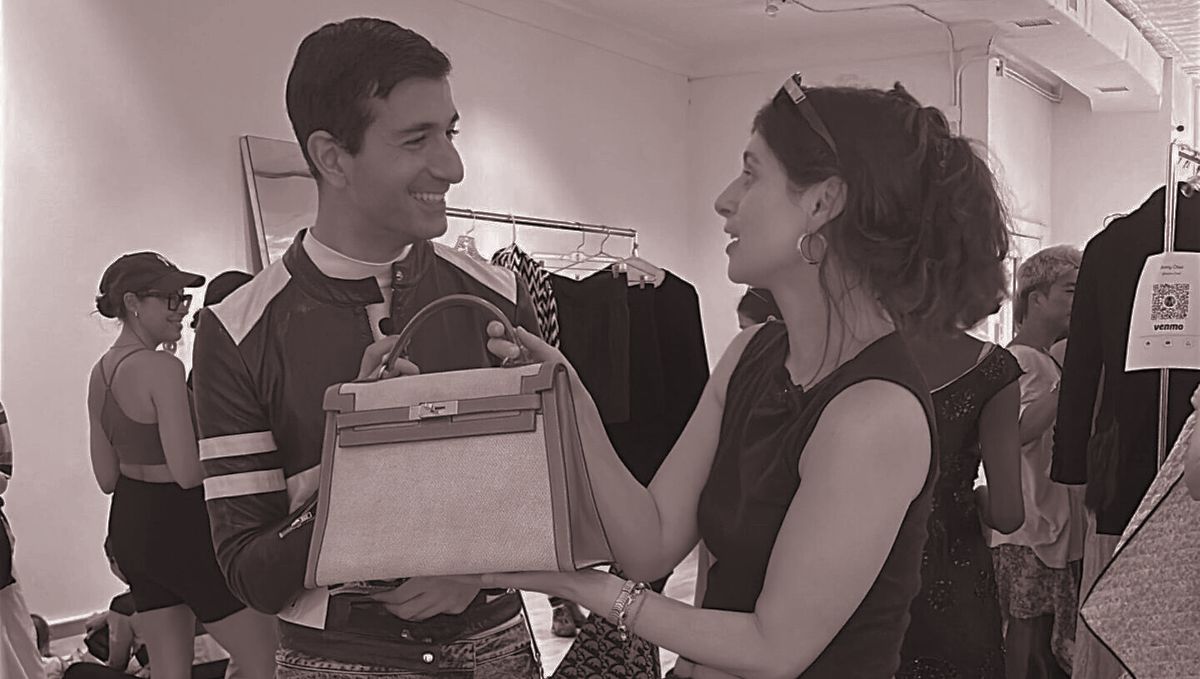
consequential retail event of 2025 was Emily Weiss’s stoop sale—sorry, garage sale—a parasocial spectacle featuring Weiss, her castoff $4,500 Margaux bag, a $600 knit set from The Row, a live D.J., and the irresistible opportunity to bask in the shadow of her $22.1 million Brooklyn Heights townhouse. But in many ways, Weiss was just capitalizing on a trend. |
|
|
A MESSAGE FROM OUR PARTNER |
|
|
Increasingly, consumers are seeking out alternatives to the familiar dopamine high and
crash of fast fashion, and the impersonal, relatively joyless experience of secondhand shopping online. Intimate, I.R.L. sales like Weiss’s represent a way to recapture the old thrill of the hunt. “Vintage became like fast fashion,” Liana Satenstein of Neverworns told me this week in the days after Weiss rolled up her garage door. Satenstein, a onetime Vogue staffer who has built out a social media business in part by helping the micro-famous (and sometimes just
regular famous) clear out their closets in Instagram-ready sales, attributes the allure of such events to that ever-discussed need for personal connection and discovery. (The Cambridge Dictionary just announced “parasocial” as the word of the year.) Or, as she put it more succinctly, these sales stand out in a world where “you can find Jennifer Aniston’s exact Maharishi pants online in seconds.”
Meanwhile, retailers are taking cues from the surge of
attention that has surrounded celebrity stoop/garage/closet sales from the likes of Weiss, Jenna Lyons, and Chloë Sevigny. As Satenstein recently wrote, the cure for brick-and-mortar boredom is to eventize shopping with one-off, live experiences that bring online communities together in the real world—like The Row’s
fall sample sale, which had lines around the block, or Gwyneth’s Marin Country Mart trunk show.
That need for connection can actually work both ways. For sellers who are sentimental about their closet,
Satenstein notes, it matters “where pieces are going—not into a faceless universe.” When former Vogue creative director Sally Singer decided to clean out her closet, for instance, she bypassed the consignment shop route and invited Vogue colleagues over to spend a few bucks on items like a pink Claude Montana jacket from the ’80s.
It almost doesn’t matter if the event is a brand activation, or if the connection between seller and buyer is fleeting—at
least something is physically changing hands. Taking home one of Sevigny’s Jean Paul Gaultier double-breasted blazers, Lyons’s white J.Crew button-ups, or even Weiss’s Elder Statesman sweaters is more memorable than making the same purchase through a resale site. (Voyeurism undoubtedly plays a significant role in these affairs, too)
Live shopping pop-ups are often more about the P.R. moment—a photogenic, one-day happening that creates media buzz—than generating revenue. All sales are
final, and profits—after staffing, food, logistics, and the time required to plan and execute are factored in—are typically modest. Weiss said she planned to donate 10 percent of the proceeds from her garage sale to charity; others may choose to donate much more, leaning into the sale as a mission-driven, community event.
The usual clumps of (inauthentic) influencers have been largely absent from the best of these sales, which have felt like truly insider affairs for editors and
other media elite and curious passersby. Lucky shoppers might have even caught word via flyer. Whether they post about their hauls is up to them. |
Have a great weekend,
Lauren
P.S.: We use affiliate links because we are a
business. We may make a couple bucks off them. |
|
|
Puck fashion correspondent Lauren Sherman and a rotating cast of industry insiders take you deep behind the scenes of
this multitrillion-dollar biz, from creative director switcheroos to M&A drama, D.T.C. downfalls, and magazine mishaps. Fashion People is an extension of Line Sheet, Lauren’s private email for Puck, where she tracks what’s happening beyond the press releases in fashion, beauty, and media. New episodes publish every Tuesday and Friday. |
|
|
Puck’s daily art market email, anchored by industry expert Marion Maneker, offers unparalleled access to the
mega-auctions and galleries, elite buyers and sellers, and the power players who run this opaque world. Wall Power also features Julie Brener Davich, a veteran of Christie’s and Sotheby’s, who provides unique insights into how the business really works. |
|
|
Need help? Review our FAQ page or contact us for assistance. For brand partnerships, email ads@puck.news. You received this email because you
signed up to receive emails from Puck, or as part of your Puck account associated with {{customer.email}}. To stop receiving this newsletter and/or manage all your email preferences, click here. |
Puck is published by Heat Media LLC. 107 Greenwich St., New York, NY 10006 |
|
|
|