Hello, and welcome back to Line Sheet. Rachel Strugatz is in town today with
the beauty story of our time: Ulta’s ambition to overtake Sephora as the go-to retailer for makeup, fragrance, and cosmetics. It all reminds me of the inflection point, around 25 years ago, when Sephora killed the department-store beauty counter. Of course, Sephora can navigate the challenge, but there’s no doubt that industry dynamics are changing once again.
In other news, I’ve got a Phoebe Philo online access update, and your thoughts on yesterday’s Condé Nast town hall meeting.
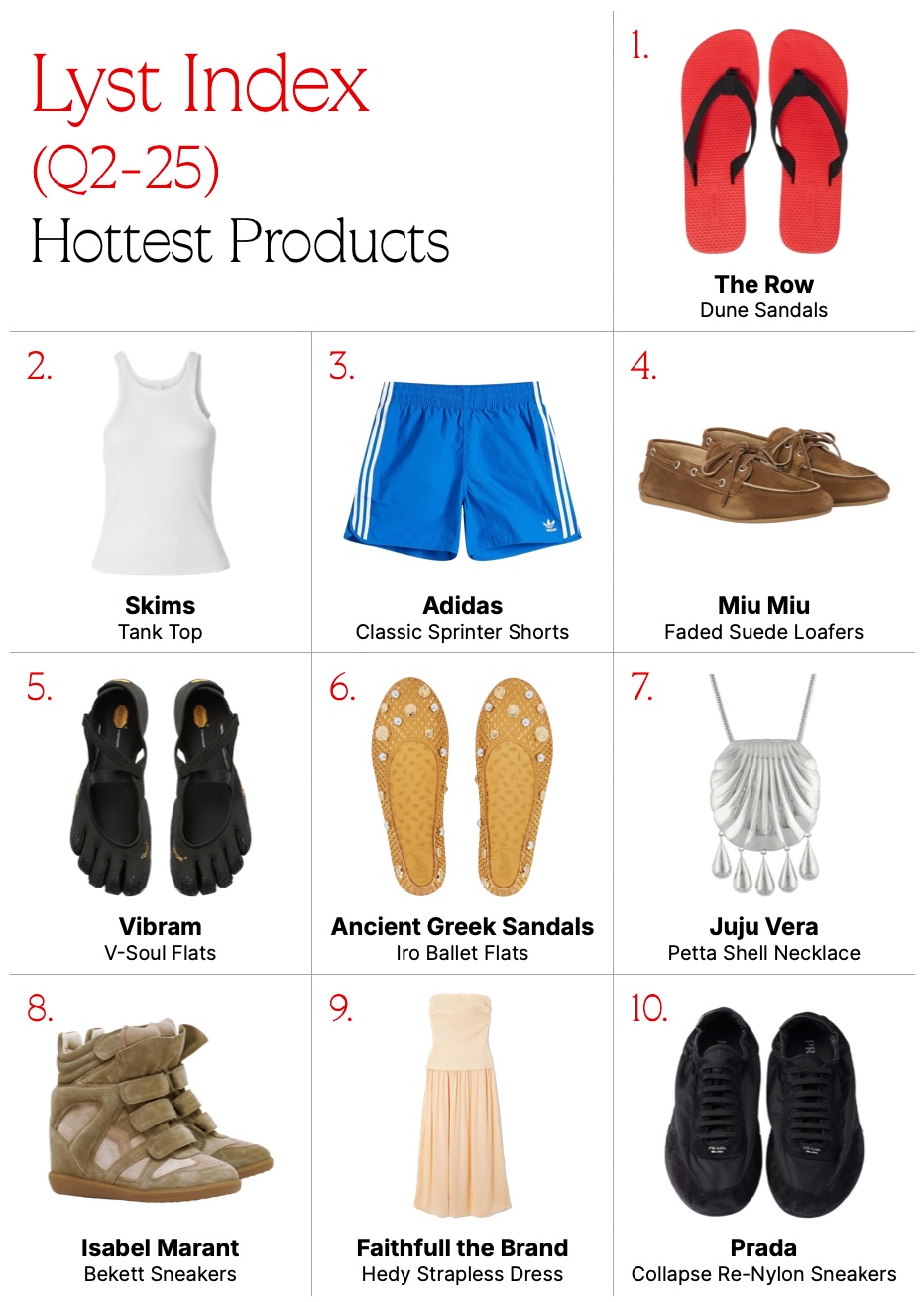
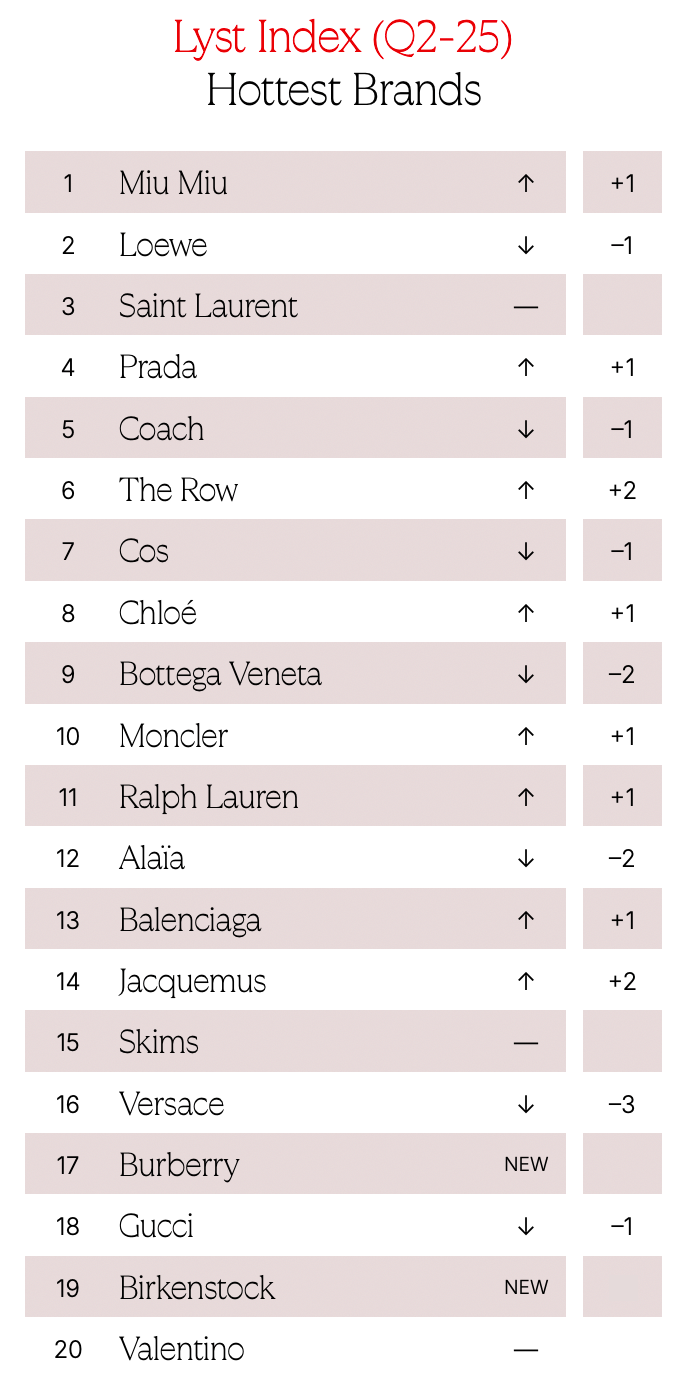
Plus, Sarah Shapiro’s back to reveal Q2’s hottest products and brands, according to Lyst, which includes already ubiquitous newbies and resuscitated favorites, across tastes and price points. (Yes, Miu Miu and The Row are repped, but so are Isabel Marant and…Vibram.)
Mentioned in this issue: Sephora, Ulta Beauty, Hailey Bieber, Jean-André Rougeot, Priya Venkatesh, LVMH, Jessica Phillips,
Mario Dedivanovic, Phoebe Philo, Condé Nast, Roger Lynch, Lyst, Birkenstock, Burberry, Joshua Schulman, and many more… |
|
|
A MESSAGE FROM OUR SPONSOR |
Very few companies share what’s happening behind the scenes in wholesale. We do — because we’re curious, and
we know the industry is too. Over 100 real brands recently shared with us what’s working (and not working) right now in wholesale. Spoiler alert: it’s not more DTC or marketplace whiplash. It’s ruthless efficiency, low-risk wholesale, and smarter supply chains. Download the 2025 State of B2B report. |
|
|
Three Things You Should Know…
|
- More
Phoebe distro intel: Big news for those of you who would like to buy a Phoebe Philo item at discount: There is a selection of goods currently for sale on Farfetch.com and marked down by, in some cases, more than 20 percent. (Consider these trousers.)
How long will these items remain on Farfetch?
Many brands are strict about their store partners selling through the platform, but this speaks to Phoebe Philo’s larger distribution strategy. To start, the company had a very disciplined channel strategy, focusing on their owned and operated platform. But then the founders pivoted, either out of opportunism or necessity (probably both), and are now selling to independent stores and even some online retailers, including Mytheresa and FWRD—although those dot-coms can only sell the items
via private channels.
The Farfetch slip will allow Philo’s store partners to peel off some product indirectly. I get the thinking here, and perhaps the iterative strategy will work long term. But it’s further proof that there is simply no replacement for an LVMH-like store network in the luxury market—just as Philo, herself, knows from her days at Céline. - Condé Nast games: Things are getting weird at One World Trade. Tuesday’s
town hall, led by C.E.O. Roger Lynch, was apparently pretty bizarre. Employees in the know were expecting a business update, given that the second quarter just closed and Lynch had recently returned from a board meeting in London. Instead, they were regaled with a re-creation of an Epicurious video, featuring the cast of Squid Game, which has recently gone viral. (This version featured Lynch and the global V.P. of brand marketing, Paul
Robertson, who I hear is hilarious offline.) As one attendee put it, “You can’t make this up!”
To be fair, there’s something to be said for boosting morale with fun-loving attempts at celebrating wins—some people are just cringey, and that’s okay. (Last year, they did a Vogue app sendup that people really liked.) The problem was that there were no real answers about what’s happening with the business. Even if there was nothing to worry about, a town hall would
have been a great moment to address various concerns—including the potential layoffs in the fall and, as the union reps put it on their Instagram account, “the future of the company.”
Last week, those reps sent Lynch & Co. a list of questions that they were hoping to have answered in the town hall, including, “How will the company support its workers in achieving [K.P.I.s] with shrinking resources?”; “Is the company for sale?”; and “Will full-time union workers be hired in-office to
replace the colleagues who are forced out when their remote status is revoked?” (The list of questions goes on…)
The single reveal, at least according to one analytical employee, was that Lynch is still betting on commerce, and will continue investing in that channel “despite the clear impact A.I. is having on commerce revenue” and the fact that peers have largely moved off the content-to-commerce train. In all, though, it was “somehow even more dystopian than the meetings in which
they’ve acknowledged things are bad.” A rep for Condé Nast did not respond to a request for comment.
|
|
|

| Sarah Shapiro
|
|
- The Isabel Marant wedge
sneaker is back, for real: As you know, Lyst compiles the habits of 160 million shoppers—insights we can pillage for a better sense of actual consumer behavior now that we’re out of Q2. In terms of brand rankings, there was surprisingly little movement. A few highlights: The seasonally relevant Birkenstock, ranked No. 19, was fresh to the list, while
Burberry showed up at No. 17, thanks to the recent festival campaign and tweaks to the business strategy from C.E.O. Joshua Schulman. Both are worth keeping your eyes on.
|
- Meanwhile, the top merchandise
rankings reflected how, generally speaking, sporty and laid-back products performed well this quarter. Those topping the list, in descending order, include The Row Dune flip-flops, a Skims tank top (yes, a white rib snagged the No. 2 spot), Adidas
baggies, Miu Miu suede boat shoes, Vibram V-Soul sneakers, the return of the Isabel Marant Bekett Y2K wedge sneakers,
and Prada’s low-profile Re-Nylon sneakers. Despite all the chatter about $690 flip-flops this quarter, none of these items are particularly major investments. Even the designer items are in the accessible price range.
Another noteworthy appearance is the Juju Vera shell pendant—which, more
than anything, highlights how much influencers are still influencing us. If the item hadn’t been splashed on Instagram Stories and linked in Substacks, it probably wouldn’t have registered, especially given that no other pendants made the list.
|
- Finally, fast-moving brands included
Pucci, the nostalgic and resort-ready brand of the summer, which saw a 96 percent increase this quarter compared with Q1. Róhe, up 27 percent this quarter, will likely continue to perform into the fall. (The brand appeals to the Toteme, Kallmeyer, Maria McManus, and TWP crew; I’ve already seen this jacket pop up in several
fall roundups.) And Jacques Marie Mage, the status-signaling luxury eyewear brand, saw a 34 percent increase. That’s noteworthy for a brand that starts around $700 and often sells for more than $1,000 a pair.
|
|
|
The mass American retailer is embarking on a global expansion that will begin to challenge
Sephora’s 35-nation global presence—and, more importantly, loosen its decades-long vise grip on the beauty retail business. |
|
|
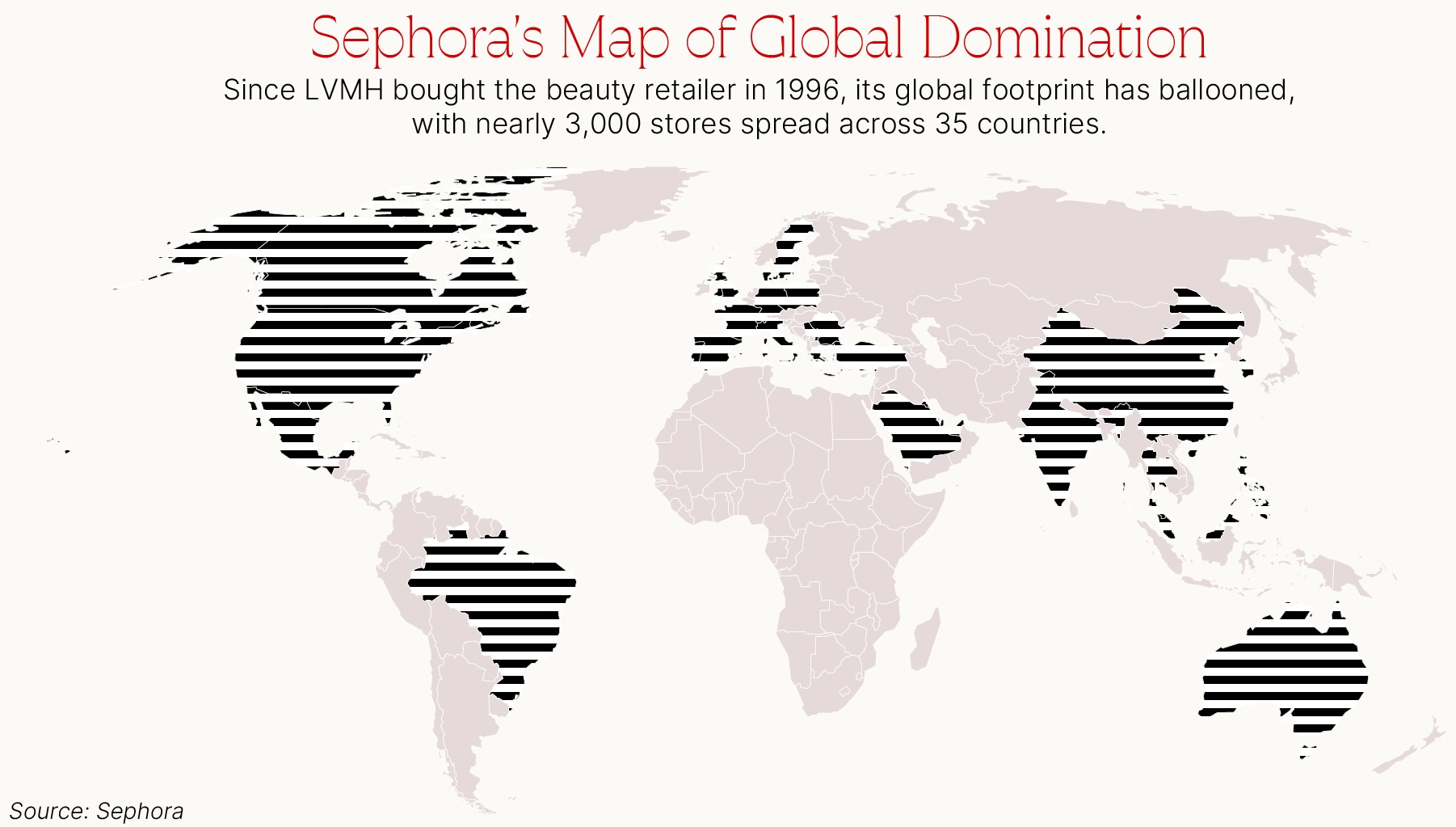
Sephora, LVMH’s retail beauty juggernaut with 3,000 stores in some 35 countries, has been the place to debut your beauty brand for decades. And given the spate of recent high-profile brands about to launch—from Hailey Bieber’s Rhode to haircare from “The Rachel” creator Chris McMillan—that remains an irrevocable truth. Sure, makeup and skincare sales are generally softening, but Sephora has generally been immune to the challenges facing parentco LVMH’s Perfumes & Cosmetics division. In fact, LVMH executives recently praised Sephora’s profit and revenue performance from the
first half of the year, specifically citing Europe, Latin America, and the Middle East as regions seeing “robust growth.”
But nothing lasts forever. Recently, Ulta Beauty—ostensibly Sephora’s biggest competitor in the retail beauty space, at least in the U.S.—has taken a handful of steps that could threaten that dominance. Last year, the company revealed that it would open doors in Mexico, and in February, Ulta’s new C.E.O., Kecia Steelman, announced that
the retailer would enter the Middle East. Earlier this month, the company announced the acquisition of Space NK, a retailer that operates more than 80 doors in the U.K. and Ireland, marking the first time that Ulta will have a European footprint. Ulta already has a robust network of 1,450 or so domestic stores—more than double Sephora’s U.S. door count—but the addition of 83 Space NK storefronts will dwarf Sephora’s tiny, but growing, network of 10 U.K. stores overnight. |
|
|
A MESSAGE FROM OUR SPONSOR |
There’s a reason the industry doesn’t publish wholesale reports often: it’s nuanced, behind the scenes, and
not particularly sexy. But we do it anyway because we care about how brands actually thrive. Our latest B2B report contains data we gathered from 100+ real brands. From choosing retail partners to ditching digital tools they barely use, brands are being ruthless about wholesale efficiency and control. Get your free copy. |
|
|
Historically, brands enter Ulta only after their multiyear exclusivity with Sephora has expired. But that
dynamic might change as Ulta beefs up its global operation. “[Sephora executives] used to think Ulta was lowbrow, and that it wasn’t a prestige experience,” said a person with knowledge of the situation. “It wasn’t thought of as that big of a threat as it’s become in the last five years.” Before he left in 2024, Sephora C.E.O. Jean-André Rougeot started pushing to open “drive-up, strip-mall-type doors for convenience,” and to partner with Kohl’s to head off the
threat. Now, with Ulta preparing to go global, the sentiment at the highest rungs of the organization has only become more serious. |
Ulta’s global merchandising strategy is said to be led by Jessica Phillips, who previously
spent six years reporting to Sephora’s global chief merchandising officer, Priya Venkatesh, before switching sides. According to an insider, it was “a big deal” when Phillips decamped. (“No one leaves Sephora to go to Ulta.”) Moreover, as multiple sources noted, Phillips is considered a strong merchant—a veteran who knows how to recruit great brands. “It was drama, and because California has no noncompetes, Jessica walked out and right into Ulta,” the insider added. “Now she’s
going head-to-head with Priya.”
Phillips may be slightly less experienced than Venkatesh, but she understands how Sephora works. And now, with the Space NK acquisition, Ulta can begin offering a cohesive global platform to brands from the beginning of their partnership—an edge that Ulta previously lacked. “Building a global presence from the ground up makes it easier to have consistency and integrate that from the beginning, something Sephora hasn’t been able to do,” said the person with
knowledge of the situation. |
Of course, that’s not entirely true: Sephora has been able to entice
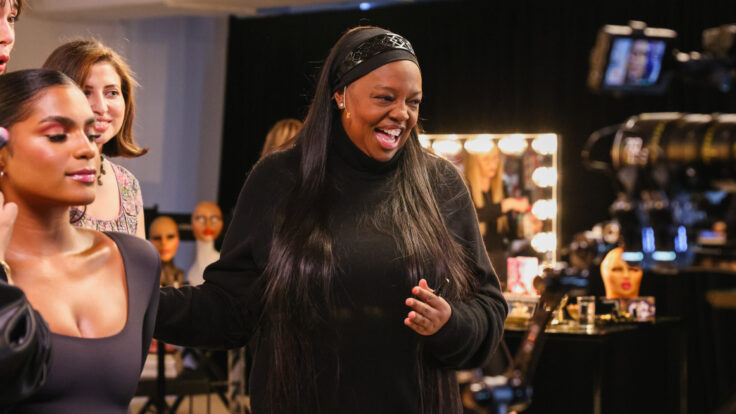
vendors into exclusive global distribution partnerships by promising priority status—which, in semi-layman’s terms, means outsize support in every market. But Sephora has really only been able to prove that out with Fenty, the first time the retailer ever pulled off a global launch. (“It’s a work in progress,” I’m told.) Another recent win for Sephora was Makeup by Mario, a Sephora exclusive that launched in several European countries simultaneously. In May, its founder and C.E.O., Mario
Dedivanovic, embarked on the retailer’s first “international masterclass tour,” which took him to Sephora U.K. and the retailer’s new store in Hamburg.
The battle, as always, is about which retailer lands the right brands, and how long those exclusivity arrangements last. LVMH executives have said that their exclusive brands, which make up “nearly half the brand portfolio,” are also responsible for Sephora’s highest increases for the first half of 2025. But Ulta can play the same
game by guaranteeing other brands priority launches in multiple markets around the world.
Naturally, Ulta is starting to negotiate with brands in the markets it plans to expand to, like the Middle East—where Sephora has been the beauty retailer of record mostly because it’s never had a viable competitor—and Mexico, where it’s taken Sephora close to 15 years to even begin to gain traction for its 30-plus stores. Ulta will likely start trying to onboard brands
in the U.K. as well. None of this is great news for Sephora, which has very strong businesses in the U.S., Canada, the Middle East, Southeast Asia, and France, but has less of a foothold in Australia, India, the U.K., and China—the last of which, I’m told, has been “the biggest flop” of all.
|
|
|
Sephora faces structural challenges related to its parentco, too. Despite attempts to allow for more shared
resources and communication, LVMH is a huge, sprawling multinational organization with more than 74 different businesses. Sharing resources and intel is always a challenge. I’ve heard from multiple sources that Sephora U.S. typically has had no idea what was happening in other global markets, which was the impetus for Venkatesh’s newish global team. In fact, one of the biggest grievances among U.S. vendors expanding into global markets is learning that teams within Sephora—contracts,
negotiations, support, and even the level of merchant talent—are completely different. “It’s a bit of a shock to the system, and you don’t know how to navigate it,” a person close to Sephora told me.
Perhaps Ulta can learn from this pain point to offer partners operating plans on a global level. Or maybe the company can even adopt a business model similar to Mecca, the leading beauty retailer in Australia, which manages everything from marketing and P.R. to logistics, so that vendors
don’t need boots on the ground. Similarly, India-based Nykaa entered the Middle East via a joint venture, Nysaa, that offers a tiered structure of margin where brands can decide how much of the logistics they want Nykaa/Nysaa to handle. “The masterstroke would be to do an alliance with [the retailer] Douglas, which is number one in Europe, but does need brand differentiation,” a veteran beauty executive suggested.
Now that would be a power move. But it’s hard enough to
scale, and even harder to integrate services along the way—especially when competing against a best-in-class competitor. After all, while Sephora and Ulta are competing in their own cold war, both are essentially testing out a two-fold proposition: How big is the global retail market? And, relatedly, is it big enough for the both of them? |
There is another Barneys New York project in the works. This one is fancier, with writer Beth Schacter (Billions, The Morning Show) and big-time director Joe Wright (Pride & Prejudice, Atonement, a Keira Knightley Chanel commercial) attached. It’s based on They All Came to
Barneys, Gene Pressman’s forthcoming memoir about growing up in the business. As a refresher, the Gossip Girl people are already working on a show in partnership with Authentic Brands Group, which owns the I.P. to the Barneys New York name.
[Deadline]
Wall Power art correspondent Julie Davich did a great job of explaining how the secondary market for handbags (and, in particular, Birkins) ballooned. [Puck]
You
have to love it when a writer’s personality comes out in a standard trend piece. Enjoy Liana Satenstein on the red-soled return of Louboutins. [NY Times]
Sam Lobban is leaving Nordstrom—where he currently runs the designer and apparel businesses—to be the C.E.O. of Zegna-owned Thom Browne, which has never
been more widely distributed but is struggling in China, like everyone else. Congrats to Sam. Over at Nordstrom, here’s hoping Rickie De Sole and Jian DeLeon get promotions. [WWD]
Lauren will do an end-of-earnings-season reflection in tomorrow’s issue, but the primer on the
Prada Group’s numbers is that Miu Miu boosted the overall group with a 40 percent year-over-year increase in sales during Q2. Prada is doing okay, too, given everything. (In the second quarter, sales at the marquee brand’s directly owned stores were down 3.6 percent, missing analyst expectations. Seems like wholesale gave them the most trouble this first half.) Also: D.T.C. sales were up in every region overall, even in Japan and China. Profit margin was steady. Not bad.
[Prada Group]
ShopMy has launched a bunch of new tools to get consumers to actually shop via the platform, not just through their affiliate links. [BoF] |
Until tomorrow,
Lauren
P.S.: We are using affiliate links because we are a business. We
may make a couple bucks off them. |
|
|
Puck fashion correspondent Lauren Sherman and a rotating cast of industry insiders take you deep behind the scenes of this
multitrillion-dollar biz, from creative director switcheroos to M&A drama, D.T.C. downfalls, and magazine mishaps. Fashion People is an extension of Line Sheet, Lauren’s private email for Puck, where she tracks what’s happening beyond the press releases in fashion, beauty, and media. New episodes publish every Tuesday and Friday. |
|
|
The industry’s go-to source for unflinching reporting on the trillion-dollar business of artificial intelligence - perhaps the
single most important technology of our time. Ian Krietzberg, the powerhouse journalist behind The Deep View, delivers twice-weekly insights into the latest dealmaking and breakthroughs in A.I., and how the intersecting worlds of finance, entertainment, media, and politics are being transformed in its wake. |
|
|
Need help? Review our FAQ page or contact us for assistance. For brand partnerships, email ads@puck.news. You received this email because you signed up to receive emails from Puck, or as part of your Puck account associated with {{customer.email}}. To stop receiving this newsletter and/or manage all your email preferences, click here. |
Puck is published by Heat Media LLC. 107 Greenwich St, New York, NY 10006 |
|
|
|