Welcome back to Wall Power, sports fans. I’m Marion
Maneker.
The May auctions and art fairs in New York consumed a lot of oxygen, but I don’t want to choke off attention for some of the great openings of the last few weeks. So tonight, I’m sharing four shows at Pace Galleries that debuted earlier in the month and will be on view until at least the end of July. Think of this as an invitation to spend some time in Chelsea.
Up top, a look at Kalshi’s new prediction markets for art. (What took them so long? Oh, right.
It’s not as easy as it seems.) Plus, there’s been movement in prices for an obscure artist who died 18 years ago (I’d like your help understanding why), and Sotheby’s has revealed Joe Lewis’s star lot for the June sale from his collection.
Also mentioned in this issue: Leonardo, Claude Monet, Basquiat, Margo Hoff, Gertrude Abercrombie, Lucian Freud, Sue
Tilley, Paul Allen, Emily Kam Kngwarray, Julian Schnabel, David Hockney, Glenn Fuhrman, Ann Craven, Paul Thek, Robert Wilson, and more.
Let’s get into it… |
-
Kalshi wants you to bet on Joe Lewis’s art: I got a note last Saturday from a lawyer who had noticed that Kalshi, not surprisingly, is trying to create a prediction market around art auctions. As some of you will know or remember, I used to run a fantasy art collecting game. Many of the former players keep asking me when I will revive it. But as I explained to my correspondent, one reason not to run an art-auction prediction market is that the sales have become so heavily
managed—especially the most visible ones from collectors with name recognition—that it makes betting difficult. Who has any real knowledge of the third-party backer conversations? Low volatility doesn’t favor a betting market.
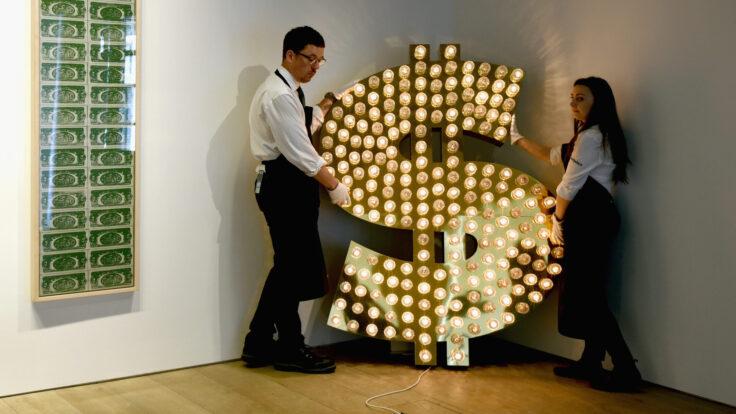
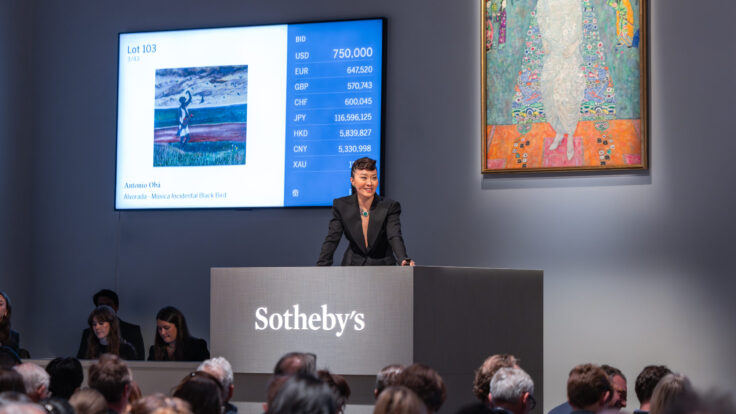
So far, Kalshi has put nine works from the Joe Lewis sale in London up for contracts. The bets will be settled based on the all-in price with fees reported on
Sotheby’s website, which means bettors will have to be familiar with the auction house fee structure as well as the discounts for guarantors. There’s also a problem with several of the bets, which are phrased as “Will Leonardo [or Claude Monet or Picasso or van Gogh or Basquiat] break his auction record this year?” Of course, there’s no indication that any of these artists will have a work come
to auction this year that could break the auction record. For instance, I can say with near certitude that we will not see a Leonardo record anytime soon—that would require the discovery of a new work, which happens but once every few hundred years. Anyway, good luck to those who cannot resist playing. I’ll be rooting for you.
|
|
|
|
A MESSAGE FROM OUR SPONSOR |
Writing essentials for the journeys ahead. Explore the new Montblanc
collection. |
|
|
|
- Margo Hoff breaks records: An art advisor tipped me off to the movement in auction prices for the artist Margo Hoff, who died 18 years ago in her Manhattan loft and studio at the age of 98. The advisor noticed that Hoff’s work had begun to trade at a premium late last year. The previous record for a work by Hoff had been $30,000, achieved for Dream of Flying, from 1950, in February of 2024. But on the same day last December, at Wright Auction in
Chicago, two Hoff paintings sold for higher prices: The Well, from 1942, made nearly $51,000, and Gypsy in the Window, from 1946, made $95,000. Then, last week, Dream of Flying came back to market at Christie’s and sold for nearly $140,000—quadruple the previous price in a little more than two years.
The advisor’s question to me was, What’s going on here? My thought is we’re seeing the beginning of a reengagement with the artist similar to what happened
with Gertrude Abercrombie. But that’s just a guess. If you have any hard information you’d like to share, hit reply to this newsletter or get in touch with me at 917.825.1391 on SMS or WhatsApp.
|
Joe Lewis’s
$33 Million Freud, Revealed
|
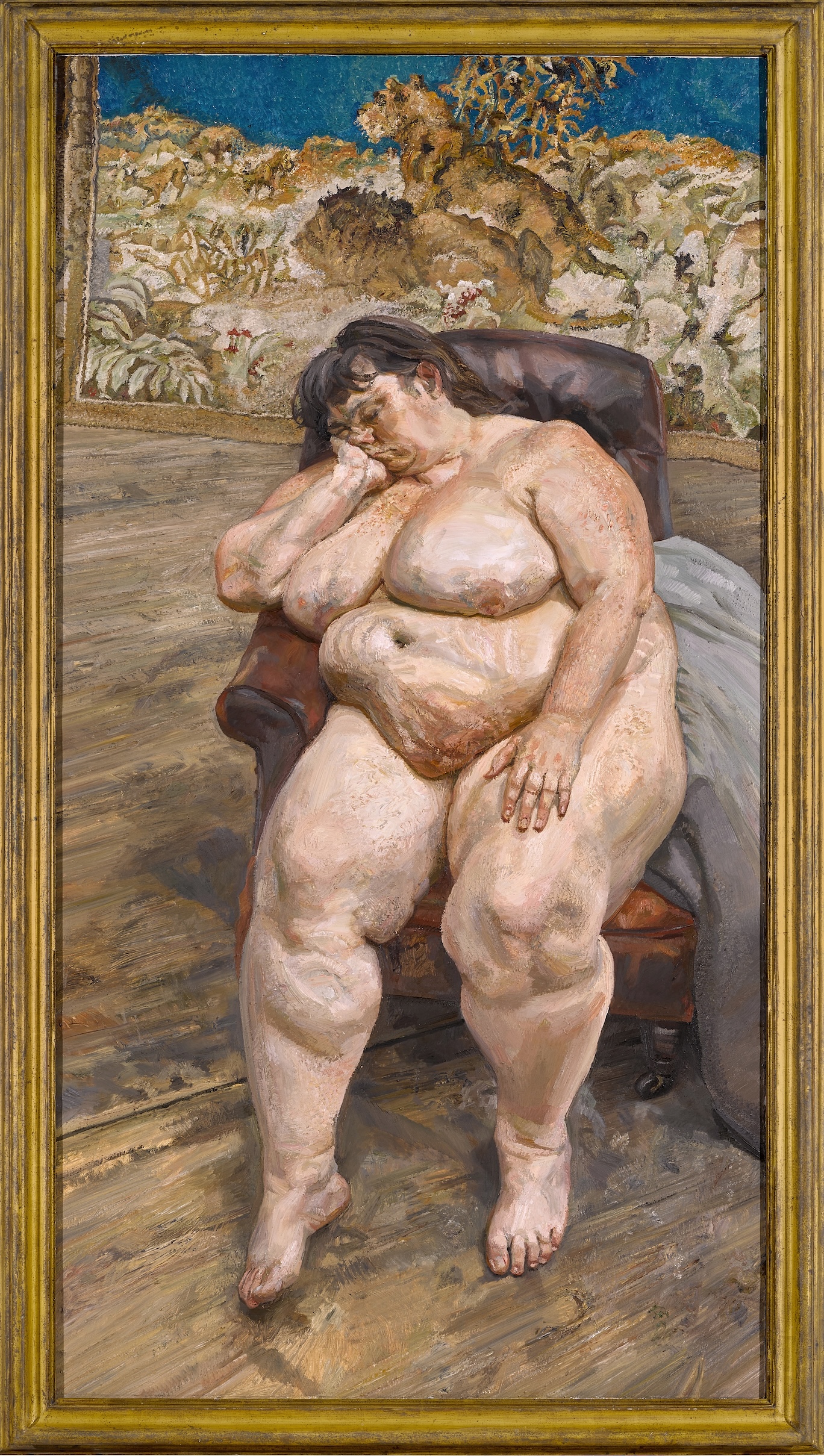
Lucian Freud, Sleeping by the Lion Carpet (1995-96). Photo: Courtesy of
Sotheby’s
|
Sotheby’s has released the top lot in the Joe Lewis sale slated for June 24th—Lucian
Freud’s painting of Sue Tilley from 1995-96, titled Sleeping by the Lion Carpet. The work, one of four paintings he made of the sitter, is estimated at £25 million ($33 million). That immediately puts the selling price equal to another painting of Tilley sleeping—Benefits Supervisor Sleeping, from 1995—which sold in 2008 for a then-record price of $33.6 million.
Then in 2015, another Tilley portrait, Benefits Supervisor
Resting, from 1994, sold for $56 million. And four years ago, an earlier, 1980 Freud painting that had been owned by Paul Allen sold for a record price of $86 million. In that context, the £25 million estimate on this painting seems restrained.
Now, let’s head to Chelsea… |
|
|
|
The global gallery represents a wide range of artists, but there is something
different about the four shows currently on view in New York. |
|
|
|
Before the May auctions roadblocked our coverage, I went to a few openings in Chelsea,
and I didn’t want to let them slip by without discussing them with you. The good news is that the big global galleries now open their shows in early May, and they’ll be on view well into the summer. That means there’s still plenty of time to see some great exhibitions if you find yourself in Chelsea on a humid afternoon looking to enjoy some visual stimulation, discover new art, and bask in the air conditioning.
For instance, on the morning that Frieze opened at the Shed in Hudson Yards,
Pace Gallery invited a handful of journalists to view four exhibitions opening in its galleries on 25th Street. As you know, Pace is a global gallery, with a long history, that represents a wide range of artists. But there was something about the mix of these four shows that was a bit different. |
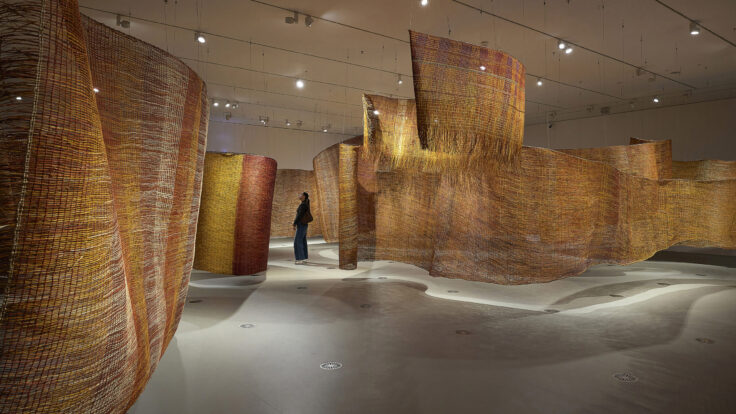
At one end of 25th Street, the gallery is showing the work of Australian Indigenous artist
Emily Kam Kngwarray (pronounced nung-wuh-ray, though many refer to her as Emily). Dedicated readers will remember that the Tate Modern opened a retrospective of her work nearly a year ago. One of the show’s revelations came by way of a large photomural created from an aerial shot of the Australian outback.
Juxtaposed with Kngwarray’s works, the image made the artist’s dots and lines seem far more documentary than abstract. |
|
|
|
A MESSAGE FROM OUR SPONSOR |
Writing essentials for the journeys ahead. Explore the new Montblanc
collection. |
|
|
|
Pace is putting on its own Kngwarray show in conjunction with D Lan Galleries, a dealer
in Australian First Nations art that has exhibition spaces in Melbourne, Sydney, and New York. It follows a similar show that Pace mounted in London to support the Tate retrospective. Besides displaying a very good selection of Emily’s works, the current show has a room of batiks that she made in the 1970s—a time when Aboriginal art was first being expressed on canvas and other flat materials. Back then, men held a cultural veto, and women artists were confined to working in batik until Emily
swept that prohibition away. That should not denigrate the cloth art works, which are vivid and electrifying.
While stomping around Chelsea yesterday, I ran into an art dealer who expressed interest in Kngwarray but felt a little under-educated about Aboriginal art. I suggested he look at the catalogue for D Lan’s three-city
show to get a better sense of the genre’s range, or even visit that gallery’s 73rd Street branch to see some of the works in person. But his point was worth noting: Collectors need a cast of Aboriginal masters to orient themselves around. Kngwarray is one of the undisputed names in the field who can—and should—bring new buyers. And though there have been some good shows of
Aboriginal art this year in New York and Washington, D.C., we have a long way to go before there is easy familiarity with names. |
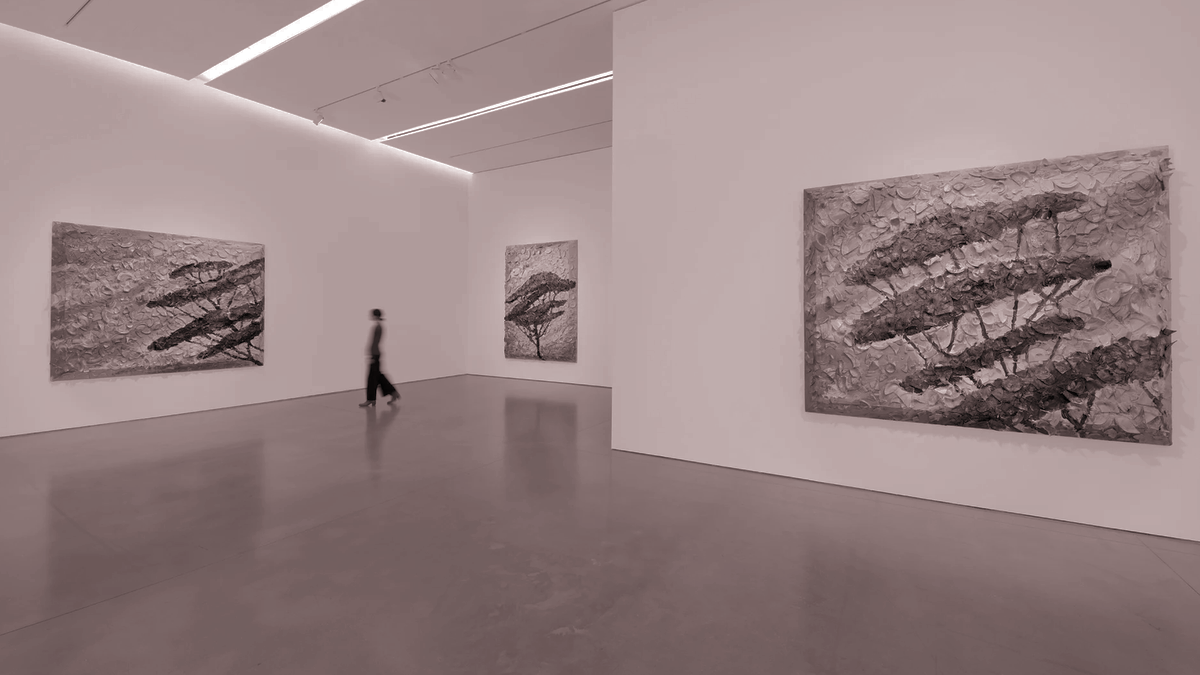
At Pace’s main building, Julian Schnabel has taken over the
primary, ground-floor space with a show centering on the theme of Italian pine trees, whose distinctive, layered canopy appears as almost abstract forms in his paintings on maps and broken crockery. Schnabel’s art has gotten prettier over the course of his career—I don’t know whether that’s a function of his work as a filmmaker or just something that
comes with age. But the pine trees and sky-blue backgrounds of these works are only part of the prettification; the flat maps allow Schnabel to show off his draftsmanship, too.
Schnabel’s most recognizable format remains the broken plates, which serve as a substrate for image-making. If you saw Mnuchin Gallery’s final exhibition
this year, it was clear that the plate paintings Schnabel made in the late 1970s and early 1980s were darker, cruder, and more enigmatic. His return to the format years later—when he started copying bright, iconic images—suggested that he was still quite self-conscious about the plate paintings and how they defined him as a painter. But in this show of the Italian pines, the plates are just one alternative to the paintings on maps—and the pictorial emphasis is back on the images themselves.
|
Hockney’s
Moonlight Sonata
|
Upstairs at 540 West 25th Street, Pace is showing a
room of David Hockney’s iPad paintings, which were created during the pandemic when he was holed up in a farmhouse in Normandy, as one does. Between April and December of 2020, Hockney, an eager adopter of new technology for the making of art, drew the night sky on his iPad every time there was enough moonlight to cast shadows. Remote Normandy’s
lack of light pollution, combined with the backlit screen of his device, gave Hockney the opportunity to do something that’s difficult for any painter: work in the dark to capture the subtleties of moonlight.
The show brings together 15 of these works in a dimly lit room with cobalt blue walls that re-creates the artist’s own experience of the landscape. After your eyes adjust, you are transported to the French countryside under a night sky. But the subject matter is only one feature of
the iPad drawings. Printed on paper and mounted on aluminum, these works are now very much in demand—recent sales of iPad drawings at auction have reached prices as high as a million dollars, although these are surely not priced anywhere near that.
Finally, it just so happens that across 25th Street, at Glenn Fuhrman’s FLAG Art Foundation, there’s a show featuring Ann Craven’s Moons, from 2012. The work is 87 small, 14-inch square canvases depicting moons, and it only takes five minutes to get a welcome perspective on the subject matter. |
|
|
|
For years, I have heard dealers and collectors speak with reverence about the artist
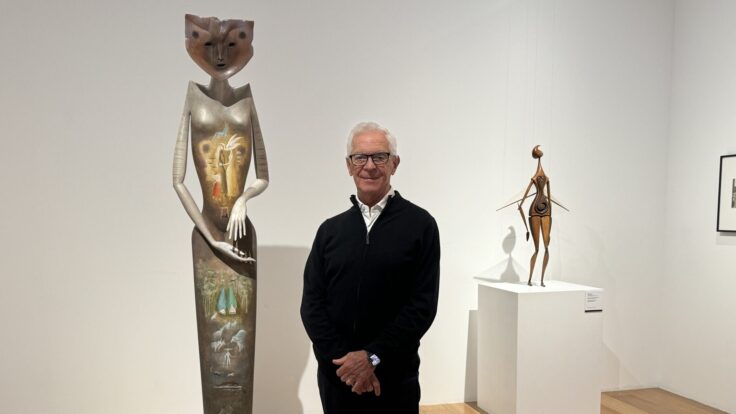
Paul Thek, but I was never able to get a good sense of his work, and I had missed the 2010 retrospective mounted by the Whitney. That makes the new show Dream of Vanishing—featuring 50 works by the artist, many of them never seen before—somewhat essential.
One reason Thek is hard to visualize as an artist is that he doesn’t have a
telltale style, or even medium. The show features a number of different series of works, including his lifelike depictions of human flesh, often just called the “meat pieces”; a series of “bad paintings” Thek made in the 1980s; and some poignant works from the last years of his life, when he was suffering from AIDS.
The show opens with selections from Thek’s series of small paintings illuminated by old-fashioned lights, placed low on the wall in front of children’s school chairs. The
effect is to make the art remote and intimate to someone other than the viewer. For me, though, the revelation of the show was the five long paper scrolls that Thek made in the 1970s and gave to his friend, the director Robert Wilson. Completely unrelated to any of Thek’s other output, these five black-and-white works evoke van Gogh’s copies of his own work, as well as pen-and-ink drawings and cloud- or seascapes that capture movement.
Thek remains
somewhat inscrutable as an artist. But the absence of an easy answer is not the same as an absence of intrigue. The show only deepens the allure of the artist’s reputation. |
I’m going to leave it there. You have a weekend to get to—and so do I. We will pick this
all up again on Sunday night. Speak to you then.
M |
|
|
|
Puck founding partner Matt Belloni takes you inside the business of Hollywood, using exclusive reporting and insight
to explain the backstories on everything from Marvel movies to the streaming wars. |
|
|
|
Unique and privileged insight into the private conversations taking place inside boardrooms and corner offices up and
down Wall Street, relayed by best-selling author, journalist, and former M&A senior banker William D. Cohan. |
|
|
|
Need help? Review our FAQ page or contact us for assistance. For brand partnerships, email ads@puck.news. You received this email because you
signed up to receive emails from Puck, or as part of your Puck account associated with {{customer.email}}. To stop receiving this newsletter and/or manage all your email preferences, click here. |
Puck is published by Heat Media LLC. 107 Greenwich St., New York, NY 10006 |
|
|
|
|