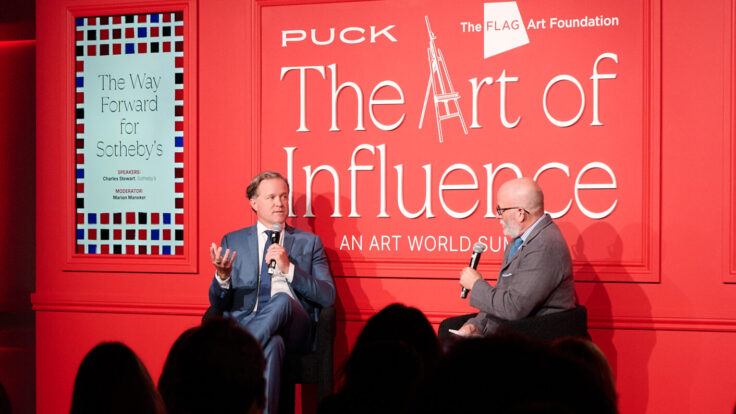
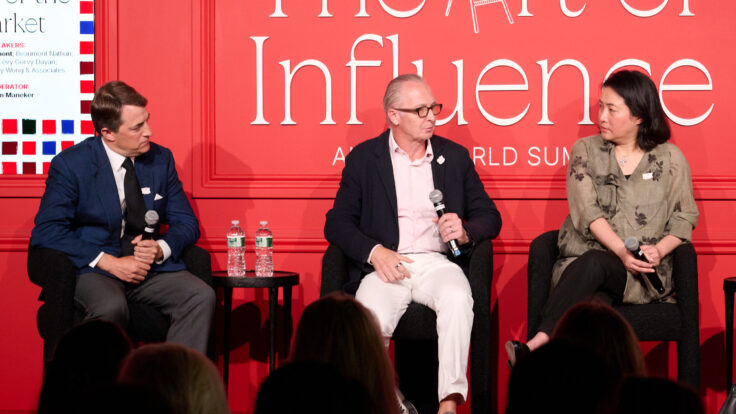
Welcome back to Wall Power. I’m Marion Maneker.
Tonight, I’m
going deep on the Newhouse collection, and for good reason—there are a number of fascinating subplots behind the sale. Up top, Phillips maintains its well-earned reputation as the scrappy, alternative house by announcing its largest evening sale by value in four years.
Mentioned in this issue: Si Newhouse Jr., Jasper Johns, Jackson Pollock, Andy Warhol, Tobias Meyer,
Claude Monet, Francis Bacon, Piet Mondrian, Henri Matisse, Robert Rauschenberg, Joan Mitchell, Agnes Martin, Alberto Giacometti, Gerhard Richter, and many more… |
|
|
|
A MESSAGE FROM OUR SPONSOR |
Nudo: An Evolving Icon For 25 years, Nudo has distilled color into pure clarity and form. The Toi et Moi earrings extend that vision, pairing a luminous amethyst with hand-set diamond pavé in a composition that feels both precise and effortless. A study in contrast and balance, they embody jewelry worn on instinct, defined by personal style, not occasion |
|
|
|
-
Phillips presents an $87M evening sale for May: While the other auction houses battled over big-name collections this season, Phillips was quietly gathering a 42-lot evening sale featuring works by Jackson Pollock, Claude Monet, Andy Warhol, Joan Mitchell, Agnes Martin, and Alberto Giacometti. The $87 million presale estimate is the highest since the salad days of 2022—a signal that the
art market’s supply-side return to health may be broad-based, or at least as broad as multimillion-dollar works of art can be.
The lot with the highest presale number is Andy Warhol’s Sixteen Jackies, from 1964, which is estimated at $15 million even though it was purchased three years ago for $24 million. At first blush, that attractive estimate and the
short turnaround time might indicate a seller in need of funds. But there’s another prominent Warhol painting on offer (with a third-party backer) across town, and the likely consignors are very savvy and solvent sellers. So I am inclined to see this as evidence of animal spirits in the market for eight-figure paintings, especially by Warhol—something that’s been brewing for several seasons. Phillips has two other Warhols in its evening sale: a Marilyn reversal
painting and a self-portrait.
Another market-driving artist, Claude Monet, is represented in the sale by a snowscape from Vétheuil painted in 1879. Monet’s winter scenes have particular appeal—this painting previously sold in 2017 for nearly $11.5 million. Phillips
has the work backed by a third party, with a very attractive estimate of $7 million. The auction house also has a large Gerhard Richter abstract from 1984, once owned by prominent collector Raymond Learsy, on offer for $6.5 million and backed by a third party. The work’s
estimate is a hair below its $7 million estimate four years ago in Hong Kong, when it sold for just above $10 million.
At around the same level is a small Jackson Pollock estimated at $7 million. The painting had been part of Robert
Mnuchin’s collection until a year and a half ago, when it sold for $15 million to a guarantor who, as you’ll no doubt recall, failed to pay for it. Now Phillips is capitalizing on the presence of a major Pollock at Christie’s to remind potential buyers about the value of this painting. For fresh-to-market works, Phillips has a very pretty Joan Mitchell painting from 1989 that was owned by Miami philanthropist Tina Hills for nearly 40 years. That’s
estimated at $5 million.
|
Now, let’s get to the main event… |
|
|
|
This week, the third tranche of art from Si Newhouse Jr. is being offered by
Christie’s. The sale is a testament to both the Condé Nast owner’s limitless, keen-eyed collecting and Christie’s ability to stage it—and will inject nearly half a billion dollars into the art market while inspiring other collectors to open their wallets. |
|
|
|
Si Newhouse Jr.’s latest tranche of art, it’s no exaggeration to say, might just
save the market. Right now, Christie’s has 16 works with a combined estimate of $462 million on display in its Rockefeller Center galleries, though the auction house’s teams of specialists are still choosing wall colors and trying out different configurations for the 613 non-Newhouse works on offer. While the previews don’t begin until Friday, Christie’s has been letting art advisors and preferred clients into the galleries to see them—partly because the dramatic hero moments that the house has
created for Newhouse’s art are best experienced in some measure of calm, which will disappear once the doors open to the public.
The exhibition contains only a small number of the objects Newhouse owned when he died nearly a decade ago, just weeks short of his 90th birthday. It’s a carefully crafted enticement to the handful of potential buyers who can spend tens of millions of dollars on a subtly magnificent work of art. But it’s also an advertisement for the value and impact of
collecting. Newhouse may have been the rare collector who bought these works for his own personal enjoyment, but over the next couple of weeks, the crowds will help underscore the way in which owning great art enhances one’s reputation. |
The first inkling I had that the art market might see a significant jump in supply this season
occurred in the winter, when I ran into an art advisor who represents a major international collector who died last year. The advisor told me that the auction houses had been making overtures and then, suddenly, stopped. When I made further inquiries, I was told both houses had dropped everything, signed serious N.D.A.s, and begun pitching a different, very large estate. |
|
|
|
A MESSAGE FROM OUR SPONSOR |
Color in Motion Nudo
extends beyond a single design. With the Nudo bracelet, color unfolds across the wrist in a silhouette made to move with you. Each detail is crafted by hand and designed to catch the light. It embodies Pomellato’s creative ethos – jewelry without constraint. |
|
|
|
It’s now clear that they were competing for Newhouse. Tobias Meyer, who has
overseen a series of sales of the publishing magnate’s collection since his death in 2017, has netted the estate the better part of a billion dollars during the past decade. In 2018, Sotheby’s sold $300 million worth of art from the collection. Privately, that same year, the family sold Andy Warhol’s Orange Marilyn, from 1964, to Ken Griffin for $235 million. The next year, Christie’s held a $215 million sale that included Jeff Koons’s
Rabbit, from 1986, which made $90 million. In 2023, another group of 16 works—including an early Willem de Kooning and a Francis Bacon self-portrait—netted almost $178 million. It seemed like the Newhouse collection was petering out, but the market was also slowing.
More recently, Meyer saw what Sotheby’s had been able to do with the Leonard Lauder collection. (Who could have missed it?) Cannily timing the market, he set his
sights on this spring to sell more of Newhouse’s collection. Clearly, he had been waiting patiently for the mood of the world’s billionaires to turn toward spending on art, as it has—and for historical works to move back into the center of the conversation.
In the end, both houses came in with estimates so close to each other that they were nearly indistinguishable. Whether the choice of Christie’s came down to Meyer’s previous working relationship with the house or slightly
higher estimates for the very top lots, I can’t tell. But it is clear that Christie’s didn’t get the consignment solely based on its track record with Newhouse. It’s also clear that whatever’s going on in the art market at this somewhat fraught historical moment, Meyer is having a great time with this sale. (Read Nate Freeman’s excellent Vanity Fair
article to get a taste.)
And why not? He dropped half a billion dollars’ worth of art into the middle of a market deeply in need of high-quality historical works with a marquee provenance. That $462 million represents the bulk of the difference between last May’s $1.15 billion
presale estimate and this May’s $1.86 billion presale estimate for all of the auction houses combined. |
How
to Ask for $100 Million
|
In 2019, the last time he had a chance to present works from the Newhouse collection, Meyer came to
Christie’s with a vision: He wanted the Koons rabbit to evoke the final scenes of Stanley Kubrick’s 2001: A Space Odyssey. Christie’s designers made it happen, and the result spoke for itself. This time around, Meyer’s cinematic reference point for staging Constantin Brancusi’s Danaïde, from 1913, was Fritz Lang’s Metropolis.
When you go to Christie’s, you’ll see the small bronze with gold leaf sculpture,
estimated at a cool $100 million, sitting in the middle of a velvet walled cylinder, surrounded by a velvet railing. Seeing pictures of the presentation, I assumed that the railing was an Easter egg drawn from Francis Bacon’s work. As it turns out, the inspiration was a Vermeer exhibition in Amsterdam. The idea is to give viewers a tactile, almost haptic experience while
gazing at an object beyond their grasp, literally and figuratively.
Seeing the art in this setting won’t give you a sense of what it was like to live with works of this caliber. Newhouse didn’t have a dramatically lit chamber to display his Brancusi; it sat on a coffee table. Collectors have a different, more intimate relationship with their art—Newhouse probably more than most—but an auction house exhibition is about showing the works in the least personal, most awe-inducing way. You
have to justify the $100 million ask.
That’s a lot of money to put into an estimate, but in the case of Jackson Pollock’s Number 7A, 1948, which Christie’s had pushed out an exterior wall to present in its main gallery, that number may be intentionally suppressed. As the auction house learned just a few years ago, when it put a $200 million estimate on Warhol’s Sage Blue Marilyn only to sell the piece for $195 million, those numbers should entice
bidding, not put off potential acquirers. If you can afford a $100 million painting, it’s likely that you can also stretch to $200 million, but there’s a huge psychological threshold many bidders just won’t cross unless they’re carried away in an auction setting.
So there’s no good reason to put a higher estimate on the work, even though Meyer himself sold a Pollock privately 20 years ago for $140 million. (And another one traded privately for $200 million a decade ago.) Markets
fluctuate, and not all Pollocks are equal. This work is similar to another black drip painting on raw canvas—part of a recognized series Pollock made with enamel paint—that Newhouse also previously owned. That one was bought by the Macklowes and made $61 million in their 2021 sale. |
|
|
|
The Brancusi and Pollock will garner much of the attention, but there’s plenty of other art to
marvel at. The sale opens with a tribute to Pablo Picasso’s cubist innovations, including a study for the famed Les demoiselles d’Avignon, estimated at $6 million. One of the artist’s editioned bronze sculptures, Tête de femme (Fernande), from 1909, is estimated
at $40 million, and the buyer will likely end up paying close to the $48 million that another example sold for in 2022. There’s also Homme à la guitare, from 1913 and once owned by Gertrude Stein, which is estimated at $35 million. A Piet Mondrian painting from 1921, estimated at $35 million, was the personal property of James Johnson Sweeney, the influential MoMA and Guggenheim figure. And one of the sleepers of the
sale (if a painting with a $30 million estimate can be called such) is the 1938 Henri Matisse painting Robe noire et robe violette, where two faceless figures sit immersed in color.
It will be interesting to see how Robert Rauschenberg’s Levee, from 1955 and estimated at $7 million, will fare. Newhouse bought it from François
de Menil—no slouch in art-collecting circles—and nobody doubts the artist’s stature. But his market has been anemic in recent years. Rigger, from 1961, sold to a guarantor last May for $8 million, losing a third of its auction value over eight years despite having once been owned by Sally and Victor Ganz. Finally, there’s a trio of Jasper Johns paintings: Figure 2, from 1955,
estimated at $10 million; Gray Target, from 1958, estimated at $20 million; and the small but fascinating Alley Oop, estimated at $6 million. Newhouse’s
affection for Johns’s work can be seen across his collecting, and these three works are true connoisseur pieces. |
The
Sole Guarantor Theory
|
Sometime in April, I started hearing chatter that Christie’s was in negotiations to have a single
backer behind the Newhouse works. The art market is gathering momentum, but as the war in the Gulf threatens to disrupt the economy even further, third-party guarantees are important confidence builders. Having a huge chunk of art guaranteed to sell is the difference between a solid season and another slide back into worries that the best art is no longer relevant to the superrich.
The guarantee made sense, but I was having trouble figuring out why there would be a single backer.
The biggest potential buyers would not need to guarantee all of the lots to get an inside line on the best works. I was also intrigued by an alternative theory proposed by one well-connected art advisor. As we all know, being rich is only the start of getting access to great art. Could the backer be someone like Jeff Bezos—who just bought his wife passage to relevance at the Met Gala—trying to obtain access to better deal flow after dabbling with a few high-value purchases?
(Christie’s isn’t commenting on the existence of a single third-party guarantor.) It would certainly be cheaper than buying one of the auction houses.
Regardless of the mystery guarantor’s identity, the Newhouse sale is more than a transfer of assets—and it’s about more than the dollars it brings to a family that already has plenty. It’s a matter of making art essential to the buyers and the broader culture. Let’s see if that happens. |
Meanwhile, I’ll be back in the Inner Circle tomorrow, trying to give some shape to the upcoming
sales using data from our friends at ARTDAI. Join me there if you’re not already a member.
M |
|
|
|
Puck founding partner Matt Belloni takes you inside the business of Hollywood, using exclusive reporting and insight
to explain the backstories on everything from Marvel movies to the streaming wars. |
|
|
|
Unique and privileged insight into the private conversations taking place inside boardrooms and corner offices up and
down Wall Street, relayed by best-selling author, journalist, and former M&A senior banker William D. Cohan. |
|
|
|
Need help? Review our FAQ page or contact us for assistance. For brand partnerships, email ads@puck.news. You received this email because you
signed up to receive emails from Puck, or as part of your Puck account associated with {{customer.email}}. To stop receiving this newsletter and/or manage all your email preferences, click here. |
Puck is published by Heat Media LLC. 107 Greenwich St., New York, NY 10006 |
|
|
|
|