 |
 |
|
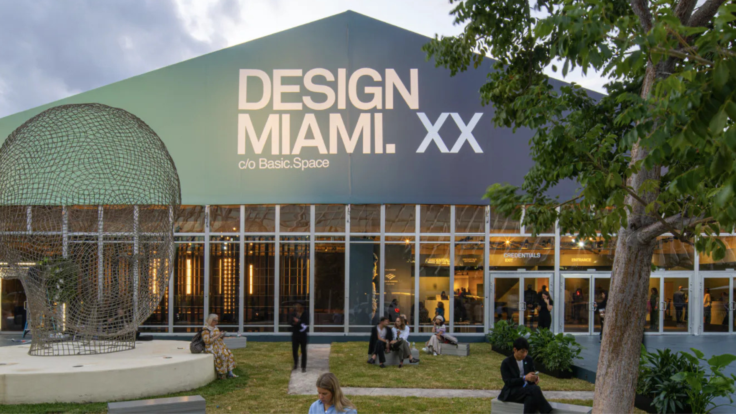
Welcome to Wall Power, where we are gearing up for the apex fair, Art Basel. Yes, there are now spinoff events in Miami, Hong Kong, and Paris, but Basel is the original, founded by Ernst Beyeler in 1970, and it remains the most desirable venue for galleries, which will spend years trying to gain access to its highest tier of collectors and museum curators.
Galleries still save their very best works for Basel in June. But for how long? Under pressure from new-ish owner James Murdoch to expand, the fair is using its flagship fair to launch its new brand extension, a merchandising program called AB by Art Basel. More on all that, plus a roundup of some of the most notable works on display, below the fold.
|
|
A MESSAGE FROM NORTHERN TRUST
|

|
|
While many collectors dream of passing their art on to the next generation, tax implications, differing tastes and the costs of maintaining a collection can complicate a well-intentioned — and sometimes emotionally charged — gift. Explore our guide for valuing, appraising and transferring your collection to ensure the pieces you spent decades collecting live on as you intended.
Art (left to right): Anna Kunz, Mock Orange, acrylic on canvas, 2024; Gwen Yen Chiu, Ink Stroke No. 3, darkened and welded stainless steel, 2024; Michael Hedges, High Tide, oil on canvas, 2024. Courtesy of McCormick Gallery
|
|
|
But first…
- More on those Sotheby’s London layoffs: The Financial Times has added to the available information about the scope of Sotheby’s layoffs in London, reporting last week that the auction house expects the total number, after consultation, to be around 50 people. That’s about 10 percent of the staff in London, substantially less than the 25 percent figure so many people in the art business have been throwing around.
Why Sotheby’s chose to let the rumors circulate for several weeks remains a bit of a mystery, especially when the firm has a strategic story to tell around the shift in resources with this summer’s opening of its new Paris headquarters. Selling art in Europe now requires a strong presence in both London and Paris.
At the same time, the FT’s headline writers seem to have fallen for a false equivalency in suggesting that Christie’s might also be making personnel moves that are anywhere near the scale of what’s happening at Sotheby’s. Anyone who has been in the business for a while will remember that Christie’s already did a massive restructuring of its London business, in 2017, when it closed its South Kensington salerooms, which focused on antiques and furniture.
- We told you there would be lawsuits…: Plaintiff’s law firm Milberg has filed a class-action suit against Christie’s, estimating that as many as 500,000 individuals might have had their data exposed in the recent hack of the auction house. (Wouldn’t it be great if there were actually that many active collectors in the art world?) Efstathios Maroulis, who also seems to go by Steven, is the plaintiff in the suit, which would appear to be an opening gambit by a firm well-known for its activities in the class-action space. Don’t expect anything to happen quickly or put too much stock into this case just yet. There’s a long way to go before we need to take it seriously.
- Tom Wesselmann Forever: The Fondation Louis Vuitton announced this week that its October show—which opens in conjunction with Art Basel Paris—will be “a two-pronged exhibition which is simultaneously a retrospective and a thematic show” around Pop art and the career of Tom Wesselmann. Since the heyday of Warhol as the central figure in the Contemporary art market, Wesselmann has been expected to come into his own. Alas, the estate has worked with a number of dealers without ever really seeing the results many have hoped for. So it will be interesting to see if the Fondation Louis Vuitton can move the needle for Wesselmann. This show comes against the backdrop, almost a decade ago, of two traveling exhibitions around the theme of Pop art as an international movement. Meanwhile, the Whitney is planning to hold a major retrospective of Roy Lichtenstein in 2026.
- On the topic of staffing up in Paris…: Galerie Thaddaeus Ropac—one of a handful of mini-mega galleries with spaces in Salzburg, Seoul, London, and Paris—announced last week that Laetitia Catoir had joined as a senior director in Paris. Catoir has been around the art market for three decades. After training at Christie’s and Phillips, she worked at Blain Southern, opened Hauser & Wirth’s Monaco gallery, and then worked at Lévy Gorvy Dayan. Catoir’s role at Ropac will encompass “global leadership of the gallery’s Secondary Market Department, as well as working in primary market sales.”
- The Tomatsu Yagi bidding wars: Last week we told you about Sotheby’s sale of art and design objects owned by former Esprit creative director Tomatsu Yagi, one of Steve Jobs’s favorite aestheticians. It’s never smart to make sales predictions—anything can happen—but the results of the Yagi sale are worth noting. A pair of Sori Yanagi “butterfly” stools priced at $3,000 sold for $60,000. Jean Prouvé’s Aéronautique table, estimated at $100,000, made $372,000 with fees. Charlotte Perriand’s Console from Maison de la Tunisie, which was estimated at $180,000, was bought for $336,000.
Two works by Cy Twombly accounted for most of the art gains. An example of the editioned Roman Notes (Bastian 21-26) set a record for a Twombly print at $1.38 million over a $400,000 estimate. Death of Giuliano de Medici, a painting from 1962, sold for $1.8 million. The entire sale brought in $7.2 million with fees. The presale estimate (without fees) was $4 million. That’s one hell of a hammer ratio.
- The Rybolovlev-Streisand Effect: Russian billionaire Dmitry Rybolovlev has invited more scrutiny after his publicists sent around a press release last week touting an E.U. Court of Human Rights decision in favor of Rybolovlev’s lawyer, Tetiana Bersheda. Her phone had been seized after she used a recording of a private conversation to try to impugn Tania Rappo, the Rybolovlev family friend who was instrumental in the transactions between Rybolovlev and Yves Bouvier, the Swiss dealer whom Rybolovlev accused of swindling him out of more than $1 billion on the sale of various artworks. (The two parties settled their epic legal saga last year. Rybolovlev had also accused Sotheby’s of helping Bouvier to defraud him, but lost that case in January.) Bersheda had given the police in Monaco, where Rybolovlev is based, her phone to verify and examine the recording.
The police were investigating an invasion of privacy claim against Bersheda, among others, for making the recording. Before handing the phone over, Bersheda had taken her phone to “IT professionals” to wipe it of any other information unrelated to the invasion of privacy claim. But when the investigators in Monaco got hold of the device, they did forensic work to revive deleted material. The actions of the authorities were deemed overreach in the ruling Rybolovlev’s people are now touting.
Scolding the authorities in Monaco for their overzealous investigation doesn’t really help Rybolovlev’s reputation as an overly litigious and vindictive dupe. Few observers would sympathize with Bouvier in this decade-long battle through the courts on three continents, except for the fact that Rybolovlev’s tactics have been heavy-handed throughout the process. Touting the Bersheda ruling just brings all of that back up. Someday I’ll tell you the story of how it all started.
|
| Now for the main event… |
 |
| The Traveling Art Circus Arrives in Basel |
| The art market isn’t in as much trouble as everyone seems to suggest. It just isn’t generating much excitement. This week, the big money crowd arrives in Basel. Will they find anything to make them open their checkbooks? |
|
|
|
| There was a time when Art Basel was the only art fair in the world that mattered. Galleries waited years to meet the sometimes mystifying demands of the fair and its vetting committee in order to get a booth. Once they did, they would save up their best, most coveted works in anticipation of the crowd of the richest and most committed collectors, who would fly to sleepy Basel just to spend a day or two perusing the floor of the Messeplatz. The fair’s quality and reputation were so great that even the most entitled wealthy patrons lined up at the glass doors for the opening “preview.”
Those days are long gone. Lining up at the doors no longer makes sense because much of the preselling is done by gallery directors over email. In the week leading up to the fair, you can follow many of those same directors, and a battalion of art advisors, on Instagram as they make their way to Basel, some via Paris, others transiting through Venice, and a few making other European stops along the way.
Twenty years ago, the fair acted like an auction—it was an event that created a sense of urgency and consequence. Collectors were on notice that they would have to act decisively or risk losing the objects of their desire to other buyers. Now, Basel competes in a far larger market, where there are more buyers and artists and means of communications. It’s also operating under the whims of new-ish majority owner James Murdoch, who continues to push the company to expand outside of its core business.
Central to Murdoch’s bet on MCH, the high-end events business parentco, is the hope that Art Basel’s enormous brand can be monetized beyond the trade fair business. To that end, Art Basel will now sell merch—excuse me, “bespoke lifestyle products that celebrate and extend the Art Basel experience and conjure the unique spirit of the contemporary art world.” AB by Art Basel is the redundant name of the new line developed in collaboration with Sarah Andelman, the former creative director of Paris’s Colette boutique. (The debut run of merch is a collaboration with Christine Sun Kim, an artist who represents Deaf culture to a non-deaf world, and includes objects like a baby rattle, a jigsaw puzzle, clothing featuring Kim’s handwriting, and a porcelain dinnerware set.)
Are Murdoch’s business extensions working? Well, they certainly aren’t making Basel more relevant. Last week, I spoke to one West Coast-based collector who was skipping this year’s fair for no other reason than not wanting to make the trip. The collector believes many other American collectors are making the same calculation. They’ll either go to Paris in October or skip Basel entirely. That attitude seems to reflect a combination of the feeling that asking prices remain too high (“too late to sell, too early to buy”), a demand doldrum, and a lack of excitement around any particular artist or category of work. By that I mean there just aren’t that many artists collectors feel they need to chase, especially at top-tier prices, the stratum that one goes to Basel to find. All that said, here is what one can expect to see in the booths of some galleries… |
|
A MESSAGE FROM NORTHERN TRUST
|
|
|
While many collectors dream of passing their art on to the next generation, tax implications, differing tastes and the costs of maintaining a collection can complicate a well-intentioned — and sometimes emotionally charged — gift. Explore our guide for valuing, appraising and transferring your collection to ensure the pieces you spent decades collecting live on as you intended.
Art (left to right): Anna Kunz, Mock Orange, acrylic on canvas, 2024; Gwen Yen Chiu, Ink Stroke No. 3, darkened and welded stainless steel, 2024; Michael Hedges, High Tide, oil on canvas, 2024. Courtesy of McCormick Gallery
|
|
|
|
|
| After the wild $24.5 million success of Leonora Carrington’s Les Distractions de Dagobert at auction in May, the gallery that gave the artist her last solo show before her death, in 2011, is striking while the iron is hot with Leonora Carrington’s Bestiary, a selection of 11 works in a wide variety of media, from oil paintings to watercolors to lithographs and even a small sculptural object. All of the works feature animals as “hybrid figures, totemic forms, surrogate selves, cosmic familiars, or protagonists.” |
|
|
| The London gallery, now with a New York presence (as well as Hong Kong, Paris, Seoul), has a Julie Mehretu from 1999 that was last seen at auction six years ago, when it sold for $2.5 million. But with a major show of Mehretu’s work at François Pinault’s Palazzo Grassi, in Venice, the asking price is surely closer to record prices than her works from that era have garnered. The gallery also has a new $500,000 painting by Howardena Pindell, the 81-year-old artist White Cube just signed. It will sit alongside a sculpture by Richard Hunt, priced at $1.75 million; a “monumental” Mark Bradford canvas; one of David Hammons’ “basketball throws” priced at $1.95 million; and a 1974 pour painting by Frank Bowling that you would have to consider spending $1.35 million to take home. There will be additional works, like an early écriture painting by Park Seo-bo, a 1964 Lynne Drexler painting ($800,000 asking price), and an appliqué quilt by Tracey Emin from 2001, priced at $1.45 million. |
|
|
| Edward Nahem will have a Jean-Michel Basquiat painting from 1984 titled Cash Crop that was last seen at auction 14 years ago, when it made a price just above $1 million. There’s also a René Magritte painting from the late 1940s, L’accord parfait. |
|
|
| Gagosian is going to flood the zone in Basel with a show at the gallery’s permanent space of 10 of Donald Judd’s wall-based aluminum-and-plexiglass boxes, made in the late 1980s and early 1990s. At Art Basel Unlimited, the gallery will feature another work by Judd, an installation of 5-foot-high dipped galvanized iron panels that has been shown at the Pasadena Art Museum in 1971 and the Whitney in 1988 (the asking price is above $10 million), and a 1961 Volkswagen Beetle Saloon wrapped by Christo in 1963 for an art director and then re-created in 2014 with the exact same model of the car.
At the booth in the main fair, Gagosian will show a “drawing in space” sculpture by Roy Lichtenstein of a woman’s profile; Jordan Wolfson’s 6-foot-tall Red Sculpture (2017-22); Lauren Halsey’s “columnar sculpture” Untitled (2024); new work by Carol Bove, a stainless-steel sculpture titled Lamy Ambuscade (2024); and Judd’s 1989 wall-mounted stack of 10 units in blue anodized aluminum and clear plexiglass. There’s also Helen Frankenthaler’s Genie (1963); Rudolf Stingel’s Untitled (2018), “a lush sunset image layered with a baroque wallpaper-like design in luxuriant gold enamel”; Jonas Wood’s Bonsai Still Life (2024); Rick Lowe’s Untitled (2024) image of patterns based on dominoes games; and Richard Serra’s drawing Diptych #9 (2019). |
|
|
|
|
| Taking part in Art Basel for the first time, Tina Kim will present “a focused exhibition of female artists who stitch, knot, and intertwine unconventional materials to respond to our contemporary moment.” These women are all part of the Asian diaspora, starting with Pacita Abad, whose retrospective is currently at MoMA’s PS1 in New York and rumored to be headed to the Tate. Abad’s work is also currently on view in Venice in the biennale exhibition, Foreigners Everywhere. Works by multimedia artist Suki Seokyeong Kang from the same series featured in her 2023 solo show at Seoul’s Leeum Museum will be on the booth alongside a sculpture by Mire Lee, who will unveil Tate’s Turbine Hall commission later this year. |
|
|
| Local heroes Hauser & Wirth have spaces in Basel, where they’re showing works by Vilhelm Hammershoi, and Zurich, where its Modern Masters include Louise Bourgeois, Jean-Michel Basquiat, Barbara Chase-Riboud, and others. At the fair, they’ll be showing a large-scale work by Henry Taylor paying homage to the Black Panther Party in the Unlimited section. Featured in the retrospective show at L.A.’s MoCA and New York’s Whitney, the installation is now for sale.
At the booth, there will be historical works by Philip Guston, a seated nude by Francis Picabia from his pin-up series, Arshile Gorky’s Gray Drawing (Pastoral), a late sculpture by Louise Bourgeois, as well as new work by Mark Bradford, Rashid Johnson, Nicolas Party, and Flora Yukhnovich. Works by Amy Sherald, Roni Horn, and George Condo will also be available. |
|
|
| At the center of its booth, Pace has Jean Dubuffet’s Banc-Salon, a work that consists of a large, multipronged bench and three objects suspended from the ceiling. All are white outlined in black, similar to Dubuffet’s famous Four Trees in Lower Manhattan.
The rest of the booth includes a Max Ernst painting once owned by Leonor Fini; an Agnes Martin from 1974 similar to a work from the same year sold at auction in 2021 for $17 million; and a 2023 Robert Indiana, Four Diamond Peace, marking the first art fair appearance for the artist with Pace since the gallery began to represent the Robert Indiana Legacy Initiative. |
|
|
| Thaddaeus Ropac is bringing prime examples of work made by its most prominent artists, like Alex Katz, Georg Baselitz, and Robert Rauschenberg. Baselitz’s rough-hewn, vivid yellow bust of a woman titled Dresdner Frauen is a bronze cast made in 2023 of his original 1990 series carved out of wood. These examples are priced at a little more than $2 million, and several museums have acquired them, including the Louisiana in Denmark and the Centre Pompidou in Paris. Baselitz’s highest price achieved at auction was the $11 million paid for one of the 1990 unique examples in wood. Ropac also has a 1994 Sigmar Polke painting titled Lapis Lazuli after the pigment; an almost 10-foot square Rauschenberg painting from 1985; and a large Katz painting of wildflowers from 2010. |
|
|
| With all the interest in Joan Mitchell’s art this last season, it shouldn’t be a surprise that her estate’s gallery has a Sunflowers painting from 1990-91. This one is a massive 9 feet by 13 feet, which is slightly larger than Ground, which sold at Sotheby’s for $10 million last month. It’s also a stronger composition.
Zwirner also has a portrait by Alice Neel from 1971. The gallery just announced that Scott Kahn has joined its roster of artists. Naturally, there will be a new work by Kahn at the booth titled Wolf Moon. There are also works by Robert Ryman, Steven Shearer, Emma McIntyre, Portia Zvavahera, Lucas Arruda, and Félix González-Torres. |
|
|
|
| FOUR STORIES WE’RE TALKING ABOUT |
 |
| License to Will |
| Uncovering the dueling narratives at the Washington Post. |
| DYLAN BYERS |
|
 |
|
 |
|
 |
| Chanel’s Bells |
| The story behind Virginie Viard’s surprise exit. |
| LAUREN SHERMAN |
|
|
|
|
|
 |
|
|
|
Need help? Review our FAQs
page or contact
us for assistance. For brand partnerships, email ads@puck.news.
|
|
You received this email because you signed up to receive emails from Puck, or as part of your Puck account associated with . To stop receiving this newsletter and/or manage all your email preferences, click here.
|
|
Puck is published by Heat Media LLC. 227 W 17th St New York, NY 10011.
|
|
|
|