 |
 |
|
Welcome back to Wall Power. I’m Marion Maneker.
Folks at Art Basel are just a little bit defensive about the fair’s success. Hauser & Wirth’s Iwan Wirth came out swinging tonight with a statement denouncing the “‘doom porn’ currently circulating in the art press and along gossip grapevines” and boasting that his gallery had “sold more work on the first day of Art Basel today than it did on the first day of last year’s fair.” Those sales included a $16 million Arshile Gorky drawing and a $3.5 million Louise Bourgeois sculpture. Meanwhile, Gladstone gallery sold a Jannis Kounellis wooden rose painting for $2.5 million and an Elizabeth Peyton for $1.35 million. And David Zwirner seems to have sold his $20 million Joan Mitchell Sunflowers painting.
We’ll know more by Sunday, when I’ll have an update on the state of the fair. Until then, I’ll just note that it’s not a surprise that galleries are doing well. The auction houses are scaling back, and there is traditionally a cycle where sales oscillate between private transactions and public auctions. When prices are stable or going down, it is often easier for buyers and sellers to transact through galleries; when the market is rising, works go to auction for price discovery.
The other art market cycle I’ve been following is the long swing between collectors chasing new talent and then gravitating back toward well-established, historical art, otherwise known as “blue chip” art. But the next swing toward blue chip art, which is often higher value, hasn’t kicked off in earnest yet.
For now, it might help to put some hard facts behind the idea that emerging artists have observable cycles. Jamie LaFleur, who runs data company ARTDAI (and has listened to me go on and on about this), has produced an interesting data set about the last five years that gives us our first look at what’s really happened. I’ll get into all that below.
|
|
A MESSAGE FROM OUR SPONSOR
|
 |
|
|
|
But first…
- Another Christie’s hack update: According to Austria’s Der Standard, Martin Tschirsich, an I.T. security expert from Zentrust Partners, was able to discover another way to access names and phone numbers of some Christie’s clients: “Logged-in users could send a simple information command to the server and replace their own customer number with another one. If this other number was assigned, the associated data was delivered.” By guessing client numbers, they were able to find some client data. This is not how the hackers accessed Christie’s systems.
Said a Christie’s spokesperson: “We can confirm that a circumstance was identified where it would be possible for an unauthorized user to view extremely limited, non-financial and non-transactional, client data by manipulating the URL. This was immediately fixed. We take this very seriously and consistently undertake, and will continue to undertake, vulnerability testing as part of our standard security practices to help prevent any compromise to our systems and data.”
- Sotheby’s lays off a dozen employees in Asia: With all of the focus on Sotheby’s UK downsizing, it was easy to miss that about a dozen employees were let go in Asia last week. Sotheby’s doesn’t comment on staff moves.
- Ketterer Kunst sales jump 30 percent: The folks at the Munich auction house were chuffed this week that their Friday and Saturday sales showed substantial growth over the previous year while the rest of the global auction market has been posting declines. Alexej von Jawlensky’s Spanish Dancer (1909) played a big role, selling for $9 million, although that was just above the estimate. There was a lot more bidding on Ernst Ludwig Kirchner’s Tanz im Varieté (1911), which went for just under $7.5 million. (The painting was thought to have been lost.) Ketterer was also able to sell a set of Andy Warhol Flowers prints from 1970 for just over $2 million—the second-highest price achieved for that set.
- R.I.P. Sidney Felsen: Sidney Felsen, the son of grocers who studied accounting at USC and went on to co-found the Gemini G.E.L print studio in the mid-1960s, has died at age 99. Gemini would become a central pollinator in Los Angeles’s art community. The Los Angeles Times has Felsen’s full obituary.
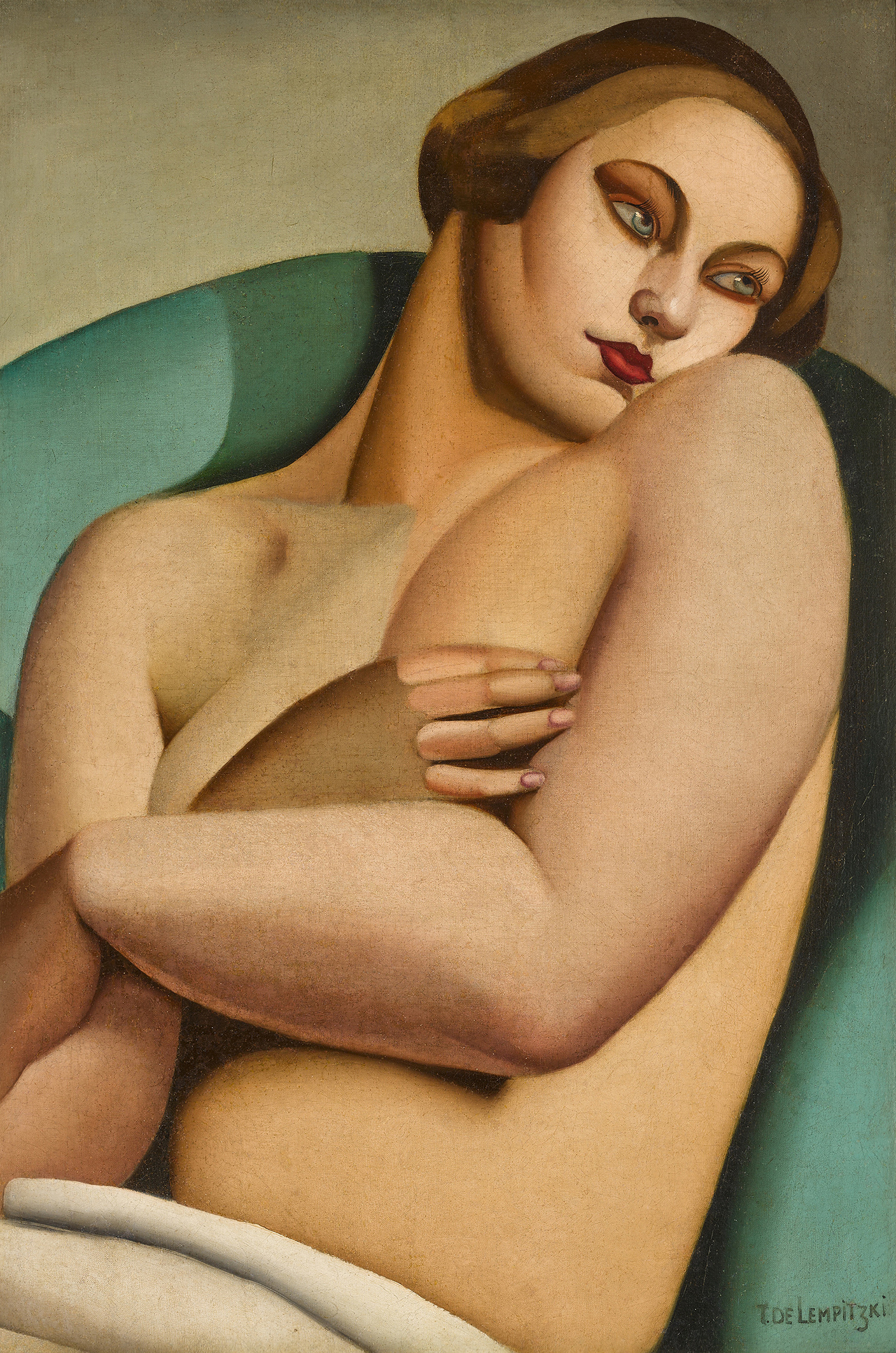
- Tamara de Lempicka to the rescue: Just when it looked like the London sales were getting downgraded to midseason events, Sotheby’s has announced that it will be selling Tamara de Lempicka’s Nu adossé (1925) in its London Evening sale on June 25. The $7.6 million estimate is a nice step up from the $5.4 million the painting achieved at auction in New York a dozen years ago. Since then, a painting by de Lempicka broke the $20 million mark in 2020, and another seven works have sold above the estimate on this painting. Of course, there’s a lot of additional excitement around de Lempicka with an upcoming retrospective in San Francisco—even if the recent Tony-nominated musical about the Polish painter struggled to draw crowds and shut down last month. Broadway is a tough business.
|
|
|
Tamara de Lempicka, Nu Adossé (1925), estimated at £6 million
|
|
|
| And now on to the main event… |
 |
| Portraits of the Young Artists… |
| According to proprietary ARTDAI data, we’ve reached the downcycle in the sales of work by emerging artists—further proof, perhaps, that the forthcoming art market revival will coalesce around more prominent historical figures. |
|
|
|
| Last Tuesday, a friend on Instagram alerted me to what he thought was a bombshell: Allison Zuckerman’s Woman With Her Pet, a 2017 painting that mixes Old Master iconography with pastiches of other art historical references, had sold at Christie’s for just $20,000. The sale was noteworthy, of course, because the same painting sold in November 2021 for 10 times that amount.
Generally, when someone points out these kinds of market pullbacks, I respond that I’m more impressed that someone was willing to pay $20,000 than I am shocked by the drop, itself. Unfortunately, that’s one of the unique features of the art market: Works that trade too frequently are treated like damaged goods, even though nothing has changed about the object itself. It’s just a matter of perception. |
|
A MESSAGE FROM OUR SPONSOR
|
|
|
|
|
| The Zuckerman sale was particularly notable, however, because she is one of 108 artists whose work had never sold at auction before 2020, but who has since gone on to generate single sales of more than $250,000, according to data provided to me by ARTDAI, an art data service. Collectively, these artists present a perfect microcosm of the boom cycle for emerging talent that we’ve just lived through—and a preview of the coming bust. Zuckerman, for instance, ranks 29th on that list with overall sales of $3.7 million in the last four and a half years, and a top sale price of $252,000. Given her $20,000 sale last week, it is unlikely that Zuckerman’s work still has the demand to achieve those prices again anytime soon. |
| The New Kids on the Block |
|
| These boom-bust cycles aren’t surprising on an individual basis. There’s typically a limited supply of work by emerging artists, almost by definition, and so demand gets satisfied. And there could easily be another upswing in the future for Zuckerman, who is only 34 years old. But on a macro level, we’re clearly on the downward slope of the emerging artist trend. Sales for these 108 artists peaked in the first half of 2022, according to ARTDAI, when $139 million worth of their art was sold. In the second half of the year, sales plunged to $68.4 million. There was a slight recovery to $80.3 million during the first half of 2023, which matched the $78.7 million for the second half of 2021. This period from the second half of 2021 to the first half of 2023 was the peak of this trend, totaling $366 million in sales.
The top artist of the period was Matthew Wong, the Hong Kong-born Canadian painter who committed suicide in 2019. Some $114 million worth of Wong’s art sold during the period, with a peak price of $6.6 million. Wong’s market has not gone away, but Christie’s was forced to withdraw a Wong painting with an estimate around $5.4 million two weeks ago during its Asian sale cycle. Amoako Boafo was next on the list but at a big step down, with total sales of $32.5 million and a top price of $3.4 million. Jadé Fadojutimi came in third with $32 million in sales and a record price of $1.9 million, which was set just this March. (That’s a reminder not to overgeneralize about this trend.) Salman Toor sold $27 million during the period, and Flora Yukhnovich sold $24 million at auction with a high-water mark of nearly $3.6 million.
In the next cohort are nine artists who saw between $10 and $20 million during the period. That includes Scott Kahn, the septuagenarian artist discovered and promoted by Wong, who recently signed with David Zwirner. His success, in many ways, is a touching legacy of the younger artist. Kahn saw $19.9 million worth of work sold at auction, with a top price of $1.4 million. Lucy Bull, who also has a cohort of Asian collectors that supports her market, saw a record price in May of $1.8 million. Her auction total: $17.6 million. María Berrío had a mishap with her second-highest-priced work at auction, which resold in May for less than a third of its original auction price. But her work still posted $15.7 million. |
|
|
| Also in the $10 million to $20 million range are Edgar Plans ($13.4 million); the very promotable Anna Weyant ($12.3 million); Ewa Juszkiewicz ($12.3 million); Hilary Pecis ($12.2 million); if you can believe it, Mr. Doodle ($11.1 million); and the last of this group, the multimodal artist Issy Wood ($10.5 million).
The list goes on with a number of artists I’m sure we’ll see again. They include Yale-educated faux naive painter Robert Nava and his doppelganger, real naive painter Jordy Kerwick. Abstract painters Michaela Yearwood-Dan and Lauren Quin are on the list, as are artists with appeal to Asian buyers like Atsushi Kaga, Rafa Macarrón, and Raghav Babbar. Likewise, a wide range of African diaspora artists like Cinga Samson, Emmanuel Taku, Otis Kwame Kye Quaicoe, Kudzanai-Violet Hwami, and Tunji Adeniyi-Jones. They sit alongside African American painters like Genesis Tramaine, Jennifer Packer, and Reggie Burrows Hodges.
Doron Langberg and Louis Fratino are on the list. Other artists not easily grouped but worth mentioning are Susumu Kamijo, Ben Sledsens, Justin Caguiat, Emma Webster, Vojtěch Kovařík, and Louise Bonnet.
As I’ve mentioned before, there’s no clear line between emerging artists and rediscovered historical artists. ARTDAI was kind enough to include another data set of artists born after 1925 who also fit the criterion of having made a sale greater than $250,000 in the last four and a half years. That list runs to 291 artists, which means there are 183 more artists born in the last 100 years who saw these kinds of auction pops.
The biggest ones are Ernie Barnes, who sold $43.2 million in the period, and Lynne Drexler, who saw $29.7 million in auction sales. Jaune Quick-to-See Smith, Wolf Kahn, Salvo, and Etel Adnan are also on that list. I surmise that the next phase of the art market will coalesce around more prominent historical figures along with rediscoveries like these. But that will also require some sort of return to the top of the market, where the big money will come out for historically valuable artworks, too. |
|
|
|
| FOUR STORIES WE’RE TALKING ABOUT |
 |
|
 |
| Profit & Kloss |
| On Karlie Kloss’s foray into magazine publishing. |
| LAUREN SHERMAN |
|
 |
|
 |
|
|
|
|
|
 |
|
|
|
Need help? Review our FAQs
page or contact
us for assistance. For brand partnerships, email ads@puck.news.
|
|
You received this email because you signed up to receive emails from Puck, or as part of your Puck account associated with . To stop receiving this newsletter and/or manage all your email preferences, click here.
|
|
Puck is published by Heat Media LLC. 227 W 17th St New York, NY 10011.
|
|
|
|