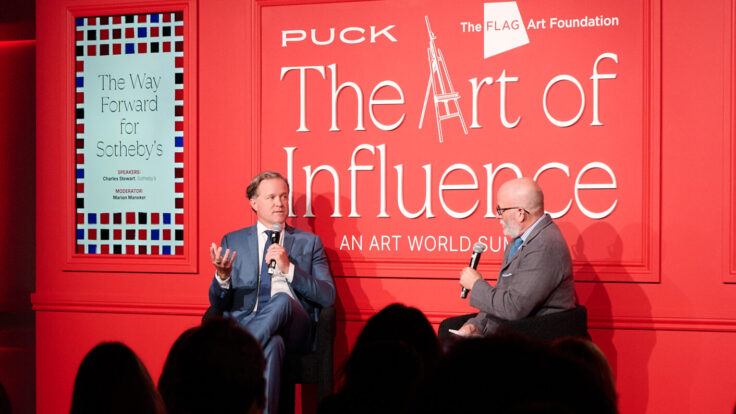
Welcome back to Wall Power. I’m Marion Maneker.
Tonight,
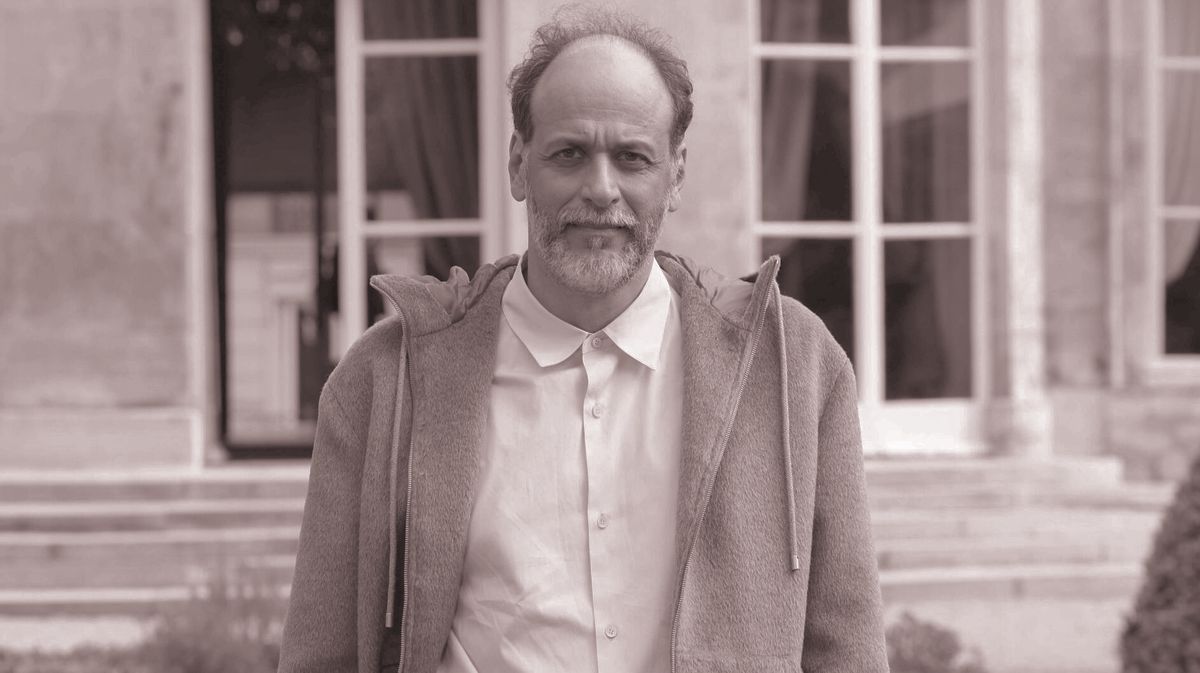
Julie follows up on the Coeur d’Alene auction. Then I talk to Luca Guadagnino, the Italian director behind Challengers, Call Me by Your Name, and Queer, about casting his art dealer, Zwirner’s David Leiber, in a small role (alongside Julia Roberts and Ayo Edebiri, among others) in his new movie After the Hunt. When Leiber told me about his experience as a
neophyte actor, it revealed a web of connections between Guadagnino’s interest as a collector and his work as a film director. And, in the endnotes, I take what I hope is a final look at the Blumquake.
But first… |
|
|

| Julie Brener Davich
|
|
Western Art Goes for a Ride
|
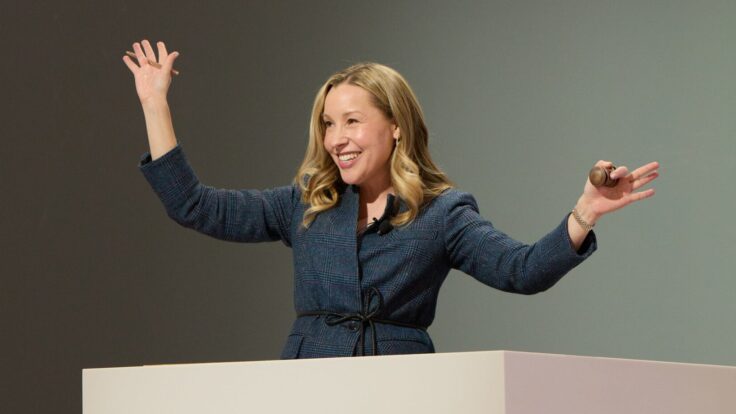
The Coeur d’Alene Art Auction in Reno made $22.2 million this past weekend, with 97
percent of the 354 lots finding buyers. It was their highest total in a decade, with three paintings from the same private collector in Wyoming selling above $1 million.
The top lot was a fresh-to-the-market, 3-foot-square oil painting by Maynard Dixon, from 1942, which sold for $2 million against an estimate of $800,000—the second-highest price for the artist at auction. “It continues to be evident that modernism in some form or another performs best,” said L.A.-based
dealer Beau Alexander. “The Dixon is modernist for the time, and is still modern for the Western market overall.”
The same consignor sold two cowboy scenes by Charles M. Russell. Roping a Wolf, a 1918 watercolor, made $1.3 million against an estimate of $500,000. It’s the third time it has appeared at auction—in 2008, oil baron T. Boone Pickens bought it at Sotheby’s for $1.1 million, then sold it at Christie’s 12 years later for
$625,000 to the current consignor. Tenderfoot, a rare oil painting from 1897, sold for $1.2 million, above the $819,000 that the consignor paid at Coeur d’Alene in 2016. “Those are big numbers for Western regionalist painting,” said Alexander. (There is a museum dedicated to Russell’s work in Great Falls, Montana.)
Works by the painter Bob Kuhn also performed well, underscoring the current market demand for wildlife scenes that appeal to buyers who hunt big game
in Africa, or who want their houseguests to think they do. The highest prices were $272,250 for a painting of a rhinoceros, and $229,900 for a painting of a leopard chasing a kudu, both from the Yturria collection in Texas, and estimated at just $60,000. Altogether, 11 Kuhns sold for more than $100,000 each, which is a big number for the market to support. |
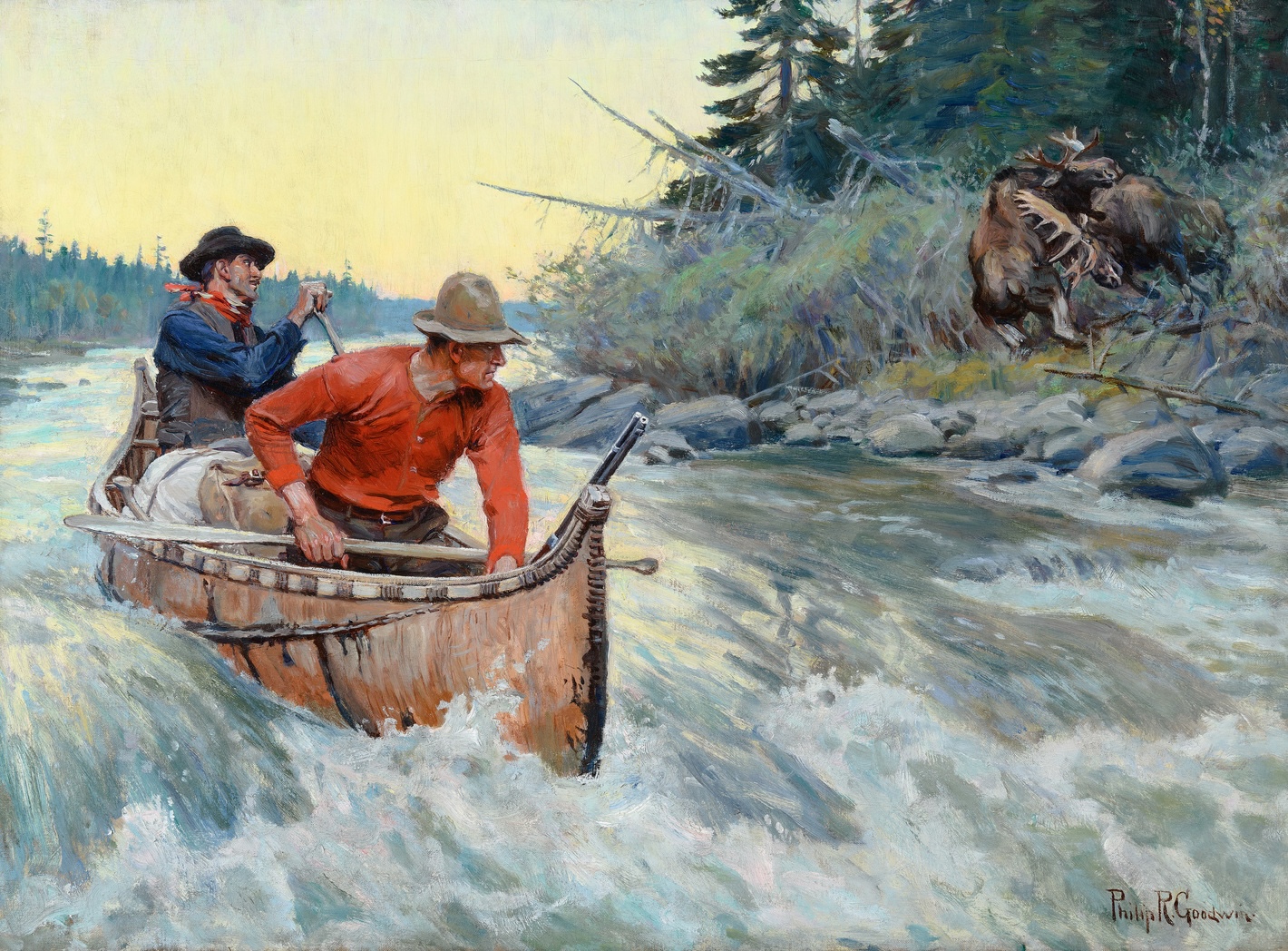
Philip R. Goodwin, An Interrupted Duel. Photo: Courtesy of Christie’s |
An Alaskan collector consigned two paintings by Philip R. Goodwin, a
friend of Russell’s whose market has been on a tear lately. The consignor had acquired both paintings in 2015 at Christie’s sale of the William I. Koch collection. An Interrupted Duel, a 1920s depiction of two adventurers in a canoe watching a pair of bull moose sparring on the shoreline, made $363,000, almost triple the $125,000 the consignor paid 10 years ago. Likewise, A Call to Action, a painting of two hunters rushing upstream on a raft to shoot a bear,
made $266,200, almost double what it made in 2015.
By comparison, the market for works by Taos Society artists, like Walter Ufer and Joseph Henry Sharp, is a bit soft at the moment. They painted gentler depictions of the West, like Native American life. Collectors are snatching up relative deals in the hope their market will rebound one day. There was a lot of hype before the sale for the modernist paintings of single figures by Sioux artist Oscar
Howe from the Reynolds family collection in South Dakota—three hammered around their $150,000 low estimate, and the one estimated at $100,000 hammered at $190,000. “They performed well but not mindblowingly,” said Alexander.
Before the sale, Coeur d’Alene’s Mike Overby had also talked up William R. Leigh’s painting The Land of the Navajos, which depicts a goat herder and his herd on a cliff overlooking a canyon. The same
private Wyoming consignor who sold the Russells acquired it in 2014 for $575,000 from Heritage Auctions. Estimated at $400,000 by Coeur d’Alene, it failed to find a buyer. As they say in the Wild West, “If you climb in the saddle, be ready for the ride.” |
|
|
A MESSAGE FROM OUR SPONSOR |
ALWAYS CONTEMPORARY
With a bold silhouette that conveys movement even at standstill, the Range
Rover Sport is striking from every angle.
EXPLORE |
|
|
Yoshitomo Nara’s
Pinky Seeks $7.7M
|
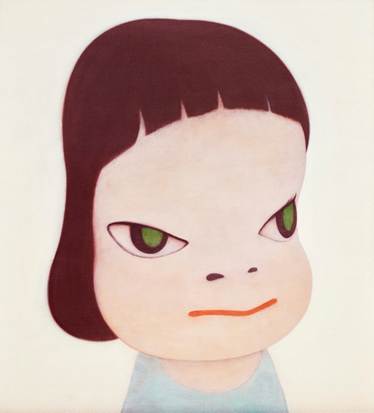
Yoshitomo Nara, Pinky (2000). Photo: Courtesy of Phillips
|
Phillips will be offering Yoshitomo Nara’s Pinky, from 2000,
as the top lot in its Hong Kong sale on September 28, with an estimate of HK$60 million ($7.7 million). The works that made Nara’s top two auction prices were painted in the same period: Knife in Back, also from 2000, sold in 2019 for just under $25 million; and Missing in Action, from 2001, sold in 2021 for nearly $16 million.
Since then, the market for Nara’s work has moderated. Nevertheless, there has already been a year-over-year uptick in the sale of high-value Nara
works, with one making $11.4 million in March. After that sale, the Hayward Gallery in London opened a Nara retrospective featuring 150 works, and reviews of the show have been strong. Phillips will be showing Pinky in London at its Berkeley Square showroom for two weeks starting today to capitalize on all the Nara-related traffic. They’re obviously hoping the wave of interest will translate into bidding on this work in September.
Now for the main event… |
|
|
The acclaimed director is a favorite collaborator of actors like
Julia Roberts, Timothée Chalamet, and Zendaya, but he also draws inspiration from painters like Giorgio Morandi, David Hockney, and Michaël Borremans. And he’s even cast his art dealer in his latest film. |
|
|
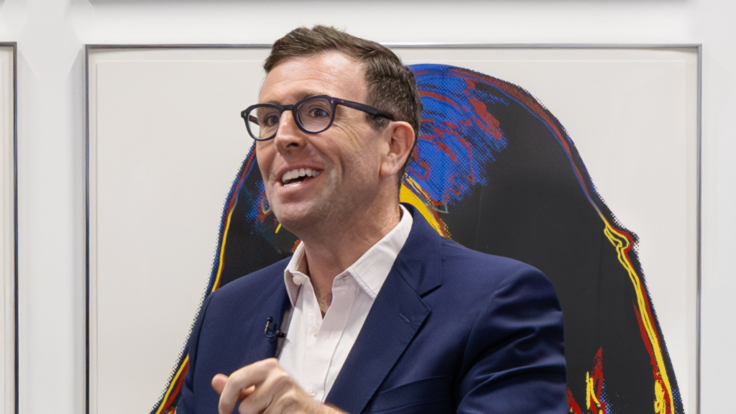
If you’ve been paying attention, you might have noticed that David
Leiber, a partner at David Zwirner gallery, has been making more cameos in the Wall Power cinematic universe. Selling art, after all, is as much a matter of performance, where the dealer dramatizes an object’s backstory—thereby matching the artwork with a buyer, their interests, and their own story. So it’s perhaps unsurprising that he’s now added acting to his résumé, with a part in the new Luca Guadagnino movie, After the Hunt, starring Julia
Roberts, Andrew Garfield, Ayo Edebiri, Chloë Sevigny, and, well… David Leiber.
Okay, maybe starring is a strong word. Leiber, a cerebral dealer with a thoughtful, hesitant speaking style and a deep connection to Italian art, appears in two scenes, playing a dean at an elite university dealing with accusations from a student (Edebiri) against a teacher (Garfield) that entangles his mentor (Roberts). It’s a film that
explores morality and power dynamics, Guadagnino told me when we spoke at the Bowery Hotel. “What does it mean, the act of saying something?” he asked rhetorically, his tall frame folded into a couch in the lobby. “Or to refrain from telling a story?”
When I asked Guadagnino why he had cast Leiber, his art dealer, he explained that he likes to cast his movies with great actors (including movie stars who can act) and then “put some real people in the frame” with them. Guadagnino called
Leiber, whom he met five years ago when he bought a Josef Albers painting, “a class act with great culture and great savoir faire.” |
|
|
A MESSAGE FROM OUR SPONSOR |
ALWAYS CONTEMPORARY
With a bold silhouette that conveys movement even at standstill, the Range
Rover Sport is striking from every angle.
EXPLORE |
|
|
Guadagnino chose Leiber for the role of the “kind and humanistic” Yale dean without
knowing that he had actually gone to Yale. Perhaps that’s one reason why Leiber, despite his lack of training as an actor, was able to “immediately embody the character,” the director said. Only Julia Roberts knew that he had no experience. In fact, Guadagnino so “loved having him on the set” that he’s already thinking of putting Leiber in another movie he’s developing. |
Many film directors have been known to draw inspiration from paintings. Some, like
Peter Greenaway, Julian Schnabel, or Robert Longo, started out as artists. Others, like Stanley Kubrick, Sofia Coppola, and even Michael Mann, have composed shots using paintings as templates. Guadagnino uses art in a different way. He calls the use of mood boards a “tragedy,” something brought into the world of cinema from advertising. “Cinema isn’t about images,” he told me. “It’s about a
point of view.”
Guadagnino eschews storyboards just as he avoids social media. “A lot of my life is dealing with images,” he said. “The commerciability of images.” Because “an image has a profound memory,” he said, there’s a need to “cleanse your gaze.” That’s where collecting art comes in—the time and effort it takes to buy and display art, he said, can be a corrective to our image-saturated culture. And, of course, he underscored the value of owning art as a way to experience
these images over time, often in changing conditions of light.
Guadagnino met Leiber only a few years ago, but art has been intertwined with his moviemaking for years. His 2009 movie about a powerful Italian family, I Am Love, starring Tilda Swinton, drew inspiration from directors like Douglas Sirk and Luchino Visconti, but also from the paintings of Giorgio Morandi, where a claustrophobic sense of silence mixes
with a subtle appreciation for the smallest of details and the sublime.
Guadagnino’s A Bigger Splash, from 2015, harks back to a French film from 1969, but also namechecks a David Hockney painting from 1967. For his 2024 movie adaptation of William S. Burroughs’ Queer, starring Daniel Craig as Burroughs’ drug-addled alter ego searching for love and enlightenment in Mexico City, Guadagnino took inspiration from the work
of Belgian painters Michaël Borremans and Francis Alÿs, the latter of whom lives in the Mexican capital. (They also both happen to be artists in David Zwirner gallery’s stable.) “There is an element of the uncanny in the work of both artists,” Guadagnino said—a quality he wanted to impart in Queer. He also cast Borremans in the movie, along with the sculptor Andra Ursuta (another Zwirner artist). She doesn’t have any lines, but appears
repeatedly as an unexplained but alluring presence with striking red hair. |
“Everything Is Intentional”
|
When I subsequently connected with Leiber, he observed that art is often the starting
point for Guadagnino’s projects. In Queer, there were lots of references to Lucas Arruda, another David Zwirner gallery artist who often paints lushly detailed jungle scenes in small formats. Guadagnino also seems to focus on the small details. “He’s so attuned to what’s on the walls and what objects surround his characters,” Leiber said. “Everything is intentional.” |
|
|
What Leiber saw on the set—the food, decorations, and objects in the production
design, on the walls, and even on bookshelves—helped him get into character while shooting at Shepperton Studios and Cambridge University. “He is so detailed,” Leiber recalled, “but then he lets things happen in a very natural way.”
Despite Leiber’s nervousness about being able to act, Guadagnino was confident that he could pull off the role. Leiber wasn’t entirely on his own: Guadagnino gave him a few ideas for each scene. And, of course, he was working with a cast of talented
professionals.
There wasn’t much rehearsal. During breaks in the filming, Leiber had to go back to his dressing room to do planks to calm down, and improve his posture. But Guadagnino trusted Leiber enough to give him some last-minute rewrites to the script. Leiber recalled, “I just went with it.” |
There’s a lot of fuss being made of Tim Blum’s recent decision to wind
down his gallery operations. In the wake of that news, the Financial Times had an interesting story about gallerists who purportedly want to avoid the siren call of overexpansion. The FT tried to structure the conflict as one between aging Boomers bowing out, and Gen Z or Millennial gallerists wanting to stay small. But a better take came from gallerist
Stuart Shave, who isn’t having all of the talk about a broken system. Instead, he told the FT, “We are in the midst of a decade-long experiment to see if those extremes of scale are even sustainable, not just for dealers but for artists also.”
The article also quoted Sadie Coles. Although she is expanding to a third exhibition space, she said that “looking through the lens of now, a controllable overhead looks smart. … I always wanted the gallery
to be a size that allows me to be completely hands-on with everything, something you cannot do if you have multiple locations across the globe.”
But even as Hauser & Wirth announced it will be opening a new gallery in Palo Alto, it would seem the real issue isn’t size and scale versus hands-on control and focus. The FT quoted Vanessa Carlos
of Carlos/Ishikawa gallery talking about her peers who chose to stay lean and focused. “[Ten] years later, so few of us have survived financially,” she lamented.
There’s no easy answer. Some galleries succeed—and others fail. It’s hard for a gallery to stay relevant, and in tune with the tastes and interests of collectors over a long period of time. And so one gallerist bowing out shouldn’t be read as anything more than one person making the right decision for himself—and
possibly opening up opportunities for other dealers to succeed.
How’s that for ending on a hopeful note?
We’ll be back on Sunday.
M |
|
|
Finally, a media podcast about what’s actually happening in the media—not the oversanitized,
legal-and-standards-approved version you read online. Join Dylan Byers, Puck’s veteran media reporter, as he sits down with TV personalities, moguls, pundits, and industry executives for raw, honest, sometimes salacious conversations about the business of media and its biggest egos. New episodes publish every Tuesday and Friday. |
|
|
The ultimate fashion industry bible, offering incisive reportage on all aspects of the business and its biggest
players. Anchored by preeminent fashion journalist Lauren Sherman, Line Sheet also features veteran reporter Rachel Strugatz, who delivers unparalleled intel on what’s happening in the beauty industry, and Sarah Shapiro, a longtime retail strategist who writes about e-commerce, brick-and-mortar, D.T.C., and more. |
|
|
Need help? Review our FAQ page or contact us for assistance. For brand partnerships, email ads@puck.news. You received this email because you signed up to receive emails from Puck, or as part of your Puck account associated with {{customer.email}}. To stop receiving this newsletter and/or manage all your email preferences, click here. |
Puck is published by Heat Media LLC. 107 Greenwich St, New York, NY 10006
|
|
|
|