 |
 |
|
Welcome back to Wall Power, coming to you from the balcony of the Capitol Theatre as Lucinda Williams warbles and drawls her way through “While My Guitar Gently Weeps.” I’m not really a live music fan, but who doesn’t love Lucinda Williams? Among other things, she’s a fine model of perseverance, still out here fighting despite surviving a stroke a few years ago.
Back in the art world, it’s almost showtime. The auction house previews opened this weekend, so from now until the sales, there will be a steady stream of collectors, art advisors, and onlookers filtering through the auction houses to assess the wares. Of course, many of those visitors have already been tipped off to particular lots by a salesperson at the auction house or an art advisor or even from reports in the media. Nevertheless, there’s always something to discover in these exhibitions—a small lot from a collector like Mica Ertegun or Sydell Miller that may not be headline-worthy but could just capture your imagination, or an overlooked consignment that opens up a whole new world for you.
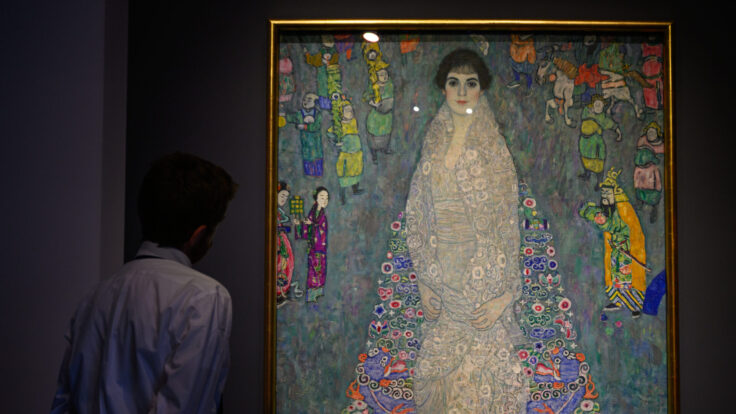
The exhibitions are also a chance to see things in person that you may never have a chance to view again. (Most of them will end up in someone’s living room.) There really isn’t a substitute for standing in front of a work of art, scanning the image, looking deeply at the details, and just seeing if the magic happens.
If you’re in town, you should definitely stop by. The exhibitions are free and open to the public. I’ll be in and out throughout the week. If you see me, don’t hesitate to say hello. I’m always happy to talk shop. Tonight, I’m going to dive into what’s on offer.
|
|
A MESSAGE FROM OUR SPONSOR
|

|
|
|
But first…
- Kenny Scharf surfaces: On Thursday morning, I was standing in front of a 1979 painting by Kenny Scharf, trying to remind myself where I’d seen the angular, Patrick Nagel-esque figure depicted in the image, when Scharf himself strode up, turned his back to the painting, and struck the same pose so someone could take his picture in front of Self Portrait With Cadillac. It was hard to see the 21-year-old new-wave musician in the bearded 67-year-old today, especially since that early painting looks nothing like any other Kenny Scharf painting. Nevertheless, the work is one of the starting points in the retrospective currently on view at the Brant Foundation study center, near Tompkins Square Park.
The exhibition traces Scharf’s journey from creating paintings with pirated cartoon figures (think KAWS without the respect for copyright) to what I can only describe as warped Old Master pieces, filled with a universe of the artist’s own characters. On the main floor, tucked in the back, there’s a really good collection of Scharf’s portraits of friends and figures from back in the day. Later in the event, I saw the pinstriped Peter Brant, himself, embrace the jean-jacketed Scharf. Try to imagine that 40-year friendship.
- Shafrazi’s post-election euphoria: You might assume, given the hothouse political opinions many artists hold and express in their work, that the art world is uniformly liberal in its politics, especially when you think of the bohemian characters like Keith Haring, Basquiat, and Scharf that dealers like Tony Shafrazi nurtured. But Shafrazi was standing in the middle of a crowd at Sotheby’s on Friday night, excitedly shouting, “We’re entering a new era!” There was no mistaking the meaning.
- Koons on the rise (again)?: One consignment that was not announced early but is having a real impact is the Jeff Koons sculpture Woman in Tub, from the Barbier-Mueller collection in Switzerland, which is being offered at Sotheby’s with a $10 million estimate. For a variety of reasons, Koons’ market is nowhere near the heights it reached in 2014, around the time of his Whitney retrospective. Koons created a lot of friction with his own collectors with long delays in delivering work and demands for more money for fabrication. With the exception of the whopping $92 million sale of the Rabbit in 2019, there hasn’t been strong demand for Koons’ work.
And yet, there are four different, important early works from the 1980s and ’90s on offer this season. Large Vase of Flowers, 1991, is guaranteed at Christie’s for $6 million. Alongside it, New Celebrity Hoover…, from 1981-86, is being offered naked with a $3.5 million estimate. At Phillips, there’s a Two Ball Total Equilibrium Tank, from 1985, with a $4 million estimate.
Then there’s Koons’ 1988 work Woman in Tub, which comes from an edition of three. At the turn of the century, Koons had already suffered the first fall in his art market currency. At the time, he seemed more like a figure from the 1980s than a hot contemporary artist. But a series of sales, culminating in $5.6 million paid for Michael Jackson and Bubbles, from 1988, and this version of Woman in Tub, broke Koons’ market out.
Tobias Meyer may get the credit at Sotheby’s for that astonishing Michael Jackson sale. But you’ve also got to tip your hat to Philippe Ségalot, at Christie’s, who masterminded a series of Koons auctions leading up to that point. First, there was the $1.8 million sale of Pink Panther in November 1999. Then, in May of 2000, Stefan Edlis paid $1.7 million for one of the three examples of Woman in Tub. (His was eventually donated to the Art Institute of Chicago.) Building on that momentum, a second Woman in Tub was sold in May 2001, two days after the Michael Jackson auction, for a big jump in price to $2.8 million.
At the time, these sales were seen as a harbinger of Koons’ return to relevance. The artist’s proof of Pink Panther was later sold in 2014 for $15.8 million. Auction prices don’t really work this way, but that result would imply Woman in Tub might have been worth $24 million at Koons’ market zenith. It’s probably not worth that now. But $10 million is still a bold estimate. And all of these early works on offer may portend another swing of the pendulum for Koons. After all, this isn’t the first time that his reputation or market had swooned—or recovered.
|
| And now to the main event… |
 |
| The Art Market’s New November Math |
| A rise in the competition for third-party guarantees and attractive presale estimates indicate that dealers and consignors are feeling good about the upcoming auctions, including Mica Ertegun’s $95 million Magritte, Sid Bass’s $50 million Ruscha, and a “value proposition” $20 million Basquiat. |
|
|
|
| The auction catalogs for the important November sales are now online, providing a complete view of the season. The aggregate presale estimate of $1.2 billion is down a third from a year ago at this time, when the aggregate estimate was just above $1.8 billion. But there are only about 1,500 lots on offer, or roughly three-quarters of the number offered last year. Fewer lots, and a lower aggregate estimate level, tells us that everyone is reading from the same playbook dictated by the weak-ish sales one year ago and in May. Consignors seem to have finally heard the message: If you want to sell something well, you have to take a risk with a very conservative estimate. Put another way, the market needs to be priced lower before it can rise higher. That’s art world math.
There are other signs that the market is gathering strength. Earlier this week, I bumped into a dealer in Nolita who is active in the guarantee market. Because he buys and sells a lot, he knows the markets of a number of specific artists really well. As a result, he gets first look at consignments that need to be backed by a third-party guarantee—the deal structure whereby the seller agrees to go to auction only if a third-party buyer commits to buying the work at an agreed-upon price if no other bidders show up.
Anyway, we got to talking, and he remarked that there seemed to be more competition for the guarantees on specific lots. Most notably, as I discussed the other week, is Mica Ertegun’s rare Magritte, which is coming to market with a whopping $95 million third-party guarantee. But this dealer revealed that there are some isolated lots where the auction houses have held an informal auction before the auction. That’s not unusual, in itself. But in these cases, the terms for the guarantee had improved for the house and seller with each succeeding offer.
That doesn’t ensure a strong season, but it means the pros are feeling bullish and fighting among themselves to get guarantees—which, of course, pay off most handsomely if the bidding exceeds expectations. I’m also beginning to hear that bidders are looking at lots with irrevocable bids in the most favorable light, which is not always the case. Everything in the art market depends on context. Ideally, in good times, a third-party guarantee acts as validation—a signal to the market that someone is ready and eager to buy but the seller is still looking for a better deal. The investment bankers call this a “go-shop” period, like the one we saw in the Paramount acquisition. But when the market needs support, third-party guarantees can feel like crutches propping up an unsteady work. In these market phases, the symbol for a third-party guarantee in the auction catalog can be a turnoff, a disincentive to bid. When estimates are high and the market seems fully priced, a third-party guarantee will make the next bidder feel she has to pay more for the work than it’s really worth. (Who wants to do that?) The irrevocable bid symbol, in those cases, tells the potential bidder they just lost the race to get to the right price.
At this point in the cycle, however, it seems the third-party symbol is acting as a confidence builder and a validating market signal. For example, an Alexander Calder mobile, Sumac VI, is back at Christie’s, after being auctioned a dozen years ago for $5.9 million. This season, it is estimated at $5 million—and has a guarantor. That should be catnip to some bidder. The same is true of the $5 million Leonora Carrington sculpture La Grande Dame, from 1951, which has an irrevocable bid, just like Carrington’s breakout work last season, which was guaranteed at $12 million but sold for nearly $24.5 million with fees. Even an old stalwart like Willem de Kooning can benefit from an irrevocable bid. Untitled XXV is estimated at $9 million. A few years ago, that number would have looked pretty solid as an estimate. But the market for late de Koonings has seen some stumbles lately. So even though this is a strong work, $9 million looks a lot more realistic if you know there’s already a buyer at that price. Similar works have sold for double in the past.
Not everyone who has slapped a low estimate on their consignment took protection, however. That, too, is a good sign. Magritte’s Les chasseurs au bord de la nuit, from 1928, was bought for more than $10 million a decade ago, but is on offer for $8 million. Nobody thinks the Magritte market has gone down in that time. (The small gouache version of L’empire des lumières is also available for the nearly laughable estimate of $6 million.) Eric Fischl’s 1982 painting The Old Man’s Boat and the Old Man’s Dog made a record price at auction for the artist two and a half years ago, when it sold for $4.1 million. You’ll see it on display at Christie’s this week with a $3 million estimate. (Rockefeller University is also selling two Joan Mitchell paintings that were gifted to the school decades ago. The cost basis on these sales makes it easy for the school to offer the works at prices close to where equivalent works traded a decade ago.)
These attractive estimates aren’t confined to the evening sale material. In Christie’s day sale, there’s a Jules Olitski painting that was bought at Phillips nine years ago for $389,000. It’s on offer with a $400,000 estimate. There are more than enough other examples of works that are estimated at prices well below what most buyers would consider market rates. No one really thinks they’ll go for a price that low, but who wants to take the risk of missing out on such a great opportunity? |
|
A MESSAGE FROM OUR SPONSOR
|

|
|
|
|
|
| Like I said, not every seller is taking a guarantee. A number of exciting lots arrived at auction this season where the sellers are clearly in charge. Sid Bass’s huge Ed Ruscha, Standard Station, Ten Cent Western Being Torn in Half, from 1964, is being sold without a guarantee and a whisper number of $50 million. That seems like an aggressive estimate when you compare it to the $52 million final selling price of his most expensive painting, achieved at auction five years ago. It looks a lot more conservative when you consider that this is one of the big daddy Ruscha paintings still in private hands. It’s been said that Bass has previously turned down higher offers for the work. So it’s not surprising that he’s not yet taking any downside protection on the trade.
Neither is the owner of the $20 million Jean-Michel Basquiat large figure, drawn in multicolor on paper, that Christie’s announced recently. That work has pride of place in a bay in Christie’s lobby. A few of Basquiat’s drawings with heads or large figures have already sold for prices as high as $15 million, so the $20 million that the consignor—likely Greenwich art collector Peter Brant—is asking isn’t a stretch. Christie’s presentation is pitching a value proposition: Get a large figurative Basquiat work for far less than similar images go for when they’re painted on canvas.
The big single-owner collection of the season, from the estate of Sydell Miller, has a lot of high-value work—but only one picture, an $8 million Yves Klein sponge painting, has an irrevocable bid. That’s because the Miller heirs didn’t take a guarantee, so Sotheby’s doesn’t have to focus on backstopping the $60 million Claude Monet Nymphéas painting or the $30 million Pablo Picasso. Meanwhile, in Midtown, Christie’s did take a third-party floor on an early Alberto Giacometti large female figure conceived in the mid-1930s, but not cast in bronze until 1961. The sculpture has a $20 million estimate.
Phillips’ highest-value work this season is their Jackson Pollock untitled drip painting, owned for many years by Florence Knoll, which has an unpublished estimate but is understood to be $13 million or more. That painting has a backer, as does their million-dollar Matthew Wong and a $2.5 million Alighiero Boetti Mappa.
Christie’s also found support for Mica Ertegun’s $15 million David Hockney painting, as well as her smaller $4 million Hockney, her $9 million Magritte, and another $3 million Magritte (not to mention the previously discussed $95 million L’empire des lumières), as well as a $4 million Joan Miró and a $2 million Arshile Gorky, who recently had a historical show at Hauser & Wirth in Soho. Works by Morris Louis, Ed Ruscha, and Adolph Gottlieb all found backers with $1.2 million estimates. |
|
|
|
|
| I know it seems like I’m trying to have it both ways by saying all of these irrevocable bids are a good sign, while also saying that it’s a good sign when consignors decide to go naked, as they say, by not taking a guarantee. But both are positive signs of animal spirits—the competition for guarantees indicates that dealers are feeling good, and the naked sales demonstrate that consignors are willing to take on risk, another positive metric for the market’s health.
Indeed, plenty of risk abounds in the November sales, but it has been moved to different places in the art market value equation. At Christie’s, they’re laying off risk—$135 million just against the Ertegun collection, including the big Magritte—because the auction house put up a big number directly to Ertegun’s estate. That moved risk from the seller to the auction house, which is, in turn, willing to give the guarantors an opportunity to make money because the guarantees protect their downside.
At Sotheby’s, the big Sydell Miller collection isn’t backed by a guarantee. The family is taking the risk. But they’re so rich, it isn’t really a risk at all. And they’re not the only ones willing to roll the dice. At Sotheby’s, one consignor is trying to completely reprice the market for Stuart Davis’s work by offering a large painting from 1963, Contranuities, with a $12 million estimate. That’s twice the price of any work by Davis ever auctioned. There’s no guarantee on that one from either the auction house or a third party.
Like polling in the election, guarantees don’t accurately predict success or failure. They’re just an indicator of sentiment. We’ll have to wait a little longer before we know what’s happening in the market for sure. |
|
|
| Okay. I could keep going with many smaller details on these sales. There are a bunch of individual lots that might help bring new works to market and generate momentum down the line. There’s a couple of Christopher Wool pictures that might cause a stir, too. But we’ll get into that in the coming days, or during the sales.
See you Tuesday,
M |
|
|
|
| FOUR STORIES WE’RE TALKING ABOUT |
 |
|
 |
| Kamala’s Fire Sale |
| How the Harris campaign is staving off its post-race debt. |
| TARA PALMERI |
|
 |
|
 |
|
|
|
|
|
 |
|
|
|
Need help? Review our FAQs
page or contact
us for assistance. For brand partnerships, email ads@puck.news.
|
|
You received this email because you signed up to receive emails from Puck, or as part of your Puck account associated with . To stop receiving this newsletter and/or manage all your email preferences, click here.
|
|
Puck is published by Heat Media LLC. 227 W 17th St New York, NY 10011.
|
|
|
|