Hi, and welcome to Line Sheet. R.I.P.
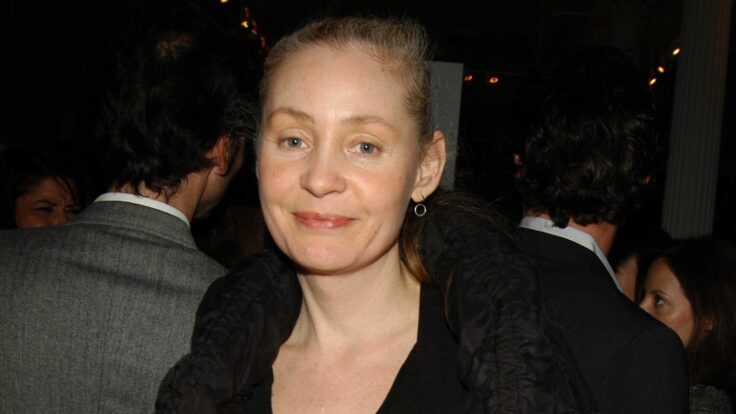
Doris Fisher.
It’s the first Monday in May, and a heavy one at that. Never has a Met Gala been so fraught: It’s too tacky, too tech-y, and altogether too much. And yet, tonight’s party will almost undoubtedly beat the $31 million raised last year for the Costume Institute. As plenty of behind-the-scenes folks lamented at last night’s UTA
pre-fete, it’s a money job for everyone involved, and treating it as anything else would be a mistake. In tomorrow’s issue, I’ll share who won the night, from designers to attendees. I honestly can’t wait to see what Sam Altman is wearing.
Plus, don’t miss my conversation with The Ringer’s Amanda Dobbins on tomorrow’s episode of Fashion People: We cover the best and worst of the red carpet, and also add to the
Devil Wears Prada 2 discourse. Listen here and here.
Today, you’ll find an update on Saks Global, which is in the midst of another round of layoffs. Plus, some intel on who paid what to attend the Met Gala and another theory about why
Lauren Santo Domingo decided to skip it. Finally, I went to see The Devil Wears Prada 2 so you don’t have to, and had a few thoughts. Meanwhile, Puck superstar producer Maya Tribbitt calculated which fashion brands won the film’s press tour—and why the number of outfit credits may not directly equate to overall impact.
Also mentioned in this issue: Geoffroy van
Raemdonck, Meryl Streep, Jeff Bezos, Emily Blunt, Anna Wintour, Amazon leggings, Matthieu Blazy, Steven Newhouse, Louisa Jacobson, B.J. Novak, Lévy Gorvy Dayan, Tracy Margolies, Aline Brosh McKenna, Jen Rubio, Aaron Levine, Entireworld, Lana Todorovich, Paolo
Riva, David Frankel, Darcy Penick, Dr. Woo, and many more… |
Three Things You
Should Know…
|
-
The price of Met Gala admission… and more: Not everyone who wants to attend the fundraiser for the Costume Institute at the Metropolitan Museum of Art is invited, and the cost of a ticket—or a table—varies widely. While Lauren and Jeff Bezos are rumored to have paid $10 million to co-sponsor the evening, there is a contingent that believes fundraiser-in-chief Anna Wintour should have asked the Bezoses
for more. (For everyone protesting their involvement: Remember that Amazon first sponsored the Gala in 2012. That’s 14 years ago.)
The Bezoses are not the only ones ponying up, though. At least some individuals paid $1 million per ticket, according to multiple sources, even though the baseline ask is $100,000, as the inimitable Bill Cohan
reported in his recent Air Mail investigation of the whole production. (A rep for Wintour, who manages and approves the guest list as the chair of the event, and Condé Nast, the media partner, did not respond to a request for comment.)
The Met is one of the last bastions of elite gatekeeping, and Wintour obviously has the savvy to know who is desperate enough
to pay a premium. Also, as Bill noted, selling tickets isn’t always easy. Moda Operandi founder Lauren Santo Domingo has been receiving kudos for her so-called boycott of the Gala amid the tech bro takeover. It’s an interesting theory, except that Santo Domingo is a friend of the Bezoses: She attended not only their wedding, but also a party at their apartment on Saturday night. Whatever the reason for her deciding not to attend this year (maybe she just doesn’t feel like
dealing with the hoopla Wintour has created?), the politically active executive is coming out above the fray, and that isn’t a bad look.
|
|
|
|
A MESSAGE FROM OUR SPONSOR |
|
|
|
-
The bone-chilling irony of ‘The Devil Wears Prada 2’ (spoilers ahead): I went to see the film, which made more than $233 million globally this weekend, at the Alamo Drafthouse in the basement of Fosun Plaza in New York City’s Financial District. I was wearing leggings, the Sunday morning uniform in these parts, that I bought on Amazon.
In The Devil Wears Prada 2—which I first reported was in development back in the summer of 2024—there is nary a legging in sight. You will, however, find plenty of fancy fashion, and not only because the story was conceived before the current crisis in the luxury market took hold. At one point, Emily Blunt’s character, Emily Charlton—formerly a Runway assistant, now an executive at Dior—notes that “luxury retail is the only part of the fashion business that still makes
money.”
That’s still true, even now. But most of the truths in the movie are about the general state of fashion media’s dwindling influence on fashion, itself. There are zero cerulean blue–style monologues this go-round, but it is noted that Dior makes up 16 percent of Runway magazine’s overall advertising spend, and that if there is “no them,” meaning Dior, there is also “no us,” as in Runway.
I’m not going to map out the entire plotline here, but the film’s
early conflict revolves around luxury brands pulling their ads after it’s discovered that a fast fashion conglomerate recently featured in the pages of Runway is running sweatshops. That’s ironic, of course, given the real-life challenges that Dior and other luxury brands have had with worker conditions at third-party manufacturers in Italy. In the film, Business of Fashion breaks the news. (In real life, BoF has closely covered Dior & Co.’s factory issues.) And as
would happen in reality, Runway editor-in-chief Miranda Priestly bends to Dior and Emily’s will.
I wonder how the powers that be at Dior, or LVMH—which is never directly named—feel about the brand’s portrayal in the film. The Dior in DWP2 doesn’t seem to belong to any one designer—at one point, Emily wears a Galliano newspaper scarf—so I suppose you could argue that all exposure is good exposure. And there’s a great line at the end, where a defeated
Emily is fired from her job at Dior and must start life anew at… Coach.
Indeed, there is plenty good to say about how much screenwriter Aline Brosh McKenna and director David Frankel got right about the fashion industry, Vogue, and Condé Nast. They even created a dramatic scene at a Vogue World–esque event in Milan (where the actual Vogue World will be staged this fall). And then there’s the intertwined narrative in which Emily is dating
a post-glow-up, Bezos-esque tech executive with whom she plots to buy Runway after the Steven Newhouse–esque character croaks, and his athleisure-wearing son, played by B.J. Novak, makes it clear that he is happy to give up the underperforming publishing empire for the right price. (There are zero Newhouses of our generation that have emerged as torch recipients, by the way.)
Anyway, I didn’t enjoy myself. Not because the movie isn’t good—it is,
and I suspect that all the specifics make it feel richer for people who don’t work at, or cover, Condé Nast. But it was just too close to home. Even the ending, which sees Miranda triumphant—trading the Bezos-esque baddie for a more benevolent billionaire owner (his ex-wife)—was chillingly on point. The brave thing would have been to have Miranda leave the magazine and start a new chapter in her life. But I guess that wouldn’t have been realistic.
|
|
|
|
A MESSAGE FROM OUR SPONSOR |
|
|
|
- Who won the ‘Devil 2’
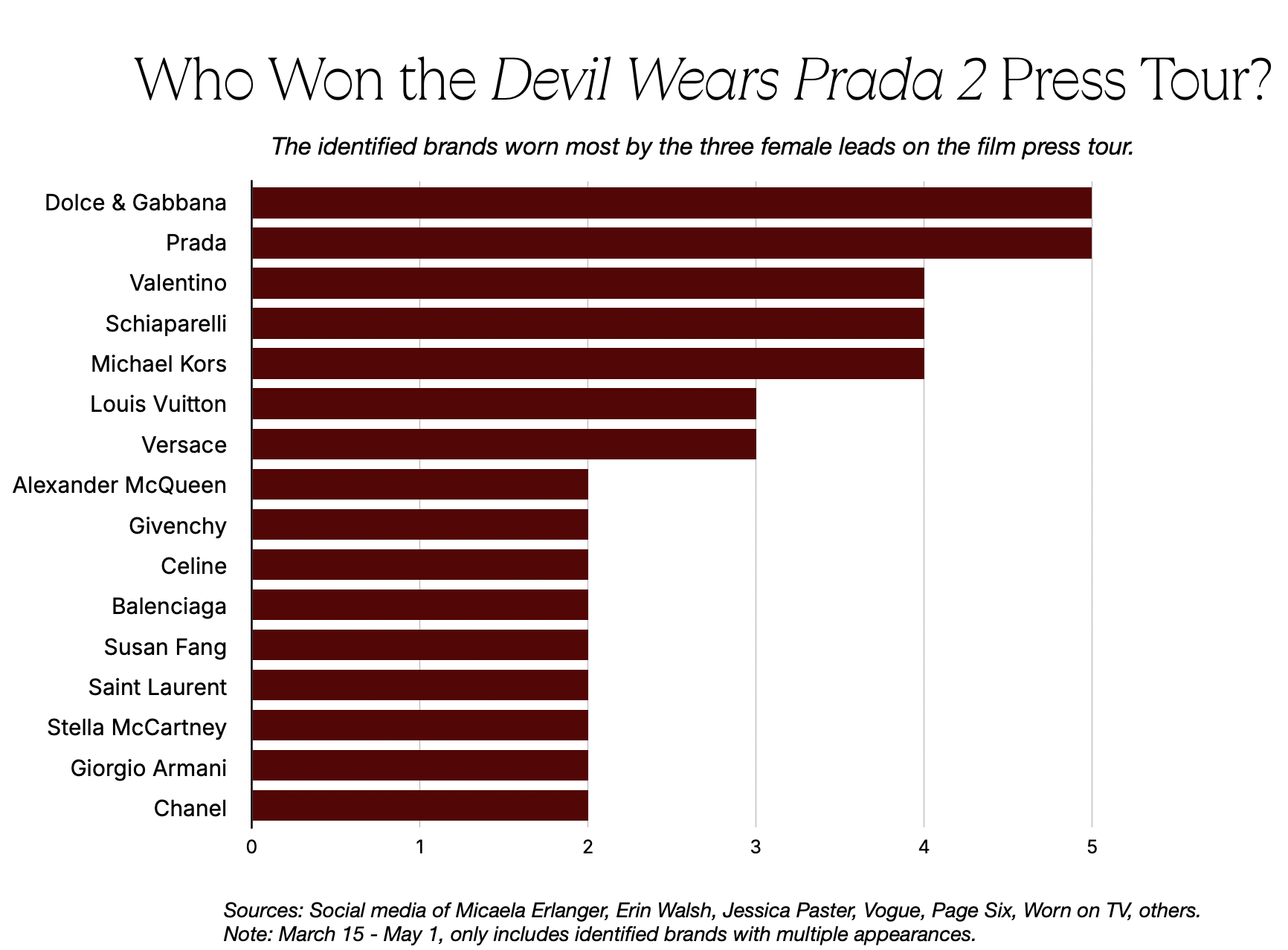
press tour?: Across more than 50 looks worn by the film’s three leads during a six-week press tour spanning five countries and three continents, with 30-plus fashion houses represented, Dolce & Gabbana (of all brands!) came out on top—albeit barely—with five looks, nearly all worn by Meryl Streep. Dolce & Gabbana plays an outsize role in the film: Miranda attends a show (which Streep actually did, in character, during Milan Fashion Week) and toasts the
designers, who both make an appearance backstage.
Prada came in second (followed by Schiaparelli, Valentino, and Michael Kors), although that doesn’t include Streep’s and Wintour’s looks for the cover of Vogue. It’s no surprise about Valentino, either, given Anne Hathaway’s close relationship with the late Valentino Garavani and the house itself.
|
-
Chanel was notably absent from the top of the chart, even though it’s mentioned in both films and remains a mainstay in Wintour’s actual wardrobe. In addition to Hathaway wearing a Chanel dress for a portrait in The New York Times, the brand’s most prominent showing was when Streep wore a Matthieu Blazy look at one of the
first press calls, during the Tokyo premiere. These days, Chanel always seems to come out on top, even when it doesn’t. —Maya Tribbitt
|
|
|
|
Now, on to the main event… |
|
|
|
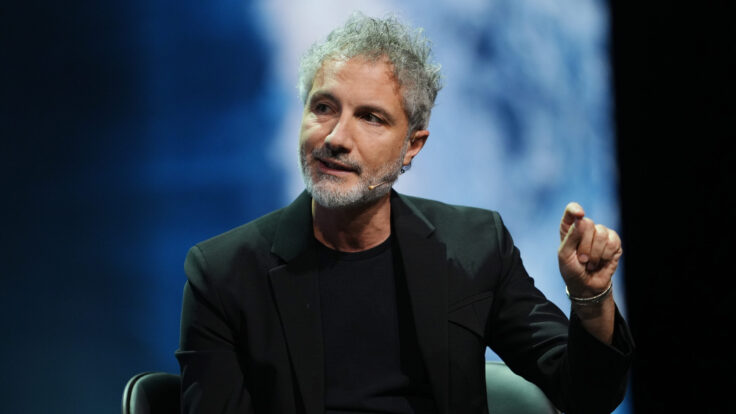
More layoffs are coming to Saks Global, and C.E.O. Geoffroy van Raemdonck is projecting
confidence as he continues to streamline operations. The question he needs to answer, though, is why anyone would shop at Saks Fifth Avenue or Neiman Marcus if there’s a Bottega Veneta flagship down the street. |
|
|
|
Over the weekend, I made the same pilgrimage as dozens of other fashion people in town for the Met Gala: I
visited the Adventure of Domenico Gnoli show at Lévy Gorvy Dayan on 64th Street, then walked down to Bergdorf Goodman to have a look around. I had no intention of buying anything, in part because a silk blouse from Chloé is
$2,150. I know the American market is thriving, but I’m not sure how when everything is cheaper in Europe, especially with the detax. Aren’t rich people savvy enough to hop on a
plane to Paris and do their shopping there—or at least have their people figure it out?
Anyway, the shop-in-shops looked good—my friend and I admired Celine’s setup—but the racks in the middle of the floor, with brands ranging from An Only Child to Jil Sander, were too stuffed, and the walls too beige. It was dreary and made me sad.
Perhaps I’m just nitpicking: Bergdorf Goodman may be iconic, but it’s not Dover Street Market. It needs to have mass luxury appeal. The good news for
Saks Global, which owns Bergdorf Goodman, is that there was plenty of stock. Just six months ago, before the parent company filed for Chapter 11 bankruptcy protection, the problem was a lack of inventory. And yet, when I visit Galeries Lafayette in Paris, the shopping experience at, say, Phoebe Philo, is far more engaging and alluring. I wasn’t the only one who felt this way during their B.G. drive-by this past weekend. The consensus was that the Gnoli show totally lived up to
the hype, but Bergdorf isn’t what it used to be. |
That dissonance flies in the face of what Saks Global is saying publicly about its current performance.
According to the company, C.E.O. Geoffroy van Raemdonck’s team is beating both internal sales goals and inventory plans, and has enjoyed an increase in retail sales month to month since the turnaround began in earnest. |
|
|
|
Still, this month, the group will lay off about 16 percent of staff at headquarters—around 640 jobs. It’s
painful, to be sure. But there are post-merger redundancies that still need to be rationalized, and the whole reason van Raemdonck is in this job is because he is responsible and committed to saving money and paying vendors on time. That’s how he whipped Neiman Marcus Group into good-enough shape to be sold to Saks Global in the first place—and why he’s also closing 24 stores to address the realities of how we shop today: mostly online, with physical stores serving as showrooms instead. (Usual
disclosure: Saks Global is suing Puck over our coverage of its debt management.)
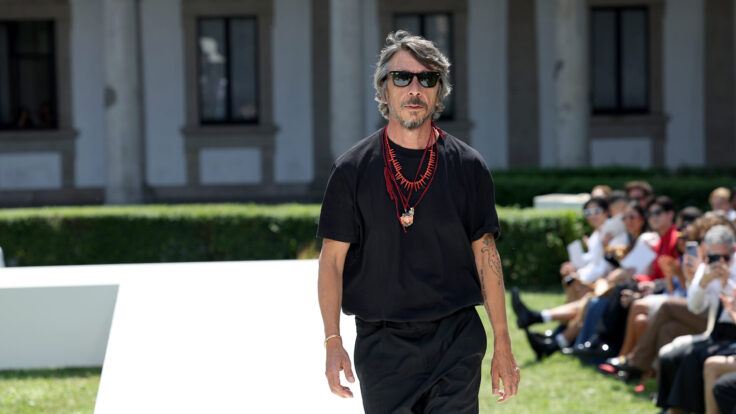
Internally, however, there’s still a question of whether the organization is too top-heavy. Saks says that its senior leadership team will stay in place for now, but there are also several people doing similar jobs: Paolo Riva is chief of brand and partnerships; Lana Todorovich is “global brands officer”; Darcy
Penick is chief commercial officer. How are their responsibilities apportioned in a case like this? Technically, Penick oversees marketing, digital, and customer care for both Saks Fifth Avenue and Bergdorf Goodman, while Todorovich is focused on large-scale negotiations with partners. Riva leads the merchant teams. But really, there’s an argument that much of this work overlaps at the C-suite level. Of course, these are all van Raemdonck’s people. (At Bergdorf Goodman, the top
brands rely on president Tracy Margolies—a Saks Global vestige—for support.) But can van Raemdonck really afford them all?
The unproven part of van Raemdonck’s plan is what happens after the obvious cost-cutting has been completed. The feeling in the market is that Saks Global’s forecasting might be overly optimistic given the weakness of its first quarter. To be fair, the first quarter was disproportionately tough because they had very little
inventory, and considerable time was spent trying to repair severely broken relationships with vendors.
The U.S. market may be thriving compared to Europe and the Middle East, and Saks Global will at least benefit a bit from this reality. But who wants to shop at Saks Fifth Avenue or Neiman Marcus when there’s a Bottega Veneta flagship down the street? That’s the question van Raemdonck needs to be asking as he continues streamlining operations. Meanwhile, Bloomingdale’s, Nordstrom, and
the independent luxury retailers—from Hirshleifers to A’maree’s to, yes, Dover Street Market—continue chipping away at its market share.
Being responsible is all well and good. But what is van Raemdonck’s plan for fixing the multibrand retail experience in America? I didn’t even bother stepping into Saks Fifth Avenue this weekend, and that’s the problem. |
What I’m Reading… and
Listening To…
|
Jen Rubio, the co-founder and former C.E.O. of Away, and her husband, the billionaire Slack
co-founder Stewart Butterfield, gave the Metropolitan Museum of Art $23 million to ensure it can offer paid internships for, like, ever. [Town & Country]
Tim and Dries!
[The BoF Podcast]
Dr. Woo’s lifestyle brand has launched. When I went to the store in Milan during Design Week—where they sell everything from fine jewelry to wine to denim, all of which can be customized with Woo illos—I was reminded of Chrome Hearts, Hermès, and glitzy Italian luxury. But it’s
all rendered through the eyes of the world’s most famous tattoo artist. Could be huge. [Instagram]
On Sunday, I stopped by the Aaron Levine x Zara Man pop-up with my friend Elizabeth, who has bought a few things from the collection. It’s interesting—basically a mini J.Crew, with more whimsy (but not as much whimsy as Entireworld).
The colors are very good, and the fabrications seemed nice. I hope he got paid a lot of money to do this—like, millions—because it’s full-on. [N.Y. Mag]
The Estée Lauder Companies had a pretty decent quarter: It beat expectations, China is finally turning around, and fragrance is up 10 percent, even though all its other categories are flat. The
original “up to 7,000” layoffs will increase to 9,000 or 10,000 and mostly affect department stores, which makes sense given Lauder’s prioritization of Amazon and retailers like Ulta. [WWD]
Yale Breslin, the writer who, for a long time, was most famous for being the only journalist with access to the
Olsens, has launched a new podcast where he talks to interesting men. [Office Of]
A bunch of ex-Vogue staffers all went to see The Devil Wears Prada 2 together. [N.Y.
Times]
Leave it to ShopMy to assemble the most “non-creator” creator table for the techiest Met Gala in history, including Alexa Chung, Lila Moss, Adwoa Aboah, Laura Harrier, Louisa Jacobson, Imaan Hammam, and Conner Ives. Many of them use ShopMy like every fashion person with real influence, and most importantly, aren’t TikTokers. [Source] |
Until tomorrow,
Lauren
P.S.: We use affiliate
links because we are a business. We may make a couple bucks off them. |
|
|
|
Need help? Review our
FAQ page or contact us for assistance. For brand partnerships, email ads@puck.news.
You received this email because you signed up to receive emails from Puck, or as part of your Puck account associated with {{customer.email}}. To stop receiving this newsletter and/or manage all your email preferences, click here. |
Puck is published by Heat Media LLC. 107 Greenwich St., New York, NY 10006 |
|
|
|
|