{{ 'now' | timezone: 'America/New_York' | date: '%b %d, %Y' }} |
|
|
Hi, and welcome back to Line Sheet. I’m only a little embarrassed to say that I had a great time
last night watching Counting Crows at the YouTube Theater, where the line for the men’s room was far longer than the women’s and frontman Adam Duritz felt compelled to explain why he was wearing an Oura ring. (He is monitoring his heart rate on stage, per doctor’s orders. Age comes for us all.) Shoutout to my friend Molly, who procured the tickets. We were both shocked that we didn’t run into anyone, but I guess neither of us knows that
many 47-year-old gaffers.
In today’s issue, Rachel “Rachel@puck.news” Strugatz is back with a doubleheader: a check-in on the state of Goop—post-Ulta expansion and Gwyneth biography—paired with fresh intel on Elm Biosciences, Martha Stewart’s new skincare line. It’s impossible not to compare and contrast the
beauty empires of these two women: Martha started a lifestyle behemoth, I.P.O.’d, and was incarcerated so that Gwyneth could… raise too much money and wish for a decent exit? They’re still both pretty lucky—and very accomplished. Rachel brings us up to speed on their latest prospects. Plus, more Condé news. (But let’s not go five for five this week, okay?)
Mentioned in this issue: Goop, Gwyneth Paltrow, Amy Odell, Sephora, Ulta, Julia
Hunter, Martha Stewart, Hailey Bieber, Condé Nast, Elizabeth Herbst-Brady, Roger Lynch, Target, Bella Hadid, and many more… |
|
|
A MESSAGE FROM OUR SPONSOR |
There’s a reason the industry doesn’t publish wholesale reports often: it’s nuanced, behind the scenes, and
not particularly sexy. But we do it anyway because we care about how brands actually thrive. Our latest B2B report contains data we gathered from 100+ real brands. From choosing retail partners to ditching digital tools they barely use, brands are being ruthless about wholesale efficiency and control. Get your free copy. |
|
|
Two Things You Should Know…
|
- Just
another Condé Nast re-org: Since her arrival about a year ago, chief revenue officer Elizabeth Herbst-Brady has already orchestrated at least one reorganization, bringing together the advertising and consumer revenue teams. Yesterday, in a note to staff, she sent word of another. To start, the brand marketing and creative strategy groups will become just one plain ole marketing team, organized by brand. Also, the “Creative,” “Events,” and “Production” teams, which are
currently siloed, will adopt a studio model. Herbst-Brady said the changes, which will be effectuated by October 1, will “strengthen our position in the marketplace, while critically streamlining decision-making and process.” A representative for Condé Nast did not respond when I asked whether the streamlining will include any job cuts. But of course it will.
It makes sense to simplify things, especially when attempting to reconstitute a business around a way of selling that really
doesn’t work anymore. C.E.O. Roger Lynch clearly wants the commercial team to focus on the kind of advertising that cannot be bought for a trifle on Meta or Google—a pursuit that has vexed him and his predecessors, and has proven far less remunerative than any of them desired. Meanwhile, a staffer reduced the new studio to “basically bringing 23 Stories back,” referring to the company’s ill-fated branded content studio. Needless to say, it will not be called 23 Stories. How many
stories does Condé even occupy now in One World Trade? These days, a lot less than 23. - The cover wars return: Magazine covers don’t matter anymore—there aren’t any newsstands and hardly any magazines, themselves—but they are still a tool for engagement, which can help satisfy advertisers and keep the magazine’s name in the online conversation. This week’s September issue cover releases, all coincidentally out of Condé Nast,
have stirred a mix of conversation and controversy.
First, let’s discuss Louis Vuitton brand ambassador Emma Stone, in Louis Vuitton, on the cover of Vogue, wearing Louis Vuitton throughout, and styled by Grace Coddington, close friend of Louis Vuitton womenswear designer Nicolas Ghesquière. I heard from multiple editors and publicists about this one, who expressed disappointment that it felt too pay-to-play. (Some
mentioned the Anne Hathaway–Givenchy team-up for the August issue of Vogue as well.) No one is naive about why this is happening; in the case of Stone, she has a contract with Vuitton, just as Michelle Williams did in 2018 when she wore LV on the cover of Vanity Fair. (Back then, it all felt a
lot more scandalous. Magazines are far more desperate now.) As much as I like hearing from Grace Coddington, it’s undeniably boring to include one designer only, unless you are outrageously creative, like when Mel Ottenberg created an entire issue of Interview dedicated to Carolina Herrera.
Norman Jean Roy’s images of Jennifer Aniston for the cover of Vanity Fair are not as beautiful as those that
Jamie Hawkesworth took of Stone. But Vanity Fair’s decision to tap Paul Cavaco to style Aniston was a nice throwback, and I love the Saint Laurent, Rabanne, and Balenciaga he put her in. But the real argument for not going the single-designer route was Travis Kelce on the cover of GQ, ingeniously styled by Law Roach, who stuck him in a pair of LaCrosse Footwear waders, handed him a gargantuan Hermès bag in
Carhartt gloves, and pushed him into a swamp.
On one hand, as a friend noted, it’s giving January 6 guy vibes. On the other, it was pretty awesome. Kelce is popular culture, and I thought this was a great example of a team doing a lot with probably a tenth of what these shoots used to cost.
|
|
|
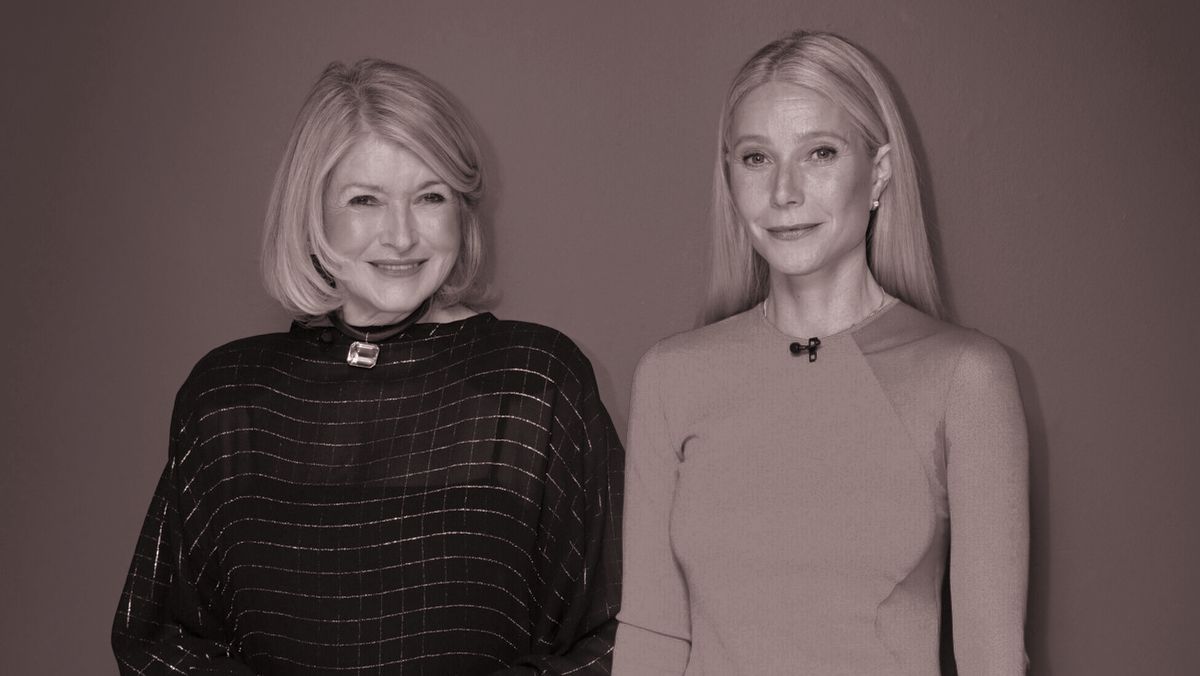
At last, Paltrow’s unprofitable Goop Beauty is embarking on a new, seemingly Hail Mary
partnership with Ulta. Meanwhile, Martha Stewart, the original celebrity lifestyle influencer, is out with her own skincare line. |
|
|
For the better part of the last few weeks, Gwyneth Paltrow once again dominated the
women-of-a-certain-age-and-status news cycle, thanks largely to Amy Odell’s biography, Gwyneth. The book, an instant bestseller, meticulously reported some salacious tidbits regarding Paltrow’s early sexual history, among other topics.
Paltrow, who didn’t participate in the book and is apparently pissed at those who did, has had little control over the narrative. It’s a marked contrast from this spring, when she intimated that Goop—her content/C.P.G. brand/food
delivery empire, which she insists is stronger than ever even though it still isn’t profitable after nearly 20 years—was exploring potential partnerships with “big wholesalers” after the company’s failed deal with Sephora. |
|
|
A MESSAGE FROM OUR SPONSOR |
There’s a reason the industry doesn’t publish wholesale reports often: it’s nuanced, behind the scenes, and
not particularly sexy. But we do it anyway because we care about how brands actually thrive. Our latest B2B report contains data we gathered from 100+ real brands. From choosing retail partners to ditching digital tools they barely use, brands are being ruthless about wholesale efficiency and control. Get your free copy. |
|
|
In retrospect, Paltrow was obviously setting the stage for last week’s exquisitely choreographed WWD
piece, which revealed that Goop was “doubling down” on Goop Beauty with an ambitious Ulta Beauty launch. Several people have described the partnership with Ulta as “desperate,” considering that a large slice of the retailer’s business comes from mass-priced and drugstore brands. But the partnership makes sense: Ulta’s in-store experience may leave a lot to be desired, but the retailer can mean big business for the right brands. Not only does it operate twice as many U.S.
doors as Sephora (with significant global expansion on the way), but it’s more representative of the way people really shop for beauty, which is high and low.
With its $150 serums and $105 moisturizers, Goop Beauty will definitely sit at the high end of the store’s offerings. It probably would have made more sense to bring
Good.Clean.Goop, the lower-end diffusion line that flopped at Target, but the company has never quite figured out how to market that product. “The consensus with everyone was, ‘Why are we doing this Target brand?’” said a person close to Goop. “It was a weird, in-between thing.” Anyway, it’s not happening.
In any case, the initial buy-in from Ulta will give Goop Beauty’s revenue a nice boost this year, and the brand could definitely see a meaningful lift in sales if Ulta leans into the
partnership. Ulta’s marketing and in-store visuals are pretty awful (I’m being polite), but thoughtful displays featuring Paltrow would generate meaningful sales, at least initially. “This consumer is not a trendsetter, but often a shopper from middle or suburban America who still thinks Goop is cool,” a beauty executive said to me about the partnership.
Surely, Goop learned a lot from its failed Sephora era, and can hopefully apply those lessons this time around. My understanding is that
Goop Beauty “never supported Sephora in a big way,” according to a person with knowledge of Sephora’s business—meaning it prioritized driving traffic to its own e-commerce site instead of Sephora’s. The brand, according to YipitData, did about $1.5 million in sales at Sephora during the past 12 months, which means Goop’s revenue was less than half of that. “That strategy kept it too narrow, as opposed to expanding Goop’s audience and client base,” said a person close to Sephora.
“They’ll need to go hard at Ulta to appeal to the average person. But Goop is literally not created for that person.”
Regardless of how the beauty partnership with Ulta pans out, Goop is still contending with a number of underlying problems: It remains unsellable at a number that would make investors whole, though many probably consider it a sunk cost at this point and are simply more worried about exiting the business without infuriating Paltrow. I know that, in the past, Paltrow has
expressed a deep desire to sell the company, but I’ve also heard that she’s reluctant to get rid of it. Both seem conceivable, and likely at the same time.
Strangely, no one seems to know whether the talented Julia Hunter, the consultant/fractional C.E.O. who was tasked with turning around Goop last year, is still working there. It’s also unclear whether Goop will ever turn a profit. I guess it’s up to Ulta shoppers to decide. |
And yet, perhaps the more noteworthy blonde entrepreneur of the moment is Martha
Stewart, the original celebrity lifestyle influencer. Last week, Stewart announced that she, too, would be expanding her lifestyle empire with the launch of Elm Biosciences, a skincare brand created alongside Dr. Dhaval Bhanusali, who is best known for co-formulating Rhode products with Hailey Bieber. Stewart, who catapulted back into the zeitgeist during Covid with a swimsuit selfie, remains the
blueprint for celebrity reinvention—even at a youthful 84. It’s in no way a stretch to say that Goop, and maybe even Rhode, are existentially indebted to her trailblazing. |
|
|
When I chatted with Odell, however, she noted a few key differences between Paltrow and Stewart. The first,
obviously, was that Stewart is self-made. The other was that, frankly, she’s just a better businessperson. Unlike Paltrow, Stewart is too smart to cosplay C.E.O. with her new venture: Over the past few days, I learned that Stewart and Dr. Bhanusali wisely left the day-to-day management of the company to Natalie Sperling, a beauty executive who was previously a V.P. at Luxury Brand Partners, the incubator behind Oribe and IGK that’s also
Patrick Starrr’s partner in One/Size. Sperling is also the co-founder and founding C.E.O. of About Face and AF94, Halsey’s makeup lines that were born out of Celebrands, John Howard and Allen Shapiro’s fund, which raised about $90 million in 2020 to invest in celebrity brands like Bella
Hadid’s Orebella. (Howard is an investor in Rag & Bone, Skims, and Ryan Reynolds’s Aviation Gin.)
Elm Biosciences also does not appear to be a craven, celeb-brand cash grab, and has been in the works for at least a few years. I’m always skeptical about buzzwords like “biotech” in skincare, but the involvement of Dr. Bhanusali
actually lends the term some credibility: Beyond Rhode, he’s had his hand in a number of non-celebrity dermatological ventures, and runs his own New York City practice. Two of Elm’s senior advisory board members are Dr.
Saranya P. Wyles, a researcher who specializes in regenerative dermatology at Mayo Clinic, and Dr. Raja Sivamani, a prolific researcher who’s been “credited with bringing bakuchiol to market,” according to an insider.
So far, the brand has raised more than $3 million, a relatively modest sum that should take the company to the point of wholesale expansion. The first two products, a serum and a supplement, go on sale in early September, and a third product
will debut early next year. Elm Biosciences’ approach, according to reports, is supposed to be limited in scale—a concept I always find at odds with the demands of a product pipeline, and the pressure to deliver newness. But here’s what I do know: I’m a paying, repeat customer of a handful of Rhode’s skincare products, and I’ll make a point to try Bhanusali’s next serum, no matter which celebrity name is on the bottle. |
The fact that apparel prices are actually down this year, despite inflation and tariffs,
encapsulates what is wrong with our culture. Clothes are too cheap. [WWD]
This watch expert guy is real worried about the 39 percent tariffs on Swiss imports. [BoF]
A very helpful and detailed
timeline of the latest drama with Huda Kattan, who most recently had a video removed from TikTok because it apparently alleged that Israel was behind World War I, World War II, and September 11. [Ahead of the Kirb]
How will restaurants deal with the fact that wealthy customers are ordering less food because they are on Ozempic? By making
portions smaller but charging more. Perhaps if they had made portions smaller in the first place, fewer people would have to be on Ozempic? [New York Times]
Plum Sykes writing an entire essay about what she wore to a live taping of How Long Gone—and the outfit being a Dior turtleneck and trousers—is peak
something. Also, damn, she looked good. [From the Desk of the Original Voguette] |
Until tomorrow,
Lauren
P.S.: We use affiliate links because we are a business. We may make
a couple bucks off them. |
|
|
Puck fashion correspondent Lauren Sherman and a rotating cast of industry insiders take you deep behind the scenes of this
multitrillion-dollar biz, from creative director switcheroos to M&A drama, D.T.C. downfalls, and magazine mishaps. Fashion People is an extension of Line Sheet, Lauren’s private email for Puck, where she tracks what’s happening beyond the press releases in fashion, beauty, and media. New episodes publish every Tuesday and Friday. |
|
|
Puck’s daily art market email, anchored by industry expert Marion Maneker, offers unparalleled access to the mega-auctions and
galleries, elite buyers and sellers, and the power players who run this opaque world. Wall Power also features Julie Brener Davich, a veteran of Christie’s and Sotheby’s, who provides unique insights into how the business really works. |
|
|
Need help? Review our FAQ page or contact us for assistance. For brand partnerships, email ads@puck.news. You received this email because you signed up to receive emails from Puck, or as part of your Puck account associated with {{customer.email}}. To stop receiving this newsletter and/or manage all your email preferences, click here. |
Puck is published by Heat Media LLC. 107 Greenwich St, New York, NY 10006 |
|
|
|