 |
 |
|
Good evening, and welcome back to Wall Power, where I’m hunkered down and tying up loose ends before the one-two punch of Frieze London and Art Basel Paris starting October 7. I’ll be arriving in London that Monday. Mrs. Wall Power is in charge of where we eat, but if you’ve got ideas for gallery shows I should see, shoot me a note or text me (details at the bottom)—or just stop me if you see me on the circuit, at the fairs or in the museums.
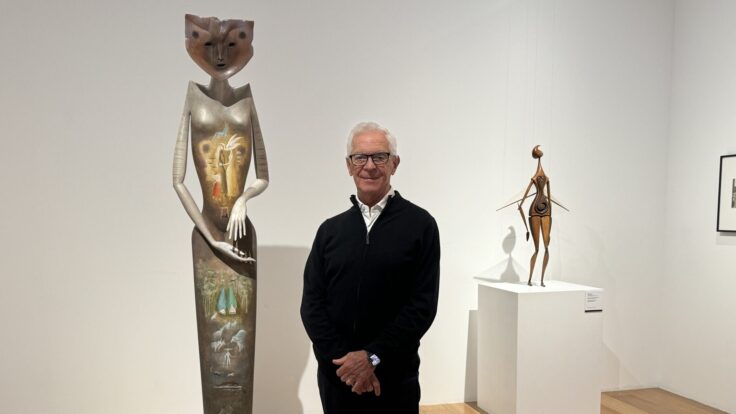
In the meantime, I’ve got a refresher course on the hottest market around: the surrealist-inflected furniture and sculpture of Claude and François-Xavier Lalanne, the late husband-and-wife duo referred to collectively by the art and design world as Les Lalanne. When Claude died in 2019, 11 years after her longtime artistic partner, she left behind a veritable Aladdin’s cave of works at their farm in Ury, some 70 kilometers outside Paris, that the pair made but never sold.
The couple’s adult children have been selling tranches of the work at auction since 2019, pushing the market for Les Lalanne to a higher register with each additional transaction. Two works going to auction in November—one each at Christie’s and Sotheby’s—are likely to blow past their estimates, too.
But first…
- That headline!: All week, I’ve been hearing complaints about the long and provocative article that The Wall Street Journal published last Tuesday with the alarmist headline, “The Art Market Is Tanking. Sotheby’s Has Even Bigger Problems.” Sotheby’s does have problems, as I reported earlier that very day. But people in the industry are rightly irked about the first half of the Journal headline, which posits that the market is in some kind of freefall. Several different people, both advisors and dealers, told me about receiving the WSJ story from clients and friends.
The headline is irksome, of course, because it’s so unsophisticated—there is solid evidence that the art market isn’t tanking. After a peak in 2022, the market has reverted to a lower level of sales; this is all part of the normal market cycle. We saw almost the exact same pattern after the 2018 peak. And based on the numbers I’ve shown you during the past few months, the market actually remains quite strong at the lower levels, even if the highest-priced, headline sales aren’t generating the same fireworks.
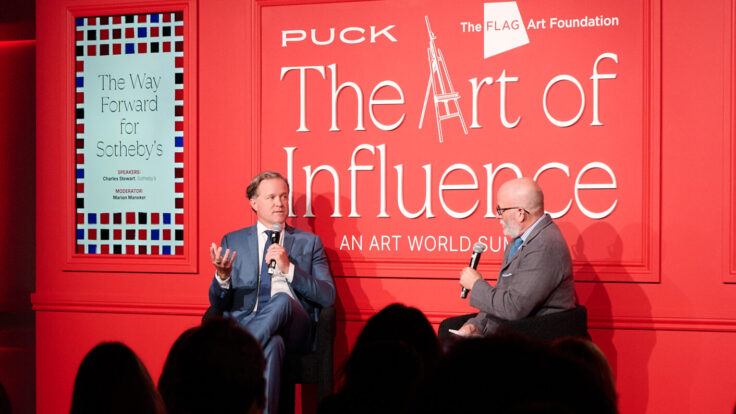
It’s true that the auction houses make a disproportionate amount of revenue from the large, high-value collections that they sell. Without a number of those collections on the market, the auction houses have had to tighten their belts. And it would appear that Sotheby’s is having a harder time with that, mostly due to its high debt load, which the company has sought to address by taking a $1 billion investment from the Abu Dhabi sovereign wealth fund ADQ. But the art market is not “tanking.”
- Hunter Biden’s art market: Why would The New York Times bother to write a triple-bylined story with such an obvious and foregone conclusion? To wit, absolutely no one thinks Hunter Biden has a career as an artist, which makes the notion that his market is now “fizzling” laughable. In the three years since the gallery show that launched this story, little has been heard about Hunter Biden’s paintings, and no one besides Times reporters—and those who want to score political points—seems to care.
Yes, there have been many prominent hobbyist painters—Winston Churchill, George W. Bush, Tony Bennett, Sylvester Stallone, Jim Carrey—and there are people who buy their work. But the Times’s own story says there were only 10 buyers of Hunter Biden’s paintings, and that half of the $1.5 million in sales went to one person. (For his part, Hunter explains that making art is part of his therapeutic efforts to deal with his addiction. That’s a good thing.) Does it appear that the president’s supporters were using sales of his son’s artwork as a way to support the family or, perhaps, to curry favor? Very much so, but Hunter is free to sell his art to anyone who wants to buy it.
- The Mattia de Luca-Morandi pilgrimage: The Giorgio Morandi retrospective at Mattia de Luca’s pop-up gallery on the Upper East Side of Manhattan is turning into the pilgrimage show of the season. (Don’t take my word, just check Instagram.) The nature of Morandi’s work—he spent decades painting variations on tabletop still lifes—would suggest that if you’ve seen one Morandi, you’ve seen them all. And yet! Even though there have been dozens, if not hundreds, of Morandis on the art market these last few years, De Luca’s show seems completely fresh.
|
|
A MESSAGE FROM OUR SPONSOR
|
 |
|
|
| Christie’s Hong Kong Sales Top $161M |
|
|
|
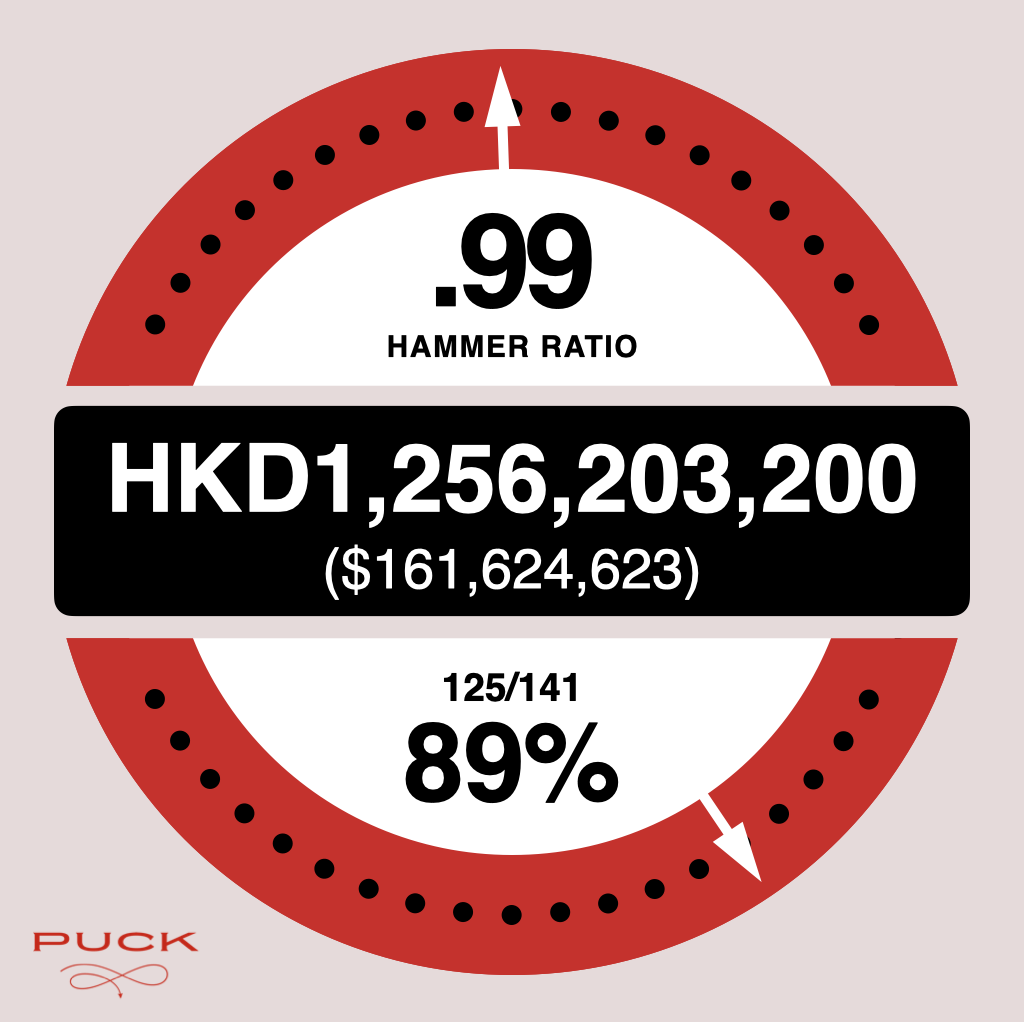
| Christie’s Hong Kong sales cycle, which concluded late last week, was a well-managed debut for the auction house’s new salerooms in the special administrative region of China, which seems to be getting less special every day. The evening sale of 20th and 21st century art was above water with a hammer ratio of 1.01. When I added in the data for the 20th Century Day Sale and the 21st Century Day Sale, the numbers began to soften a little. But at the end of the day, Christie’s did what they needed to do in Hong Kong: They planted the flag and sold art successfully. Artists who saw strong sales included Christine Ay Tjoe, Nicolas Party, Li Chen, Mehdi Ghadyanloo, Lucy Bull, Alix Aymé, Ting Yin Yung, Rhee Seundja, Takeo Yamaguchi, Le Phô, Kazuo Shiraga, and Ronald Ventura.
Two-thirds of the $161 million in total sales came from the top 10 lots. The top three lots were also two-thirds of the total for the top 10. So you can see there’s a power law at work. Overall, estimates were fairly close to what buyers paid. Only one of the top 10 lots had been bid above the estimate range. But none of that is surprising considering the macroeconomic conditions in China. |
|
|
|
|
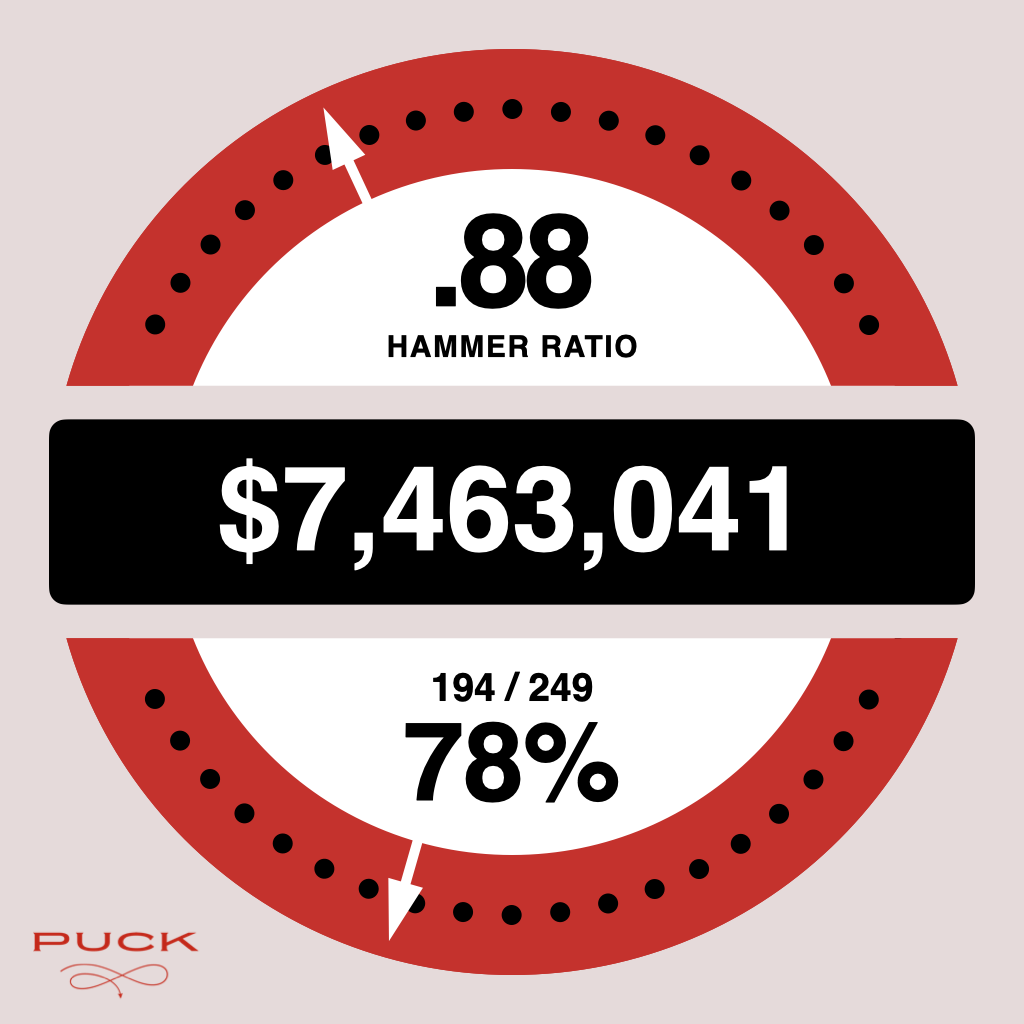
| It’s no secret that the market for emerging artists has cooled, leaving Phillips—which has made this category its bread and butter—in a pinch. Throughout the British auction house’s New Now sale, last Tuesday, works struggled against estimates, even though the estimates were low. The hammer ratio was a low .88. The sale also fell slightly short of the industry-standard low-80 percent sell-through rate, at 78 percent. Even so, there were a number of strong sales for works by Daisy Parris, Jörg Immendorff, Ron Gorchov, Richard Prince, Alfred Leslie, Peter Cain, and Theaster Gates. |
| Sotheby’s Contemporary Curated Hits $20M |
|
|
|
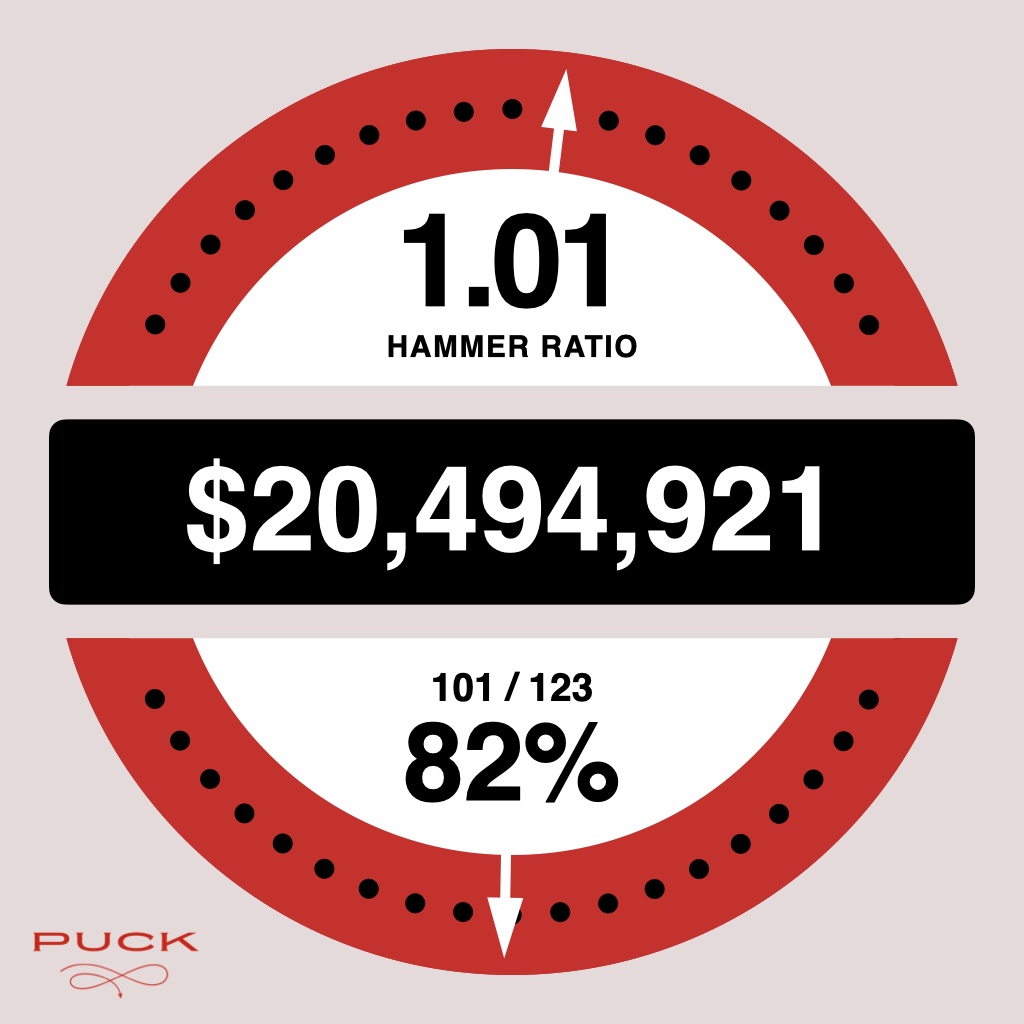
| Sotheby’s was able to match estimates to demand and post a Contemporary Curated sale that landed pretty much on the money, with a 1.01 hammer ratio for $20.49 million in total sales. The sell-through rate matched the industry standard level, too. That’s hardly a “tanking market.” The artists who outperformed expectations were Osvaldo Mariscotti, Emmi Whitehorse, Salman Toor, Carroll Dunham, Jenny Holzer, Fernando Botero, Perle Fine, Richard Estes, Ruth Asawa, Elaine de Kooning, and Diane Dal-Pra.
Just before the Contemporary Curated sale, Sotheby’s also sold works from the estate of RobertAbrams, the book publisher, some of which had been acquired by his father, HarryAbrams, the pioneering art book publisher. The sale totaled $13 million, with nearly a third of the lots finding prices above the estimate range. The top lot was an Isamu Noguchi sculpture that made $4.65 million. Bob Thompson’s Nativity Scene, from 1964, sold for $870,000. Marisol’s The Bicycle Race, from 1962, pulled straight from the traveling retrospective of her work, made $456,000. Works by George Segal, Allan D’Arcangelo, Yaacov Agam, Frank Stella, Mary Bauermeister, Komar and Melamid, and Jackson Pollock all performed better than the estimates.
N.B.: All of the charts were made with data provided byLiveArt. Now on to the main event… |
 |
| Year of the Camel |
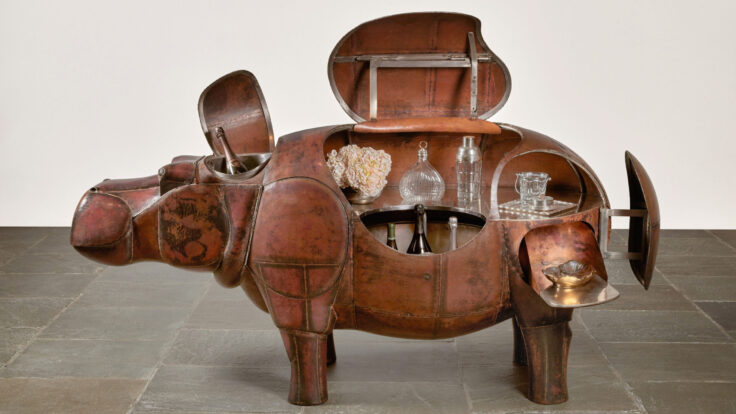
| In the white-hot market for the hybrid sculpture-furniture works by the late husband-and-wife team known as Les Lalanne, nothing is as it seems. Camels are couches, hippos are bars, and the prices always seem to be going higher and higher. This fall, after an opulent show in a Venice palazzo, the auctions may give us even more to talk about. |
|
|
|
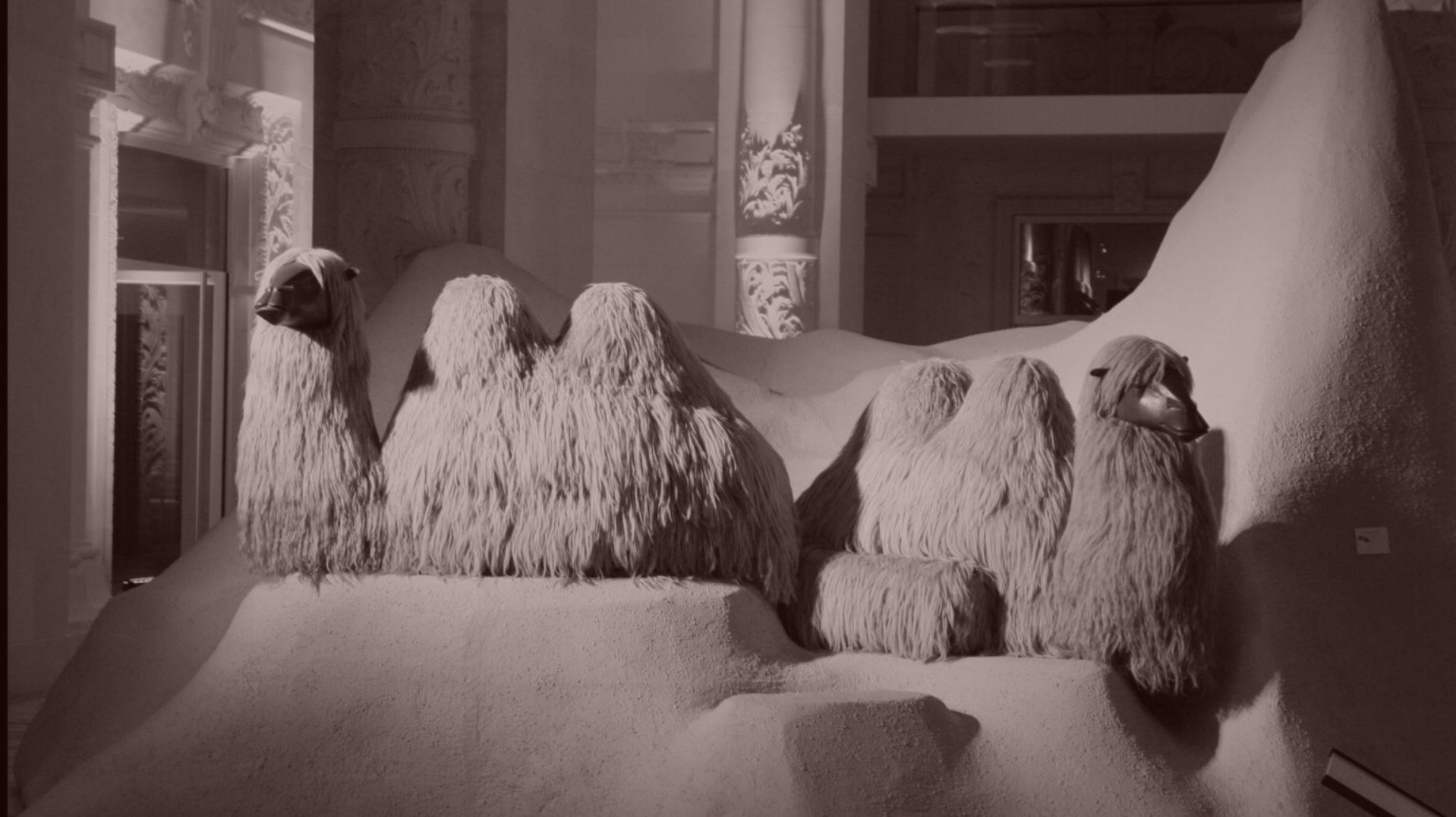
| This fall, in Christie’s November auctions, one of the lots will be a historic piece of furniture—or sculpture, depending upon your point of view—depicting two camels, complete with shaggy fur, that function as couches. The hybrid, hard-to-define work was made by François-Xavier Lalanne. He and his wife, Claude Lalanne, are the surrealist-inspired duo whose oversize, animal and vegetal objets have become some of the most sought-after works in the art market.
The pair of camels, which are two of only four ever made, carry an estimate of $4 million. Yet that number hardly even touches the levels at which work by “Les Lalanne,” as they are collectively known to the art world, can reach. Yes, the Sydell Miller estate, which will be sold at Sotheby’s in November, includes a Lalanne elephant table also estimated at $4 million. But a companion table, offered by Christie’s with the same estimate in 2021, sold for $6.6 million. The Lalanne camels, which were last shown in public at a seminal exhibition organized by Peter Marino at the Musée des Arts Décoratifs, in 2010, will almost certainly blow past estimates, too.
A year ago, Christie’s offered a rare example of a large secretary desk, shaped like a Rhinoceros, in a single-lot evening sale in Paris. Estimated at €4 million, the work had appeared in that same 2010 Parisian exhibition as the camels. The night of the sale, the bidding on the early, unique work—which had been held in the same family for more than half a century—overshot the estimates to land at €18.33 million ($19.4 million), or more than twice the previous record for the artist. The price seemed spectacular, but works by Les Lalanne are no stranger to making an impact at auction. |
|
|
| In the depths of the global financial crisis, in 2009, Christie’s held the sale of works owned by Yves Saint Laurent and Pierre Bergé, which included several important Lalanne works as would befit the couple’s early patron. As the banking system teetered on the edge of armageddon, rich people were happy to fling their presumably much-needed cash at a wide range of art and decorative objects owned by the legendary designer and his mastermind partner. Carla Fendi was one of them. She bought François-Xavier’s custom-made Bar YSL, which was estimated at a reasonable €200,000, for a stunning €2.75 million ($3.5 million), which would be $5.22 million today, adjusted for inflation.
And the market for work by Claude and François-Xavier Lalanne has more than kept pace with inflation. According to Ben Brown, prices for Lalanne works were doubling every two years from 2015 to 2022. Brown should know: With his galleries in London and Hong Kong, along with Galerie Mitterrand in Paris and Kasmin in New York, Brown has been an essential market-maker in works by the late French couple. Currently, he has an installation of Lalanne works at a palazzo in Venice. Dubbed Planète Lalanne, the show includes nearly 125 different works across eight rooms, ranging from major pieces like the bronze Hippopotamus II bar (another example in the series sold for $7.5 million in May 2023) to one of Claude’s signature Choupattes, a large cabbage standing on chicken feet.
By his own admission, Brown spent a fortune staging his Lalanne show in Venice. But it is the kind of opulent setting that Brown felt was the last missing piece from the jigsaw puzzle of the Lalanne market. Timed to coincide with the Venice biennale, the show opened in April and will last until November. “This show is effective because extremely important collectors came and bought,” Brown said. “This show is part of the reason for the demand.” |
|
A MESSAGE FROM OUR SPONSOR
|
|
|
|
|
|
| Brown and I got to discussing the curious nature of the Lalanne market. After the YSL-Bergé sale, there was an increased appreciation for—and visibility of—the couple’s work, especially the stone sheep which act as market bellwethers due to the large editions in which they were made. Currently, Lalanne stone sheep trade for prices around half a million dollars. (Lalanne dealers will often step in to buy ones at auction that fall below the market price.) But Brown says he only gets his hands on maybe one in five sheep that come to auction—a sign of strength in the market. “I am absolutely delighted,” he told me, “when I get nothing.”
Much of that stronger demand has manifested in the last five years, following the death of Claude Lalanne, in 2019, at the age of 94. (François-Xavier died more than decade earlier, in 2008.) In some ways, this dynamic has been counterintuitive. When Claude passed, the Lalanne estate was inherited by the couple’s four daughters. The estate put a large number of works up for auction—and important works were donated to French museums. Then two of the daughters began to sell through the auction houses. Ordinarily, such a volume of sales might have suppressed the market.
Instead, it has grown stronger. The first sale, with Sotheby’s in October 2019, made a whopping €91 million—a portion of which went toward settling the estate’s tax obligations. That allowed the Lalannes’ daughters to divide the rest of the seemingly boundless trove of objects stored at Les Lalanne’s farm in Ury, outside of Paris. Two years later, buoyed by the success of the sale, one of the daughters, Dorothée, held two auctions at Sotheby’s, making an additional €129 million. The next year, Marie Lalanne, another of the daughters, held a sale at Christie’s that netted €77 million. Now, on October 10 in New York, Dorothée will sell at Christie’s an additional 70 lots in a rare sale that focuses only on François-Xavier’s works. Christie’s wants to put the spotlight on his work as a sculptor. And though the Lalannes were an artistic team, they rarely collaborated on works. The sale will have a low estimate of $16 million.
Don’t pay too much attention to the estimates. One of the peculiarities of the Lalanne market is that almost everything sells for higher prices. That’s mostly because the consignors can keep the estimates low, feeling confident that the market will absorb the work. Even non-estate sellers like Pauline Karpidas, who sold the contents of her home on the island of Hydra at Sotheby’s last year, had gotten the memo. The Lalanne estimates were all easily surpassed in the sale.
In situations like this, there is usually a great deal of friction between the galleries that represent an artist and the auction houses that are often competing for the same material. Right now, however, the Lalanne market continues to expand. That’s good for Brown. He believes Dorothée’s upcoming Christie’s sale has good things in it. For example, the Trés Grand Ours is estimated at $2 million, even though a version of the bear two-thirds its size sold at Christie’s two years ago for $3.66 million. Or this bronze Belier that is estimated at $400,000, even though three other examples of the work have sold in the last three years for prices ranging from double to triple that estimate. Good things at seemingly low prices are exactly what make the auctions work. |
|
|
| That’s enough for today. Just a quick reminder that I do like to hear from you all. Feel free to simply reply to this email. Or send me a text to my SMS channel. You can also reach me at 917.825.1391 on Signal, WhatsApp, or regular SMS text.
Let’s check in again on Tuesday,
M |
|
|
|
| FOUR STORIES WE’RE TALKING ABOUT |
 |
|
 |
| Netflix Comp Wars |
| Digging into the standoff between Netflix and talent agents. |
| MATTHEW BELLONI |
|
 |
| Delphine Streets |
| Illuminating the pressure on the new C.E.O. at Dior. |
| LAUREN SHERMAN |
|
 |
|
|
|
|
|
 |
|
|
|
Need help? Review our FAQs
page or contact
us for assistance. For brand partnerships, email ads@puck.news.
|
|
You received this email because you signed up to receive emails from Puck, or as part of your Puck account associated with . To stop receiving this newsletter and/or manage all your email preferences, click here.
|
|
Puck is published by Heat Media LLC. 227 W 17th St New York, NY 10011.
|
|
|
|