 |
|
Wall Power is heading out of town for a couple of days. You’ll get another newsletter from me next Sunday after my trip to the hinterlands.
Before I go, I want to take another stab at the question: Where did all the money go? When I wrote about Jacob King’s analysis of the primary art market, I got an email from a money manager who wanted to flag a major factor in declining art spending. As he noted, rich people often borrow against their art to buy more art. These days, of course, interest rates have surged, which may explain the fairly abrupt drop in buying. I’ll explain how all of this works, below.
✍️ P.S., we’ve updated our Newsletter Experience questionnaire for Puck subscribers. If you haven’t filled yours out, it takes less than 3 minutes, and your feedback will help us develop new products and services. Click here to complete the brief survey—no need to log in. Thanks!
But first…
- Phillips posts robust sales: Phillips had $373 million in sales in the first half of 2024, down from $409 million last year, an 8.8 percent decline—not great but also not bad, considering the state of the market. (Like Christie’s, no private sales are included in that number.) The sell-through rate on lots was 87 percent (just like Christie’s). An additional, pretty astonishing fun fact: 41 percent of the auction buyers in the first half of 2024 were new to Phillips. Moreover, a full 50 percent of clients at the company’s Dropshop division were first-time buyers.
- A little more on last week’s data…: When ARTDAI was kind enough to run numbers for me last week on the last 10 years (or last 20 half-years) of auction sales at the three big auction houses, they gave me the results by market segment. The different price bands behave differently over time, so it is worth a closer look:
Above $25M: Lots offered above $25 million saw the highest hammer ratio in the first half of 2017 and the lowest in the second half of 2016. The highest average selling price for works in that segment was $55 million in the first half of 2022; the lowest, $25.5 million in the second half of 2016.
$5M to $25M: Still quite expensive, this price band saw the most competition during the Paul Allen sale period and the lowest at the tail end of the so-called “masterpiece market” from 2011 to early 2015. The highest hammer ratio for works in this band was 1.29 in 2H2022; the lowest was in 2H2015, when the hammer ratio was 1.01. The highest average price for this band was $12.95 million in 2H2014; the lowest was $9.7 million in 2H2019.
$1M to $5M: This was the meat of the high-value market, which peaked during the pandemic liquidity rush. The hammer ratio reached its zenith in 2H2021 at 1.41; its nadir was 1.17 in 1H2024. The average price reached a high $3.18 million in 2H2021; its low point was $2.55 million in H1 of 2016.
$250K to $1M: This price band is a transition between the middle market and the high-value market. The high for hammer ratio was 1.72 in 2H2021; for average selling price, it was $854k in 2H2021. The lows were a 1.28 hammer ratio and $626k average price in 1H2020.
$50K to $250K: The heart of the middle market, bidding pressure in this price band maxed out at 1.92, with a $220k average selling price, in 2H2021; the hammer ratio was lowest in the first half of this year, when it hit 1.46, with an average price of $163k. These numbers were only slightly lower than what was seen in 1H2020 and 1H2016 for both metrics.
Under $50K: In the lowest-value auction price band, the hammer ratio reached 2.10 in 1H2021. The next semester, the average selling price rose to $32,060. In 1H2016, the hammer ratio fell to 1.60; in 2H2023, the average price was its lowest, at $23,006.
- What do you get for a guy who already has a copy of the Constitution?: Ken Griffin likes to buy very expensive things and loan them to museums. When he spent $500 million buying two paintings from David Geffen—Willem de Kooning’s Interchange and Jackson Pollock’s Number 17A—he loaned them to the Art Institute of Chicago. Recently, he spent $43 million on an early copy of the U.S. Constitution and loaned it to Crystal Bridges Museum of American Art in Arkansas. Now he’s paid $44 million for a stegosaurus skeleton found nearly intact in Colorado. The 150 million-year-old animal has been nicknamed “Apex.” No word yet on which museum Griffin will loan it to, but presumably he won’t be keeping it in his foyer.
|
| Now let’s talk about loans… |
 |
| The End of the Art World’s Arb Era |
| Why is the art market down so much in volume when other markets haven’t seen the same drop? One explanation might be the billions of dollars in art loans that are now being reversed in our high-interest rate environment. |
|
|
|
| One of the great ironies of finance, a banker friend likes to remind me, is that no institution wants to lend money to someone who really needs it. Between 2010 and 2022, as excess liquidity sloshed through the system, ultra-high-net-worth individuals borrowed billions and billions of dollars against their assets. For many art collectors, that meant leveraging their art—sometimes to make money in other asset classes, sometimes to buy more art. Starting two years ago, those conditions have reversed, draining the art market of billions.
Art-backed loans have been a fixation in the financial world for more than a decade. Alternative-asset giant Carlyle tried to get into the game, and Sotheby’s Financial Services—which recently sold a $700 million portfolio of art-related loans as an asset-backed security—has attracted attention from investors for its unique position within the auction house. But the dominant player in this field has been Bank of America, which used its clout with its rich clients to create a massive art loan book of $10 billion by offering exceedingly low rates—at least while they lasted.
For years, this was a dual benefit for banks and their clients, especially for high-net-worth individuals looking to do what another banker described to me as balance sheet arbitrage. In short: Most wealthy people have the bulk of their net worth in semi-illiquid assets, like company stock, real estate, and equities held in family trusts. So when someone comes to you with an investment opportunity, but you don’t want to trigger a major taxable event to free up some cash, you have to get creative.
Enter your banker with an arbitrage opportunity. Instead of selling your assets to make a short- or even medium-term investment, your banker will happily make you a loan. The financial math is simple. As long as the return from the investment is higher than the cost of the loan, you’re making money. Also, you don’t have to sell any assets, whatever they may be. Banks love these loans because the borrowers don’t really need the cash, which means they’re low risk for everyone involved. If the bank can see what you’re really worth, and they can perfect the collateral you offer for the loan—i.e., they gain legal control over your money or property—they can offer you a very good rate.
This is especially important to the art world because for those dozen years, from about 2010 to 2022, the art market was goosed with billions of dollars—I’ve seen estimates of $17 billion-$20 billion—in art loans that were built on this exact principle. These loans were also used for lifestyle goals. Don’t want to exercise your Goldman options but still want a glow-up? Your banker can help get you into that Hinckley picnic boat or acquire another Vilhelm Hammershoi for the beach house. |
|
|
| Earlier this month, I wrote about Jacob King’s provocative theory that today’s art market doldrums can be attributed, in part, to the years-long glut of collectors rushing into the secondary market with an “investment mindset,” driving up prices to unsustainably high levels and thus choking off new activity. But as I was reminded by a savvy money manager, who reached out after reading my column, much of the slowdown can also be attributed to the fact that art loans have gotten much more expensive.
Interest rates are a crucial input for the art market ecosystem, of course, because many of the most successful long-term collectors are art rich but cash poor. Fine art, after all, is one of the most illiquid assets in the world.
Before Jay Powell started jacking up interest rates, private bankers—especially those managing collectors’ non-art assets—were lending against up to 50 percent of the value of the investors’ art holdings. That means if you had $20 million in art in your house or storage, you could get $10 million in cash to invest in other things. That might sound reckless, but it’s more prudent to diversify your holdings, especially if you’re merely art rich.
That same bank probably had a number of different investment opportunities it wanted to sell you on. The bank made money; you made money; and your portfolio generated income, as well as being balanced against the risk of the art market falling. If the bank was managing your investments, they felt much safer making the art loans because they knew the money was in something as (or more) valuable than the art. And they could keep an eye on it.
In exchange for all of that confidence, the bank was willing to lend at very low rates, sometimes as little as 75 to 150 basis points above the discount window. For much of the period from 2010 to 2022, the Fed was operating under a Zero Interest Rate Policy that meant money was essentially free to these banks. Collectors were paying 1.5 percent or less to borrow and invest.
Anyway, most borrowers put the money in a range of financial or alternative investments that generated much higher returns than fine art. But a few enterprising art collectors recognized there was an arbitrage opportunity available only to them. As we’ve discussed, the art market is clannish and exclusionary. You cannot simply buy art because you have the money; you have to add value. Established art buyers with recognized and admired collections move to the head of the line at any gallery. The dealer wants to sell to someone whose name and reputation will advance the visibility and status of the artist.
For much of the ZIRP era, it was easy for well-respected collectors to get primary market works from the most sought-after new talents at prices below market value. If you could borrow $1 million against your art holdings at 1.5 percent annual interest and buy a dozen or more primary market paintings, and then quietly flip them for double or triple the price, why wouldn’t you? Especially if it was only costing you $15,000 a year in interest payments to make that million or more.
This has always been one of the dirty secrets of the art world. Everyone loudly condemns speculators—people who flip art for short-term profit—but the speculators are usually people with the most access to art, meaning the most respected collectors. And they’re abetted by the very galleries who control the markets of the artists everyone is speculating in!
There were not a lot of people playing this game. Nevertheless, it ended when dealers raised primary prices and the Fed raised rates. In both cases, the spread collapsed, eliminating the arbitrage opportunity. |
|
|
| In 2022, the Fed began raising the rate it charges banks, eventually topping out where we are today, at 533 basis points. That drove the Secure Overnight Financing Rate, the benchmark that loans are calculated from, up to the same level; banks also raised the extra fees they charged from 57-150 basis points up to 300-500 basis points. Today, the total cost to art market borrowers ranges from 8.33 percent to as high as 10 percent. At that level, these loans are no longer cheap.
That doesn’t mean everyone is running for the exits. Remember, few of the people who are borrowing against fine art need the money. They’re simply reallocating their investments. Often these loans are combined with a margin loan against equity holdings. And the art market may be down, but the equity market is definitely not. So it isn’t very hard to move money from one part of the balance sheet to another. One banker wondered aloud if the $10 billion art loan book at Bank of America had dropped closer to $8 billion over the last 18 months.
The BofA book has declined rapidly, in part, because art loans don’t have a long duration. They’re short-term loans by definition, because the art market is illiquid and it is difficult to mark the collateral to market. With auction volumes down nearly 50 percent from the 2022 peak, art valuations are also down. That means the collateral is getting reduced and the loans are being called in.
Since these borrowers have only a small percentage of their net worth in art and their portfolios are still strong, paying down the art loans or credit lines used to buy art isn’t a disruptive event. But it does mean the collector has less money to spend on art right now—which is probably a good thing because, as most wealth managers will tell their clients, now isn’t a great time to buy art. One person in the advisory business who deals with collectors and artists recently told me, “Investment opportunity in art is at the lowest it ever was.” The big-money buyers have walked away, which makes it even riskier to buy art at this price level. The last thing you should do at a time like this is borrow against art to buy more art.
It’s also a lousy time to sell art, but that might not be why we’re not seeing some of this art liquidated. The truth of the matter is that collectors are still collectors. The value of art isn’t in the financial gains; it’s in what they call psychic income: the status and satisfaction one gets from owning art, which isn’t easy to measure but is a significant driver in the market. Art, after all, is often the last asset buyers acquire—after the house, the beach house, the boat, and, for some, the plane. And because buying art is so personal and connected to the collector’s sense of status, it’s often the last thing they sell, too. (Just ask Ron Perelman.) It’s very hard to explain to your friends at the private club why you’re dumping your art even in the worst of times. |
|
|
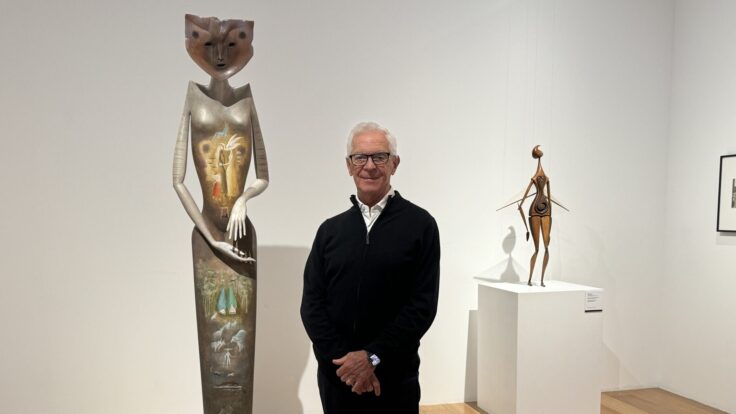
| That’s all for today, sports fans. I’m off to Buffalo this week to see the new Buffalo AKG and their retrospective of Marisol, an important but overlooked Pop artist who bequeathed her estate to the museum.
I’ll have more on Marisol, the Buffalo AKG, and what to do, see, and eat in Buffalo next Sunday.
Marion |
|
|
|
| FOUR STORIES WE’RE TALKING ABOUT |
 |
|
 |
| Zaz’s Epiphany |
| A close look at David Zaslav’s WBD anxieties. |
| MATTHEW BELLONI |
|
 |
| Iron Manfred |
| A candid chat with MLB commish Rob Manfred. |
| JOHN OURAND |
|
 |
|
|
|
|
|
 |
|
|
|
Need help? Review our FAQs
page or contact
us for assistance. For brand partnerships, email ads@puck.news.
|
|
You received this email because you signed up to receive emails from Puck, or as part of your Puck account associated with . To stop receiving this newsletter and/or manage all your email preferences, click here.
|
|
Puck is published by Heat Media LLC. 227 W 17th St New York, NY 10011.
|
|
|
|