Welcome back to Wall Power. I’m Marion Maneker.
Selling art
isn’t easy. It takes a lot of thought, strategy, and effort from a fair number of people to provide the context that ultimately convinces collectors to exchange useful, fungible money for an object whose value is primarily cultural and, in many cases, historic. With that in mind, I want to take you on a brief tour of a few New York gallery shows doing said work exceptionally well.
Mentioned in this issue: Eduardo Costantini, Doris Salcedo,
Jesús Rafael Soto, Carlos Cruz-Diez, Vik Muniz, Si Newhouse, Ken Griffin, the Al Thani family, David Geffen, Clyfford Still, Banksy, Faith Ringgold, Richard Diebenkorn, Julian Schnabel, Andy Avini, Brett Gorvy, Jay Krehbiel, and many
more…
Let’s get started… |
-
MALBA x Daros: Argentinian collector/real estate mogul Eduardo Costantini has been on a mission in recent years, buying up important works by Latin American artists to enhance the collection of MALBA, the museum he founded in Buenos Aires in 2001. Now Costantini has bought the Daros Latinamerica collection, comprising 1,220 works of art by 117 artists from the region. The
collection was created by the Schmidheiny family, Swiss industrialists who also own the Daros collection of contemporary art in Zurich.
The acquisition nearly doubles MALBA’s holdings to 3,000 artworks, complementing the existing collection with works by contemporary artists.
Seventy-five of the artists with work being acquired are new to the institution, including Doris Salcedo, Jesús Rafael Soto, Carlos Cruz-Diez, Alexander Apóstol, and Vik Muniz. MALBA also plans to expand its building and recently hired Rodrigo Moura, chief curator of El Museo del Barrio in New York, to be its artistic director.
|
|
|
A MESSAGE FROM OUR SPONSOR |
The first steps towards a masterpiece starts with a dream. The all-electric BMW i7 – the
evolution of brilliance. Learn more at BMWUSA.com |
|
|
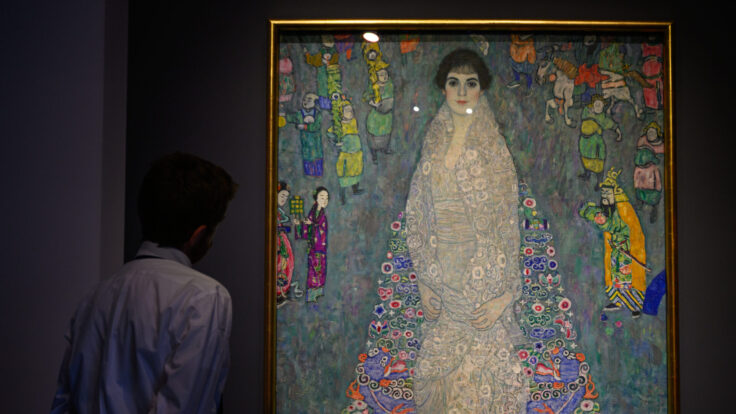
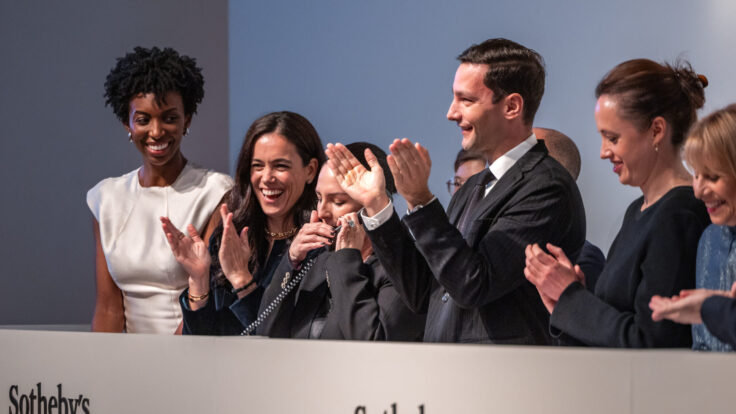
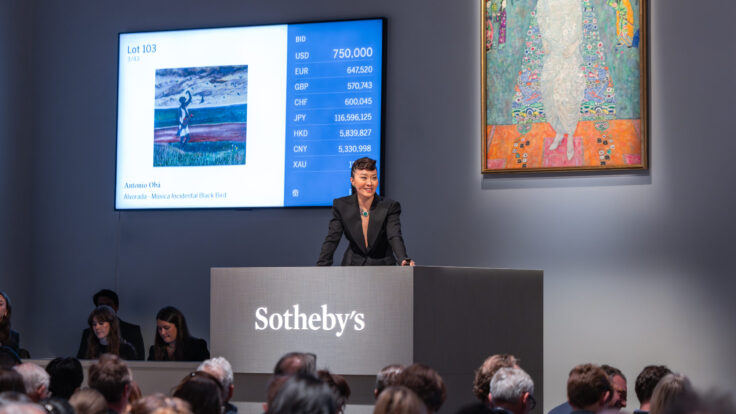
- Sotheby’s Icons: The conceit of Sotheby’s Icons show, running through December 21, is that each work represents an important sale at the auction house in recent years. It has borrowed pieces from prominent collectors like Ken Griffin, Pierre Chen, and most likely, Qatar’s Al Thani family for the show, which also seems to be part of Sotheby’s broader campaign to fully capitalize on the Breuer Building as its main showcase and
headquarters.
At the Breuer you’ll get a chance to see Andy Warhol’s Shot Orange Marilyn, from 1964, and Jasper Johns’ False Start, both recently hanging at the Philadelphia Art Museum. Si Newhouse purchased each about a decade apart, the Johns in 1988 and the Warhol in 1998, for $17 million. Newhouse eventually sold False Start to David Geffen, who in turn sold it to Griffin for
$80 million in 2006; Griffin was also rumored to have paid Newhouse’s estate $240 million for the Orange Marilyn in 2017. Another loan from Griffin is Jean-Michel Basquiat’s untitled painting of a head from 1982, which astonished the art market when it made $110 million in 2017. The buyer at the time was Yusaku Maezawa, a Japanese retail entrepreneur, who is rumored to have sold it to Griffin for considerably more.
But the highest-value work in
the show is actually Willem de Kooning’s Interchange, from 1955. That painting was sold to a Japanese dealer at the height of the 1980s art boom for nearly $21 million, eventually also ending up with Geffen, who then sold it to Griffin for $300 million in 2016. (Indeed, Geffen’s talent as an art trader is the hidden theme of the show.) Other high points include the Piet Mondrian, Composition No. II, from 1930, which Chen bought for $51 million
in 2022. Clyfford Still’s 1949-A-No. 1, from 1949 (naturally), reportedly sold to a member of the Al Thani family for nearly $62 million in 2011, as the art market recovered from the global financial crisis and Qatar, among other Gulf states, started acquiring works for long-gestating museum projects. Sotheby’s also borrowed Banksy’s Girl Without Balloon, from 2018, which sold for more than $25 million in 2021, as well as Jane
Birkin’s Birkin prototype bag, which a Japanese fashion reseller bought for $10 million earlier this year.
|
Now let’s get to the main event… |
|
|
Three striking new gallery shows—Faith Ringgold, Richard Diebenkorn,
and Julian Schnabel—show how gallerists work hard to steer perceptions and provide context to decades-old works. It’s harder than it looks. |
|
|
It’s been a long, event-filled art-selling season, and I’ve seen a lot of art in the
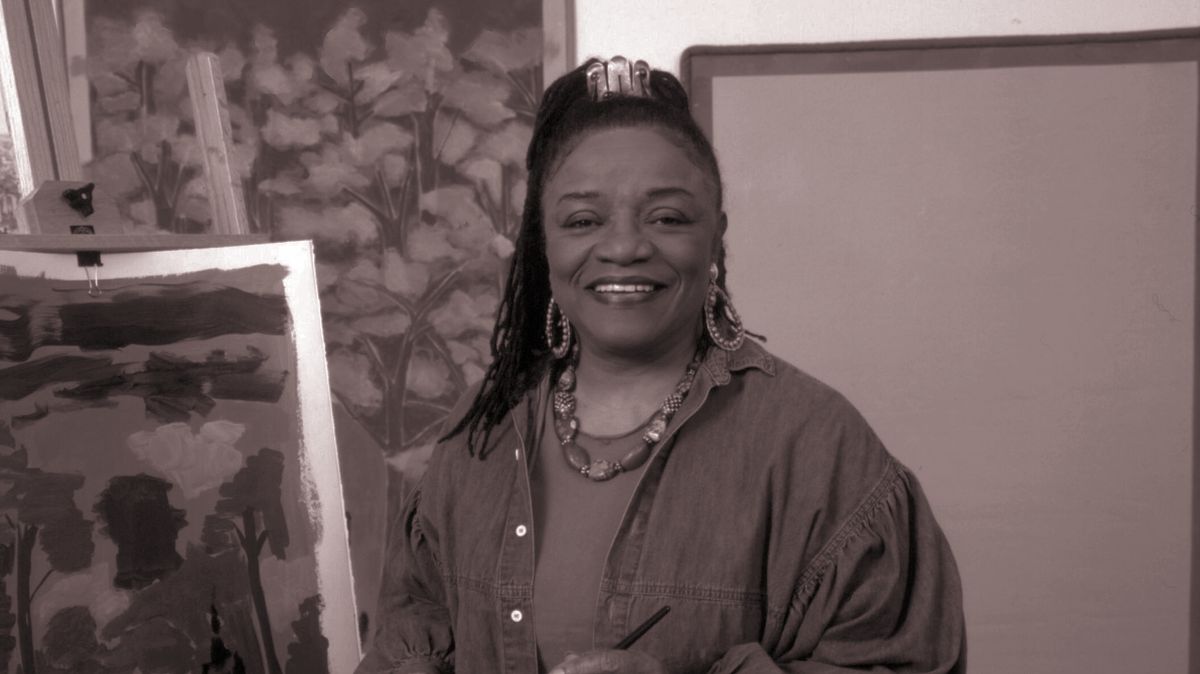
last three months. But no matter how much you see, there are always some shows you can’t get to, so I tried to partly remedy that with a gallery tour late last week. My first stop was Jack Shainman Gallery, where I saw the inaugural show of the groundbreaking artist Faith Ringgold’s estate. Then I caught an uptown 6 train to Gagosian’s flagship at 980 Madison Avenue, where I finally got to see the Richard Diebenkorn show, also an inaugural of his
estate. (Yes, the gallery is still showing art long after it was supposed to have vacated the building.) After that, I stopped in at Mnuchin Gallery, which is holding a show of Julian Schnabel’s plate paintings stretching back to the 1980s.
The only throughline to these shows was that the works on display were all historical—the latest evidence of a well-noted pendulum swing in the market. Naturally, selling historical works requires more than just hanging the paintings
and expressing excitement. But one of the advantages of offering them is that the artists’ careers have already taken shape, which allows you to answer some central and perennial concerns of buyers—namely, what the art will look like in their homes in five or 10 years, and how it will reflect on its owner. Collectors want to be seen as thoughtful and enlightened, not as fad-chasers falling for the “it” artist or movement of the moment. |
Jack Shainman has had a long and influential career as a gallerist,
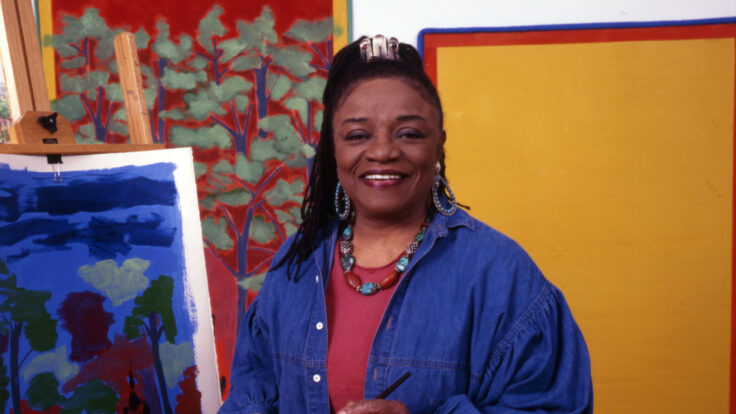
representing African American and African diaspora artists such as Nick Cave, Kerry James Marshall, Toyin Ojih Odutola, Lynette Yiadom-Boakye, and many others. So it was not much of a surprise when Jack Shainman Gallery announced in the spring that it would take over representation of Faith Ringgold’s estate from her dealer of 30 years, ACA Galleries. (Ringgold died in 2024 at the age of 93.)
|
|
|
A MESSAGE FROM OUR SPONSOR |
The first steps towards a masterpiece starts with a dream. The all-electric BMW i7 – the
evolution of brilliance. Learn more at BMWUSA.com |
|
|
Though there are some similarities between representing an artist and an artist’s
estate, there are also differences. Knowledge that an artist’s output is finite changes the calculus of value. Selling works to museums becomes even more important, to enhance and maintain the artist’s stature, as well as to maximize the value of future sales. Reputations are fragile in the art world, and an artist doesn’t have to be tarnished to suffer from fading interest.
That said, Shainman is hardly starting from scratch. He has the great benefit conferred by Ringgold’s late-in-life
recognition from important institutions. You’ll probably remember the 2019 relaunch of MoMA, when the museum inaugurated its planned ever-rotating permanent exhibition by juxtaposing Pablo Picasso’s earth-shattering Demoiselles d’Avignon, from 1907, with Ringgold’s equally (or maybe more) upsetting American People Series #20: Die, from 1967. The move
accomplished two things: It showed MoMA was seriously committed to a broader definition of contemporary art, and it elevated Ringgold to a stratospheric position.
Three years later, the New Museum followed that provocation with a sustained argument for Ringgold’s importance as a tentpole artist. Her African American identity is essential to her art, but the
retrospective that focused on the storytelling in her work also showed her great range of innovative materials and the syncretic influences that helped create her unique mix of textiles and painting. Here, Shainman is picking up the baton.
The current show tries to be comprehensive, but is constrained by what the estate owns. While the New Museum could borrow from collectors who were prescient enough to see Ringgold’s importance, the estate owns a substantial number of certain works but
lacks others—as is typical for the estates of many artists whose work is only fully appreciated in retrospect. Nevertheless, we get a good overview of Ringgold as a painter in the 1960s, when she drew on different traditions but maintained a distinctive style. In the early 1970s, after the artist discovered Tibetan Thangkas in the Rijksmuseum, we see a newly liberated Ringgold combining painting with textiles in a wide range of forms and styles.
Thankfully, the art world’s lingering
prejudice against works that are based on textiles is rapidly dissipating. Shainman is asking mid-to-high-six-figure prices for many of these pieces, and the prices look more realistic the more you see the work. In a generation, in fact, these works may seem to have been wildly cheap. |
No one needs to make a case for adding Richard Diebenkorn to the postwar
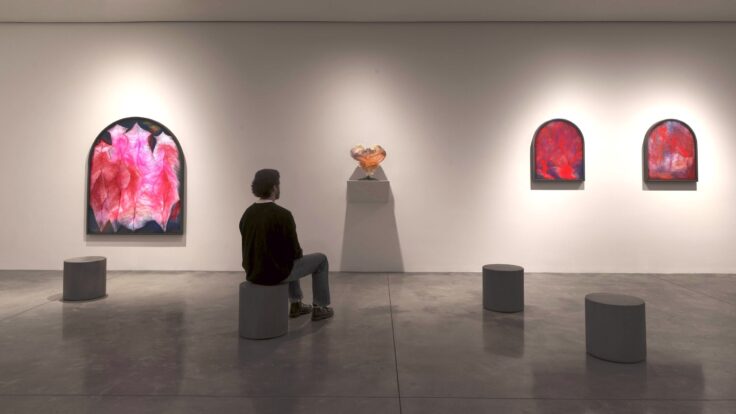
canon. He’s a giant of abstract art, but also something of a cult favorite among artists. That point was made to me by Andy Avini, a managing director at Gagosian, who told me he’s hoping to organize a life-drawing class for artists in the skylit gallery at 980 Madison. That’s also where he has hung the first show of work from Diebenkorn’s estate. Avini
envisioned a group of artists sketching from a nude model surrounded by the wide range of Diebenkorn’s work, which was drawn from the estate. |
|
|
But even with his stature and a spate of relatively recent record sales—like the $46
million paid for 1965’s Reflections of a Visit to Leningrad two years ago—Diebenkorn can seem less essential. That’s a danger when an artist’s reputation and market suggest the work is out of reach. To counter that perception, Avini chose three very different canvases by the artist: a 1952 abstract painting in rich umber
tones that has vague hints of being an interior scene; a 1960 painting, Two Nudes; and another untitled work from 1985-88 that’s a solid example of the famous Ocean Park series. These paintings anchor the show, while staking out the perimeter of Diebenkorn’s body of work.
In between, Avini gives us an array of works on paper, some abstract, some representative, others a tantalizing mixture of both. I was particularly transfixed by the untitled charcoal work from 1980-90 that
appears to be a study. But you might find yourself interested in the ways that the abstract lines of the Ocean Park paintings appear as early as 1955 in Still Life with Matches; or in the Matisse-like tree depicted in the green, grey, and white untitled work from 1990. Whatever attracts your eye, Avini’s point has been made: Diebenkorn can be a more accessible and engaging artist than many of us might have realized. |
For its part, Mnuchin Gallery’s Julian Schnabel: Plate Paintings, 1978-2025
does something different: It gives some historical heft to an artist who may have become more famous as a personality in recent years. Earlier this week, I was speaking with a prominent museum curator who casually mentioned his view that artists of the 1980s were undergoing a thorough reassessment. I also noticed Brett Gorvy’s recent Instagram post saying that over 30,000 visitors had attended his show with Mary Boone at Lévy Gorvy Dayan: Downtown/Uptown:
New York in the Eighties. There are more shows to come, with the Brant Foundation’s planned Keith Haring exhibition next spring.
The Mnuchin show fits right in. Even though Schnabel has returned to making plate paintings in recent years, this time focusing more on portraits, Mnuchin’s exhibition is a reminder of the big, bombastic works that Schnabel started making after returning to New York from a trip to Barcelona in 1978. Here are full gallery walls of
crockery-studded works in mud tones. One work prominently shown with a partially burnt log propped in front of the canvas brings to mind Anselm Kiefer’s work from the same neo-expressionist period. To be honest, it’s hard to remember the appeal of such work. I’m not saying the plate paintings aren’t impressive, but I’m also not saying they’re all that appealing. Still, stranger revivals have happened. |
That’s it for today. I’ll be back in tomorrow’s Inner Circle with an interview with
Freeman’s Jay Krehbiel. Upgrade, if you haven’t already, to read it.
See you then,
M |
|
|
The ultimate fashion industry bible, offering incisive reportage on all aspects of the business and its biggest
players. Anchored by preeminent fashion journalist Lauren Sherman, Line Sheet also features veteran reporter Rachel Strugatz, who delivers unparalleled intel on what’s happening in the beauty industry, and Sarah Shapiro, a longtime retail strategist who writes about e-commerce, brick-and-mortar, D.T.C., and more. |
|
|
Finally, a media podcast about what’s actually happening in the media—not the oversanitized,
legal-and-standards-approved version you read online. Join Dylan Byers, Puck’s veteran media reporter, and Julia Alexander, a longtime media analyst, as they sit down with TV personalities, moguls, pundits, and industry executives for raw, honest, sometimes salacious conversations about the business of media and its biggest egos. New episodes publish every Tuesday and Friday. |
|
|
Need help? Review our FAQ page or contact us for assistance. For brand partnerships, email ads@puck.news. You received this email
because you signed up to receive emails from Puck, or as part of your Puck account associated with {{customer.email}}. To stop receiving this newsletter and/or manage all your email preferences, click here. |
Puck is published by Heat Media LLC. 107 Greenwich St., New York, NY 10006 |
|
|
|