Hello sports fans, and welcome back to Wall Power, where the November art season is
kicking off in earnest here in Manhattan. I’m Marion Maneker.
Yesterday was back-to-back-to-back press previews and openings for the New York sales season. Soon, everyone will be flocking to the city to hit the gallery shows, watch the auctions, and maybe indulge in a few extra art-related activities. I’ve already run into more than a few art pros who are ensconced in fancy hotels for the next few weeks. The collectors they serve won’t be far behind, and most of
those people are coming to see the shows you’ll read about here tonight. I’m offering my version of what the kids do on TikTok, but instead of “get ready with me,” I’m going to take you along on a day of press tours and openings.
But first… |
-
Love of chair: A quick congratulations to Sara Friedlander, who was named a chairman of post-war and contemporary art for the Americas at Christie’s yesterday. She joins her colleague Max Carter, who was anointed a chairman of 20th/21st century art for the Americas in September. The new titles cement the team around Alex Rotter, Christie’s global president, who was himself elevated earlier in the year.
|
|
|
A MESSAGE FROM OUR SPONSOR |
The first steps towards a masterpiece starts with a dream. The all-electric BMW i7 – the
evolution of brilliance. Learn more at BMWUSA.com |
|
|
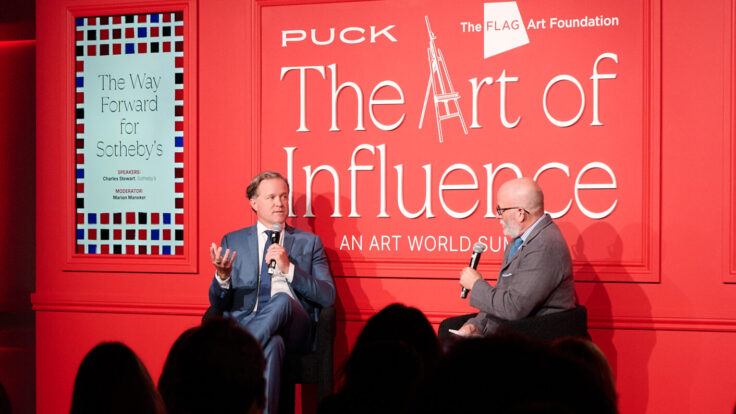
- The FLAG Foundation partners with Parrish Art Museum: Glenn Fuhrman’s FLAG Art Foundation, Puck’s partner in the Art of Influence conference, has funded a new curatorial position at the Parrish Art Museum in Water Mill to maintain three rotating exhibitions in two of the museum’s dedicated galleries. Scout Hutchinson, who will curate the program through 2030, is building on a series of single art work exhibitions that have been running since 2024.
The first show in the series will open in March 2026, and focus on the career of Ellsworth Kelly.
- Kaplan offloads a Rembrandt: Investor Thomas S. Kaplan is selling Rembrandt’s drawing, Young lion resting, circa 1638-42, to benefit his wild cat conservation organization, Panthera. Kaplan bought the drawing—the last depiction of an animal by Rembrandt remaining in private hands—in 2005. He
subsequently sold half his ownership in the work to his partner Jon Ayers.
The sale is a branding exercise for Panthera, but also for Kaplan’s Leiden collection of Old Master works, which includes 17 Rembrandt paintings and the only remaining Vermeer in private hands. The lion drawing will be sold at Sotheby’s in New York next February and carry a $15 million estimate.
|
Now, let’s get to the main event… |
|
|
A meandering preview of Manhattan’s most pressing gallery shows, from
the Studio Museum in Harlem’s Tom Lloyd retrospective to Gagosian’s arresting Richard Prince exhibition, in anticipation of the New York sales season. |
|
|
I started my Thursday trek along the spine of Manhattan, closer to the top of the
island than the bottom. Up on 125th Street, the Studio Museum in Harlem held a press preview for the opening of its new David Adjaye–designed building—a project that has been long in the making and is finally being unveiled. The event also revealed a lot about the new Studio Museum itself. For instance, Raymond McGuire, the chairman of the museum’s board of trustees, announced that the 57-year-old institution had exceeded its $300 million
fundraising goal to both pay for the new building and provide the museum with an endowment and reserve funds.
In the current political and cultural climate, where diversity and inclusion have become flashpoints in a renewed culture war, the museum’s new building suddenly seems prescient and essential. In his remarks, McGuire noted, “This building says to the world: Harlem matters; Black artists matter; and Black institutions matter.” These were no hollow words: McGuire spoke from the
stage of an amphitheater that rises up to street-level glass doors under a soaring atrium, emphasizing the museum’s role as a center of community activity and engagement.
The Studio Museum will open next week with a surprisingly engaging retrospective of the work of Tom Lloyd, who was featured when the museum first opened in 1968, alongside exhibitions that highlight the institution’s history, permanent collection, and the many great artists who’ve participated in its
prestigious artist-in-residence program. But in many ways, the real star of this phase of the opening is Adjaye’s building. Starchitects tend to have signature design elements. Some of Adjaye’s, like his interest in stone composite panels, are on display here. But after my recent tour of Adjaye’s Princeton University Art Museum, I was most struck by how an
architect could meet similar design briefs for two very different clients in very different ways. |
|
|
A MESSAGE FROM OUR SPONSOR |
The first steps towards a masterpiece starts with a dream. The all-electric BMW i7 – the
evolution of brilliance. Learn more at BMWUSA.com |
|
|
Both Princeton, with its $36 billion endowment, and the Studio Museum, with its far
smaller one, were asking for essentially the same thing: a building that would integrate art and artists into the daily lives of the community. But while Princeton got a building that floats above a leafy quadrangle and provides sight lines for discovery within a dense museum collection, Harlem received a solid edifice that invites the community into a grand, welcoming space. One of the central features of the Studio Museum is a multistory staircase that connects the amphitheater at the bottom
of the building to the galleries midway up. This provides simplicity and focus, but also physically connects the programming space with the galleries. |
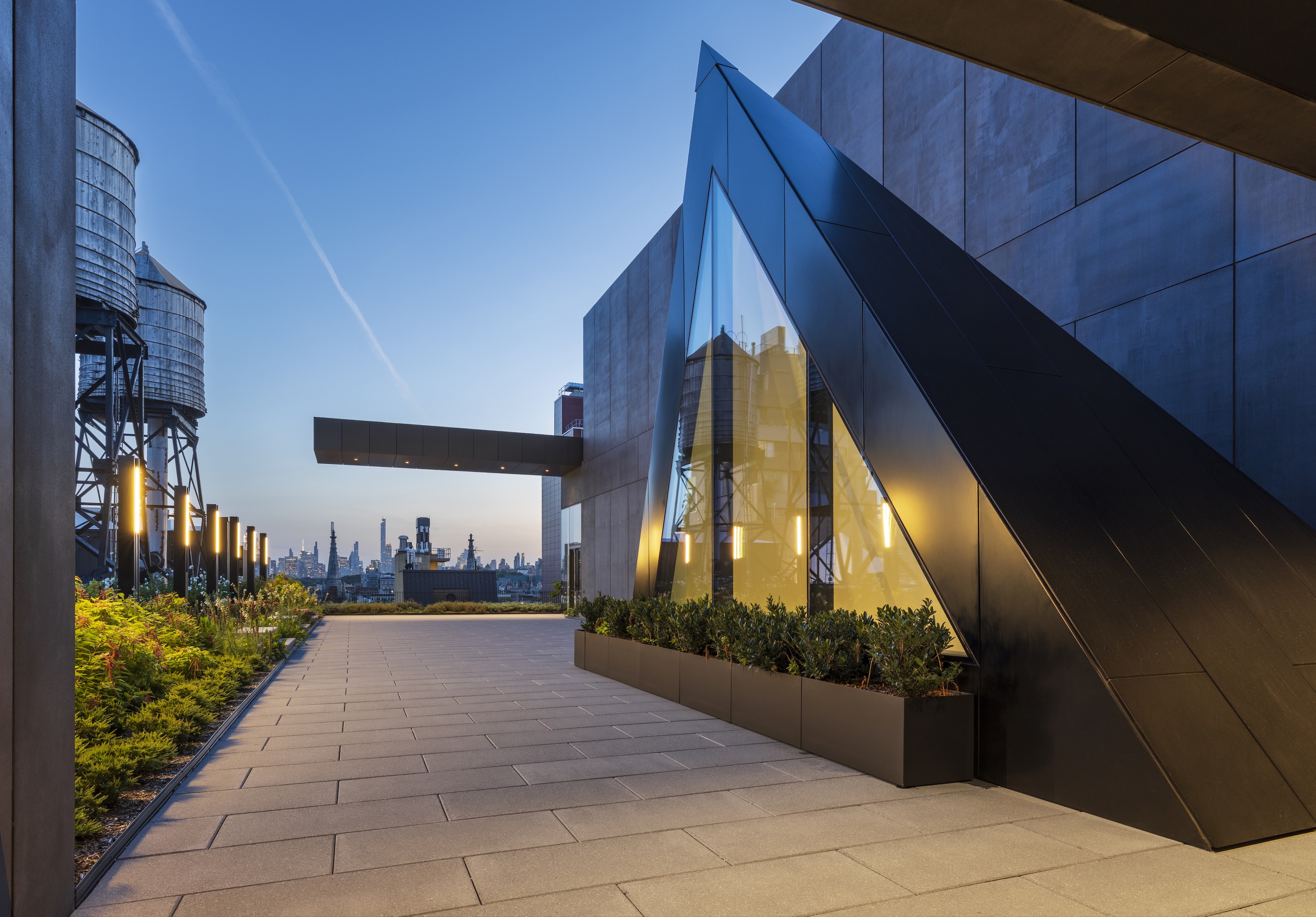
The terrace at the Studio Museum in Harlem. Photo: Albert Vecerka/Esto/Courtesy of
the Studio Museum |
At first, I thought that was all there was to the museum. Then, through a hallway, a
whole separate part of the building revealed itself. Here were conference rooms, exhibition spaces, and a long second staircase connecting to a floor for events as well as a spectacular roof garden with views of the city spreading out below. Taking in that vista, and listening to the comments from the many persons touring the new facility, I understood that this is not the end of a long story for the Studio Museum, but the beginning of a new era. Black institutions matter, indeed. |
Pace’s Lost Artist & A Gagosian
Surprise
|
One of the benefits of the Studio Museum’s location is its proximity to several train
and subway stops. I arrived via Metro-North, walking a few blocks west down 125th, and left on the A train, another block or two west. I was due at Pace Gallery to see the Glimcher family’s new show of Agnes Martin works. Titled Innocent Love, the exhibition features a selection of 13 of the artist’s late paintings, gathered at great effort by Arne and Marc Glimcher to close out the celebration of their 65th year in
business.
Martin’s close relationship with Arne Glimcher is well known. They first met when she lived in Coenties Slip, but he only began to represent her—which he did for 30 years, until her death—after she moved to New Mexico. The paintings on view are notable for their use of subtle color and Martin’s somewhat late-in-life embrace of, well, innocent love. Closing out his remarks, Arne observed that Martin “died less troubled than she was her whole life.”
After the Martin show,
the Glimcher crew took us upstairs, where Oliver Shultz, Pace’s chief curator, walked the assembled crowd through a mini-retrospective of the Spanish artist Antoni Tàpies, featuring his works on paper. Shultz made the case, underscored by the two Glimchers, that Tàpies is one of the original mark-makers to come out of surrealism and develop a distinctive abstract vocabulary. In other words, at some point in the last few decades, this once-influential artist—whom
the Pace team argues should rightly be seen as a peer of Cy Twombly—had gotten lost in the shuffle. The not-subtle subtext of the pitch to collectors is that Pace will put in the effort to restore Tàpies’s reputation, and collectors who share their vision will benefit.
The Pace crew was also kind enough to host a lunch just above their seventh-floor exhibition of Li Songsong’s new work. On my way out, I stopped by the new show of Friedrich
Kunath’s work, the first under Pace’s representation. Kunath’s painting rides a knife’s edge between mawkish kitsch and cultural satire. I was told by an advisor that the show had easily and quickly sold out before the opening.
Although I had to yo-yo back uptown to see Christie’s preview (more on that next week), I did get a chance to swing by Gagosian’s flagship 24th Street gallery. I ran into Richard Prince’s studio manager, Matt
Gaughan, who was taking a break from hanging Prince’s new show. Matt quickly turned on his heels and led me through the show, which should provoke a reaction. The new work is both familiar and somewhat shocking in its imagery of broken teeth and stitched wounds. Prince is an uncompromising artist—and his desire to go his own way only seems to be increasing. |
Zwirner’s Mitchells & Karma’s Avery
Bet
|
After my brief sojourn uptown, I returned to 20th Street, where David Zwirner gallery
was holding previews of its latest show of work from the Joan Mitchell estate. Curated by Sarah Roberts, now a senior director at the artist’s foundation, the show focuses on the period between 1960 and 1965, leading up to Mitchell’s so-called black paintings, which aren’t black at all. Zwirner, of course, represents the Mitchell estate, and this is another in a series of shows focusing on distinct periods of the artist’s work that aim to
further educate potential buyers. |
|
|
Around the corner, on 19th Street, Zwirner had painter Luc
Tuymans explaining three new bodies of work on display in a new show. One group of paintings involves 3D-printed figurines in uncanny group portraits and tableaux; another series is based on a YouTube documentary about illuminated manuscripts, which Tuymans enlarged until he could see the grain of the parchment. These patterns form the basis of the large abstract works he made.
On my way back to Grand Central, I stopped in at Karma, which has a new show of Milton
Avery’s figurative works. Ever in advance of a new trend, Karma seems to be tapping into growing interest in Avery, and a market that seems to be gaining momentum. I was also able to pop into Friedman Benda, where they are showing new furniture designed by Adam Pendleton.
With that, I hiked back to Hudson Yards and headed home, barely scratching the surface of the new show openings and art on offer this season. On Tuesday, we’ll look at the
auction houses. |
I couldn’t let pass this morning’s
story in The New York Times speculating—with no confirmation from any of the relevant parties—that hedge fund manager Steven Cohen is the consignor of Maurizio Cattelan’s America, the solid gold toilet that will be auctioned at Sotheby’s in two weeks.
Similar to last year’s follow-up story to the Comedian sale, where the Times interviewed a fruit vendor outside Sotheby’s to make a very tendentious point about income inequality, today’s piece cites the price of a commode at Home Depot against the $10 million starting bid for Cattelan’s working, 18-karat gold plumbing fixture. Did you know you could buy 100,000 toilets just for the price of the gold in the Cattelan?
Not only does this kind of reporting mock the serious
issue of income inequality that just manifested in the unlikely election of a democratic socialist as mayor of the city, it also seems oblivious to the point of the artwork itself. Cattelan’s hardly subtle work is seductive because it actually makes its point best when it attracts crowds titillated by the idea of using a gold toilet, which would seem like a kitsch absurdity if we didn’t have a president who few doubt would be happy to own the fixture earnestly—and so many others who wanted to
use it, too, when it was installed at the Guggenheim.
One final comment on the Times’s dull sense of satire: The paper tries to turn around and hype the sale as the last surviving example of America, since the other gold toilet Cattelan had fabricated was stolen from Blenheim Palace in 2019. Except they got it wrong: The artwork is an edition of three with two artist’s proofs. Just because two of the three editions were produced doesn’t prevent Cattelan from selling
another (or either of the two artist’s proofs), presuming someone wants to pay for the very not-cheap fabrication.
Of course, after the sale of America later this month, those three remaining examples in the editioned work may be much, much more expensive than the one that Cohen (or whoever the consignor is) bought. I don’t think the Times quite understands how much they are playing into Cattelan’s hands when they do this. But that’s for them to work
out.
We will be back on Sunday.
Until then,
M |
|
|
The ultimate fashion industry bible, offering incisive reportage on all aspects of the business and its biggest
players. Anchored by preeminent fashion journalist Lauren Sherman, Line Sheet also features veteran reporter Rachel Strugatz, who delivers unparalleled intel on what’s happening in the beauty industry, and Sarah Shapiro, a longtime retail strategist who writes about e-commerce, brick-and-mortar, D.T.C., and more. |
|
|
Finally, a media podcast about what’s actually happening in the media—not the oversanitized,
legal-and-standards-approved version you read online. Join Dylan Byers, Puck’s veteran media reporter, and Julia Alexander, a longtime media analyst, as they sit down with TV personalities, moguls, pundits, and industry executives for raw, honest, sometimes salacious conversations about the business of media and its biggest egos. New episodes publish every Tuesday and Friday. |
|
|
Need help? Review our FAQ page or contact us for assistance. For brand partnerships, email ads@puck.news. You received this email
because you signed up to receive emails from Puck, or as part of your Puck account associated with {{customer.email}}. To stop receiving this newsletter and/or manage all your email preferences, click here. |
Puck is published by Heat Media LLC. 107 Greenwich St., New York, NY 10006 |
|
|
|