Hello, sports fans, and welcome back to Wall Power. I’m Marion
Maneker.
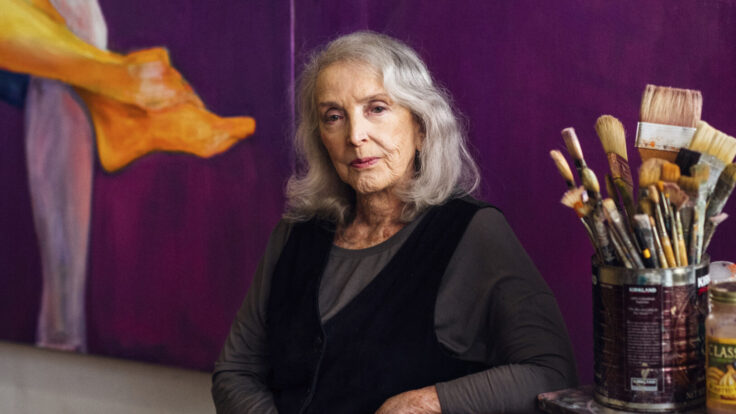
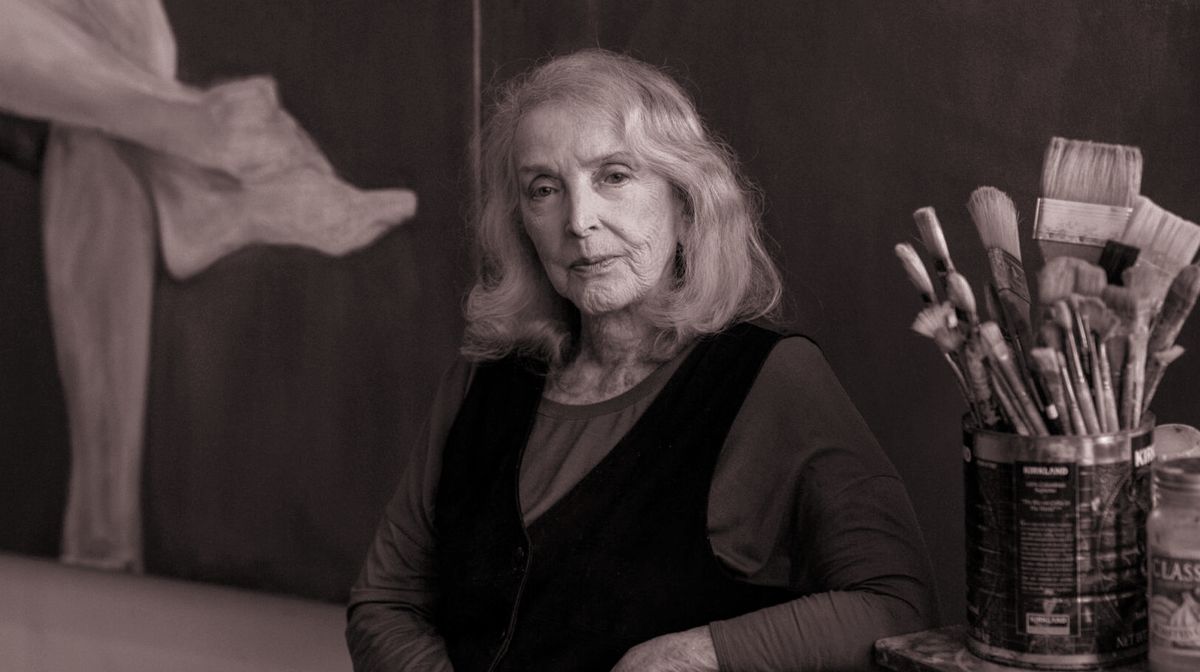
I went to see the Joan Semmel show at the Jewish Museum on Monday. Don’t worry if you haven’t heard the name before—she isn’t famous, but she was a groundbreaking feminist artist in the 1970s. Now 93, and as sharp and insightful as ever, she has seen her market building, with a big auction number early last year and a private sale at close to $1 million much later in 2025. I’ll walk you through the show below the fold.
Also mentioned in this
issue: Sebastian Smee, John Wilkerson, Barbara Wilkerson, Steve Martin, Anne Stringfield, Jeffrey Epstein, Löic Gouzer, Ales Ortuzar, Joan Snyder, Nancy Spero,
Hannah Wilke, James Tissot, Max Weber, Larry Rivers, Jack Levine, Jules Pascin, Raphael Soyer, Rebecca Shaykin, Alex Katz, Audrey Flack, Willem de Kooning, Steve Ivy, and many
more…
But first… |
-
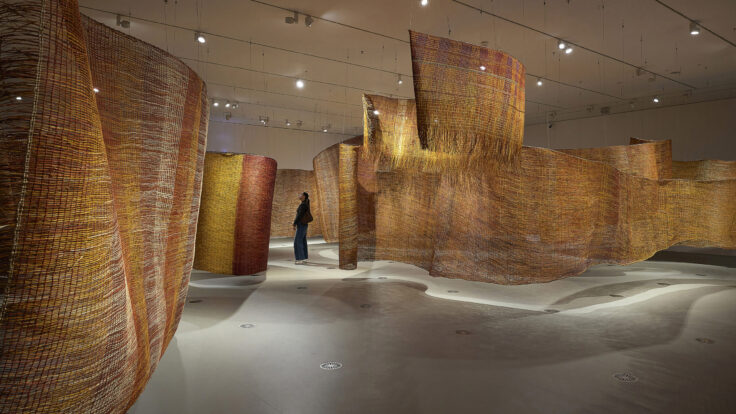
About those Aboriginal artists: I was impressed by the response to my column on Sunday about the Stars We Do Not See show at the National Gallery in Washington. To be honest, I thought most of you would roll your eyes and think I was back on my bullshit. But as I said in the newsletter, Sebastian Smee is right that it would be
great to see a show of the best Aboriginal art solely as art, and not as artifacts from a colonized people.
One of you was kind enough to point out that there’s now a website detailing two leading collections of Australian Indigenous art. Visiting Two Collections isn’t the same as seeing the art in person, but since few of us are going to get invited to the homes of groundbreaking collectors such as
the venture capitalist John Wilkerson and his wife, Barbara, or the actor Steve Martin and his wife, Anne Stringfield, the website offers a substitute. More to the point, these two highly curated collections from true connoisseurs can together function, at least for now, as a simulacrum of what Smee wanted: a show of the best of Aboriginal art from an aesthetic point of
view.
Since the website gathers some of the top examples of “desert painting,” it is the ideal starting point for anyone interested in learning more about Aboriginal art. The Wilkersons began collecting almost by accident after traveling to Australia in the early 1990s, and their collection focuses on Western Desert paintings and
Papunya boards from the early 1970s, when Indigenous elders first began to record their oral traditions on permanent media. The Martin and Stringfield collection picks up the story later; it is centered on work created after the mid-1980s and up to the present. Once you’ve seen the extraordinary examples these two collections have gathered, you’ll understand
Smee’s longing for a blockbuster show. Unfortunately, there has not been enough of an effort to create an audience for these works. This website is an admirable start. - The secret Epstein auctions: Another reader sent this New York Post story from last month revealing that the
contents of Jeffrey Epstein’s townhouse were quietly auctioned by Millea Bros. last year, with sales in June and December, but that none of the Epstein objects were sold with the disgraced financial advisor’s provenance. Few of the objects were particularly valuable, with most lots selling for low four- and five-figure prices.
|
Now, let’s get to the main event… |
|
|
A career-spanning new exhibit of Joan Semmel captures an artist challenging
conventional nudes, addressing women’s liberation, and making her own depictions of sexuality, aging, and herself. |
|
|
Löic Gouzer, the founder of Fair Warning, was out
sledding with his young son in Switzerland when I called him yesterday. But when we eventually connected, he was surprised to hear that the Jewish Museum had recently opened In the Flesh, a show dedicated to the 93-year-old Joan Semmel, whose work had been sold on Gouzer’s auction platform. I had first encountered Semmel’s work about a year ago, when Fair Warning sold one of her distinctive paintings from the 1970s—an erotic scene of intertwined bodies depicted in vivid
but unnatural colors—for $400,000. That was more than twice the previous high paid at auction for one of Semmel’s works, in 2018.
When I asked Gouzer about that record price, he explained that although there were not many exhibitions of Semmel’s work and few auction sales, she was a painter many other artists admired. And it isn’t just her painting that makes her inspirational. Her uncompromising independence and insistence on women’s subjectivity in art have also made her a role
model.
Gouzer, always plugging his business, said the sale was an example of Fair Warning’s conviction-based business model. But he also pointed to dealer Ales Ortuzar, who sold a 1975 Semmel work, Through the Object’s Eye, to a collector just a few months ago, on the opening day of Art Basel Paris. The painting, which had a $1 million asking price, is now on loan to the museum for the show. Always bullish, Gouzer said the main problem with Semmel’s market is
that the collectors who own her work just don’t want to sell it—at any price, really. And the show at the Jewish Museum illustrates why. |
I knew little about Semmel or her work prior to making the trip to upper Fifth Avenue. In the
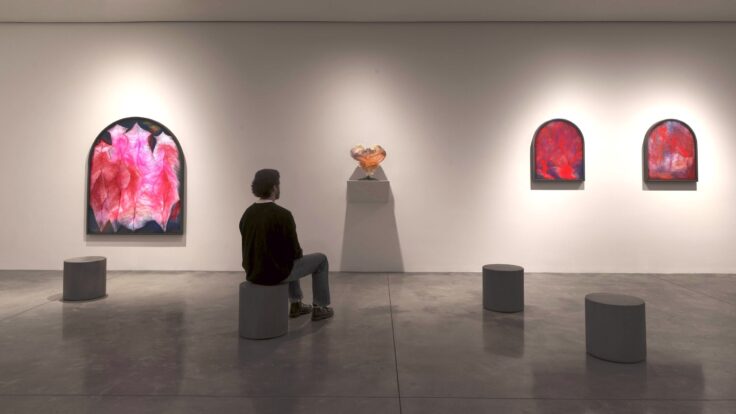
Flesh charts the artist’s career through 16 paintings she made from 1971 to 2023—all of which are nudes. In many ways, Semmel’s reimagining of female subjectivity is the core of her contribution to art history. Some of the images will seem strangely familiar, because they are painted from the perspective of a woman’s eyes, occasionally Semmel’s, peering down at her own body. You will recognize this view from the now-ubiquitous Instagram selfie angle that produces an image almost halfway
between subjectivity and objectification.
Before she started painting from this perspective, Semmel created graphic depictions of sex, aiming to break the taboo surrounding women’s sexuality and combat the objectifying nature of that art history staple, the nude. Over time, her work turned into a meditation on self-image and then on aging, another formerly taboo topic.
The show also includes 42 works from the Jewish Museum’s own collection, chosen by Semmel to highlight other
female artists—like Joan Snyder, Nancy Spero, and Hannah Wilke—who were prominent during “the height of the women’s movement” in the 1970s. They’re also there to provide nudes different from her own work, presenting models that “appear profoundly uncomfortable and powerless.” Those nudes hail from artists as disparate as James Tissot, Max
Weber, Larry Rivers, Jack Levine, Jules Pascin, and Raphael Soyer.
Semmel’s independence is a recurring theme of the exhibition and some of the materials created to support it. In an interview with Rebecca Shaykin, the Jewish Museum’s curator of contemporary art, Semmel recalls growing up in a Jewish neighborhood just off
the Grand Concourse in the Bronx—“a shtetl, essentially”—where everyone knew everybody’s business. It was “intrusive, with little room for an individual who wanted to be different,” she told Shaykin. “Those things made you learn how to resist, how to make your own place and insist on it.”
It wasn’t until Semmel went to the High School of Music & Art, and then to Cooper Union (in the era of Alex Katz and Audrey Flack),
that she was exposed to people from different parts of the city with intellectual backgrounds and interests. She was indoctrinated into abstract expressionism, and later moved to Spain with her husband and young children. Being a foreign woman who painted in an avant garde style served Semmel well in Madrid, where she launched her career as an artist and showed at the city’s best gallery.
Everything changed when she returned to New York several years later, to get a divorce and start
over. In SoHo, she found a group of politically active women artists and critics who supported each other’s work—even if getting it shown was nearly impossible. Semmel recounts how, despite the praise these women got from male critics, the men who ran museums and galleries were mainly indifferent to them. If a female artist wasn’t attractive, she was ignored. If she was, it was assumed that whoever made the introduction was sleeping with her. |
“I
Didn’t Want to Objectify Anybody Else”
|
In New York, Semmel’s work turned from abstract to figurative, even photorealistic, and it was
graphically sexual. As she told Shaykin of that time period: “Well, I was interested in sex. I was 30 years old and free from an onerous marriage. It seemed important. Everything in New York was open and free.” Yet the circumstances were somewhat different for women, even during the sexual revolution. “I realized that many women of my generation still believed that sex was shameful, and that it was never free,” she said. “It always had a cost.” Whatever the tensions around loosening sexual
mores, Semmel was able to find couples to model for her and other artists looking to depict sex, she said. “They were exhibitionists, essentially.” |
Through the Object’s Eye (1975) at Joan Semmel: In the Flesh, the Jewish Museum,
New York. Photo: Kris Graves/Courtesy of the Jewish Museum |
But if Semmel had moved to New York in search of sexual freedom, she instead found
commercialization that offered “women’s bodies for sale.” In her most graphic works, the viewer only sees the bodies of her couples, no faces or heads. And those bodies are painted in colors that heighten but also distance the reality of what is being shown. Much of this work from the first half of the 1970s, including the show opener, Through the Object’s Eye, attempts to reclaim subjectivity for women in sex. A little later, Mythologies and Me, from 1976, makes the point as
starkly as possible.
Semmel painted the work in response to a gallery owner who did not understand how her nudes could be seen as political. Her rebuttal was to paint “a diagram”—a triptych centered on a nude image of herself from the now-familiar perspective of her own gaze. On either side are appropriated images: On the left, a painting of a nude image from Playboy embellished with feathers; on the right, a repainting of a work from Willem de Kooning’s famous
Woman series, adding a faucet head as a nipple.
From there, Semmel began to paint herself more, creating Sunlight, which comes from the Jewish Museum’s own collection, and other works that depict her body from her own perspective. “I was never interested in a likeness. I was interested in creating an iconic figure rather than a presentation of myself,” she told Shaykin. “I used myself as a model, as you might use any model who is a stranger. I didn’t want to objectify
anybody else.”
Semmel took a 20-year hiatus from using herself as a model, from the 1980s until the turn of the 21st century. When she returned to the subject of her own body, sexuality was no longer the theme that gave her work a frisson of boundary breaking. Aging was. She was ahead of the discourse again, and her new subject felt more powerful to her than sexuality. She also felt less vulnerable “than I ever did as a young woman,” she said. “I had the power of my profession now.”
|
If you get a chance, go see the show for yourself. It’s up until May. Otherwise, come back tomorrow
to the Inner Circle, where I have an interview with Heritage C.E.O. Steve Ivy. Sign up here if you’re not a member yet.
Until Friday,
M |
|
|
Puck founding partner Matt Belloni takes you inside the business of Hollywood, using exclusive reporting and insight
to explain the backstories on everything from Marvel movies to the streaming wars. |
|
|
The ultimate fashion industry bible, offering incisive reportage on all aspects of the business and its biggest
players. Anchored by preeminent fashion journalist Lauren Sherman, Line Sheet also features veteran reporter Rachel Strugatz, who delivers unparalleled intel on what’s happening in the beauty industry, and Sarah Shapiro, a longtime retail strategist who writes about e-commerce, brick-and-mortar, D.T.C., and more. |
|
|
Need help? Review our FAQ page or contact us for assistance. For brand partnerships, email ads@puck.news. You received this email because you
signed up to receive emails from Puck, or as part of your Puck account associated with {{customer.email}}. To stop receiving this newsletter and/or manage all your email preferences, click here. |
Puck is published by Heat Media LLC. 107 Greenwich St., New York, NY 10006 |
|
|
|


%20jpg_01KEWD7MPSZNKBS44MTEADWER5.jpg "Through the Object’s Eye (1975) at Joan Semmel: In the Flesh, the Jewish Museum, New York. Photo: Kris Graves/Courtesy of the Jewish Museum")