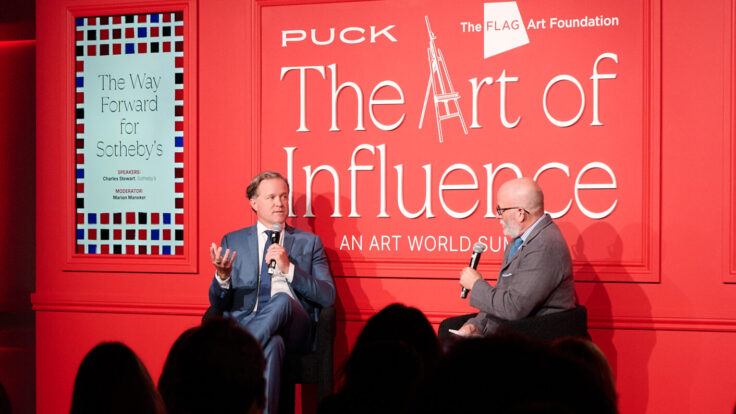
Welcome back to Wall Power. I’m Marion Maneker.
It’s been a
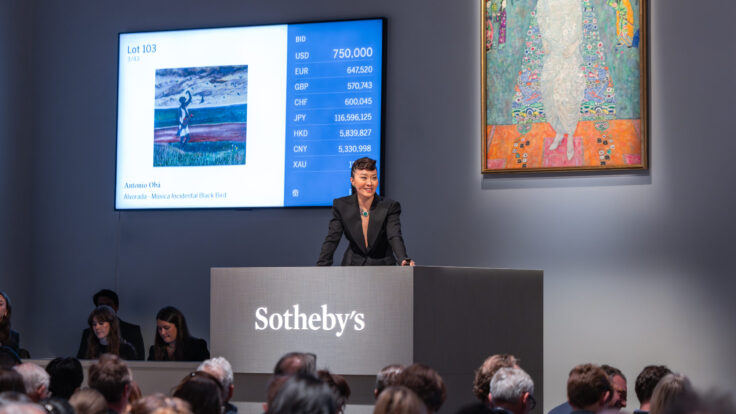
slow but steady reentry for the art market. Late last week, Sotheby’s posted a win with their latest Lichtenstein sale. Today, Christie’s completed the cycle of midseason contemporary art sales in New York, selling more than $35 million worth of works in the category—a solid uptick from last year. I’ll have more details on that sale tomorrow. In the meantime, Keith Haring’s talent is coming back into the frame as Gladstone gallery hosts a show of work from the
artist’s foundation that highlights his enduring appeal. I’ll explain how Haring is building momentum below the fold.
Also: Don’t miss your chance to take advantage of Puck’s fourth anniversary deal for new subscribers—30 percent off your first year if you subscribe by October 4. Join our community yourself, buy a gift subscription for a friend, or even upgrade to Wall Power’s Inner Circle (we’re offering 20 percent off there, too). |
|
|
A MESSAGE FROM OUR SPONSOR |
Greatness isn't achieved in an instant. It's tested until there is no question — only performance.
|
|
|
- Did Jacob Pabst just try to implode Artnet?: Things seemed to be moving along nicely for Andrew Wolff, the founder of Beowolff Capital, who is now calling the shots behind the scenes at Artnet. The company had delisted from the Frankfurt Stock Exchange, and yesterday held its annual general meeting, which was meant to be a pro forma affair as the company finally issued its financial reports for 2024 and the first half of 2025. But nothing is ever easy with
Artnet. Although the minutes published in Germany show that all items on the agenda passed, including the much-needed “creation of authorized capital,” I was told by an investor who attended that more than half the meeting was taken up with questions about the sudden
resignation of Jacob Pabst, Artnet’s C.E.O. for the past 12 years, the night before. The company confirmed, but did not explain, his departure.
Even though the Neuendorf family remains substantial shareholders in Artnet—Jacob is the “eldest boy”; his brother, Albert, is the chief strategy officer; and their sister, Sophie, has held a communications role—Pabst’s resignation is hard not to interpret as an action meant to
undermine the company. The shareholder I spoke to believed Pabst planned the move well in advance, because none of the other Neuendorf family members showed up at the A.G.M. “As surprising as this move was,” the shareholder said, “it is in line with the Neuendorf behavior during the past decade.” When I asked Albert whether he still worked at Artnet despite his brother’s resignation, he said yes but did not answer any other questions.
Meanwhile, Pabst’s departure had not been announced at
Artnet as of yesterday, according to people who work there, nor had they been told that Wolff had taken on the role of interim C.E.O. But this morning, a former Artnet employee who’s in touch with ex-colleagues told me that Sophie had circulated an internal memo about Pabst’s departure. And Wolff held a company town hall today. What was the mood? “Wolff seems spirited and energetic,” one attendee told me. “Who knows what he’ll do, but the tone was far better.”
According to its most recent
financial statements, Artnet still loses more than $1 million each year and spends around $2.5 million annually on product development without releasing much in the way of new products. Earlier this year, the data team that gathers auction prices for the core database product was laid off, then rehired, after failed attempts to replace them with A.I., according to a member of the data team.
If Pabst’s move was indeed meant to undermine the company, it’s hard to see how that would have
worked. Whatever Wolff is planning, he’ll need a free hand to restructure, and Pabst has given him exactly that. - Is Muhammad Ali’s draft card worth $3 million?: Next month, Christie’s is offering Muhammad Ali’s unsigned draft card at an
estimate of $3 million in a single-lot online auction ending October 28. Ali, of course, famously refused to go to Vietnam when he was drafted in 1967, claiming conscientious objector status. He was subsequently stripped of his boxing license, convicted of draft evasion, and became an outspoken opponent of the war and an advocate for civil rights. Nearly 60 years later, Christie’s books and manuscripts team is promoting the card, consigned by Ali’s daughter, Rasheda Ali Walsh,
as a piece of sports memorabilia rather than a historical document—the company even announced the sale in the Sports section of the Times.
The world auction record for a piece of Ali fight-worn memorabilia was the $6.2 million paid at Heritage in 2022 for the championship belt he won by defeating George
Foreman in 1974’s “Rumble in the Jungle.” The buyer was the late Indianapolis Colts owner Jim Irsay, who died this past May. (I’m told the auction houses are competing to sell his memorabilia collection.) This past February, Sotheby’s sold Ali’s satin shorts from his 1975 “Thrilla in Manila” fight against Joe Frazier for $1.2 million; they last sold at
Heritage in 2012 for just $155,530. But the record for an Ali document is only $53,775, achieved in 2009 for his 1974 passport, which he used to travel to both Zaire and the Philippines for those two historic fights.
There are not many comparable sales, though two historically important documents related to Jackie Robinson sold for $2 million and $1.7 million in
2013 and 2022, respectively. A books and manuscripts expert I spoke to called the
draft card estimate “outrageous, even in today’s robust market.” That said, “It’s a weird market,” the expert added. “It’s the kind of thing that might get two people excited.” —Julie Brener Davich - Sotheby’s Hong Kong evening sale speaks: There were strong prices at Sotheby’s $43 million Sunday evening sale in Hong Kong, including a new record price for Li Hei Di at nearly $350,000. Beyond bringing new works to market, there
were a number of repeat sales in the auction that deserve attention. Pablo Picasso’s Buste d’homme, from 1969, was estimated at HK$15 million but sold for HK$20 million, or $2.6 million—$800,000 more than the $1.8 million that the work made the last time it was auctioned, in 2017. A Yayoi Kusama “Infinity Net” painting, purchased at auction in 2018 for $1.7 million, failed to find a buyer at an estimate just under that price. Another Kusama, Oil No.
19, from 1997, was purchased in 2015 for just above $200,000 and made $650,000 this past weekend. Kazuo Shiraga’s painting Work, from 1962, was bought at auction for nearly $1.9 million in 2016, at the height of enthusiasm for the rediscovered Gutai movement. It sold again on Sunday for a little more than $1.5 million. That loss was nothing compared to the one perfected by Takeo Yamaguchi’s Ho (Crawl), from 1961, which was bought at
auction three years ago for $1.6 million but sold two nights ago for $620,000. Christine Ay Tjoe’s 2009 painting Verso of the Landscape sold for $300,000 in 2014 and sold again this past weekend for $800,000. Zhang Xiaogang’s Bloodline, Big Family No. 7: Siblings, from 1996, sold in 2007 for under $1.2 million, sold again in 2009 for $725,000, and this weekend in Hong Kong made just under $500,000.
|
Now, let’s get to the main event… |
|
|
It’s rare to see a show of the subway artist’s best works, not least
because good collectors tend to hold on to them. But Gladstone has one now, and two more are coming next year—potentially tempting the next generation of Basquiat collectors, too. |
|
|
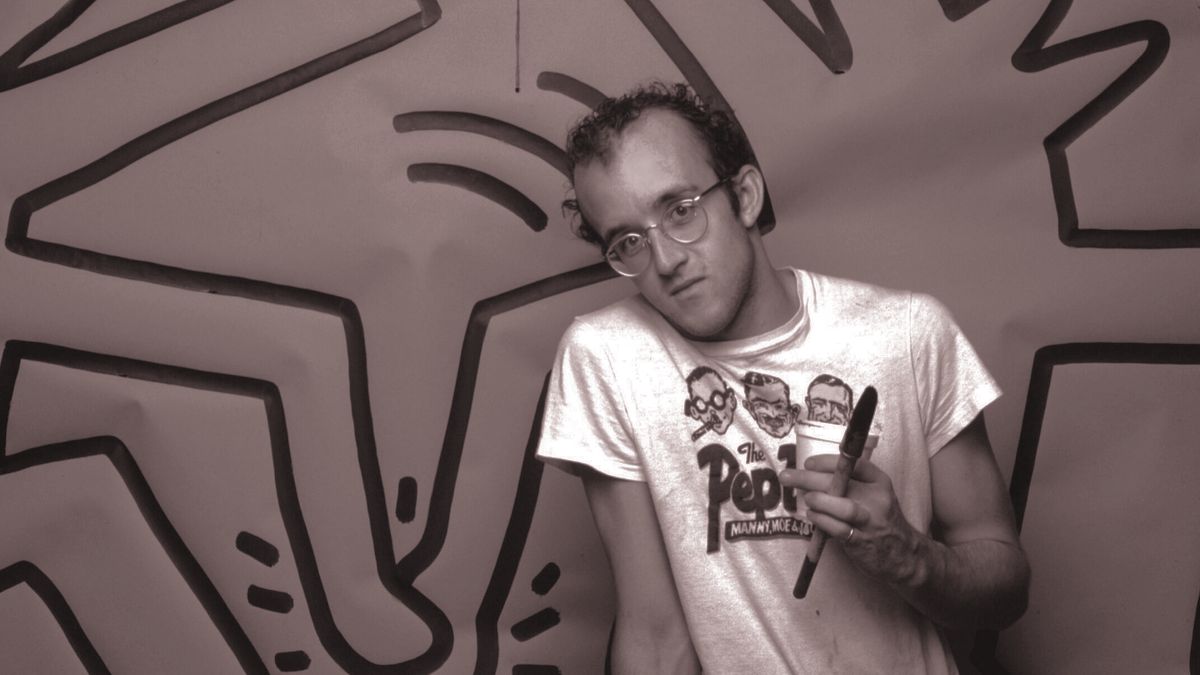
Keith Haring’s subway drawings were never meant to
be preserved or sold. But in the early 1980s, the collector Larry Warsh began an obsessive and diligent pursuit to track them down. It paid off in a great immersive show at Sotheby’s last November that earned $9.2 million for the group.
The subway drawings were the beginning of Haring’s emergence as a major artistic talent with extraordinary public impact, and two important shows will highlight that work next year. In the spring, the Brant Foundation in the East Village
will focus on the artist’s formative years of 1980-83, and writer Glenn Adamson is curating a show at Crystal Bridges, to open around the same time, highlighting Haring’s work on three-dimensional objects. If you want a taste of what will be in that show—TVs, rocking horses, cars, decorative columns, and more, all festooned with Haring’s signature manic motifs—check out the fiberglass vase that Warsh loaned to Lévy Gorvy Dayan’s Downtown/Uptown: New York in the Eighties
show, which runs through December 13. |
|
|
A MESSAGE FROM OUR SPONSOR |
Greatness isn't achieved in an instant. It's tested until there is no question — only performance.
|
|
|
With all of that going on, I was excited to learn last week that Gladstone gallery
had opened Liberating the Soul: Keith Haring’s Paintings, a show of eight pieces from the artist’s foundation, more than a decade after the gallery’s last show featuring his work. It’s rare to see a really great show of Haring’s work—the last I can think of at a museum was the Broad’s Keith Haring: Art Is for Everybody from two years ago. One
reason is that the best collectors hold on to his works, and the Keith Haring Foundation, to which the artist left his estate, still has some of the greatest pieces. Since 1990, despite not having much in the way of cash assets at the beginning, the foundation has made grants of more than $43 million to educational and HIV/AIDS-related nonprofits, helped by growing revenue from licensing Haring’s still-popular imagery.
Not everything in the Gladstone show is for sale; the gallery would
prefer to focus on the way the show highlights Haring’s practice, which it certainly does. Also, as Warsh told me, the sales that do happen will be more about placing the artist’s work with great collectors and museums that will continue to raise his stature. Despite Haring’s enduring fame and relevance, after all, his best work is somewhat overlooked by today’s collectors. But there’s a good case to be made that 1980s nostalgia can be an enticement to a new group of collectors who don’t know
much about what Haring could really do as an artist. This exhibition shows them.
The Gladstone show consists of half tarpaulins and half works on canvas, including a triangular tribute to Jean-Michel Basquiat using the latter’s signature crown motif. That painting and another untitled tarp are made in the color triad of black, white, and red accents. Both reinforce one of the ways we tend to think of Haring—more about line and frenetic forms than color. But on 24th Street
you’ll also see six different works notable for their vibrant shades. Tree of Life, from 1985, is a tarpaulin with a Pepto-pink background, a green tree dominating the image, and four yellow figures dancing in the foreground. Unknown (Mother and Child), from 1984, is all reds and oranges on a black background. Brazil, from 1989, is orange and black with an empty blue space where the image falls apart.
Phallic images were a favorite theme for Haring, whose
sexuality was never in doubt or something he felt any shame about. Two of the works in the show confront the viewer with male sexuality in ways that may still discomfort collectors or museumgoers. There’s an untitled 10-foot-tall work from 1985 whose centerpiece is a large penis. And perhaps the best work in the show depicts two pink male figures engaged in mutual masturbation underneath a huge motto, written in red over a yellow background: “Safe Sex.” |
Two Market Paths Diverged
|
These frank depictions of men engaged in sex may be one of the less-mentioned reasons
for the diverging market paths of Haring and his buddy Basquiat. When Haring was a student at the School of Visual Arts, Basquiat was a street kid he let into the building to leave graffiti tags. Both would become famous during the 1980s—each maintaining a pop culture presence that artists rarely ever enjoy in their own lifetimes, Haring perhaps even more so than Basquiat—and then died young. Basquiat died of an overdose in 1988 at the age of 27; Haring survived until 1990, when he died of AIDS
at the age of 31. |
|
|
If you had to guess at the time, you might have thought Haring would become the
bigger artist in the long run. His art seemed friendlier and more relevant. He had already created the Pop Shop in New York and Tokyo, an early attempt to weave art into street culture and move it beyond the confines of high-value works—years before peers like Jeff Koons, and younger artists such as Takashi Murakami and Kaws, cracked the code for making cheaper work that could be mass produced. Haring’s motto during his life was, “Art is for
everyone.” Of course, he died before the explosion of artists’ product collaborations with luxury brands, but the Haring Foundation’s licensing income is only a hint of what Haring might have been able to do had today’s AIDS treatments been available then.
As it is, Haring’s work has barely moved above $5.9 million at auction. Basquiat, on the other hand, has slowly grown into the market’s most dominant artist; his works have several times sold at auction for near or above $100 million,
and fetched much higher prices privately. That’s a huge gulf in pricing between the two, but it doesn’t have to stay that wide forever—in fact, the Gladstone show might be able to help shrink it. More to the point, as I mentioned a week or so ago, Basquiat has become an entry point for a new generation of very wealthy collectors. When I asked an auction house leader to tell me what else those buyers look for in the art market, I got sincere equivocation. But they ought to be buying Haring’s best
works, too. |
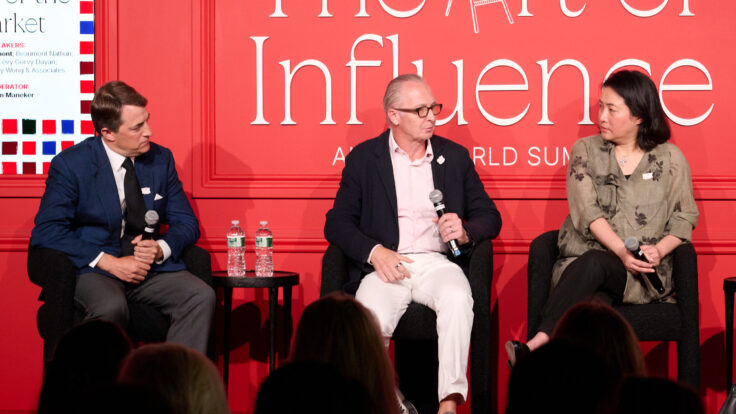
That’s it for today. I’ll be back tomorrow with more of my conversation with
Larry Gagosian from The Art of Influence. Join the Inner Circle if you want to participate.
M |
|
|
The ultimate fashion industry bible, offering incisive reportage on all aspects of the business and its biggest
players. Anchored by preeminent fashion journalist Lauren Sherman, Line Sheet also features veteran reporter Rachel Strugatz, who delivers unparalleled intel on what’s happening in the beauty industry, and Sarah Shapiro, a longtime retail strategist who writes about e-commerce, brick-and-mortar, D.T.C., and more. |
|
|
Finally, a media podcast about what’s actually happening in the media—not the oversanitized,
legal-and-standards-approved version you read online. Join Dylan Byers, Puck’s veteran media reporter, as he sits down with TV personalities, moguls, pundits, and industry executives for raw, honest, sometimes salacious conversations about the business of media and its biggest egos. New episodes publish every Tuesday and Friday. |
|
|
Need help? Review our FAQ page or contact us for assistance. For brand partnerships, email ads@puck.news. You received this email because you signed up to receive emails from Puck, or as part of your Puck account associated with {{customer.email}}. To stop receiving this newsletter and/or manage all your email preferences, click here. |
Puck is published by Heat Media LLC. 107 Greenwich St, New York, NY 10006
|
|
|
|