{{ 'now' | timezone: 'America/New_York' | date: '%b %d, %Y' }} |
|
|
|
Hello, and welcome back to Line Sheet. If you live in Europe, you’re probably already obsessed
with Vinted, the preferred app for shopping vintage and secondhand that’s currently valued at a whopping $9 billion. But can they make it in America? Malique “Malique@puck.news” Morris is here with the inside story.
Up top, Malique has the scoop on Victoria’s Secret’s latest battle with an activist shareholder (it never ends), as well as some news from Montreal, where
Ssense continues to downsize. Beauty queen Rachel Strugatz cameos with the latest on a new round of Goop layoffs.
Are you in London right now? Might be worth checking out the Steven Meisel
exhibition at Photo London, which runs through May 18. Wednesday night, for the opening, I’m moderating a conversation between Plum Sykes and Bella Freud, who were captured by Meisel in the early 1990s. (Why they need me, who knows, but I’m honored to do it.)
Tickets appear to be sold out, but if you are interested in attending, let me know—or rest well knowing we’re going to run the chat on a future episode of Fashion People.
Also
mentioned in this issue: Rami Atallah, The RealReal, Thomas Plantenga, Moj Mahdara, Depop, Kacey Musgraves, Vestiaire Collective, Goop, Mariam Naficy, Ralph Lauren stamps, Emma Chamberlain, Brett Blundy, Highsnobiety, Julia Hunter, Hillary Super, Geoffroy van Raemdonck, Gwyneth Paltrow, Jongjin
Park, and more… |
Three Things You Should Know…
|
|
|
|

| Rachel Strugatz
|
|
- More Goop cuts and Gwyneth’s
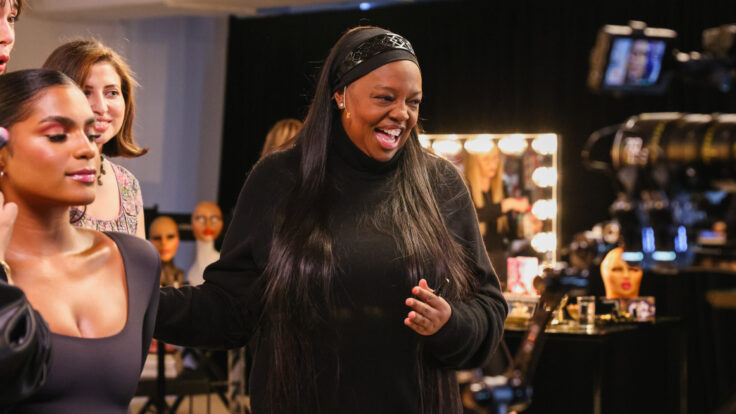
new advisor: Goop conducted another round of layoffs this week. This time, according to a person familiar with the matter, “profitability and A.I.” were the rationale amid a significant downturn in business from last year. While my sources put the number of layoffs at 20, a company spokesperson said the final number was less than that. “Goop, like many companies, is adapting to a shifting landscape and finding new ways to operate more efficiently,” the spokesperson said.
Meanwhile, I
hear that Goop founder and C.E.O. Gwyneth Paltrow has brought in pal Moj Mahdara, her co-founder in V.C. fund Kinship Ventures, as a high-level consultant to help stabilize the struggling business. A few years ago, of course, Paltrow tried a similar tactic when she hired former Jenni Kayne C.E.O. Julia Hunter as a fractional C.E.O.-type tasked with overseeing a turnaround. Hunter joined Goop’s board and even brought in a
“tiger team” of consultants, but the relationship fizzled pretty quickly. Alas, I’ve heard that not much has changed and that Goop’s C-suite remains populated almost exclusively by consultants.
|
|
|
|
A MESSAGE FROM OUR SPONSOR |
|
|
|

| Malique Morris
|
|
- The Victoria’s Secret proxy
battle: The lingerie maker continues to push back against activist shareholder Brett Blundy, the Australian billionaire whose investment firm, BBRC International, owns 13 percent of the company. Lately, Blundy has been urging investors to join him in advocating for a board shake-up, following his own failed bid for a seat. On Monday, the board justified its refusal to appoint him in a proxy statement—pointing to, among other factors, accusations that Blundy had a
“pattern of hiring executives with a history of serious allegations of sexual harassment.” Victoria’s Secret noted that Mariam Naficy—a finance, tech, and retail veteran who’s served on the board since 2022—won’t stand for reelection at the upcoming annual meeting, in part because of the “time and attention required to engage with BBRC’s proxy contest.” In a statement, BBRC said, “Victoria’s Secret is trying to divert attention away from the campaign, which is focused on one
thing: establishing accountable governance at the company.”
The tit-for-tat is putting a damper on an otherwise seemingly above-board turnaround for C.E.O. Hillary Super. The company’s net sales rose 5 percent year over year in 2025 after being nearly flat in 2024, and the stock has more than doubled in the last year. But where there’s smoke… I’ll be keeping a close eye on this. - Ssense’s HQ reshuffle: Ssense is preparing
to shutter one of its two and a half floors at the company’s Montreal headquarters next month, according to sources. The downsizing would likely be a straightforward cost-cutting tactic amid the luxury e-tailer’s ongoing restructuring. Just last month, C.E.O. Rami Atallah outlined a turnaround plan after striking a deal with a Canadian family office to
buy back the company. That plan includes opening a U.S. distribution center later this year.
But I’m told that executives haven’t formally announced the downsizing. Inside the company, the perceived lack of communication is adding to staffers’ anxieties that a massive round of layoffs is coming, according to a person familiar with the matter. Remember, Ssense has not yet emerged from CCAA proceedings—Canada’s version of bankruptcy protection, which allows insolvent companies to
restructure. Between now and then, there’s plenty of time for management to make significant cuts, including further headcount reductions. Ssense’s return to normalcy still looks likely to be bruising.
|
|
|
|
And now, here’s Malique on Vinted… |
|
|
|
Thomas Plantenga’s methodical leadership has taken Vinted from acquisition target to
Europe’s dominant resale force, with a $9 billion valuation. Will his measured strategy help the company conquer the U.S.? |
|
|
|
When Thomas Plantenga became C.E.O. of Vinted, in 2017, the Lithuanian secondhand fashion
marketplace was nearly out of cash after years spent chasing growth. Plantenga had a roughly $250 million offer on the table from a South African tech group called Naspers (not to be confused with Napster), but he rejected it; instead, he raised €25 million to preserve Vinted’s independence. By then, a series of operational changes he had introduced—including a new fee structure, better fraud protections, and lower shipping costs—had already begun translating into higher sales.
|
|
|
|
A MESSAGE FROM OUR SPONSOR |
|
|
|
Plantenga’s bet paid off. In 2019, the company became Lithuania’s first unicorn. By 2025, Vinted’s free
cashflow was €137 million, up 36 percent year over year, and gross merchandise volume had climbed 47 percent to €11 billion ($13 billion)—making it at least five times larger than competitors Depop, Vestiaire Collective, The RealReal, and Poshmark. Last month, Vinted reported a more than $9 billion valuation after closing an €880 million secondary led by existing investor EQT.
Vinted conquered resale in Europe by operating less as a fashion resale platform and more as a tech
company. It built its own in-house payments platform, Vinted Pay, along with Vinted Go, its logistics arm. I’m told the company has invested more than $100 million in some 16,000 lockers around Europe, where users can pick up and drop off packages. It also operates mostly automated warehouses staffed by robots purchased from China, which the company then programs itself to save costs. “They realized early on that Vinted was not going to win on front-end consumer marketing and splash. The
RealReal is good at that,” a person familiar with the company’s inner workings told me. “A lot of those businesses are run by people who came from the fashion and marketing side. Vinted is a utility.”
Now Plantenga is applying that same methodical approach to the U.S., where the app has been available—and mostly ignored—since 2013. In January, Vinted started a pseudo-relaunch in New York, allowing buyers to hunt for pre-owned Dries Van Noten, Helmut Lang, and Jil Sander from U.K.-based
sellers. The company is partnering with local distribution sources, including bodegas, for faster and cheaper delivery. The plan is to replicate that strategy in other states.
But the U.S. is a far larger and more difficult market to crack than Europe. Customer acquisition and shipping costs are higher, and differences in sizing and consumer taste between American states are wider than those between entire European countries. One person familiar with Vinted’s business told me the company
will probably have to devise a plan for each state, built around a reliable network of local sellers whose hand-me-downs appeal to buyers in their area. Even for a company that managed to build a parcel locker network across Europe, that’s a big ask. |
Plantenga has also been bulking up through strategic M&A, which may explain why eBay—often cited internally
at Vinted as a major rival—recently announced a deal to acquire Depop for $1.2 billion. In 2022, Vinted acquired the reseller Rebelle to expand into the luxury sector. And I’m told the company has also explored buying Vestiaire Collective, though no active talks are underway. That deal would make sense, in theory, if only to tap Vestiaire’s authentication
prowess as Vinted grows its luxury business. During a recent internal meeting, Plantenga announced that the company had sold its first $20,000 handbag. (Vinted declined to comment. Vestiaire Collective didn’t respond to a request for comment.)
Still, if Vinted wants to outpace its peers in the U.S., it will have to compete more aggressively on marketing and branding. So far, the company’s market share in the U.S. is negligible, having gone from 0.2 percent in the final quarter of 2025
to 0.3 percent in the first quarter of 2026, according to Consumer Edge. And while Vinted has gotten away with conservative advertising spend in Europe, where word of mouth and bus-stop ads still lure consumers, things aren’t so serendipitous in the States. Here, influencer campaigns and celebrity-fronted social media ads drive conversion, and Vinted’s competitors don’t mind shelling out: Depop recently tapped Kacey Musgraves for a brand campaign; The RealReal’s most recent
holiday clean-out push featured Gwyneth Paltrow; and Emma Chamberlain contributes to a vintage storefront on eBay. |
|
|
|
There’s a lot riding on Vinted’s U.S. expansion. Plantenga recently
told The Wall Street Journal that the company is considering an I.P.O. in either the U.S. or Europe. While he has assured colleagues that Vinted isn’t in any rush to go public, he’s added board members from public companies and installed an executive in Brussels to build relationships
with E.U. regulators. “We continue to prepare to operate like a mature, public-ready company, but there is no set timeline for an I.P.O.,” a Vinted spokesperson said in a statement.
At a nearly $10 billion valuation, Vinted will have a lot of hype to live up to when, or if, it eventually goes public. Conquering the largest retail market in the world will determine whether Plantenga’s measured, disciplined strategy can work at scale. |
The Loewe Craft Prize is the most legit fashion-related design initiative around. Today, the new
winner—Seoul-based Jongjin Park, recognized for his “seatlike form,” Strata of Illusion—was named in Singapore from 30 finalists. [Artsy]
Yes to the Ralph Lauren stamps! Love stamps. [Highsnobiety]
Saks Global C.E.O. Geoffroy van Raemdonck told The Business of Fashion that he isn’t ruling out an I.P.O., an acquisition by a strategic, or a sale to private equity or sovereign wealth investors once the company emerges from bankruptcy later this year. [BoF] |
Until tomorrow,
Lauren
P.S.: We use affiliate links because we are a business. We may make
a couple bucks off them. |
|
|
|
Need help? Review our
FAQ page or contact us for assistance. For brand partnerships, email ads@puck.news.
You received this email because you signed up to receive emails from Puck, or as part of your Puck account associated with {{customer.email}}. To stop receiving this newsletter and/or manage all your email preferences, click here. |
Puck is published by Heat Media LLC. 107 Greenwich St., New York, NY 10006 |
|
|
|
|