|
Welcome back to Wall Power. I’m Marion Maneker—and we’ve made it to the end of another gigaweek.
Tonight, I’m pouring myself a Sam Smith Organic Chocolate Stout (maybe two) and thinking of going to bed early. But before I get there, I want to tell you about the contemporary evening sales and day sales at Christie’s and Sotheby’s, which I’ll get to below the fold.
Mentioned in this issue: David Geffen, Charles Stewart, Laura Sweeney, Lillian Heidenberg, Emily Kaplan, Sarah El-Tamer, Nick Cinque, Max Dolgicer, Hugh Gibson, Martha Craig, the Nahmads, the Mugrabis, Brett Gorvy, Alina Kohlem, Alain Benatar, Michael Altman, Jussi Pylkkänen, and
many more…
|
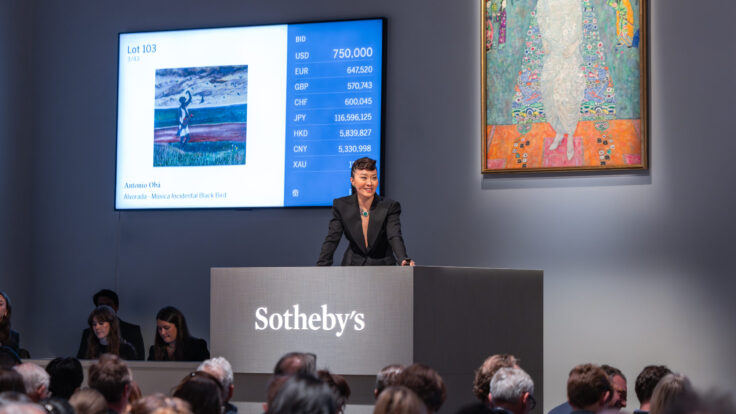
- Sotheby’s The Now & Contemporary makes $127 million: Sotheby’s evening contemporary sale was topped by an untitled Jean-Michel Basquiat work on paper that made $16.4 million. Robert Rauschenberg’s Rigger—once the only unsold lot at the famous Victor and Sally Ganz sale, which announced the end of the 1990s art slump—made $8 million. Ed Ruscha’s That Was Then, This Is Now, sold for $7.8 million.
- Sotheby’s Im Spazio: The Space of Thoughts tops $40 million: All 15 of dealer Daniella Luxembourg’s lots were sold, including Lucio Fontana’s Concetto spaziale, La fine di Dio, which went for almost $14.5 million, and two Alexander Calders: Armada for $6.4 million, and The Beetle for $4.2 million.
- Sotheby’s Selections from the Collection of Barbara Gladstone hits $18.5 million: Led by two works from Richard Prince—a nurse painting that made almost $4 million, and a joke painting, Are You Kidding?, that made just above $3.5 million—the sale also included Gladstone’s rare and distinctive black example of Andy Warhol’s Flowers, which sold for a little more than $3.8 million.
|
|
|
|
A MESSAGE FROM OUR SPONSOR
|
A new campaign starring Julia Garner celebrates the House’s storied silk scarves and their enduring legacy within the House’s design codes.
DISCOVER MORE
|
|
|
- Christie’s 21st century sale makes a combined $96.5 million: Top lots included Basquiat’s Baby Boom, which sold to the guarantor for a reported $23.4 million (the bid was $20 million), Marlene Dumas’ Miss January, which also sold to the guarantor for a reported $13.6 million (the bid was $11.5 million), and a Cecily Brown Bedtime Story that made $6.2 million.
- Christie’s postwar and contemporary day sale ends with $66.5 million: There was a stunning battle for Mark Tansey’s Study for “The Enunciation,” which sold for $3.2 million against an estimate of $300,000. Joan Mitchell’s Petit Matin also made slightly more than $3 million, and an untitled Isamu Noguchi sold for a little more than $2.2 million. There was also another strong Helen Frankenthaler price for Cloud Harbor, which made $2.1 million.
|
|
Now, before the main event, a little more on the Giacometti that passed…
|
Second-Guessing Giacometti
|
The failure of the Alberto Giacometti bronze head to meet its $70 million estimate at Sotheby’s put a number of market participants in a bad mood. The issue isn’t so much the absence of bidders, but rather the message it sends to wealthy people who might be art-curious. After all, the health of the art market depends on new buyers coming into the fold, attracted by auction excitement. Auctions are crucial to marketing the idea of art itself, which may explain some of the crestfallen post-sale coverage, and even Sotheby’s response. The Wall Street Journal devoted a whole article to the head’s failure to attract a bid, its only coverage of the sale.
Inadvertently, the Journal explained the problem facing the Giacometti market when they cited the lawsuit between David Geffen and Justin Sun over the entertainment mogul’s purchase of the crypto founder’s Giacometti, Le Nez, for $10 million plus two paintings, which Sun’s people couldn’t sell. That’s a far cry from the $78 million that Sun paid for the sculpture at the Macklowe sale just four years ago. The previous prices for other casts of the Grande tête mince were set at $50 million, more than a dozen years ago. Even though inflation puts that $50 million at $70 million today, none of Geffen’s peers were going to chase the bust without the cover of other bidders. Who wants to be seen overpaying for a Giacometti after Geffen so publicly schooled the crypto kid? At their level, everyone needs to be seen as a savvy dealmaker.
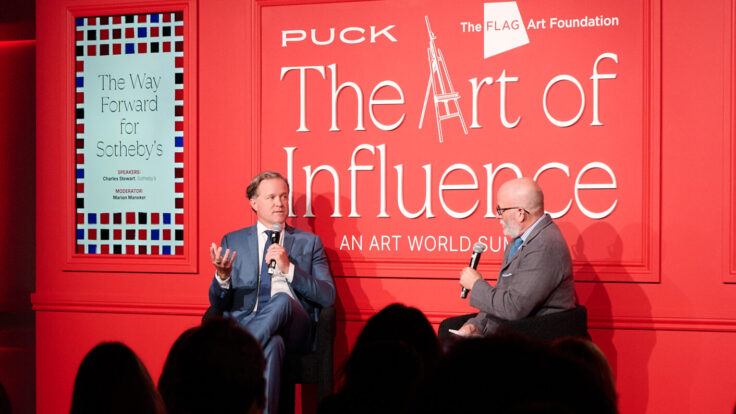
“Nobody lost money,” Sotheby’s C.E.O. Charles Stewart told reporters, taking a no-harm-no-foul approach to the whole matter. Some of you have wondered whether this is the most valuable work ever to be bought in. I’m told it’s not. (Though, I’m not sure how anyone would research that, since the records often disappear.) “The work didn’t sell, but it goes back to the owner,” Stewart said. “They’re fine.” True enough, especially in the case of a seller who was determined to call his own shots, refused a guarantee, and was said to be demanding a fixed price before Sotheby’s made any money.
Stewart went a little further when he defended the choice not to withdraw the lot. By referring to the failed sale as a “genuine auction moment” that was “better than watching 20 lots engineered to sell on a single bid,” he seemed to be emphasizing the casino-theater aspect of an auction—the kind of action that attracts new punters—over the house’s fiduciary responsibilities. It’s true, the Soloviev Foundation is going to be just fine. But Sotheby’s also has hundreds of other clients who benefit from the “engineering” that the house offers. So while it may be advantageous to put on a show for potential new buyers, most sellers who are also the auction houses’ actual clients want to get their works sold at the best price, whether that’s in a dramatic auction or a quiet prearranged deal.
Finally, if Sotheby’s truly values “organic auction moments,” as Stewart said, its social teams haven’t gotten the message. On Wednesday morning, I looked for the video of Sotheby’s modern evening sale, but it wasn’t available as it usually is the morning after. I thought it was just me being Boomer-y, but others had the same experience. You can see it now—but you won’t see the Giacometti sale. Sotheby’s has edited out all of the failed lots from the video.
Now, back to gigaweek…
|
|
|
|
The big spring sales have come to a close, leaving in their wake a distinctly unremarkable impression: Good works are selling, but there’s a limit to how high prices will go—and how far anyone is willing to stick their neck out, even for something they believe in.
|
|
|
How’s everyone feeling after the week we’ve had? Yeah, me too. I would say it was a roller coaster, but perhaps it was simply a week filled with a little false drama, some wary hopes, and a bit of good old-fashioned commerce. I’ll have more to say next week, probably in Wednesday’s Inner Circle email (you can sign up here). But the overall impression was of a market where there were many bidders, but few who would go past a clear, predetermined limit. One of the issues may be the prevalence of third-party guarantees, which has created a certain spiteful psychology among buyers: If they can’t get the guarantee, especially if someone else already got there first, then why bid?
For recently-made art, high primary market prices—and the absence of a must-have trend—have pushed buyers to auction, but they’re all looking for deals. At least, that’s the opinion of one advisor who reported the mood of her group chats of market makers and speculators. “Action at or below the estimate and quick drop-off,” the advisor texted me during Sotheby’s contemporary evening sale, “is the theme I see this week.” We had both observed that several lots saw a flurry of early bids—sometimes leaving hopeful buyers unable to get a bid seen or acknowledged by an auctioneer—that then stopped abruptly close to the estimate price. It’s a very cautious market where buyers want to feel rewarded, not at risk.
|
|
|
|
A MESSAGE FROM OUR SPONSOR
|
A new campaign starring Julia Garner celebrates the House’s storied silk scarves and their enduring legacy within the House’s design codes.
DISCOVER MORE
|
|
|
|
A good example of this came on Wednesday night at Christie’s. Lynette Yiadom-Boakye’s The Quickness, from 2013, saw a flurry of early bids from collector Jeff Magid and advisor Alex DiPersia, as well as two telephones. But the action came to a halt as soon as an “excellent advisor,” as she asked me to identify her, bid $640,000, which was less than 7 percent above the estimate. The advisor won the painting and no one else seemed terribly put out to have lost it.
Tiqui Atencio’s third-party-backed Cecily Brown painting, Bedtime Story, saw sustained bidding from San Francisco advisor Laura Sweeney, who lost out to private dealer Lillian Heidenberg. But the final price was only 28 percent above the estimate, at $6.2 million, which is the fairly consistent price level for a top work by Brown. The current market has a hard ceiling, indeed.
|
|
Some other examples: A representative for David Zwirner, dealer Paolo Vedovi, and Christie’s Emily Kaplan all bid on Sherrie Levine’s Fountain (After Marcel Duchamp), but only to a price 20 percent above the estimate. Christie’s Sarah El-Tamer, Nick Cinque, and Alex Rotter did the same on Yayoi Kusama’s Infinity-Nets [HSO]. The first sold for $300,000 hammer and the second sold for $3 million hammer. In each case, the bidding followed the same pattern of petering out a little above the estimate.
I ran into a different San Francisco advisor who told me he had the third-party guarantee on a 1997 Damien Hirst spot painting from the Atencio collection well below the estimate. A bidder from the back row of Christie’s salesroom lobbed in a slightly higher bid, but still below estimate, and the advisor let him have it. He liked the painting but just wasn’t ready to do battle for it. “That guy owes me a commission,” the advisor joked with me later. “I made it safe for him to bid.”
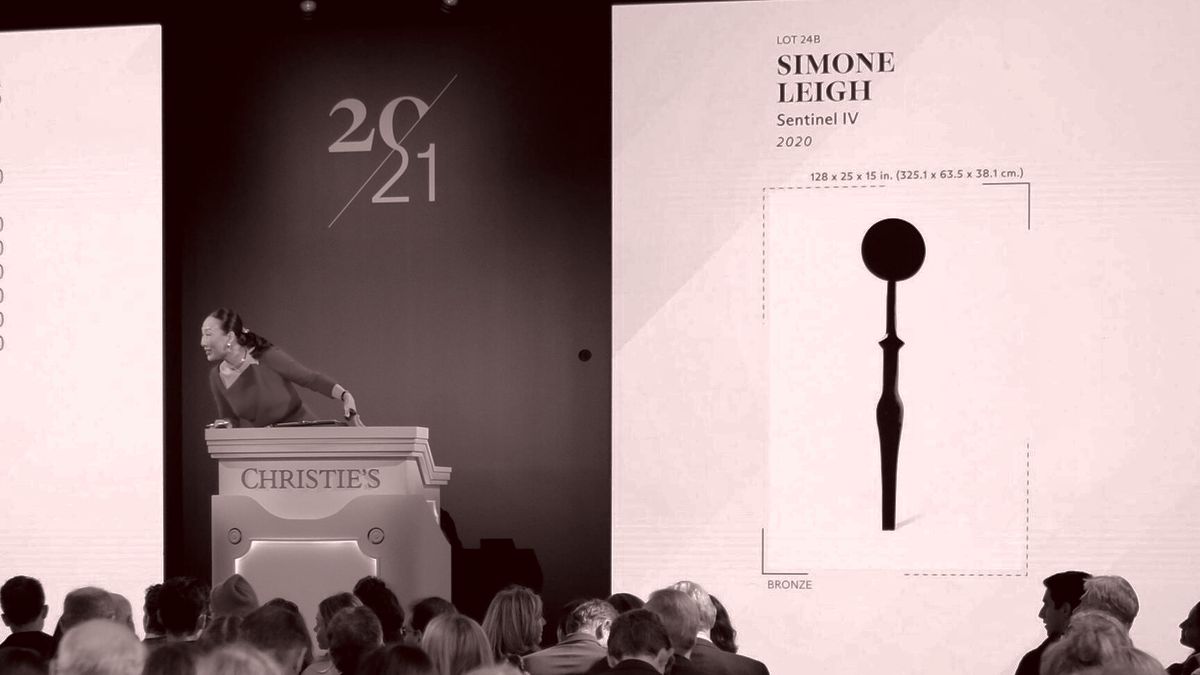
It wasn’t just advisors. Three Christie’s professionals manning phones fought for Simone Leigh’s Sentinel IV. Yet the extended bidding resulted in a price only 34 percent above the estimate. The exception to this rule was when Max Dolgicer, Hugh Gibson, Alex DiPersia, Christie’s Tan Bo, and an online bidder all drove Danielle McKinney’s The Fool from a come-and-get-me estimate of $50,000 to a $165,000 hammer price, or $208,000 with fees. (McKinney went four-for-four on the week, with prices ranging from $120,000 to $280,000 for works that all predate her joining Marianne Boesky’s gallery.)
|
|
The pattern continued during the opener at Sotheby’s, with a sale of works from dealer Barbara Gladstone’s estate. Two-thirds of the 15 lots sold for prices close to the low estimate. Works by Thomas Schütte, On Kawara, Carroll Dunham, and Raymond Pettibon, and especially the rare black Warhol Flowers painting, were all exceptions. On the Warhol, there was a frustrating run of blocked early bids as auctioneer Oliver Barker worked his way up between the book (auction parlance for a bid left with the auctioneer to execute) and head of private sales David Schrader. The final hammer price of $3.1 million was three times the estimate.
|
|
|
All but three of the 15 lots in Daniella Luxembourg’s sale of Italian art, Im Spazio, made prices close to the low estimate. The exceptions were a small Lucio Fontana sculpture, a sexy Michelangelo Pistoletto mirror work that Beaumont Nathan’s Martha Craig also tried for, and Pino Pascali’s steel wool Arte Povera work, which was estimated at $400,000 but hammered at $1.3 million.
In the main sale, Yu Nishimura’s Across the Place was bid to $320,000 against a $50,000 estimate. With the recently announced backing of David Zwirner gallery, he’s become the flavor of the moment in the market. All nine Roy Lichtenstein works from the estate sold at or above the estimates, with Nudes in Mirror (Study), Bonsai Tree, and Stretcher Frame with Cross Bars III all doing exceptionally well.
Gerhard Richter’s smallish grey abstract painting, acquired in 1991 directly from dealer Anthony d’Offay, had a robust $5 million estimate, but advisor Bernie Lagrange bid only $5.65 million to get the work, paying nearly $7 million with fees. Another Warhol 24-inch Flowers painting, this time with all of the bright colors, was estimated at $1 million, but got bid to $3.3 million, which translates into a little more than $3.8 million with fees.
Two other sales are worth noting as a way to measure the market and its changing tastes. The first comes from a giant of postwar art; the second comes from a recently rediscovered and revalued female abstract painter. I’ve been anticipating a swing back to the historical figures, and the success of the Lichtensteins somewhat validates that pivot. But the effect isn’t across the board. Giacometti isn’t the only great artist from the past who is seeing his market struggle. To wit, Robert Rauschenberg’s Rigger, from 1961, is considered a masterpiece of the artist’s oeuvre. It failed to find a buyer in the Ganz sale, but sold 20 years later, almost a decade after the artist’s death, for a bit more than $12 million. Last night, it came back to the block and sold to the irrevocable bid for $8 million.
Contrast that with Lynne Drexler’s Herbert’s Garden, which made a record price of $1.5 million three years ago. The owner had pledged the painting as collateral to Sotheby’s Financial Services, along with more than a dozen other works, and was walking away from them. Normally, the quick return to market and the fact that the work was in a distressed sale would make buyers run; add to that the idea that Drexler’s burst of popularity might not last. But Sotheby’s gave the painting a healthy $1 million estimate, which bidders met and slightly exceeded by 15 percent, bringing the selling price to $1.45 million. That’s not a terrible haircut, and a real demonstration of the depth of demand for Drexler’s best works.
So the market hasn’t really changed its taste all that much. Prices have just come down, and the competition is all eyeing one another, reluctant to make a move that might leave one out on a limb. There’s also a sense, conveyed to me by a few former auction house people, that maybe the houses have created a bit of a monster with all of their preselling and guarantee packages. Indeed, a guarantor isn’t necessarily a bidder. For some reason, guarantors who were getting good prices—but little upside—for their third-party backing just don’t want to bid. (Maybe Charles Stewart has a point.) That does not make for a sexy market with auction headlines, but it shows there’s still strong demand for art.
|
|
I went to Coco’s at Colette, the elegant GM Building private club, on Thursday afternoon to see Fair Warning’s first live auction. The room was a who’s who of the auction market: Nahmads, Mugrabis, two-thirds of Lévy Gorvy Dayan, Skarstedt’s Alina Kohlem, Belgian dealer Paolo Vedovi, French advisor Alain Benatar, American advisor Michael Altman, and dealer Christophe Van de Weghe, just to name a few. Former Christie’s auctioneer Jussi Pylkkänen, currently an advisor himself, was there to do the honors auctioning Pablo Picasso’s Tête d’homme à la pipe, a late work on paper made in 1971. Estimated at $6 million, Pylkkänen eked out another 10 percent as three telephone bidders and others on the app competed for the work. It sold for $7.8 million.
|
|
Jussi Pylkkänen at Fair Warning’s live auction, New York
|
|
There’s not a lot of high-value Picasso on the auction market. The Riggios had their Lee Miller painting, which sold for $28 million. Sotheby’s had a 1969 Homme assis that sold for $15 million. These days, if you want to buy a serious late Picasso, you will have to look privately. Dealer Brett Gorvy recently highlighted Le peintre et son modèle, dated on Bastille Day in 1969, which was featured in his late exhibition at the Palais des Papes in Avignon and now hangs in Gagosian’s last show at 980 Madison, which features some of Paloma Picasso’s collection of her father’s work. Not one of Paloma’s works, it is for sale privately, and shows the fading libido of an 88-year-old man who was married to a woman half his age. “The eroticism of his earlier embracing couples is now a comforting cuddle,” Gorvy wrote in an Instagram post.
After a long and sometimes grueling week, I’m going to cuddle my glass of stout. Let’s speak again on Sunday.
M
|
|
|
|
The ultimate fashion industry bible, offering incisive reportage on all aspects of the business and its biggest players. Anchored by preeminent fashion journalist Lauren Sherman, Line Sheet also features veteran reporter Rachel Strugatz, who delivers unparalleled intel on what’s happening in the beauty industry, and Sarah Shapiro, a longtime retail strategist who writes about e-commerce, brick-and-mortar, D.T.C., and more.
|
|
|
|
Puck founding partner Matt Belloni takes you inside the business of Hollywood, using exclusive reporting and insight to explain the backstories on everything from Marvel movies to the streaming wars.
|
|
|
Need help? Review our FAQ page or contact us for assistance. For brand partnerships, email ads@puck.news.
You received this email because you signed up to receive emails from Puck, or as part of your Puck account associated with . To stop receiving this newsletter and/or manage all your email preferences, click here.
|
|
Puck is published by Heat Media LLC. 107 Greenwich St, New York, NY 10006
|
|
|
|