Welcome back to Wall Power, coming to you from Paris for the second part of this
two-act drama of the October art market. I’m Marion Maneker.
Tonight, I’m taking you to three of the big museum shows that opened here last week, featuring three of the most attention-grabbing artists of the last 50 years: Gerhard Richter, Philip Guston, and George Condo.
But first… |
-
Gagosian’s Rubens gambit: It took a little jiggering with Art Basel’s rules, but by now you’ve heard that Gagosian will have Peter Paul Rubens’s The Virgin and Christ Child, with Saints Elizabeth and John the Baptist (dated from 1611–14) on its stand at Art Basel Paris. Technically, the work will be presented in dialogue with contemporary artists like John Currin, Jadé Fadojutimi, Alberto Giacometti,
Pablo Picasso, Auguste Rodin, Jenny Saville, Ed Ruscha, and Albert Oehlen. This is just another example of what it takes to sell high-value art these days, as dealers work to identify what excites buyers. In this case, Bernard Lagrange, of Gagosian’s advisory services arm, worked with the consignor; then he and Gagosian had the idea of bringing the work to Basel in Paris to see
if it would cut through some of the noise.
|
|
|
A MESSAGE FROM OUR SPONSOR |
|
|
- The farewell that
never ends: Elsewhere in Gagosian news, the gallery announced this morning that it will represent the estate of Richard Diebenkorn. In late 1992, just before the artist died, Gagosian held a show of Diebenkorn’s Ocean Park series at his gallery at 980 Madison. On November 8, there will be another Diebenkorn show at 980 Madison to inaugurate the representation. But wait, I hear you say, I thought Gagosian had given up the gallery space there. Well,
as happens in many real estate stories, the landlord has extended Gagosian’s lease, and without the new retail-level space ready, the gallery is happy to keep showing in its preferred space.
|
|
|

| Julie Brener Davich
|
|
- Louvre heist
inventory: We now know the full tally of the brazen daytime smash-and-grab at the Louvre this weekend, and it is truly devastating. In total, nine royal treasures of incalculable historic value were carted off by thieves in
a matter of minutes, including the diadem, necklace, and one of the earrings from the 1820s Sapphire Parure; the necklace and earrings from the Emerald Parure (circa 1810) by court jeweler Marie-Étienne Nitot; the Broche Reliquaire (circa 1855), by Bapst, set with two historic Mazarin diamonds from Louis XIV’s
crown collection; and the Second Empire pearl-and-diamond diadem and diamond bow-shaped and tasseled bodice brooch, both worn by Empress Eugénie. Her crown, with 1,354 diamonds and 56 emeralds, was also taken, but later abandoned and found, albeit damaged. These pieces are all the more valuable given that so few of the French crown jewels remain: Some were stolen during the French Revolution, and the Third Republic sold others in 1887.
|
|
|
Now, let’s get to the main event… |
|
|
The Louvre smash-and-grab is the talk of Paris, but let’s focus on the
museums that didn’t get robbed—including a major retrospective of Gerhard Richter, and shows that should help Philip Guston and George Condo cement their places in art history. |
|
|
Paris, as we now know, is not very good at protecting its crown jewels. But while the
shocking weekend heist at the Louvre might have embarrassed the city, it did not obscure what Paris does exceptionally well—unite the entire city around a major cultural event. That was evident last year during the Olympics, but it’s equally true of the city’s main art event, especially in the three years since Art Basel took over the fall fair at Paris’s Grand Palais. Museums around the city take advantage, coordinating major shows to open alongside the fair and giving its many visitors a
richer cultural experience while they are here.
Granted, this hasn’t always gone smoothly—in the past, everyone trying to open their shows during the same big week has created a logjam of events. But this season, the planning got more sophisticated. The George Condo show at the Musée d’Art Moderne de Paris was unveiled first, more than two weeks ago; then the Philip Guston exhibition at the Musée Picasso kicked off early last week; and the Fondation Louis
Vuitton’s massive Gerhard Richter retrospective opened last Friday. So I got to see all these shows on Sunday before the whirl of gallery- and fair-related events that took off Monday. Yes, the burglary at the Louvre embarrassed the French government with a vicious act of vandalism, but that’s really detracting from this week’s experience. There’s a lot to learn from paying attention to the museums that weren’t robbed. |
It would have been easy for Dieter Schwarz and Nicholas
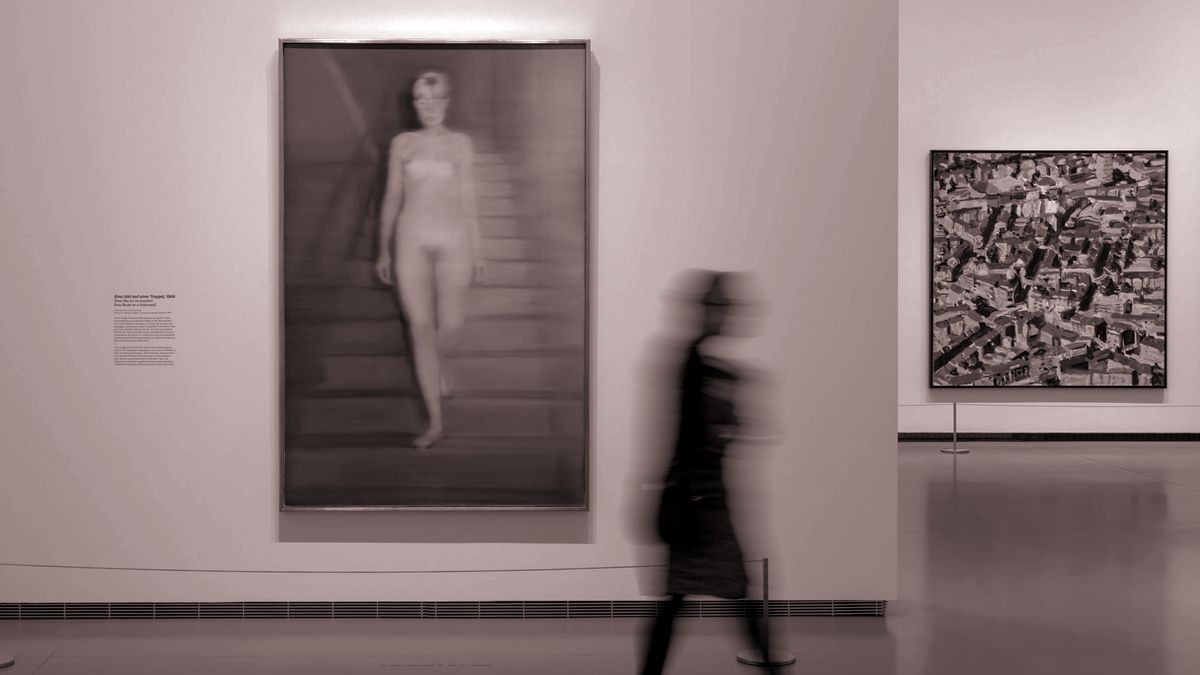
Serota—one a well-respected curator, the other a prominent former museum director—to create a Richter retrospective out of crowd-pleasing heroic moments from the German painter, who is known for grand pictorial statements. I don’t want to suggest that the new show isn’t a crowd-pleaser: The museum was full to capacity on the Sunday morning when we visited. But the 275-work retrospective of Richter’s 55-year working life—starting from the first painting he declared in 1962 and ending in
2017, when he decided he had nothing more to do as an artist—is about exactly that: his working life. |
|
|
A MESSAGE FROM OUR SPONSOR |
|
|
It is a comprehensive chronological look that shows the many different ideas and
obsessions the artist tried to work through. Some of his best paintings are included in the show, though far from all of them, and a few of the greats—like the portrait of his daughter, Betty, from 1988, or the portrait of his wife, Reader, from 1994—are presented almost in passing. Though the show features many of his signature abstract paintings, it doesn’t dwell on them.
Perhaps the curators didn’t feel the need to sell the merchandise, as it were, because
Richter is unassailably the world’s greatest living painter—the rare artist who declared both an official beginning to his career and a proper end to the painterly project. Schwarz and Serota call Richter a “classical studio artist” more concerned with the creation of images than with self-expression. “You immediately recognize a Richter painting,” they wrote in their catalogue essay, “but you don’t recognize his hand. There’s no typical gesture, no given flourish, no sense of
signature.”
Indeed, that’s what is fascinating, beguiling, and frustrating about the Richter show. We get to see the long working life of an artist constantly looking for a meaningful image to make and often toggling back and forth within a wide range of ideas. He’s not interested in painting from life. His art is mediated through photographs, materials, concepts, and even the notion of nostalgia so aptly captured in the blurring technique he uses on his realist paintings from
photographs.
This isn’t to say that the show isn’t great. To the curators’ credit, it doesn’t pander to the viewer or excessively flatter. There’s a matter-of-fact quality to the show and signage, which seems to say, Here’s what he was getting at in this series, and here’s what the goal was with that series. And, by the way, there are a lot of different series. Richter had a lot to work out.
The show’s chronological construction highlights some of Richter’s
recurring interests. For instance, throughout his career, Richter created works that were essentially mirrors. (Talk about removing the artist’s hand from the image-making.) Some of these are glass panels; others are colored glass arranged at angles to make what he called “corner mirrors.” There is even one large mirror hung in a gallery: a portrait of you, the viewer. I never really understood Richter’s mirrors, or realized he had taken them so far as to produce large ones as “paintings.” But
later in the show, there is a structure that combines 11 panes of clear glass into an object that reproduces an image of the viewer, and it uncannily resembles one of Richter’s own blurred portraits.
Was that what the artist had been searching for? Had he finally found a way to create an image directly from life that matched his aesthetic point of view, but did not involve him personally in any way? There is no photograph to paint from, just a reflected image of the viewer, in the most
Richter way possible. Of course, I took a picture of “my” Richter, which is to say, my own reflection in his work looking uncannily like a blurred Richter portrait. Anyway, if you happened to be a collector in town and this show inspired you to get on the Richter bandwagon, the artist’s gallery, David Zwirner, was happy to help; they opened their own micro-version of the retrospective on Monday night, complete with several glass and mirror pieces. All you have to do is convince
Zwirner to sell one to you. |
Musée Picasso’s Philip Guston show has a thin premise connecting the two artists—though
any 20th century artist with any ambition can be connected to Picasso. Indeed, what the exhibition really represented was the last stop in the lifelong campaign of Guston’s daughter, Musa (as chronicled in her
memoir), to see her father’s art
elevated into the pantheon of international greatness. Much of it was drawn from the gift of works she recently made to the Metropolitan Museum of Art, the same gift that formed part of a much larger show at the National Gallery in Washington and the Tate in London last year. The show has been reduced to its most potent images, displaying the youthful Guston’s social realism and his heyday as an abstract expressionist, while combining that with Guston’s skill as caricaturist, as seen in the
great Nixon takedown from 1975 titled San Clemente, or his self-caricature from 1969 of a Klan-hooded artist, In the Studio, which he marked “not for sale” and will now end up in the Metropolitan Museum of Art. |
|
|
If Guston’s place in art history is finally secure, George Condo’s should be soon.
The show of his work at the Musée d’Art Moderne is being presented as the third installment of a trilogy on 1980s East Village artists that includes Jean-Michel Basquiat and Keith Haring. Of course, MAM did shows about those other artists more than a dozen years ago. And though Condo’s long career means that he was indeed an East Village bad boy, that hardly seems to be the reason we pay any attention to him today.
Condo is most famous for his
figures—first, the bizarre surrealist buck-toothed characters; then the cubist crowds and solo shots. But the exhibition wants to position Condo as an artist whose work is about art history, opening with a room full of Condo’s most dramatic takes on other artists like Rembrandt, Goya, Rodin, and Picasso. I only wish the works chosen for this room were among Condo’s best. But the 80 paintings and 110 drawings gathered across the whole exhibition
remind us of his great achievements throughout his career. There are the all-over works that he began calling “expanded canvases” as far back as 1985. There’s a group of fascinating word paintings he made from his own name. Groups of works he did in blue, black, and white each get their own focus in the show.
Condo has been a market mainstay for the last seven years, with his auction totals ranging from $36 million to $73 million each year since 2018, and ticking along at a solid $40
million a year since 2022. That makes Condo one of the most consistent and traded contemporary artists. The market boom seems to have come on the heels of the 2017 retrospective of his work at the Phillips Collection and the Louisiana Museum in Denmark. Let’s see if this one has a similar catapulting effect. |
Just one more comment on the Louvre heist for today. Paris has a history of daring
jewelry robberies, and there were already questions and concerns about the Louvre’s security before this shocking breach. (We’ve seen heists at art fairs, too, as when thieves invaded TEFAF Maastricht three years ago.) Some reports suggested that the Louvre thieves would break down the jewels to sell off the precious metals and stones. But these famous objects are far more precious than their component parts, and the stones will be very hard to disguise. Even if they can be sold, it’s
hard to imagine that thieves would have targeted the Louvre had this theft been about money—there are plenty of jewelry stores left to hit. This looks far less like a profit-making exercise than an act of vandalism or political humiliation.
Sorry to leave you on that unhappy note. The good news is I’ll be back with the Inner Circle tomorrow, and that you can still join us here if you
haven’t yet upgraded.
’Til then,
M |
|
|
The ultimate fashion industry bible, offering incisive reportage on all aspects of the business and its biggest
players. Anchored by preeminent fashion journalist Lauren Sherman, Line Sheet also features veteran reporter Rachel Strugatz, who delivers unparalleled intel on what’s happening in the beauty industry, and Sarah Shapiro, a longtime retail strategist who writes about e-commerce, brick-and-mortar, D.T.C., and more. |
|
|
Finally, a media podcast about what’s actually happening in the media—not the oversanitized,
legal-and-standards-approved version you read online. Join Dylan Byers, Puck’s veteran media reporter, as he sits down with TV personalities, moguls, pundits, and industry executives for raw, honest, sometimes salacious conversations about the business of media and its biggest egos. New episodes publish every Tuesday and Friday. |
|
|
Need help? Review our FAQ page or contact us for assistance. For brand partnerships, email ads@puck.news. You received this email because you signed up to receive emails from Puck, or as part of your Puck account associated with {{customer.email}}. To stop receiving this newsletter and/or manage all your email preferences, click here. |
Puck is published by Heat Media LLC. 107 Greenwich St, New York, NY 10006
|
|
|
|