Welcome back to Wall Power. I’m Marion Maneker.
Mary
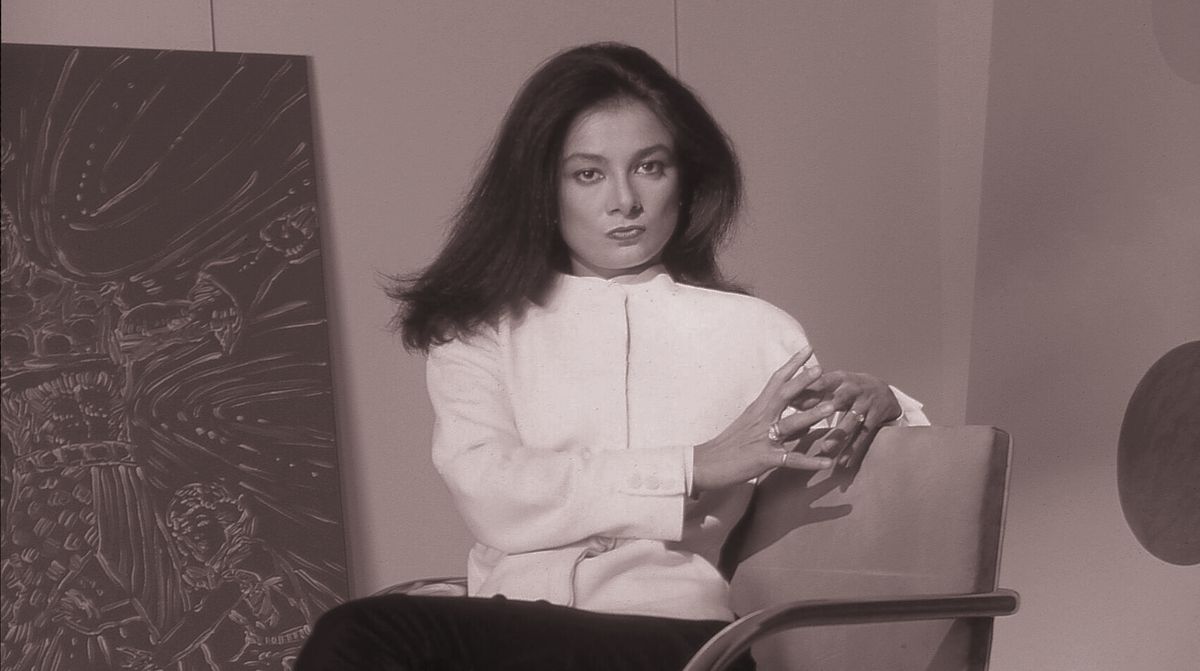
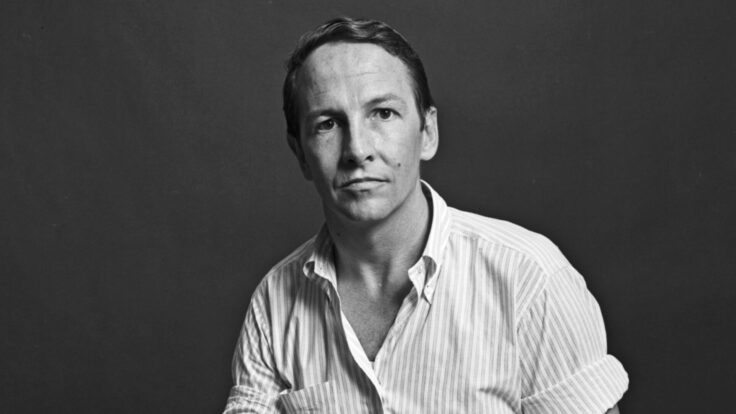
Boone is back. And tonight, we’re going to talk about Lévy Gorvy Dayan’s new show, Downtown/Uptown, which celebrates New York in the 1980s, and Boone’s inimitable role in it.
Let’s get started… |
-
Don’t miss out on our fourth anniversary subscription offer: In honor of Puck’s fourth birthday, we are offering new subscribers 20 percent off your first year of Puck. Join our community, or buy a colleague a gift subscription—that’s what colleagues do for each other. Also, if you’re
already a member and thinking about upgrading to the Inner Circle, now is a great time: We’re also offering 20 percent off there. Just click here to claim your spot.
- Larry’s
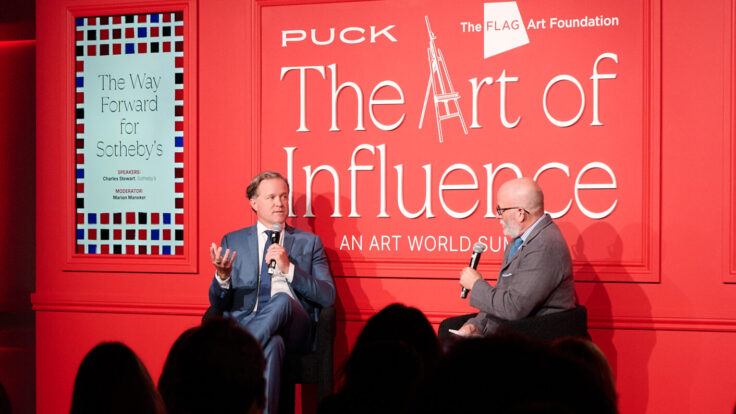
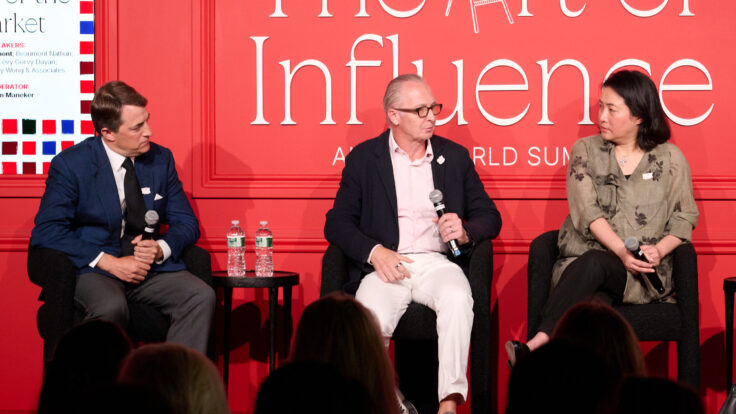
sunglasses: The surprise topic of conversation at last week’s inaugural Art of Influence conference, which Puck hosted in partnership with Glenn Fuhrman’s FLAG Foundation, was Larry Gagosian’s Dolce Vita–like sunglasses. In the aftermath, numerous people mentioned them to me. I’ve been trying to get the art dealer’s
office to tell us who makes them, but one enterprising art advisor, Beth Terry, didn’t want to wait for word from the big man. She guessed these Jacques Marie Mage Yellowstone VI: Cougar frames. Got a better guess? Just hit reply on this email or send me a text, WhatsApp, or Signal at 917.825.1391. The winner, if we can ever confirm it, will receive a status-defining Puck hat.
|
|
|
A MESSAGE FROM OUR SPONSOR |
Have you planned for the future of your art collection?
Explore our guide for valuing, appraising and transferring your art collection to ensure the
pieces you spent decades collecting live on as you intended. |
|
|
- A little more Gagosian: Tomorrow in the Inner Circle, we’ll run an edited version of my interview with Gagosian from The Art of Influence. If you want to read it, upgrade your subscription here.
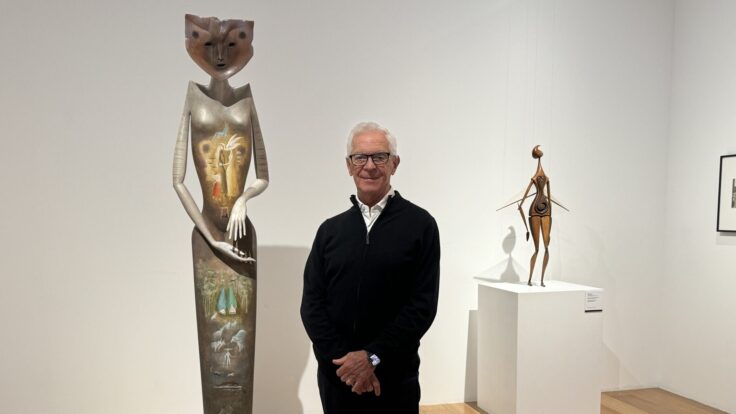
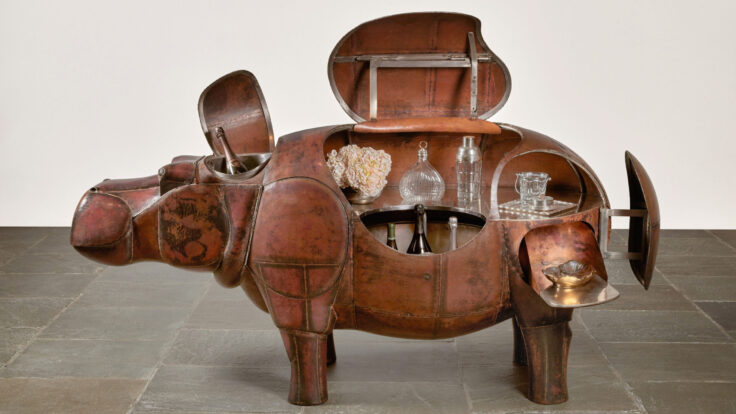
- Acquavella gets into the design crossover market: It’s no secret that the design market has continued to rage even as the art auction market has waned. And the hottest part of the design market over the last several years has been the work of sculptors who make furniture, like Diego Giacometti, and Claude and François-Xavier Lalanne. That’s not lost on Alex Acquavella, whose gallery
held a show for Harumi Klossowska de Rola in Palm Beach earlier this year.
Like Giacometti and Les Lalanne, the sculptor draws inspiration from the natural world. (Notably, she is the daughter of the painters Balthus and Setsuko.) But she also looks to mythology, and her sculptural design work will
appeal to buyers who either can no longer chase Giacometti’s and Les Lalanne’s prices, or who simply want something different in a similar vein. Acquavella will begin by representing Klossowska de Rola in the United States, but will show her work at art fairs in the run-up to a gallery show in New York some time next year. - Sebastian Fahey joins Art Intelligence Global in Asia: Sotheby’s alums Yuki Terase, Mike
Goss, and Amy Cappellazzo have brought on their former colleague Sebastian Fahey as chief operating officer, Asia. Fahey, who until late last year was Sotheby’s global fine arts managing director, will join Art Intelligence Global this month alongside Matt Bangser, who recently arrived from Blum.
|
Now let’s get to the main event… |
|
|
A new retrospective at Lévy Gorvy Dayan, on the New York art scene of
the ’80s, offers a nostalgic view of the wild Koch era. It also serves to replatform one of the day’s heroines: Mary Boone. |
|
|
By the end of the 1970s, the New York art world had gotten pretty stale. Major
collectors had bowed out, bored after buying the giants of pop and not seeing much new or exciting work beyond them. Artists seemed to be outdoing each other to make work that only an institution could love or exhibit. The city itself had become a dystopia after a financial crisis created bombed-out boroughs, exacerbated by the middle class fleeing to the suburbs.
Then, “after a dozy decade,” as the writer Anthony Haden-Guest put it, the art world came to “noisy,
aggressive, and controversial life.” Mary Boone helped bring new talent, personalities, and gossip to the scene in the 1980s, reviving and expanding the art world and setting the stage for it to grow beyond what anyone had previously imagined was possible. She partnered with Leo Castelli to turn Julian Schnabel and David Salle into star painters, and usher in a revival of figuration that many would call neo-expressionism—a style
exemplified by artists like Ross Bleckner, Francesco Clemente, Eric Fischl, and even the transcendent juggernaut Jean-Michel Basquiat. The McNally brothers and Lynn Wagenknecht provided a stage at The Odeon for all this drama to play out. |
|
|
A MESSAGE FROM OUR SPONSOR |
Have you planned for the future of your art collection?
Explore our guide for valuing, appraising and transferring your art collection to ensure the
pieces you spent decades collecting live on as you intended. |
|
|
At least that’s the story Lévy Gorvy Dayan wants to tell in their new show,
Downtown/Uptown: New York in the Eighties, which opened late last week. Of course, this is a telescoped version of what occurred in the city during that decade, colored a little by survivorship bias and nostalgia. Brett Gorvy, the show’s organizer and co-curator with Boone, was a teenager living in London when it all went down. The exhibition is very much the 1980s New York of his imagination, with the added showmanship of rehabilitating Boone’s image after her
unfortunate stint in prison for tax fraud.
When I first saw that Boone would play a prominent role in the show, I was surprised—but then I remembered that getting in trouble with the tax man was the most New York thing one could do in the ’70s and ’80s. Andy Warhol began dictating his diaries after an I.R.S. audit in the ’70s; in 1980, Steve Rubell and Ian Schrager were convicted of skimming their own cash at Studio 54 to avoid
taxes. At the turn of the decade, the collector Peter Brant would serve a little time for his own tax troubles. Boone’s revival was on brand, even if a little on the nose.
Not coincidentally, Boone’s revival helped persuade The New York Times to commission a long feature on the show. The paper convened the surviving
artists on display—at least the ones who showed with Boone—at Eothen, Warhol’s remote Montauk retreat. (The property now belongs to Gorvy’s partner Amalia Dayan and her husband, Adam Lindemann.) Of course, none of the artists wanted to be known as “neo-expressionists”—the word is “dull and doesn’t mean anything,” Schnabel complained to the Times—or have their careers reduced to what they did during a brief period in the 1980s. Indeed, no artist wants
their oeuvre retrofitted neatly into a Times narrative, even if they still would like to pose for the picture. |
Downtown Artists in an Uptown
World
|
We don’t have to entirely fall for the show’s premise to enjoy Downtown/Uptown,
which Gorvy told the press was titled to capture the mutual admiration of Warhol, the uptown denizen, and the downtown kids happy to consort with him and his world: Basquiat, Schnabel, and Keith Haring. In fact, two of Haring’s subway drawings—the white chalk on black paper graffito that the artist started making in 1980—stand like sentinels in the outside windows of LGD’s 64th Street gallery, which was once the Wildenstein mansion. (Indeed, Gorvy’s title also
seems to gesture at downtown artists in an uptown setting.)
But just inside the doors is an homage to Warhol: One of his “fright wig” self-portraits hangs on one wall, and a vaguely Vitruvian portrait he made of Basquiat adorns the one opposite. Between them is a gridded wall of 40-by-40-inch, mostly black-and-white portraits of artists Clemente, Haring and his partner Juan Dubose, Peter Halley, and Robert Mapplethorpe.
Almost
immediately, we snap back downtown, with a selection of Kenny Scharf’s work that’s maybe not his best—though there is a very nice untitled 1979 piece collaging found objects onto a space-themed background, and one of his painted household objects, this one an answering machine. The Scharfs frame a Basquiat boxer’s heavy bag emblazoned with “Mary Boone,” and a Haring pink happy face painted on a sheet of metal. The ground floor also features four large works that represent key
1980s figures: Schnabel’s Aborigine Painting, from 1980; Clemente’s Name, from 1983, which shows a large head with smaller heads peering from the eyes and mouth; Salle’s King Kong with its attached wooden table; and Haring’s monumental Untitled (Dancing Dogs), from 1981, once called a “definitive summary of Haring’s pictorial lexicon.” Halfway up the grand staircase hangs Tseng Kwong Chi’s famous photo of Haring in a subway car, glimpsed
through a broken door with one of Haring’s original subway drawings visible in its advertising frame. |
|
|
Upstairs, the show opens its aperture and takes in more of what was happening in New
York in the ’80s, or at least what remains relevant. There are great examples of Barbara Kruger paintings alongside Christopher Wool word paintings next to a Richard Prince joke painting. You get the point. Work by those three artists is enhanced and amplified by three examples of Guerrilla Girls posters. There are also several very good echt Jeff Koons works and a handful of Basquiats, including a self-portrait
on paper from 1982. Basquiat works on paper have become their own market sensation recently. While I was at the gallery, Amalia Dayan remarked to me, as other dealers have, that the artist’s work has become a serious high-level entry point for a whole new group of collectors.
The show also takes some calculated risks. In a small room at the top of the stairs, Gorvy has hung a selection of photographs that were highly controversial at the time. (Maybe focusing on Mary Boone was a way to
draw attention away from this room.) These works include Andres Serrano’s Immersion (Piss Christ) from 1987, Mapplethorpe’s Man in Polyester Suit, from 1980, two Sally Mann photographs, and the lightning rod image by Prince called Spiritual America, from 1983. Prince’s photograph is based on a still from Louis Malle’s Pretty Baby of a nude 11-year-old Brooke Shields.
|
I remember when Serrano and Mapplethorpe became the poster children for the ’80s-era
culture wars, but that seems like child’s play compared to our current politics. I was more interested in another room, at the bottom of the stairs, where Gorvy has gathered some documentary images from the period, including Clemente watercolors of fellow artists and Polaroids that Warhol took for the grid of portraits in the entryway. The room also contains vitrines with various documentary objects from the time, including an issue of Art in America with a Fischl painting on the cover,
and Haden-Guest’s New York Magazine cover story anointing Boone the “New Queen of the Art Scene.”
Curiosity got the best of me. I read the story and was surprised at the number of parallels to today. The market’s current two-and-a-half-year lull is nothing compared to the slump of the late ’70s—when, according to Haden-Guest, a British aristocrat slumming it in New York, artists “wanted to make uncollectable work and successfully created uncollectors.” The galleries didn’t help
much either. They were “occupied by the remnants of once powerful movements like so many stragglers from dispirited tribes,” he wrote. He even quoted an artist complaining that criticism had collapsed and only the market would provide meaning. Sound familiar?
This was the world into which Boone emerged, and Haden-Guest’s disclosure that she owned between 100 and 200 pairs of shoes became an art-world meme ante litteram—though the proto-consumerism seems quaint from our current
vista. Still, the story ends on a positive note, with Castelli extolling the launch of Tony Shafrazi’s gallery, which would do so much to make Haring an international superstar, and vouching for Annina Nosei, who would launch Basquiat in a few short years. All of which is to say, even when the art world is at its bleakest, you never know what’s coming next. |
That’s all for today. Join us tomorrow in the Inner Circle for your first taste of The
Art of Influence.
M |
|
|
The ultimate fashion industry bible, offering incisive reportage on all aspects of the business and its biggest
players. Anchored by preeminent fashion journalist Lauren Sherman, Line Sheet also features veteran reporter Rachel Strugatz, who delivers unparalleled intel on what’s happening in the beauty industry, and Sarah Shapiro, a longtime retail strategist who writes about e-commerce, brick-and-mortar, D.T.C., and more. |
|
|
Finally, a media podcast about what’s actually happening in the media—not the oversanitized,
legal-and-standards-approved version you read online. Join Dylan Byers, Puck’s veteran media reporter, as he sits down with TV personalities, moguls, pundits, and industry executives for raw, honest, sometimes salacious conversations about the business of media and its biggest egos. New episodes publish every Tuesday and Friday. |
|
|
Need help? Review our FAQ page or contact us for assistance. For brand partnerships, email ads@puck.news. You received this email because you signed up to receive emails from Puck, or as part of your Puck account associated with {{customer.email}}. To stop receiving this newsletter and/or manage all your email preferences, click here. |
Puck is published by Heat Media LLC. 107 Greenwich St, New York, NY 10006
|
|
|
|