|
Welcome back to Wall Power. I’m Marion Maneker.
Happy 80th birthday to Larry Gagosian. And to Paloma Picasso, who turned 76 yesterday. I’ll have more on their collaboration to show unseen works by her father during Gagosian’s final show at his 980 Madison Avenue location. At the same time, Gagosian is christening his newly renovated Chelsea space with a new look at Willem de Kooning. I’ll tell you all about these in detail below the fold.
|
|
|
|
A MESSAGE FROM OUR SPONSOR
|
The first steps towards a masterpiece starts with a dream. The all-electric BMW i7 – the evolution of brilliance. Learn more at
BMWUSA.com
|
|
|
 |
Julie Brener Davich |
|
- A Zwirner family affair: The art-and-fashion pop-up at the MZ Wallace store in SoHo this week is a Zwirner family-and-friends production. Mom Monica Zwirner’s accessories brand, known for its signature quilted nylon bags, and the Zwirner kids’ online art marketplace, Platform, are both showing collabs with artists in the Zwirner orbit. On view through next Sunday, the first Platform pop-up at MZ Wallace is showcasing original paintings by Silas Borsos, but what caught my eye is the latest offering of artist objects from the David Zwirner stable: a $475 silk scarf by Elizabeth Peyton featuring her 2009 painting Twilight; a $45 kite by Nate Lowman displaying two of his hurricane Doppler paintings; and a $275 bolster pillow printed with the late Noah Davis’s untitled painting of two girls asleep on a sofa, from the MoMA collection. Davis painted the canvas in summer 2015, a month before he died, and it closed out his emotional retrospective at the Barbican Gallery. Next month, Platform is launching an edition of eight patinated bronze bowls by Louis Eisner. Other upcoming artist objects are from Michaël Borremans and R. Crumb.
For its part, MZ Wallace is celebrating the launch of the latest in the brand’s artist series, a collection of pink bags printed with multimedia artist Sara Cwynar’s peony photograph. The previous bag collab was with artist Cynthia Talmadge.
|
|
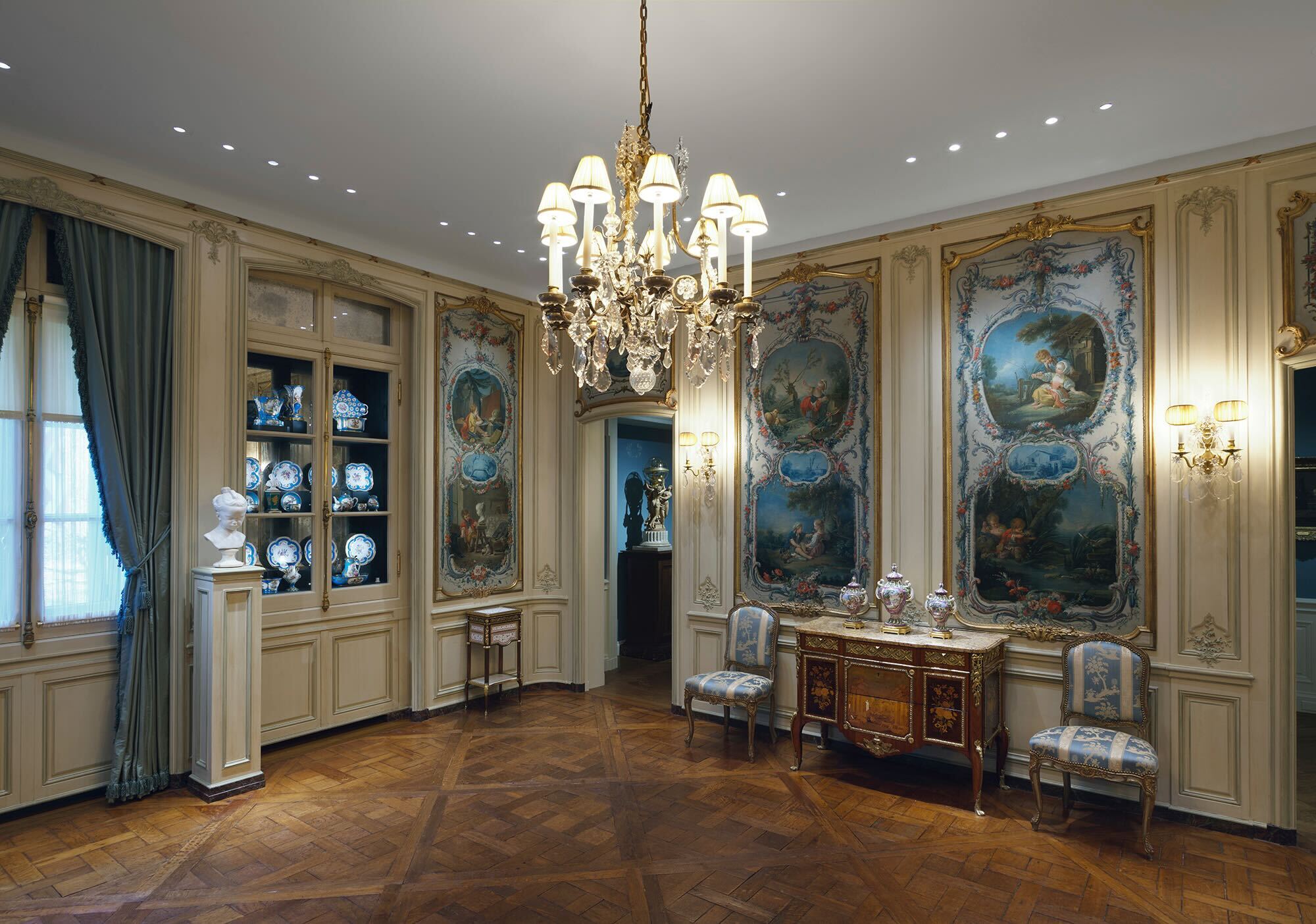
Boucher Anteroom, The Frick Collection, New York. Photo: Joseph Coscia Jr.
|
- What’s upstairs at the Frick?: The Frick’s four-year, $220 million, Annabelle Selldorf–led renovation has made space for about 400 more paintings and objects—ceramics, furniture, enamels, medals, and timepieces from Europe and Asia spanning the 16th to 19th centuries. The Frick family’s former residence on the second floor, containing 10 rooms and five passages, is now open to the public, along with the grand marble staircase that leads up to it. The rooms were designed in the early 1910s by pioneering American decorator Elsie de Wolfe. When Henry Clay Frick’s house became a museum in 1935, the upstairs rooms were closed and repurposed, and the eight François Boucher panels in his wife’s boudoir were moved downstairs. (Adelaide Frick’s dressing room had most recently been used as the museum director’s office.) The highlight of the second floor is the reinstated Boucher Room. The panels are back in their original location, as is the 40-panel parquet de Versailles wood floor and marble hearth and hearthstone. In the corner is a built-in cabinet containing about 25 pieces of turquoise Sèvres porcelain gifted in 1934 by the Fricks’ daughter, Helen Clay Frick.In the matching powder-blue anteroom are two Turkish-style console tables topped with Qing dynasty vases and covered jars. Marie-Laure Buku Pongo, the museum’s associate curator of decorative arts, told me, “We realized over the years that several Chinese porcelains bequeathed by [the Fricks’ son] Childs Frick were very good (some of them have imperial marks), and because we now have more space, it gave me an incredible opportunity to display more Chinese porcelain.”Next door, in what used to be a butler’s pantry, is a small gallery dedicated entirely to clocks and watches. Many of the pieces on view there, including 13 pocket watches from the 16th-19th centuries, come from a 1999 bequest of some 40 timepieces from Winthrop Kellogg Edey. The clocks include an almost-2-foot-tall, late 17th century mantel clock by André-Charles Boulle, called a tête de poupée (doll’s head clock) because of its shape. “While clocks have long been displayed in the first-floor galleries, they were often overlooked as visitors gravitated toward a Vermeer, a Rembrandt, or a Turner,” said Pongo. “It’s wonderful that these intricate objects now have their own space.”
The Ceramics Room houses the collection of French faience ceramics bequeathed by Sidney R. Knafel, and the small Du Paquier Passage is named for the collection of Viennese Du Paquier porcelain gifted by Melinda and Paul Sullivan. There is also a room dedicated to the collection of Renaissance portrait medals assembled by Stephen K. and Janie Woo Scher. They not only gifted some 450 of these commemorative medals, described by the Frick as essential to the development of Western portraiture, but also established a center at the Frick for studying them. All of these collections are promoted as the best private collections in their category in the world.
|
|
|
|
A MESSAGE FROM OUR SPONSOR
|
The first steps towards a masterpiece starts with a dream. The all-electric BMW i7 – the evolution of brilliance. Learn more at
BMWUSA.com
|
|
|
Frank Lloyd Wright’s $3M Lamp to Be Sold at Sotheby’s
|
|
Frank Lloyd Wright, Double Pedestal Lamp. Photo: Courtesy of Sotheby's
|
Frank Lloyd Wright’s Dana-Thomas House in Springfield, Illinois, the first commission for which the architect was given free rein, boasts the “the largest collection of site-specific, original Wright art glass and furniture,” including a rare double-pedestal lamp that sits in the dining room. According to Sotheby’s, “the lamp distills the essence of the architect’s core design principles into a single object.”
Only two of the lamps were ever made, and Sotheby’s will be auctioning the other example, currently part of a private collection, in the May modern evening sale. The lamp carries an estimate of $3 million—not much more than the $2 million it sold for more than 20 years ago. As Sotheby’s head of design, Jodi Pollack, put it, “It’s like owning a perfect little house—by none other than Frank Lloyd Wright.”
If the lamp sells, it will be a new record for a Wright-designed object. The previous record was set two years ago, when the Wolf family collection sold a Francis W. Little House ceiling light for $2.9 million.
And now to the main event…
|
|
|
|
To mark the end of an uptown era and the revitalization of his downtown flagship, Larry Gagosian has launched exhibitions of Pablo Picasso and Willem de Kooning, two artists he has shown many times before.
|
|
|
|
Larry Gagosian turned 80 yesterday, but he’s not looking to wind things down. Instead, Gagosian seems to be gearing up to make the most of what suddenly seems like a potentially resurgent and revitalized art market. After unexpectedly losing the lease on his flagship Madison Avenue gallery space when Bloomberg Philanthropies pushed them out, Gagosian renovated his 24th Street gallery, adding office space for some of those displaced, and improving the flow and integration of the exhibition spaces. (We will have to wait to see what goes in the renovated street-level spaces at 980 Madison.)
Then he commissioned two exceptional shows that return to winning themes from his long career as an art dealer: a new look at Willem de Kooning and a rare glimpse of Paloma Picasso’s holdings of her father Pablo Picasso’s work. As Gagosian points out, this will be the 21st Picasso show at a Gagosian gallery, and the sixth solo show for de Kooning. The reasons should be obvious. Both titanic artists produced a range of work in a variety of styles. They are also two artists whom wealthy collectors tend to get fixated on enough to spend nine figures on their work.
Gagosian knows his audience, and he understands that, in sales, having an opportunity to start a conversation is as valuable as having something to sell. Which is why we’re seeing two big shows of two very famous artists with nothing officially for sale. These shows are about impressing potential buyers and building an appetite for the artists’ work. And for the rest of us, they im are an opportunity to see these important artists in a different context.
|
A Fresh Look at de Kooning
|
|
Cecilia Alemani, the director of the High Line, who previously curated Tetsuya Ishida: My Anxious Self for Gagosian, told me that the only instruction she’d been given for Willem de Kooning: Endless Painting, was to come up with a fresh take. Not an obvious choice to curate a de Kooning show—Alemani is known for her work with contemporary artists—it was unlikely that she would produce anything but a new way of framing the Dutch master.
The show contains the most expensive de Kooning painting ever sold at auction—Woman as Landscape, from 1954, which made nearly $70 million in 2018, as well as the record-setting sculpture Clamdigger, from 1972, sold for nearly $30 million in 2014—but it isn’t about the money. Since de Kooning was so successful early on, during abstract expressionism’s emergence, much of his best work has been in museum collections since the middle of the 20th century. And the remaining few very high-value works owned by far-sighted collectors, like David Geffen, have sold privately for eight- and nine-figure prices to collectors like Steven Cohen and Ken Griffin, all guys likely to be listed as favorites in Gagosian’s iPhone. You won’t see those here, but you’ll see something that may be better.
|
|
|
|
Alemani wanted to focus on de Kooning’s recurring use of different forms, often drawn from the human body. Among the abstract expressionists, de Kooning presents a problem, since so much of his work, from the Woman series on down, is also figurative in some way. Alemani took this theme much further. Starting with the painter’s largest and most accessible body of work—the paintings from the 1980s, when he was slipping into dementia and painting proved a lifeline—Alemani has arranged work in a constant counterpoint or conversation with the artist’s own past.
|
|
Installation view of Willem de Kooning: Endless Painting, Gagosian Gallery, New York. Photo: Courtesy of Gagosian Gallery
|
|
As we walked through the show, Alemani pointed to various shapes that echoed body parts, including the W-like shape in Woman on a Sign II, from 1967, that defines the figure’s “bottom,” as Alemani delicately put it, that could also be seen undergirding the massive 12-foot-tall, 21-foot-wide bronze Standing Figure, first made in 1969 and scaled to monumental size in 1984, visible through the gallery doorway.
The result is, indeed, a fresh look at de Kooning. Even if you don’t respond to Alemani’s emphasis on body parts like elbows, knees, mouths, and eyes—and, yes, even bottoms—which connect to de Kooning’s earlier interest in cubism and surrealism, the show is an almost-comprehensive sampling of the artist’s career.
|
|
Using the same idea—a conversation across subjects and periods—in a different way, Gagosian has collaborated with Paloma Picasso for her own “fresh take” on the modern master. Building from a core of a dozen works that have not been seen since they were in Picasso’s studio—along with others that have not been exhibited in decades, and some borrowed works to illustrate themes—Picasso: Tête-à-tête, contains 50 works arranged in three galleries meant to provoke connections and revelations.
|
|
Pablo Picasso, Femme au vase de houx (1937). Photo: Courtesy of Gagosian Gallery
|
|
The show begins with one of Gagosian’s favorites: a bronze of a girl skipping rope, from 1950, an edition of only two. It stands guard before the gallery’s signature skylit square exhibition space, lined with more than a dozen figures, mostly women. The star attraction will be a 1937 Marie-Thérèse painting, but there are a number of interesting pairings here, including the slightly smaller Femme au vase de houx, also from 1937, and two other portraits of Marie-Thérèse. There’s also the fascinating pairing in one corner of two portraits of Picasso’s first wife, Olga, depicted in the neoclassical style in 1923 and in a cubist collage in 1918. Those works sit close to the amazing 1946 surrealist work Nu assis sur fond vert, borrowed from the Musée Picasso, Antibes.
Gagosian’s Michael Cary, who once worked with Picasso biographer John Richardson, highlighted some interesting works in the second gallery: examples of Picasso painting sculpture to represent women, and paintings of women depicted as sculpture. It’s hard to describe, but the painting Tête trois-quarts gauche, from 1945, shows Françoise Gilot as a kind of metal sculpture with a painted head, a pole for a body, and solid metal half-round base. Flanking that work are two vitrines with metal poles welded to square bases upon which women’s faceted faces are painted on weather vane–like panels. If that connection doesn’t interest you, the same painting vectors toward a surrealist work, Visage de profil sur fond dégradé, from 1929.
On the other side of the room are astonishing pairings, like Le Baiser from 1969 and Le Baiser from 1931. The first is a classic large late Picasso in grisaille; the second is a small, brightly colored work that would be hard to identify as a Picasso were it shown on its own without a label. (The figures look like two Muppets.) The same wall holds two still lifes, one borrowed from 1932, and the other from 1945, with a bronze skull from 1943 nearby echoing a skull in the second still life.
Finally, in the third and most intimate gallery, we get to see Paloma’s most personal works, including a series of Paloma dolls her father made for her in 1952. Finally, there’s a drawing of a child in red crayon and a self-portrait of Pablo at the age of 16 that serve as a final reminder of Picasso’s immense and precocious talent as a draftsman, made all the more poignant by the personal connection.
|
|
Phew. That’s enough for today. I’ll be back on Tuesday with yet another big consignment announcement for the May sales. And that won’t be the end of it. There’s still more to come before we kick off the auction marathon that’s coming.
Until then,
M
|
|
|
|
The ultimate fashion industry bible, offering incisive reportage on all aspects of the business and its biggest players. Anchored by preeminent fashion journalist Lauren Sherman, Line Sheet also features veteran reporter Rachel Strugatz, who delivers unparalleled intel on what’s happening in the beauty industry, and Sarah Shapiro, a longtime retail strategist who writes about e-commerce, brick-and-mortar, D.T.C., and more.
|
|
|
Need help? Review our FAQ page or contact us for assistance. For brand partnerships, email ads@puck.news.
You received this email because you signed up to receive emails from Puck, or as part of your Puck account associated with . To stop receiving this newsletter and/or manage all your email preferences, click here.
|
|
Puck is published by Heat Media LLC. 107 Greenwich St, New York, NY 10006
|
|
|
|





_01JSADSDAVF0XPC3P4HHV1GR87.jpg "Frank Lloyd Wright, Double Pedestal Lamp. Photo: Courtesy of Sotheby's")