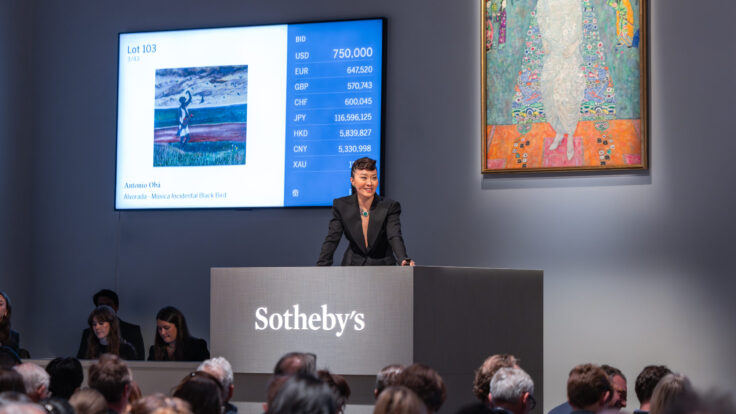
Welcome back to Wall Power, coming to you from London after a busy Frieze week filled
with mostly positive vibes. I’m Marion Maneker.
The overall mood here is defined by a recognition that art remains important to people. Thousands of people traveled to London for Frieze, and a new generation of art-curious potential collectors are poking around the fairs trying to decide whether and where to plunge in. I’ll have a lot more detail below on the auctions and Frieze, itself.
But first… |
|
|

| Julie Brener Davich
|
|
- Pink or
blue?: Sotheby’s has announced the highlight of its upcoming Geneva season: the Glowing Rose, a 10.08-carat cushion-cut Fancy Vivid pink diamond. Only the third gem of its kind to come to auction in the past decade, this one has an estimate in the region of $20 million. Rather than presenting the
pink diamond as a loose stone, Sotheby’s partnered with British jeweler Boodles to offer it in a ring setting.
Pink diamonds represent five of the 10 most expensive diamonds ever sold at auction, including the most expensive—the 59.6-carat gem sold for $71.2 million at Sotheby’s Hong Kong in 2017. The most valuable gemstone sold at auction so far this year was the $21.5 million, 10.03-carat Fancy Vivid Mediterranean Blue, offered at Sotheby’s Geneva in May.
The Glowing Rose
comes to auction straight from the earth: It was cut from a 21-carat rough stone mined in Angola in 2023. It goes head-to-head in Geneva next month with Christie’s 9.5-carat Mellon Blue, a Fancy Vivid blue pear-shaped stone that once belonged to Bunny Mellon, which comes up for auction at the same time. And while the Glowing Rose doesn’t have the Mellon provenance, it comes with the recently added assurance of being ethically sourced. Will the winner hinge on the gender of
China’s richest newborn born in Q4? Perhaps!
|
|
|
A MESSAGE FROM OUR SPONSOR |
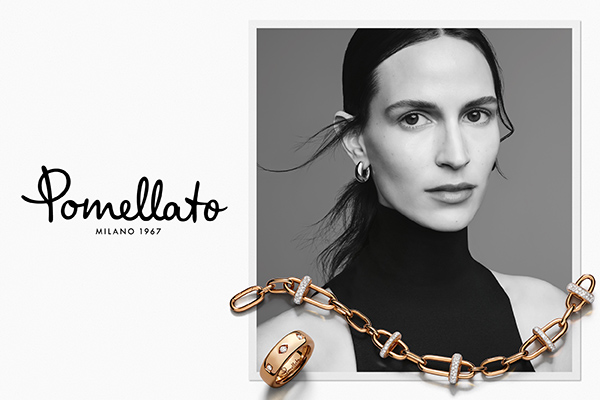
Bold, sculptural, and fluid.
Pomellato’s Iconica collection honors Milanese goldsmithing with handcrafted pieces that are more than just jewelry; they are a symbol of empowerment, authenticity, and timeless beauty. From statement necklaces to stackable rings, each piece reflects expert craftsmanship and modern expression. |
|
|
- Christie’s $15 million Calder: Christie’s announced this morning it will offer an early wooden Calder mobile with an estimate of $15 million at the November sales. The work has the highest estimate for a Calder at auction. Titled Painted Wood, from 1943, it is being sold by Patricia Phelps de Cisneros.
- Paper lions: Christie’s and Sotheby’s both had collections of works on paper that performed
exceptionally well in the London sales, reminding us of the strength in the market below $1 million. A strong provenance from a respected collector—in this case, Klaus Hegewisch, who died in 2014—can help new (and experienced) buyers feel more confident about spending money. That seems to have
happened: The first tranche of the Hegewisch collection made nearly £9 million, with exceptional prices for works by Rembrandt, Picasso, Albrecht Dürer, and Edvard Munch.
At Sotheby’s, the focus was on iPad drawings by David Hockney. These 17 works, none
estimated above £120,000, made a total of £6.2 million, or $8.3 million. That’s an average price per lot of more than £360,000.
|
Now, let’s get to the main event… |
|
|
Frieze week in London delivered a swirl of mixed messages: Collectors
are wary of overspending and dealers are relying on the old dependables, but there’s a new wave of younger art-curious collectors circling the hunt. Meanwhile, Frieze’s newly enhanced V.I.P. team appeared to get results. |
|
|
“Any action yet?” a seasoned dealer asked a colleague as he returned to their booth
at the Frieze Masters tent early Wednesday. His query was upbeat, but laced with dread. And it seemed to capture the mood of the art market this week in London.
Stalwart collectors and industry professionals came to the fair, but so did what feels like the next generation of art buyers, or at least the art curious. This morning, an auction house executive pointed out that “the great and good” people of Europe were showing up to her house’s events this week; the executive said that it’s
cool to go to auction house dinners here in a way it isn’t in New York. And instead of London and Paris being pitted against each other—as it seemed they would be when Art Basel took the week after Frieze for their fair—the sales and fairs were timed so that collectors and social figures could appear in London on Wednesday, stay for the British Museum’s inaugural gala event on Saturday, then cross the Channel to put in another few days in Paris before returning home. Eight days, two cities, and
tons of art.
While everyone is together in the galleries, at the dinners, in the tents, and at the auction houses, they’re all looking at one another, trying to suss out what the next big, broad theme of the art market will be. I don’t think the market’s new mood has fully emerged quite yet, but we’re getting some signs. Let me explain… |
For better or worse, the auctions are as visible a place as any to get a market pulse.
On Wednesday, Christie’s evening sale made £107 million, or $143 million—which, as the house was quick to mention, represented a 30 percent increase over last year’s total for a similar sale. Christie’s also pointed out that their total was the highest for an evening sale in London since 2018. That said, many lots were still sold at prices that required consignors to lower their reserves. |
|
|
A MESSAGE FROM OUR SPONSOR |
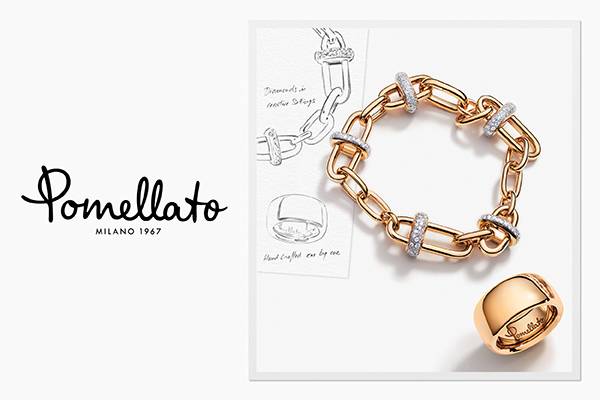
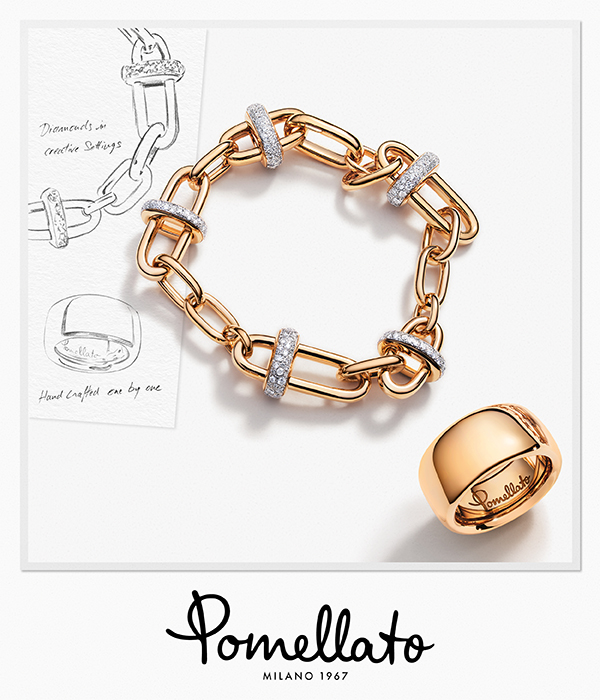
Handcrafted in Milan. Inspired by Pomellato's rich heritage, the Iconica Collection is a masterclass in quiet precision. The Iconica Bracelet features alternating gold and diamond links sculpted to a seamless silhouette. The matching ring shares the same commitment to fluidity and comfort. The result is timeless Milanese elegance with a contemporary edge. |
|
|
The top lots at Christie’s were two classic Peter Doig paintings
from the 1990s: Ski Jacket (1994) and Country Rock (1998-99). Advisor Francis Outred—bidding, it was speculated, for a Montreal collector—won Ski Jacket for $19 million, while a phone bidder got Country Rock for $12 million. (A Hong Kong specialist who vied for both had to settle for a smaller Doig.) Chris Ofili’s Blossom, from 1997, also made a strong price. All four of these works came from the estate of Danish
collector Ole Faarup. A Gerhard Richter photo painting of tulips, from 1995, also sold well at a little more than £6.1 million, or $8.2 million.
Christie’s head of contemporary art in London, Katharine Arnold, told me these sales reflected a strategy built around works from the 1990s. After all, there seems to be a certain commercial nostalgia for that era. Just look at the crowds at the Oasis reunion concerts, the renewed fascination
with J.F.K. Jr. and Carolyn Bessette, the baggy jean revival, etcetera.
Other works that performed well included a restituted Paul Cézanne painting that made £5.5 million, or $7.4 million, and Hurvin Anderson’s Lower Lake from 2005, which sold for more than twice its estimate to make £3.2 million. (Anderson, as it happens, was Doig’s student, and will have his own retrospective at the Tate next
year.) Two Magritte works on paper inspired a number of aggressive bids that far exceeded estimates. Works by Marc Chagall, Maurice Denis, Suzanne Valadon, and Robert Mangold also exceeded estimates—though these artists and works have little in common with one another, which is another reason the market feels confused to me. Advisor James Sevier bid a small Warhol Mao
painting, which had been in the same collection for the last 25 years, to a selling price of nearly $1.3 million.
The works that sold well speak to the quality of the individual paintings, but auction specialists seem to be feeling their way through the dark looking for what might excite buyers. Still, the houses remain reliant on consignors, who make their own decisions. Christie’s had a Yoshitomo Nara painting from 1998, Haze Days, for which I’m told the
consignors turned down a third-party guarantee. There were bidders waiting on the phones to jump in, but everybody held their fire without a committed bid. The work will likely sell privately, but the outcome is a lesson in how cautious the market can be—no buyer wants to spend a penny more than they absolutely have to right now or, worse, buy a work they think no one else wants. |
A really good example of that dynamic comes from a consignment of vastly different
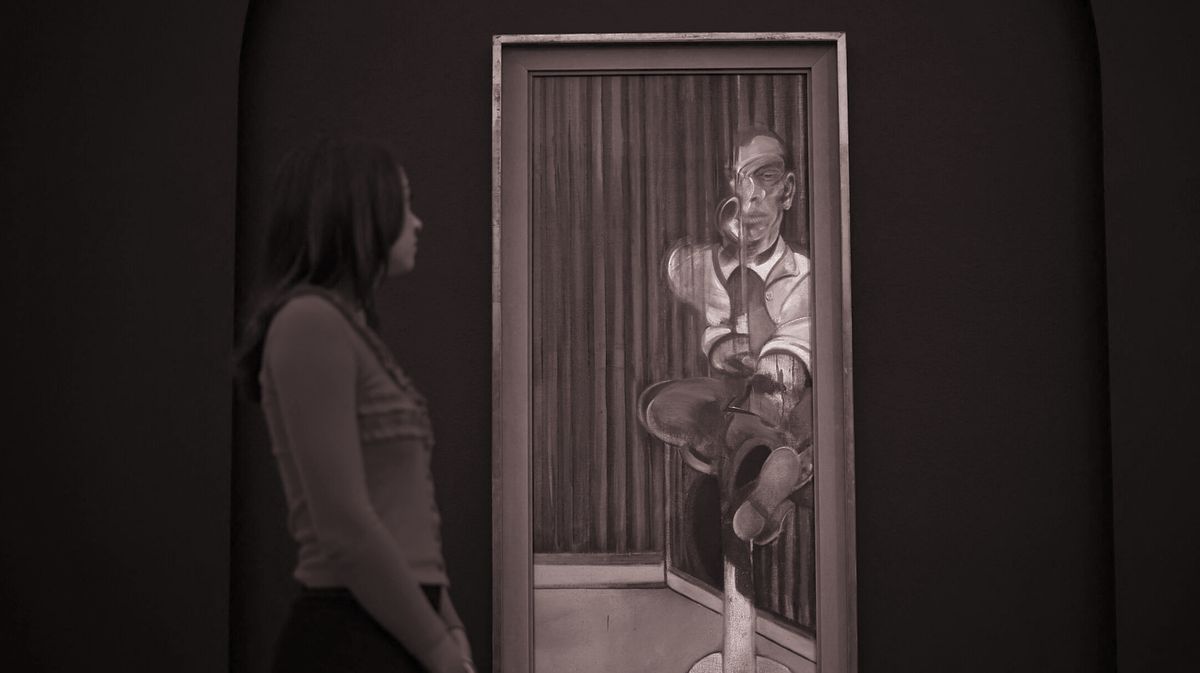
works: two Auguste Rodin sculptures, and two paintings by Francis Bacon, which provided strong tentpoles for Sotheby’s £47.5 million ($63.3 million) sale. Both Rodins sold to the same paddle number for prices at or slightly above the estimates. One Bacon, a final self-portrait, had an irrevocable bid but saw another buyer push the final price close to the low estimate. But Bacon’s Portrait of a Dwarf, from 1975, which had been in the artist’s own
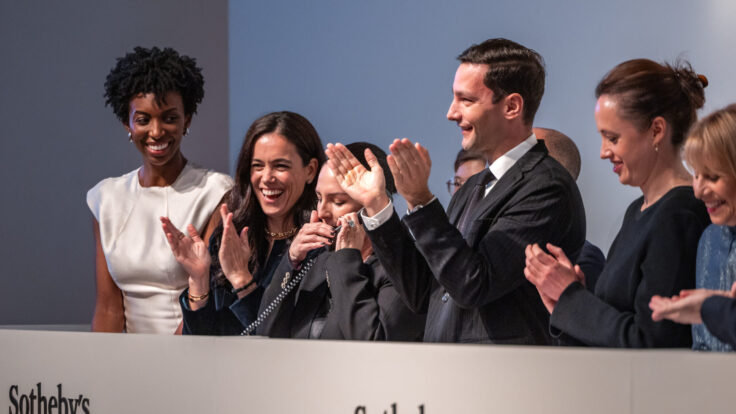
collection and is often included in major exhibitions, provoked a 17-minute bidding war. Tom Eddison, taking his first auction in the box, ably oversaw the frenzy that drove the selling price to £13 million ($17.5 million), or nearly twice the estimate.
In fact, Sotheby’s generally managed their sale well—with strong prices for Lucy Bull, Georg Baselitz, Warhol, Thomas Schütte, and
Jenny Saville—and defensively. A Matthew Wong painting that had an irrevocable bid was sold at a price less than half of the estimate. The seller of Warhol’s Four Pink Marilyns was able to eke out a small profit on what the previous buyer had paid a decade ago. The consignor of the Yves Klein fire painting got a good price of $3.6 million with fees, but that’s a lot less than the $5.4 million paid for the work in 2014. As you can see,
it’s not an easy market to gauge no matter where you stand. |
|
|
Phillips was able to make £10.3 million, or $13.9 million, from 18 works. A large
portion of that total came from Jean-Michel Basquiat’s work on paper Untitled (Pestus), from 1982; a Flora Yukhnovich painting from 2017; and a Sean Scully work from 2010, also bought by Sevier, presumably for a client. Phillips also did well with works by Robert Rauschenberg, Derek Fordjour, Bernar Venet, and Noah
Davis. As another collector remarked to me over WhatsApp, the trade was active this week at the auctions, a sign that prices are attractive and dealers are willing to take on risk. |
We went to Frieze Masters first on Wednesday, on the theory that buyer interest was more
focused on historical works than the riskier primary-market art. From the unmistakably upbeat atmosphere, it was clear that wasn’t a bad bet. Overall, dealers seemed happy with both sales and foot traffic. I ran into one who remarked that Frieze had done a good job reinvigorating its V.I.P. team. He joked about getting disintermediated from his buyers, but overall he was quite happy with how Frieze was delivering potential customers, which is, after all, what a dealer is paying for at an art
fair—even more than the booth space.
A Frieze rep told me that they had restructured and enhanced the V.I.P. team after acquiring the Armory Show fair and Expo Chicago. Now it’s organized regionally, with dedicated heads for Europe, Asia, and the Americas to service Frieze’s seven fairs. And while there had previously been no dedicated U.S. team, there are now half a dozen persons working with U.S. museums and collectors “to build more strategic and localized engagement” and “ensure
participating galleries connect with the best collectors worldwide.”
The efforts seemed to be paying off. When I stopped by the main Frieze tent, I saw throngs of people in the aisles. Over at the booth of our new friends from Edinburgh, Ingleby Gallery, I learned that though the collector Richard Ingleby had lined up to buy the stunning large Caroline Walker painting of a woman line cook, he had decided not to pull the trigger. At least two other
collectors new to the gallery but familiar with his artists had already shown up and agreed to buy the works. That’s what art fairs are for: making sales to new clients and replenishing a gallery’s roster.
Taking together the fairs, the auctions, and the gallery shows around town, London felt much better than the general coverage of the art world would lead one to expect. Given what’s going on in the world economically, politically, and geopolitically, the art market seems to be
holding up fairly well—and now would not be a bad time for a new wave of collectors to enter it, because prices are low and competition isn’t fierce. All it takes is confidence and a strong interest in joining the hunt. |
That’s it for today. Julie will be here on Sunday to discuss PAD and
the London design scene.
M |
|
|
The ultimate fashion industry bible, offering incisive reportage on all aspects of the business and its biggest
players. Anchored by preeminent fashion journalist Lauren Sherman, Line Sheet also features veteran reporter Rachel Strugatz, who delivers unparalleled intel on what’s happening in the beauty industry, and Sarah Shapiro, a longtime retail strategist who writes about e-commerce, brick-and-mortar, D.T.C., and more. |
|
|
Finally, a media podcast about what’s actually happening in the media—not the oversanitized,
legal-and-standards-approved version you read online. Join Dylan Byers, Puck’s veteran media reporter, as he sits down with TV personalities, moguls, pundits, and industry executives for raw, honest, sometimes salacious conversations about the business of media and its biggest egos. New episodes publish every Tuesday and Friday. |
|
|
Need help? Review our FAQ page or contact us for assistance. For brand partnerships, email ads@puck.news. You received this email because you signed up to receive emails from Puck, or as part of your Puck account associated with {{customer.email}}. To stop receiving this newsletter and/or manage all your email preferences, click here. |
Puck is published by Heat Media LLC. 107 Greenwich St, New York, NY 10006
|
|
|
|