 |
 |
|
Welcome back to Wall Power. I’m Marion Maneker.
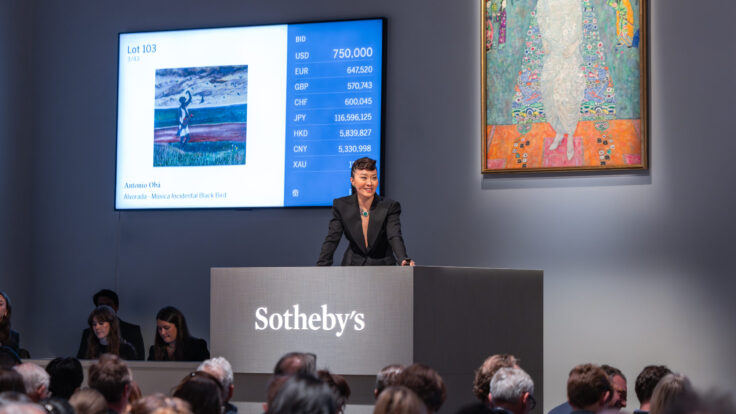
Gigaweek, with an estimated $1.25 billion worth of art on offer at the auction houses, is finally here! An incalculable amount of art is also on display at galleries and art fairs around the city right now. Artists and dealers are taking advantage of the presence of thousands of collectors, museum benefactors, art advisors, buyers, sellers, and scenemakers who have convened to take part in the action.
The atmosphere seems calmer than last year, when everyone was nervously wondering how far the market could fall. (There was plenty of premature bargain hunting when naive observers declared a “buyer’s market” long before sellers had reached a point of capitulation.) This season, despite there being even less art on offer, everyone seems to be in a more sanguine mood: Buyers seem resigned to the present vibe, while consignors are accepting much lower estimates, especially in the day sales, which could bring buyers back to artists who previously got overpriced.
I’ll have more on that below—including details on the Rosa de la Cruz sale. I’ve also been going through the art fairs to get a sense of what’s on offer in the private market, the largely unseen counterweight to the big auctions.
And a quick note for subscribers: We’ve updated our Member Information questionnaire, which takes only a few seconds to fill out. Your responses will help us develop new products tailored to your interests. Just click here to submit your answers, and make sure you’re logged in. Thanks.
But first…
- Christie’s and the terrible, horrible, no good, very bad weekend: On Thursday evening, Christie’s website started showing 404 errors for this week’s big sales, making the catalogs inaccessible to the numerous interested parties. By Friday, the entire website was down. It’s Sunday night, Christie’s has put up a workaround site here, and clients will soon receive an email from Christie’s C.E.O. Guillaume Cerutti telling them that the sales will take place as usual, with live, telephone, and internet bidding through their internet platform, Christie’s LIVE. (New bidders to Christie’s LIVE will have to open their account through a representative who can be reached via the website.) Sale broadcasts on YouTube and Facebook remain unaffected. Two luxury sales in Geneva will be moved from Monday to Tuesday so the platform can be thoroughly tested, Christie’s representatives said.
The galleries at both houses were especially busy this Sunday. While I was at Christie’s, most specialists seemed in very good spirits about the sales but annoyed about the thrashing they’re taking publicly. Several executives pointed out the company had to take down their own internal systems due to cybercrime response protocols. Following the advice of their consultants, Christie’s is remaining silent about the nature and extent of the attack.
- It’s all about the averages: In response to my recent newsletter about lower aggregate volume this auction season, Christie’s C.E.O. Cerutti took to LinkedIn to point out that the average estimate per lot at Christie’s has only declined by $27,000. “USD 852k this May at Christie’s vs. 879k last year. So a smaller season, but still with quality!,” he wrote. That’s only a 3 percent drop in average presale estimate value, whereas the rest of the market has gone from an average estimated value of about $747k in 2023 to $672k in 2024. That’s a 10 percent drop.
- Swann’s Freeman rises: Swann Galleries’ Nigel Freeman will take on more responsibilities as their new head of fine art. The new position will also have him acting as the director of Swann’s Contemporary art sales while continuing to run the house’s African American art sales. Congrats, Nigel…
|
|
|
| A Few Thoughts on the Cruz Sale… |
|
| One shibboleth of the art world is that an artist’s market can only go up and must never go down. Naturally, this creates a fundamental tension between the auction houses and primary dealers, who stand behind their artists and try to place their work with collectors and institutions that will not resell them. If the collector does need to resell, the dealer would prefer the work go through them, and for it to end up in the hands of another collector or institution. Above all, the dealer doesn’t want a public price that shows the artist’s market in retreat.
Rosa de la Cruz was unquestionably one of those reliable collectors. When dealers sold to her, few expected the art ever to be sold again. That’s why many were surprised when the de la Cruz family, after maintaining what looked like a private museum for so many years, began quickly divesting themselves of Rosa’s art after her death in February.
Born in Cuba, Rosa and her husband, Carlos, were already collectors of Latin American art when they arrived in Miami in the 1970s. But she soon became a stalwart of the Contemporary art scene, opening her home and art collection to visitors and helping transform the city into an important art center. After Art Basel Miami Beach launched, in 2002, visits to her house became a veritable tentpole event for the art fair’s V.I.P. program, attracting gaggles of museum trustees to admire, scratch their heads, and take notes. “A lot of collectors have a lot of affection for these works,” said Julian Ehrlich, Christie’s specialist handling the 26-lot evening sale, and the hundreds of other lots where the de la Cruz property will be dispersed throughout the year. “They saw them when they visited de la Cruz’s house.”
The evening sale features multiple works by artists with whom Rosa was closely associated, including Félix González-Torres, Christopher Wool, Wade Guyton, Rudolf Stingel, Peter Doig, Tauba Auerbach, and fellow Cuban Ana Mendieta. “She was foundational in gathering collectors around these artists,” Ehrlich continued.
Alas, the market for almost all of these artists peaked nearly a decade ago. And the works trade infrequently, providing little guidance toward pricing and expectations. No one doubts the quality of these works. But markets are not only, or even predominantly, about quality. It bears repeating that the art market is a distribution market. That brings us back to why an artist’s dealer would prefer not to see the works return to a public sale and possibly make a price significantly lower than what is visible in the public record.
For example, the top price for a Christopher Wool painting at auction was just shy of $30 million. Rosa’s silkscreen painting isn’t one of his highly valued “word” paintings, and comparable silkscreen works have sold at auction for $1.3 million 11 years ago, and $1.2 million five years ago. Christie’s has an estimate of $600,000 on the work in Tuesday night’s sale. It also has a third-party guarantee backstopping that price.
Rudolf Stingel’s top price at auction was just over $10 million. But a comparable work to Rosa’s silver “carpet” painting peaked at $4 million in 2016. Prices for those works have slid over the past seven years, and the last carpet painting to sell at auction made $800,000 in October 2023. Christie’s has estimated the Stingel carpet in Christie’s Tuesday night sale at $600,000, too.
Wade Guyton’s untitled work from 2005, one of his famous flaming U paintings, is priced at $800,000—a far cry from the $3.5 million price for another example in this size sold in 2014. Tauba Auerbach’s once-famous “fold” paintings—her top 17 auction prices are for works in the fold series—reached prices that peaked at $2.2 million in 2014. Rosa’s fold is estimated at $200,000.
The gap for Rosa’s Christina Quarles painting, which has an estimate of $500,000, is almost as big as the Auerbach. When Howard Rachofsky sold his Christina Quarles at Sotheby’s two years ago, it made an astonishing $4.5 million. The next season, there was a follow-up sale of a work from the same year, with a similar composition and a similar size. It sold for $1.5 million.
Before you get the idea that this is a fire sale, it’s worth pointing out that the star lot of the evening, Félix González-Torres’s light string, untitled (America #3), from 1992, is estimated at $8 million. That’s an impressive number when the top auction price for one of these works is nearly $5.2 million. But it’s cheaper than trying to buy one from the foundation through David Zwirner at $10 million, which is said to be the asking price there.
Yes, auction estimates are not appraisals. They are marketing statements. The hope is that more than one person will show up thinking they’ll get a great bargain, and then once bidding begins and the behavioral psychology of auctions sets in, the price will rise and rise. Rosa de la Cruz bought art out of love, not as an investment. Her family is finding good homes for these works. Of course, Rosa bought early and she got good prices. So there’s little chance the family is losing out here at any price.
And now to the main event… |
 |
| Tenth-Avenue Frieze Out |
| News and notes on all the shows around New York, what everyone is saying, and not saying, too. |
|
|
|
| One of the axioms of the art market is that buyers tend to fluctuate, over multiyear cycles, from an obsessive focus on mostly young up-and-comers toward a fascination with historical artists from different eras. That’s certainly the case this year, where there’s a lot more historical art on view in the city. But we’re also witnessing another, more portentous shift this season toward more private dealing. There’s a simple reason for this, of course: When the art market is contracting, negotiating prices down is best done in private; bidding them up is more easily done in public.
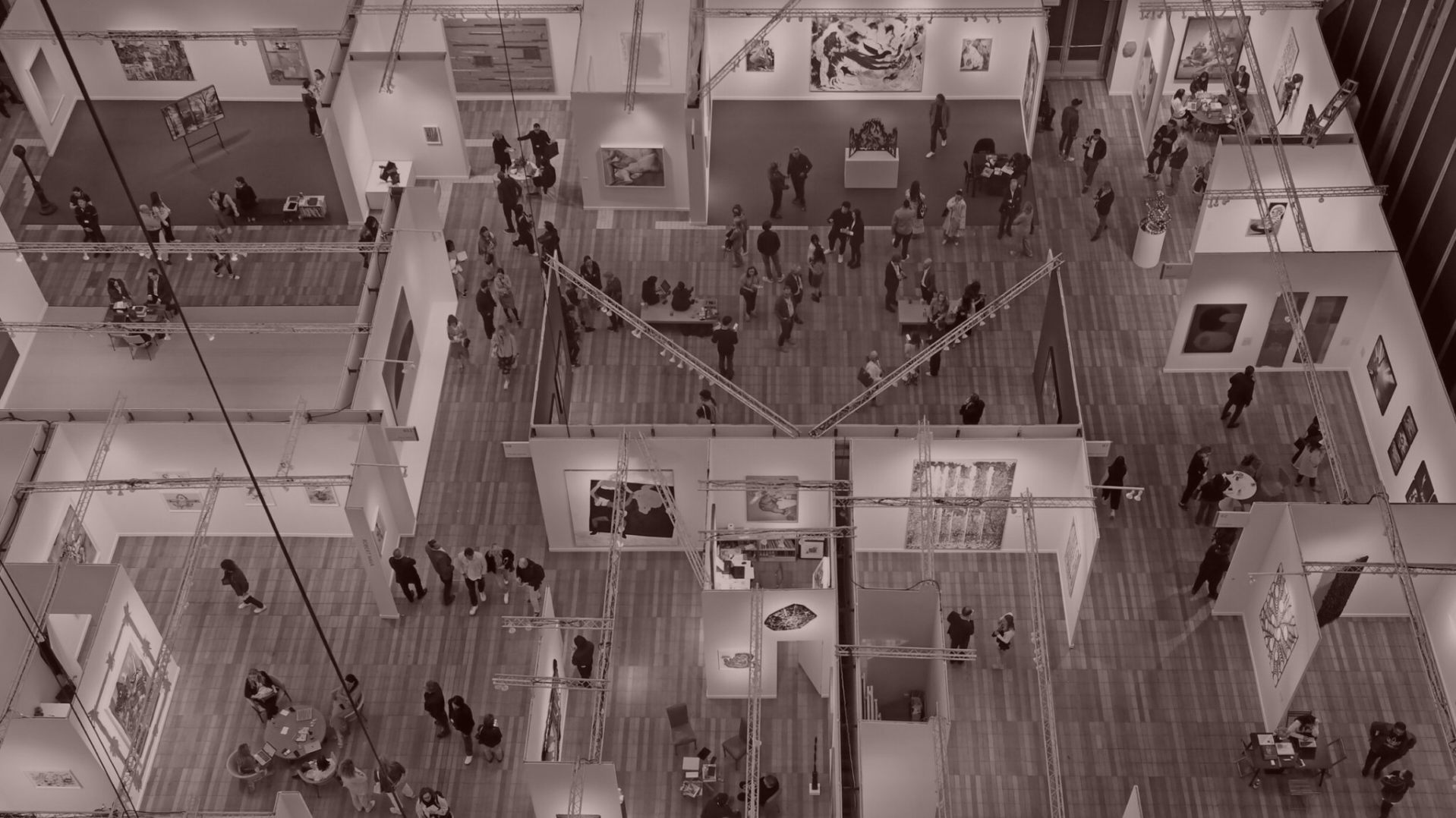
With that in mind, I went to four of the art fairs that recently rolled through New York, as well as a number of gallery shows that opened in time to take advantage of the tide of trade viewers and collectors who are in town for this two-week swirl of lunches, after parties, and frenetic negotiation. And, of course, I took notes.
My week began with Frieze New York, which has been held in The Shed in Hudson Yards for the last several years. It’s always hard to tell whether the somber mood at Frieze is a function of the fair or the venue. But something about The Shed is a serious buzzkill. This year’s fair was well attended, but the opening day seemed more of an opportunity for advisors and clients to check in with gallery staff than as a venue for the booth presentations or actual sales. The gallery sales reports had the not-unusual feel of pre-chewed business done ahead of time but consummated at The Shed.
Don’t get me wrong, there were some interesting artworks around the fair. If you follow the Instagram account of an art advisor with a very good eye, it’s easy to kick yourself afterward for having either overlooked or underappreciated some of them. And on the upper floors there were good discoveries like the Indigenous Brazilian artist Carmézia Emiliano, showing at Sao Paulo’s Central Galeria, who makes beautifully detailed and colorful depictions of her youth in the Brazilian rainforest among the Macuxi people. Emiliano explains why she features only women in her images: “Women, they do everything. I am portraying only women, who are powerful women.”
I may be the only one who misses Frieze’s tent on Randalls Island. After attending Frieze and Frieze Masters in London and Frieze Los Angeles, which was quite good this year and a real improvement from the reports about last year’s debut at the Santa Monica Airport, Frieze in The Shed seems like a weak link in the chain. Frieze now owns the Armory Show, which has a prime spot in September in the capacious Javits Center. I understand that Frieze is running its new Seoul fair at the same time, but it would appear to the outsider that Frieze would be better served by moving its flagship fair to a better venue and possibly a better time.
Like last week’s NADA fair, The Independent was well attended with enthusiastic discovery hunters. The Independent fair has returned to Spring Studios, a co-working space in Tribeca that is less than ideal for an art fair. Yet only a few of the people I spoke to seemed to feel the same ennui at Independent that was in the air at The Shed. Sure, expectations matter—Independent is about discovery. But it’s also just the space. It’s less oppressive. Parts of the fair can feel like improvisation, with galleries putting on displays in passageways, like the collaboration between London gallery The Approach and Los Angeles’s Chris Sharp to show 70-year-old Bronx native Glenn Goldberg’s unique and highly detailed works.
Some other art and artists that stood out were Martin Bodilsen Kaldahl’s sculptures at Hostler Burrows, Tsai Yun-Ju at Tara Downs, Ryan Mrozowski at Iceland’s i8, Delia Brown at Galerie Hervé Bize, and Colombian artist Oscar Santillán at London’s Copperfield. |
|
|
| More Perusing, More Dish… |
|
| By the time I got to Tefaf New York on Thursday, the fair situation seemed like the season as a whole: nice but unexciting. And, you know, there’s nothing wrong with that. Too much of the art market coverage treats a normal resting cycle as a cause for panic. Tefaf turned that proposition on its head. The Modern and Contemporary New York offshoot of Maastricht’s 10-day extravaganza was filled with solid examples of historical work ranging from great tiny Alexander Calder stabiles at DiDonna Galleries to a number of photorealist gems by Ralph Goings and Richard Estes at Waddington Custot and by Robert Bechtle at Anthony Meier. Meier also had nice examples of Gerhard Richter and Etel Adnan on the front of his booth.
Tefaf was also a great venue for treasure hunting. Richard Green had a booth full of tabletop works by Barbara Hepworth, Henry Moore, and Ben Nicholson that all seemed timelessly appealing. David Kordansky had several Cindy Sherman film still photographs and a giant “men in the cities”-era Robert Longo drawing that brought back the Pictures Generation. Templon, from Paris, had a Philip Pearlstein figure study complementing Bortolami’s recent show of the artist in Tribeca. Following the lead of the auctions, which each have a major Frank Stella work, Paul Coulon’s stand at Tefaf also offered a concentric squares diptych.
On Friday, I ran the gantlet up Madison Avenue to see Lévy Grovy Dayan’s great Yves Klein show of paintings made with his “living brushes,” women slathered in his bespoke blue pigment pressed or dragged across canvases. They’re still startling even after more than 60 years. It would be enough if Di Donna Galleries had put on a show of the exceptional Calder mobiles it gathered. But the exhibit becomes an Enchanted Reverie when juxtaposed against the works of Paul Klee, an artist more for connoisseurs than for showoffs. Nahmad Contemporary has the first show pairing Alberto Giacometti and Jean Dubuffet in New York since 1968.
Around the corner, Acquavella had a show of Wayne Thiebaud paintings, mostly works held by the foundation with a few from private collections. Further up Madison, Sprüth Magers showed a range of historical works by Alighiero Boetti. Boetti and Thiebaud both have solid presences in this week’s auctions. I ended the day at Beaumont Nathan, the transatlantic advisory firm, which had borrowed 10 Wassily Kandinsky paintings from their clients to illustrate the value of historical taste. While there, Hugo Nathan marveled at the prices and opportunities available to collectors in the early 20th century art scene, and even the buyer’s market for post-Impressionists. If you’re a value collector, or even if you just want to enjoy the process without feeling that you must pay top price to get anything you might want, there’s a whole hidden world of buyers looking to the past. |
|
|
|
| FOUR STORIES WE’RE TALKING ABOUT |
|
|
|
|
|
 |
|
|
|
Need help? Review our FAQs
page or contact
us for assistance. For brand partnerships, email ads@puck.news.
|
|
You received this email because you signed up to receive emails from Puck, or as part of your Puck account associated with . To stop receiving this newsletter and/or manage all your email preferences, click here.
|
|
Puck is published by Heat Media LLC. 227 W 17th St New York, NY 10011.
|
|
|
|