{{ 'now' | timezone: 'America/New_York' | date: '%b %d, %Y' }} |
|
|
|
Hi, and welcome to Line Sheet, coming at you live from the Chanel superstore on Rodeo…
Just
kidding! I’m still in Paris. But thank you to the friends who sent me photos of the endless queue, and to salespeople at various Chanel boutiques and shop-in-shops who told me the weekend set records. We’ll know for sure in 2027, when this year’s financials are revealed. Until then, hopefully the industry will be able to celebrate itself again amid a new war and skyrocketing oil prices.
In today’s issue, I’ve got a crucial update on the fate of Everlane, a D.T.C.-era darling once
heralded as the next Gap. Everlane never fetched the kind of valuation Quince received last week ($10 billion? Okay…), but it was still a big bet for L Catterton, which sunk $85 million into the business back in 2020. Turns out, the cash came at the wrong time, and now the private equity firm is looking for a speedy solution. I’ve got all the details on what went wrong.
Up top, you’ll find my summation of the Oscars red carpet: who won, who lost, and who is in prime position for next
awards season. Plus, news of a meaningful exit at Lanvin, some new Saks Global money, and a crucial biz update from Kering.
If you can’t get enough carpet commentary, be sure to check out tomorrow’s super episode of Fashion People. We went full Joan Rivers with a panel of elite guests: stylist Jamie “Sweet Baby” Mizrahi, Who What Wear’s Hillary Kerr, and The Ringer’s Amanda Dobbins. If you want
to know how I really feel about the combination of pink and red, listen here and here.
Also mentioned in this issue: Siddhartha Shukla, Jonathan Anderson, Matthieu Blazy, Anna
Wintour, Alfred Chang, Mia Goth, Charles Finch, whatever it is that Charles Finch does, John Galliano, Michael Preysman, Peter Copping, The Frankie Shop, Luca de Meo, Geoffroy van Raemdonck, Rose Byrne, Teyana Taylor, Jessie Buckley, Sarah Burton, Elle Fanning,
Timothée Chalamet, ex-Calvin employees, Michael Rider, Michael B. Jordan, Ryan Coogler, Nicolas Ghesquière, Costco, and more… |
Three Things You Should Know…
|
- What
to do with a brand like Lanvin?: On Friday, Siddhartha Shukla announced his exit from the Lanvin Group, where he was deputy C.E.O. of the Lanvin brand and also advised on strategic initiatives. It’s not entirely surprising: Lanvin Group, which was established by Chinese conglomerate Fosun, and includes St. John Knits, Sergio Rossi, and Wolford, has struggled to compete since it went public in December 2022. (Shares are down about 80 percent.) That said, it did feel
like Lanvin was regaining some traction with designer Peter Copping, whose most recent collection received great reviews.
Despite minimal investment from the parentco, Shukla was able to rebalance Lanvin’s business away from men’s sneakers, back toward women’s ready-to-wear and suiting. (Right now, if Chanel is any indication, people are into buying fancy shoes and expensive, special clothes.) Anyway, the brand will now be overseen by Andy Lew, an
American executive who was promoted to lead the group in 2025 after four years running St. John. No word yet on where Shukla is headed. - Kering’s not-so-tiny tweaks: The French conglomerate has finally decided to stop breaking out the performance of individual brands, other than Gucci, and will instead lump them together in a fashion and leather goods category. This is less fun, but makes sense on a macro level: no reason for the market to worry
about a brand having one slumpy quarter; if the problems are bigger than that, we’ll figure it out with time. Meanwhile, C.E.O. Luca de Meo has just named Jean-Marc Duplaix, who was in the running for the top group job, as the C.E.O. of Kering’s newly formed jewelry division, indicating that the company is serious about further developing the high-margin, resilient category.
|
|
|
|
A MESSAGE FROM OUR SPONSOR |
For over 90 years, we have defined Italian elegance. As a family-owned brand across three generations, we celebrate
heritage, craftsmanship, and timeless style. Made in Italy is more than a label— it’s our promise of quality, responsibility, and enduring design. Blending tradition with modern sensibility, we shape men’s style worldwide with understated luxury that transcends trends, generations, and borders. Discover our collection at Canali.com |
|
|
|
- Saks
Global’s five-year plan: Geoffroy van Raemdonck, the indebted company’s still-newish C.E.O., has made good on his word to close stores and act like a rational person—and has now gotten access to another $300 million of Saks Global’s $1.75 billion bankruptcy funding package to enact his turnaround. In the coming weeks, Saks Global is expected to file its full restructuring plan, which will indicate whether parts of the business, or the whole thing, will be sold to
someone else. Since January, the company has counted $1.4 billion in retail receipts from 600 brands willing to give the firm another chance—a true vote of confidence for creditors. We’ll see how it all unfolds, but van Raemdonck’s background as a management consultant is really serving him at the moment. It should also be noted: while he was hanging around the shows during Fashion Month, he wasn’t front and center, because he’s not tacky. I’m sure the brands appreciate that, too. (Disclosure:
Last year, Saks sued Puck over our coverage of its financial condition.)
|
Oscars Red Carpet
Winners, Losers & Honorable Mentions
|
This year’s Academy Awards red carpet was pretty good, if almost wholly devoid of personal style thanks to
the extreme corporatization of fashion, the decline of film paychecks, and the subsequent desperation of actors to sponsor every inch of their wardrobes. More good news: Everybody’s bodies are really tight right now (thanks to GLP-1s and reformer pilates), and there was a focus on fit after a year of messy, wrinkled dresses. Here’s what stood out: |
- Dior
vs. Chanel: The big story of the season was the unspoken (well, sometimes spoken) battle between the two megabrands, which both had great showings on Sunday, featuring some of the best gowns designed by Jonathan Anderson and Matthieu Blazy. But I’d say that the pre-parties—Dior’s dinner and karaoke set on Thursday night, co-hosted by Sara Moonves and W mag, and Chanel’s annual dinner at the Polo Lounge with
producer/publisher/we still don’t quite know what Charles Finch—upped the ante. (Notably, Anderson, who is part of the Costume Designers Guild of America and could very well be nominated for an Oscar one day, was fully present at Dior’s party; Blazy was not photographed at Finch Fest.)
|
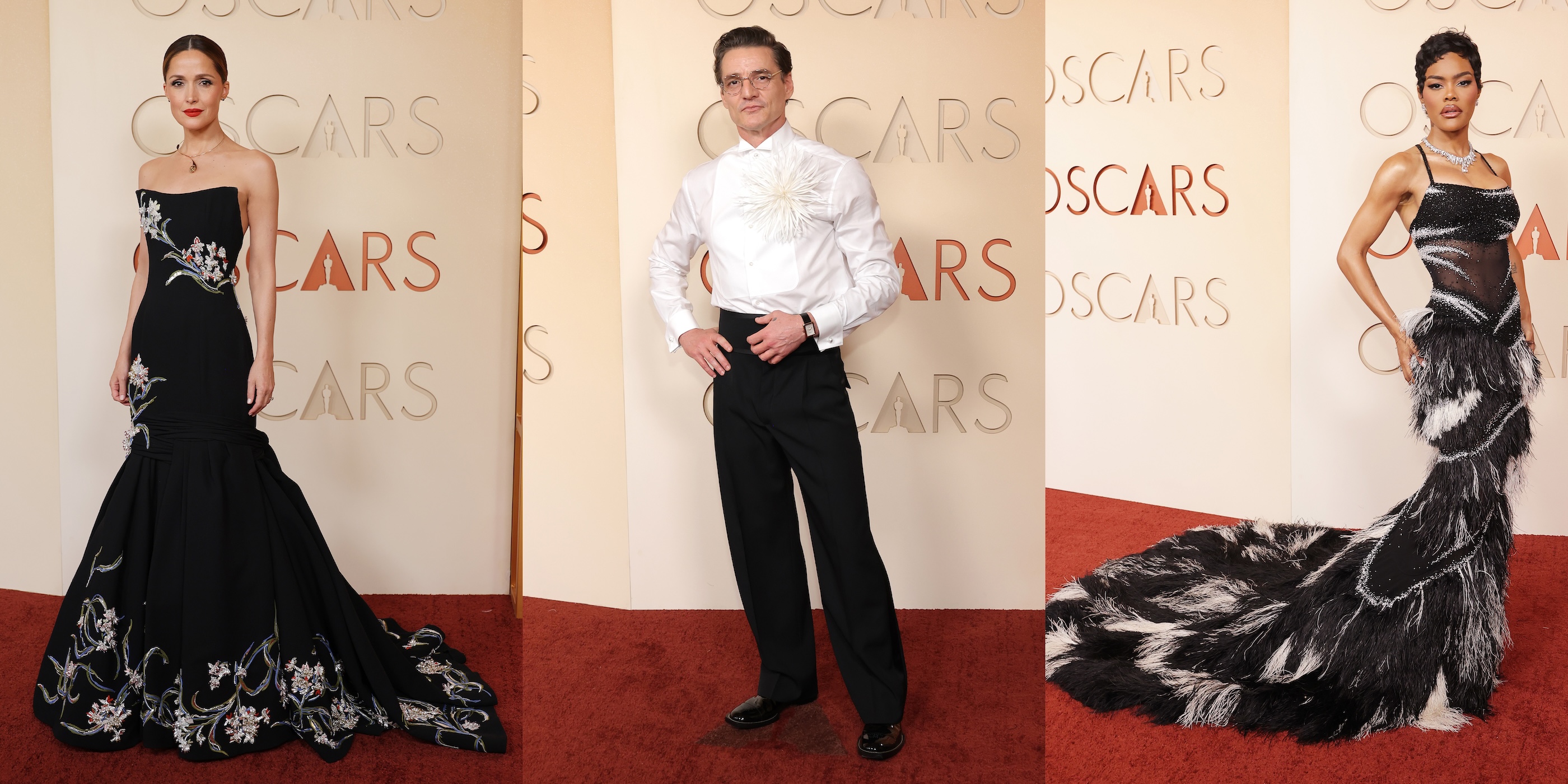
From left: Rose Byrne, Pedro Pascal, and Teyana Taylor. Photos: Mike
Coppola/Getty Images |
- Who won?
Easy to say Chanel, given the consumer frenzy around Blazy’s first collection, which debuted just before Oscars weekend. As one industry observer put it to me, the brand is “swallowing” everyone else right now. Still, I’d argue that Rose Byrne in Dior was the best dressed of the evening, and that the other big gets—Mikey Madison and Mia Goth, especially at the Vanity Fair afterparty—were some of Anderson’s best red carpet looks so far.
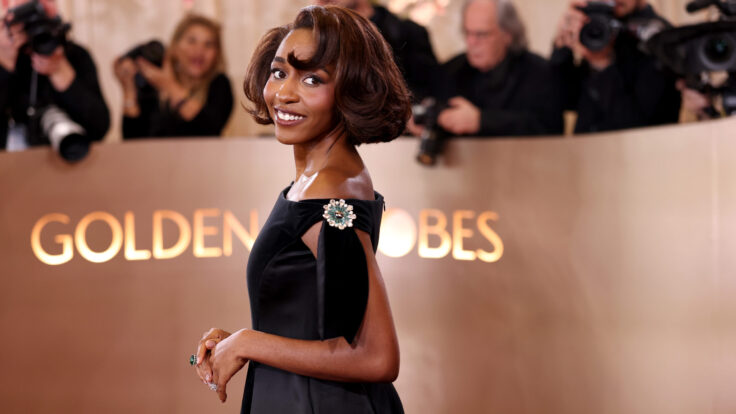
On the Blazy side, I wasn’t crazy about best actress winner Jessie Buckley’s red and pink gown—despite my love of that color combination—but thought Teyana Taylor (who undoubtedly won this year’s red carpet wars), Gracie Abrams, and Pedro Pascal all looked really sexy in Chanel. That’s not a descriptor typically associated with that brand. Anyway, I am not sure the red carpet does much to spur sales, but it does influence
sentiment. So while Chanel won the weekend, it was pretty good for Dior, too.
|
- Givenchy’s
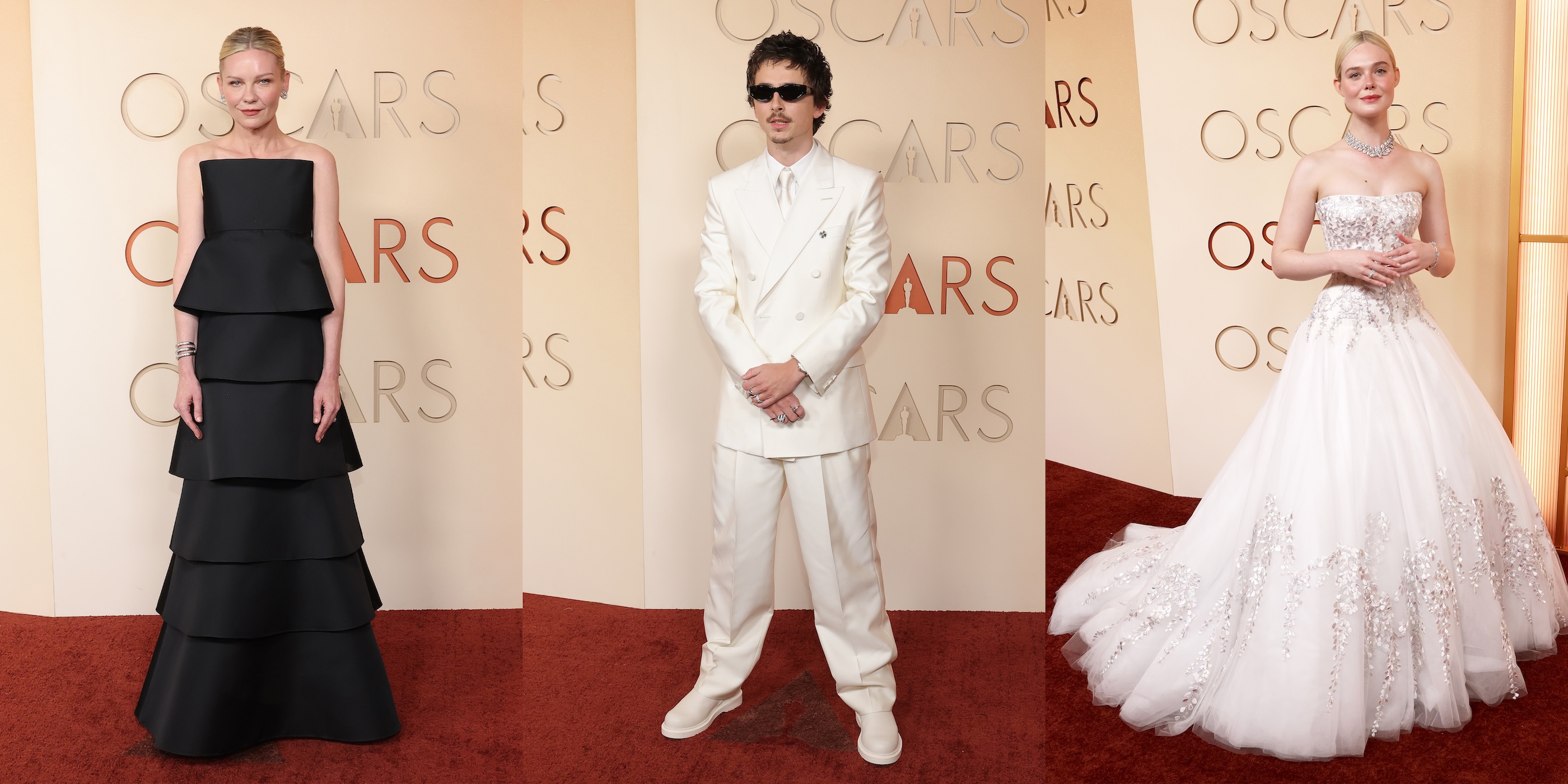
red carpet surprise: The best thing about Givenchy right now is what Sarah Burton has done with Elle Fanning and Timothée Chalamet in Hollywood. I just wish the runway was somehow more closely linked to the red carpet, which feels more on-brand to me. What does the Givenchy brand stand for (other than Audrey Hepburn’s little black dress)? We know the answer to that question for Chanel, Dior, Louis Vuitton, and
Hermès—and even Celine (bourgeois dressing) and Loewe (Spanish leather). The brands that are struggling the most right now need an answer, too.
|
From left: Kirsten Dunst, Timothée Chalamet, and Elle Fanning. Photos: Mike
Coppola/Getty Images; Frazer Harrison/WireImage |
- Celine
and Loewe are finding their footing: As I’ve written before, it’s been a challenge for smaller houses to find celebrity brand ambassadors who aren’t already claimed by Louis Vuitton, Chanel, and Dior. And yet, Celine and Loewe stood out last night, mostly because they focused on a few key moments and made sure the looks were right: Kirsten Dunst and Paul Mescal in Celine; and Inga Ibsdotter Lilleaas in Loewe. Dunst, like Teyana
Taylor, has a lot of personal style, and was exactly right for Michael Rider’s Celine.
|
|
|
|
A MESSAGE FROM OUR SPONSOR |
For over 90 years, we have defined Italian elegance. As a family-owned brand across three generations, we celebrate
heritage, craftsmanship, and timeless style. Made in Italy is more than a label— it’s our promise of quality, responsibility, and enduring design. Blending tradition with modern sensibility, we shape men’s style worldwide with understated luxury that transcends trends, generations, and borders. Discover our collection at Canali.com |
|
|
|
- The
John Galliano resuscitation, cont’d: There is a lot of chatter about the Met’s 2027 exhibit potentially being dedicated to John Galliano. (Costume Institute doyenne Anna Wintour has wanted to build an exhibit around him for years; it was just a matter of when, not if.) Perhaps it’s fitting, then, that so much of his work is popping up on the red carpet (and at vintage stores and Instagram accounts I frequent). At the Academy Awards alone, Marty
Supreme costume designer Miyako Bellizzi (who is on Fashion People this Friday!) wore a vintage Dior dress designed by Galliano, while Ariana Greenblatt wore an off-the-shoulder (obviously vintage) gown from his namesake brand, which is owned by LVMH but currently dormant. Will 2027 be the year of Galliano?
- Louis Vuitton was… not it: The men’s looks—Michael B. Jordan and Ryan
Coogler—were good, but the women’s, after a few seasons of improvement, were not strong. They are too generic. They need to feel connected to Nicolas Ghesquière’s ready-to-wear. I know that’s not easy (especially given the state of that most recent collection), but it’s about balance, and finding the right person to lead that studio who can make it feel of the same world without looking alien. Prada does a good job of this. Gucci is figuring it out. (Loved Kate
Hudson at the Vanity Fair party.) Anyway, it needs to be fixed. We want these women to look good so we can say nice things about them.
|
And now, on to the main event… |
|
|
|
For a moment, Everlane was valedictorian among its class of pandemic-era D.T.C. basics
brands. But its story lost momentum, and Millennial customers largely moved on—as has the cheap money. Now, insiders say, Everlane is looking for a new financial backer as it tries to right the ship. |
|
|
|
About a year and a half ago, a guy named Alfred Chang became the C.E.O. of Everlane, the San
Francisco startup once thought of as a second (or third? or fourth?) coming of Gap. Chang, a longtime PacSun executive credited with making Fear of God a suburban middle-school staple by distributing Jerry Lorenzo’s Essentials line in hundreds of malls across America, arrived at Everlane at a crucial moment: Four years after receiving an $85 million investment from LVMH-linked private equity firm L Catterton, the company was in all but freefall following the exit of its founder,
Michael Preysman, who had been replaced in 2021 by Deckers exec Andrea O’Donnell.
The reason for the slump was complicated. Everlane made headlines at launch in the early 2010s for its transparent pricing and sourcing strategy, positioning itself as the preferred basics purveyor of elder Millennial normcore types who preferred to wear light-wash, high-waisted jeans and stripey t-shirts with their New Balance. But what was a pretty good product to start
never really hit its stride, and the company struggled to figure out exactly what Everlane should stand for in a post-sweatpants, post-pandemic world. (I remember hearing lots of talk about trying to compete with bossy, cheapo suitmaker The Frankie Shop.)
Chang, who had transferred from PacSun to Fear of God for a year and a half prior to joining Everlane, hired an outside agency to create a splashy new positioning. They called it “Clean Luxury”: The campaign was pretty, but the messaging
was off and confusing. A box-cut t-shirt from Everlane, possibly its greatest cultural export, costs $38—hardly “luxury” pricing in any sense of the word. Plus, consumers were sick of mostly phony sustainability rhetoric: Anything to do with “clean” products was suddenly cringe. That was followed by an even more senseless campaign with jazz-pop star Laufey—an attempt to relate to a customer that had moved on.
It wasn’t anyone’s fault, really. Preysman, who had worked in
private equity prior to launching Everlane, was careful not to raise too much money for the first decade or so in business. L Catterton arrived at a crucial time for retail expansion, and given the firm’s track record, it seemed plausible that what had been a near-$200 million business could more than double in a few years, leading to a strategic exit. But the product problems, combined with other strategic mistakes with hiring and positioning, cost Everlane its moment. |
|
|
|
Among its challenges was an at-times strained relationship with L Catterton, a large firm with dozens of
different teams. Matt Leeds, the investor who brought Everlane to L Catterton, left shortly after the investment, and the team that replaced him never gelled with those at the company, I’m told. A representative for Everlane disputed that characterization, calling L Catterton a “supportive and engaged partner” that has brought “deep experience in consumer and retail.” A rep for L Catterton did not respond to a request for comment.
Now, Chang is in a position where he
needs to find a fast exit in order to keep the business moving. According to multiple sources with firsthand knowledge of the business, Everlane is now looking for a new investor to inject more cash. L Catterton is also willing to put more into the business with a new partner, I’m told—assuming the new money can clear away its debts. |
Everlane currently generates about $170 million in annual sales, I’m told, and is essentially breaking
even—good but not great for a decade-plus-old company that has raised about $130 million in equity financing, plus a $25 million loan from Gordon Bros. and a $65 million asset-based revolving credit line. According to tracking firm Consumer Edge, which uses data from 40 million U.S. credit cards, year-over-year sales have been down nearly every month for the past two years. Yet another big challenge is the cost of tariffs, which have been a drag on the bottom line.
The story, in some
ways, is as boring as Everlane’s clothes, and reflects the realities of Glossier and many other D.T.C.-era launches. Back then, the money was cheap and the message was clear, but the product, in many cases, did not hold up over time. Reformation, conversely, is better positioned for an exit by current owner Permira, because the executive team has managed to keep improving the product. The thing about Everlane, though, is that there had been a moment in time when it all made sense, and there had
been a feeling that it could, someday, replace Gap as the go-to for bougie basics.
That’s never happening. But I could see a scenario where a new cap table brings back Preysman, as well as former chief creative officer Alexandra Spunt, who was caught up in the great reckoning of 2020 (unfairly, by many accounts). They had the right sense of the brand, and could potentially reposition it to focus on value and quality rather than price, which is an
impossible game. But a rebuild would take five years, at least. But then again, Everlane could quickly find itself in an Outdoor Voices–style situation, taken over by a licensing firm that demands the team start producing exclusives for Costco.
Whatever happens, it’s impossible not to compare Everlane’s predicament to the success of Quince, which was just valued at a semi-absurd $10 billion. In some ways, that other San Francisco–based upstart has turned out to be the ultimate Everlane
killer, taking the “luxury for less” ethos to extremes. But it’s also a cautionary tale for investors who think Quince is invincible. When you’re dealing with a commodity, which low-cost fashion inevitably becomes, no one is safe from the consumer getting bored. |
Loved this profile of Check the Tag, the best identifier of red carpet dress designers this side of Page
Six’s Elana Fishman! [Vanity Fair]
Red carpet jewelry was pay-to-play long before the fashion. Stellene Volandes explains why it’s important that Rose Byrne’s necklace was Taffin by James de Givenchy.
[Town & Country]
These ex-Calvin Klein employees are really enjoying their time in the social media spotlight!
[N.Y. Times] |
And finally… Did you notice that, on every image from the Vanity Fair Oscar party posted to
Getty, the caption reads, “[Celebrity name] attends the 2026 Vanity Fair Oscar Party Hosted By Mark Guiducci”? A wonderful flex, Mark. (Sorry, everyone, he’s doing a good job…)
Until tomorrow,
Lauren
P.S.: We use affiliate links because we are a business. We may make a couple bucks off them. |
|
|
|
The industry’s go-to source for unflinching reporting on the trillion-dollar business of artificial intelligence - perhaps the
single most important technology of our time. Ian Krietzberg, the powerhouse journalist behind The Deep View, delivers twice-weekly insights into the latest dealmaking and breakthroughs in A.I., and how the intersecting worlds of finance, entertainment, media, and politics are being transformed in its wake. |
|
|
|
Puck founding partner Matt Belloni takes you inside the business of Hollywood, using exclusive reporting and insight to explain
the backstories on everything from Marvel movies to the streaming wars. |
|
|
|
Need help? Review our
FAQ page or contact us for assistance. For brand partnerships, email ads@puck.news.
You received this email because you signed up to receive emails from Puck, or as part of your Puck account associated with {{customer.email}}. To stop receiving this newsletter and/or manage all your email preferences, click here. |
Puck is published by Heat Media LLC. 107 Greenwich St., New York, NY 10006 |
|
|
|
|