Welcome back to Wall Power. I’m Marion Maneker.
Tonight, I want to share
some interesting art world reporting from my colleagues at Air Mail. First, there’s Peter Saenger’s profile of Midwestern architectural master and Frank Lloyd Wright protégé Bruce Goff; then Spike Carter’s
look at Buddhist ceramicist JB Blunk; and, finally, a quick assessment by Tobias Grey of a Caravaggio on view at London’s Wallace Collection. All that below the
fold. (And you can see all of Air Mail’s offerings here.)
Also, it probably goes without saying at this point. But if you’re not a subscriber, and you’re reading this newsletter, you need to get right with the lord. And remember, if you have a tip, just want to vent, or take exception with something I’ve written, always feel free to email me at Marion@puck.news or contact me at +1.917.825.1391 on SMS, WhatsApp, or Signal.
Also mentioned in this issue: Roger and Josette Vanthournout, Max Ernst, Pablo
Picasso, René Magritte, Robert Mnuchin, Agnes Gund, Alison Fisher, Mies van der Rohe, Laura Andreson, Shoji Hamada, Nancy Waite, Mariah Nielson, Christine Nielson, Francesco Maria del Monte, Cecco Boneri, Helen Langdon, and many more…
Let’s get
started…
|
-
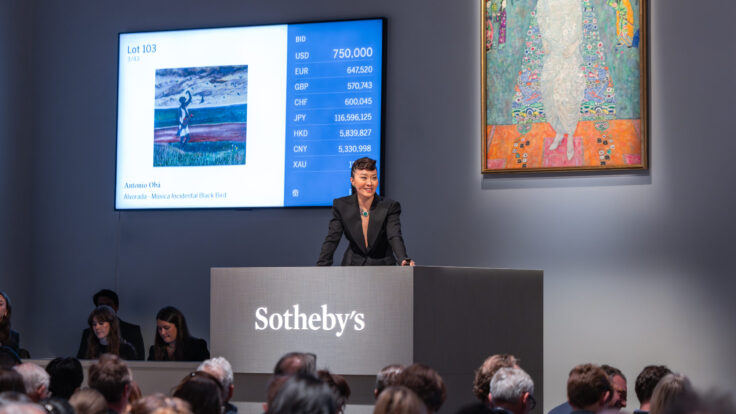
A £40m Belgian collection will star in Christie’s London sales this March: Christie’s announced this week it would be holding three dedicated sales from the collection of Roger and Josette Vanthournout, a Belgian couple who have been amassing a trove of art since the mid-1950s. The
highlights of the sale are works by Max Ernst, Pablo Picasso, René Magritte, Yayoi Kusama, Henry Moore, and Lucio Fontana.
With sales the evening of March 5, a dedicated day sale on March 6, and an additional online auction, the Vanthournouts’ art will take some time to vend. The most
expensive estimates are for Magritte’s La plaine de l’air, from 1940, estimated at £3.5 million; Moore’s Goslar Warrior, from 1973-74, also estimated at £3.5 million; and Picasso’s Nu debout et femmes assises, from 1939, estimated at £3 million. There are some additional gems from Agnes Martin, Tracey Emin, and Jean Dubuffet that might see attentive bidding. - Speaking of big collections that drive the art market…: There’s been growing speculation around the tables at Sistina regarding what big collections might come to market this season. People keep talking about Robert Mnuchin, the Goldman Sachs legend and longtime dealer who died in December, but he may have already placed much of his art—and it’s not clear that his widow wants or needs to sell. Good estate planning avoids the
issue.
Meanwhile, Agnes Gund, the banking heiress and former MoMA president, has already made significant sales to endow her Art for Justice fund. (Again, good planning makes the most of market timing.) It will be interesting to see how much of Gund’s remaining collection comes to
market, but I’ve been warned to temper expectations.
So while a very large market-driving collection has not emerged, that doesn’t mean the auction houses won’t be able to feed the demand we saw in November. And if you talk to anyone who has been around the art game for the last few decades, they will start naming a couple dozen collections they either know or have worked with that will be coming to term quite soon. The big question is whether families will wait until someone dies, or
take advantage of a market that seems to have more demand than supply. So far, I’m told, neither of the houses’ business-getting teams seems to be too worried. That may just mean we’re going to see more discretionary deals brought to market with an armature of guarantees.
|
Now, let’s read some work from my new colleagues at Air Mail… |
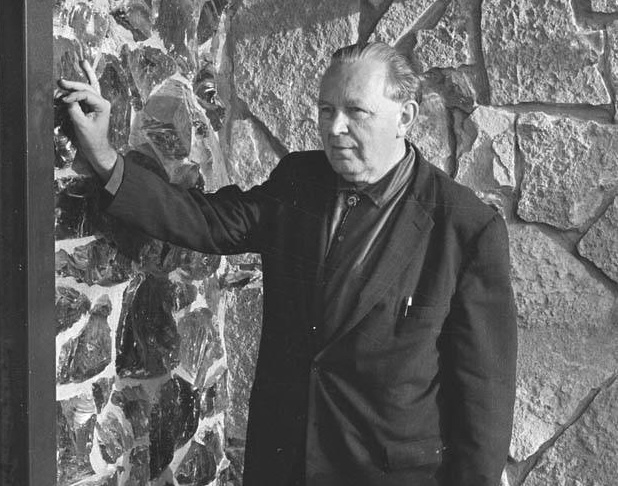
Photo: The Art Institute of Chicago, Bruce
A. Goff Archive |
A house by the architect Bruce Goff was not for the faint of
heart. In 1949, in Aurora, Illinois, for instance, Sam and Ruth Van Sickle Ford—a civil engineer and an artist—commissioned a Goff home whose central structure would eventually resemble a pumpkin. Deciding they’d had enough criticism from neighbors, the Fords put up a sign at the construction site that read, We Don’t Like Your House Either.
Today, plenty of people love Goff and his houses for the way they burst out of modernism’s stern functionality.
Working mostly from the 1940s to the 1980s, largely in the Midwest, Goff produced hundreds of designs for homes and public buildings, with around 150 of them built. The more than 200 works in “Bruce Goff: Material Worlds”—an exhibition that opened in December at the Art Institute of Chicago—include architectural drawings and models, slideshows of the finished buildings, and examples of Goff’s abstract, rather mystical watercolors. For personal style, there are pieces of his own furniture,
objects, and clothing. The fact that this is Goff’s first major show in more than 30 years suggests that his position as an architectural superstar remains a work in progress.
He was born in Kansas in 1904. When the family moved to Tulsa, Oklahoma, Goff was apprenticed at age 12 to the architectural firm of Rush, Endacott and Rush. Several years later, the firm was assigning him commissions and his champion Frank Lloyd Wright was urging
him to skip a university degree, afraid it might stifle his unique talent. Goff’s gift lay partly in making almost every home unique, while binding the client’s wishes to his own artistic sensibility—often expressed in unexpected materials such as unprocessed glass chunks, cellophane, and surplus rope. The houses often seem to be frozen snapshots of some motion-filled moment in Goff’s restless, inventive mind.
Alison Fisher, a curator of architecture and design at the Art
Institute, organized the exhibition with Craig Lee, an assistant curator of architecture and design at the museum. Fisher values two Goffian characteristics in particular: He insisted his practice include projects that were modest as well as luxurious, and he made listening to clients a priority. In contrast, to paraphrase the architectural historian Penelope Dean, Mies van der Rohe might tell them they couldn’t
have closets.
Among those more modest projects was Goff’s 1948 Hopewell Baptist Church in Edmond, Oklahoma, which used steel pipe donated by a local oil company to form a 90-foot conical sanctuary. The top was dominated by an ecstatic, 12-pointed star-shaped skylight, and a hanging sculpture was made from aluminum cake pans. The churchgoers, many from the oil industry, helped build the church.
Goff loved to re-purpose things. In 1970, for Glen
Harder and his family, turkey farmers in Mountain Lake, Minnesota, Goff created a house evoking Japan, its deeply scalloped eaves suggesting the house might float off the ground entirely if it weren’t for the red-orange Astroturf covering the roof. (Pipettes that aid turkey reproduction ended up strung with beads as decorative items inside.) To build the Ford house in Aurora, Goff used ribs from a Quonset hut, a prefabricated staple for military use during World War II, to
create the pumpkin-like central dome.
Goff, who died in 1982, had his share of reversals. In 1955, he resigned his leadership of the University of Oklahoma’s architecture school in the wake of a sting operation organized by local police. It was the early days of the “Lavender Scare,” a homophobic panic, and it was clear to Goff, a homosexual, Fisher said, “that the local community was hell-bent on removing him” from his post. In 1996, a fire destroyed what Fisher considers his magnum
opus, an elaborate family home for the Asian art collector Joe Price. And Goff’s 1961 design for the Viva Casino & Hotel in Las Vegas, a space-age fantasy complete with medieval turrets, never got off the ground. But overall, enough remains of his creations to see that Goff, who also wrote poetry, did not merely do so on paper. |
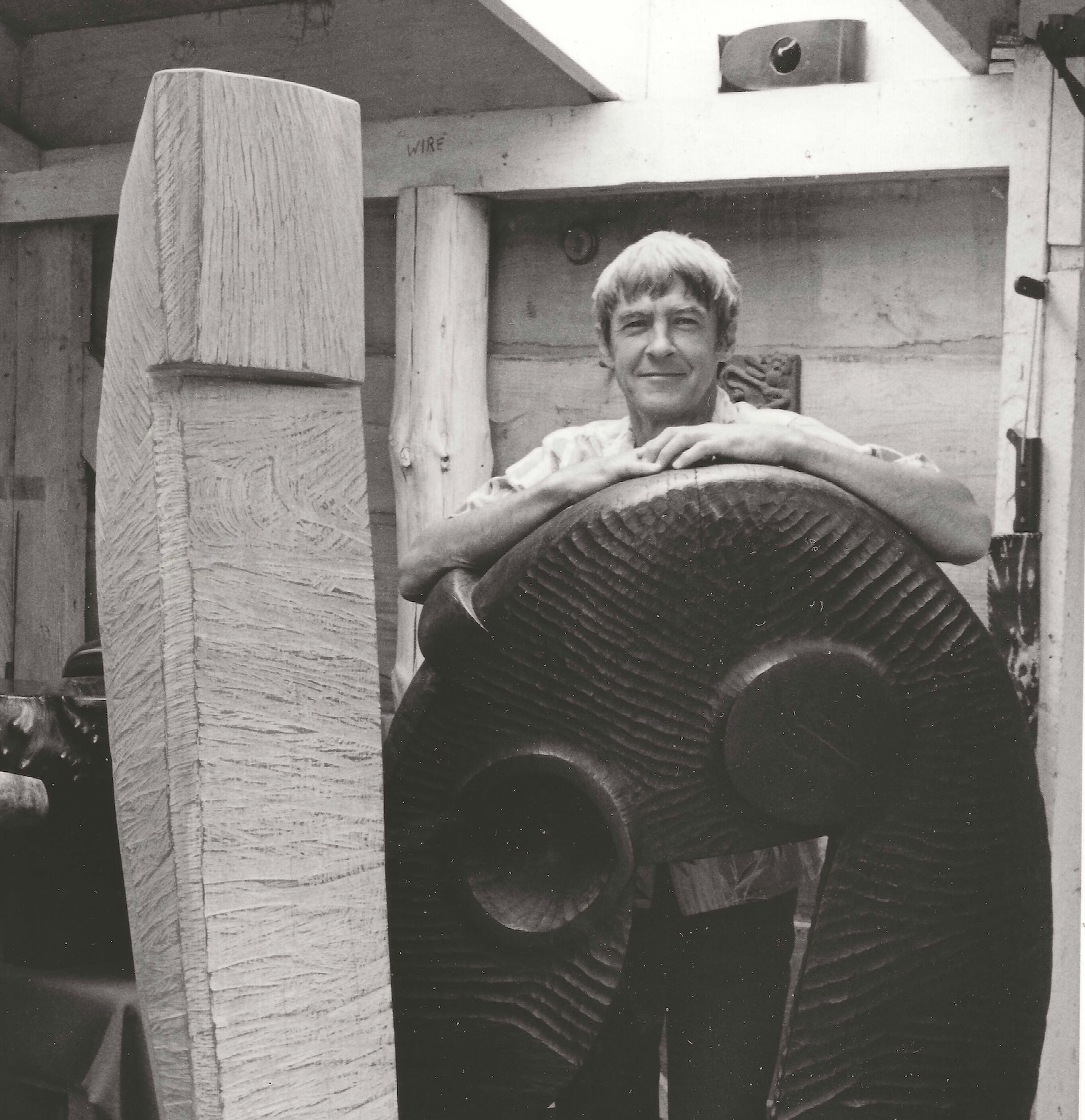
Photo: Jan Watson/Courtesy of the JB Blunk Estate |
“I think life is a series of beginnings,” said the sculptor JB Blunk, who lived
from 1926 to 2002, “and the one who feels they are always a beginner is the one who has the best chance.” A student of Zen Buddhism, Blunk saw work as a source of infinite inspiration, a medium, if you will, unencumbered by the constraints of time. “When you’ve created something that makes a difference to someone, that juice, that energy, occurs through us. See, I think all the discoveries, all the essence is already in existence.”
Born in Kansas, James “JB” Blain Blunk moved to
California when he was 20. At U.C.L.A., he initially studied physics, then switched majors to ceramics, where he came under the tutelage of Laura Andreson, who had created the program. A class field trip to see work by the esteemed Japanese potter Shoji Hamada proved revelatory for Blunk. “It was a shock,” he recalled. “I walked into the room and something went ping! I have to figure out a way to get to Japan.”
Soon after
graduating, Blunk was drafted to serve in the Korean War, which became the perfect way to visit Japan and meet Hamada. After his discharge, he apprenticed under two revered Japanese potters—first, Kitaoji Rosanjin, in Kamakura, and later Kaneshige Toyo, in Bizen. These immersive studies essentially made Blunk the first American to absorb the country’s tradition of unglazed, woodfired stoneware. “I’d like to show the people in
the States this material and way of using just earth, water, and fire,” he wrote.
In 1955, Blunk moved to Northern California, where he and the British-born painter Gordon Onslow Ford bonded over their shared reverence for Japanese aesthetics—and Zen Buddhism—a friendship that would last both of their lifetimes. When Onslow Ford and his wife acquired a large plot of virgin woodlands in the unspoiled hills of Inverness, Blunk helped them
build a house and studio that was integrated into the mountainous landscape. In 1958, when construction was completed, Onslow Ford gave Blunk and his wife, Nancy Waite, an acre of the land on which to build their own home.
Comprising salvaged materials and built by hand over several years, Blunk’s house in the woods, said Onslow Ford, “was his first masterwork. It was built with wholehearted dedication stone by stone, beam by beam, and plank by plank.”
Just about everything inside—from candleholders and mezcal cups to the doors and furniture—was handmade by Blunk and Waite.
In his Inverness home studio, where cypress and redwood were added to his arsenal of materials, Blunk produced explosive pieces. Weighing in at two tons, for instance, with a 13-foot diameter, his 1969 seating sculpture The Planet was carved out of a single mammoth ring of redwood burl. Today it lives at the Oakland Museum and is referred to as “one of the
most touched pieces of sculpture” in America.
Since Blunk’s death, his “back to the land,” “made by hand” legacy has only grown. Mariah Nielson, his daughter with second wife Christine Nielson, a textile artist, is the director of the JB Blunk Estate, of which Blunk Shop and Blunk Space are a part. Located nearby in Point Reyes Station, the shop offers artisan-made reproductions of Blunk’s original objects, and the space,
founded by Nielson in 2021, presents exhibitions like the one that opens this Saturday—“100 Candleholders.” Modeled on Blunk’s own 1981 exhibition, “100 Plates Plus,” and following 2023’s “100 Hooks,” this show features work by more than 100 international artists and designers. Their brief? “To create a candleholder of any material inspired by JB Blunk, his work, or the Blunk House.” |
Photo: Courtesy of Wikimedia Commons |
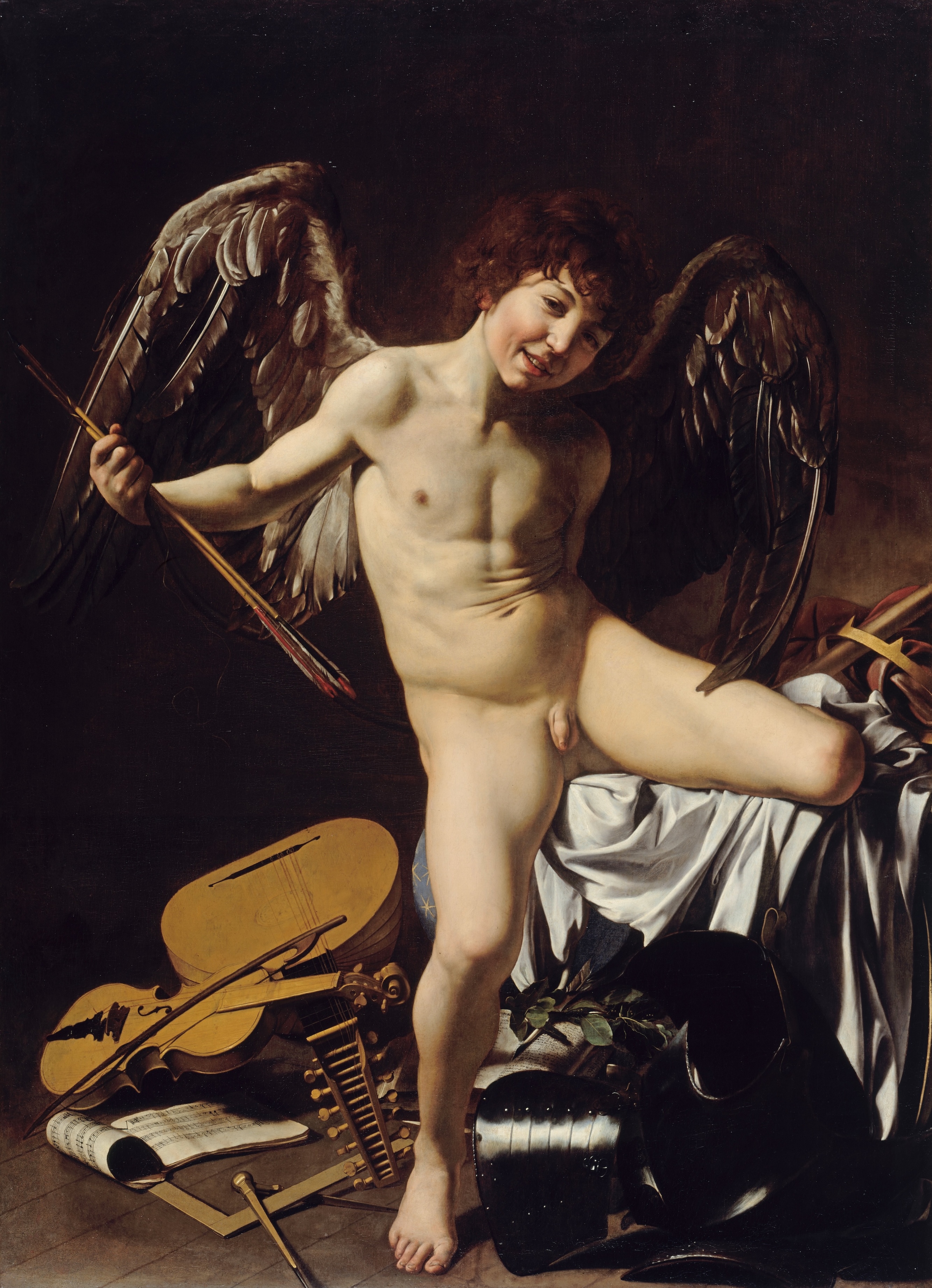
Looking at Caravaggio’s Victorious Cupid for the first time, it’s hard to
escape the feeling that the instant one’s back is turned, the naked young boy in the picture will jump down out of the frame and run riot. Downright shocking in its life force, Caravaggio’s allegorical painting is unlike anything that came before or after. Indeed, it seems to bespeak some kind of Faustian pact.
Cardinal Francesco Maria del Monte, an early patron of Caravaggio’s, perhaps best captured his protégé’s artistry when he described it as “natural magic,”
particularly in the way light and shadow were used to conjure the profundities of human nature. In Victorious Cupid, Caravaggio demolished Renaissance ideals of the chubby, celestial putto by depicting a young god with the body of an Adonis and the face and feet of a cheeky street urchin. On loan from Berlin’s Gemäldegalerie, and never before publicly on view in the U.K., this work is now the centerpiece of the exhibition “Caravaggio’s Cupid,” at
London’s Wallace Collection.
It has long been believed that the model for Victorious Cupid, completed in Rome in 1601 or 1602, was Caravaggio’s young assistant and bedmate Cecco Boneri. The face certainly appears to be that of Boneri, who was also the model for two other Caravaggios. But while the luminous flesh tones of the body achieve a
rare naturalism, the extraordinary physique echoes ancient sculpture and the attributes of an older boy. “I think it’s partly this juxtaposition which creates the picture’s shock value,” said the show’s curator, Helen Langdon, author of the seminal biography Caravaggio: A Life (1998).
Langdon believes that the widely held contemporary view of the painting as a manifesto of Rome’s homosexual demimonde, with Caravaggio at its center, is overdone.
Too often overlooked is the part that Caravaggio’s erudite patron Vincenzo Giustiniani played in commissioning the work and advising on its literary theme of love conquering all. “There is no way Giustiniani would have been interested in showing in the very center of aristocratic Rome a painting about homosexual subculture,” Langdon told me. “That doesn’t seem to me to be remotely convincing.”
When Victorious Cupid was completed, it took pride of place among the
paintings and sculptures at the Palazzo Giustiniani, which became an opulent showcase for one of the most extensive art collections of the Baroque era. Giustiniani’s curator, Joachim von Sandrart, wrote about how he decided to put it behind a green silk curtain. “He was very precise about it,” explained Langdon. “He wanted it not to obliterate the pictures around it, which were great paintings by people like Titian. He also, I think, wanted to
increase its incredible presence with a flourish at the end of his tour.”
Several years after Caravaggio died under mysterious circumstances in 1610, at the age of 38, Giustiniani wrote a letter to his lawyer Teodor Amideni asserting that Caravaggio had told him that it took “just as much effort to make a good painting of flowers as it was to make a picture of figures.” This gift for still life is made gloriously apparent in Victorious Cupid, where the young god
has symbols of architecture, music, and warfare scattered at his feet. But there is no paintbrush or palette to be seen. “It makes me think that this is not just a painting about Cupid’s triumph,” Langdon said. “It is also about the triumph of Caravaggio himself and of naturalistic painting. |
Thanks to my various Air Mail colleagues. On Sunday, I’m going to have another great piece from Air
Mail. This time, Elaine Sciolino sits down with the Louvre’s embattled director, Laurence des Cars.
See you then,
M |
|
|
Puck founding partner Matt Belloni takes you inside the business of Hollywood, using exclusive reporting and insight to explain
the backstories on everything from Marvel movies to the streaming wars. |
|
|
The ultimate fashion industry bible, offering incisive reportage on all aspects of the business and its biggest players.
Anchored by preeminent fashion journalist Lauren Sherman, Line Sheet also features veteran reporter Rachel Strugatz, who delivers unparalleled intel on what’s happening in the beauty industry, and Sarah Shapiro, a longtime retail strategist who writes about e-commerce, brick-and-mortar, D.T.C., and more. |
|
|
Need help? Review our FAQ page or contact us for assistance. For brand partnerships, email ads@puck.news. You received this email because you
signed up to receive emails from Puck, or as part of your Puck account associated with {{customer.email}}. To stop receiving this newsletter and/or manage all your email preferences, click here. |
Puck is published by Heat Media LLC. 107 Greenwich St., New York, NY 10006 |
|
|
|