Welcome back to Wall Power. I’m Marion Maneker, settling back… back in
the New York groove after a 52-hour sojourn in America’s Corn Belt.
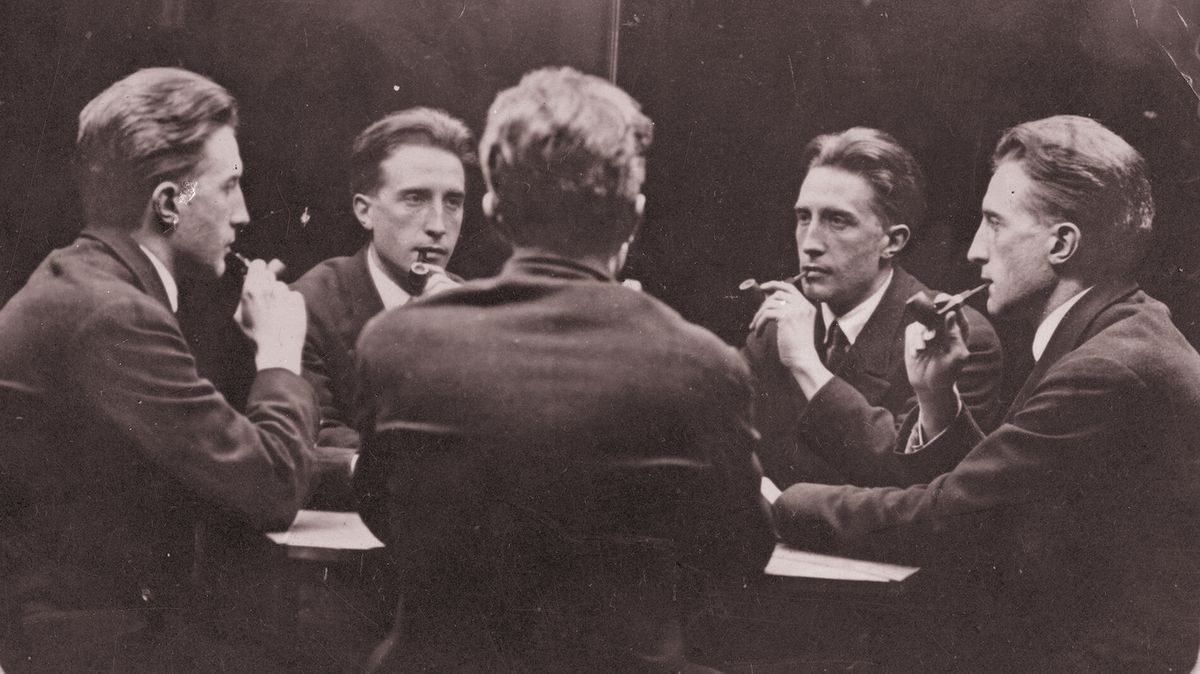
The new Marcel Duchamp show at MoMA is a very big deal indeed. By now, you’ve probably heard that the last Duchamp retrospective was 53 years ago, which is a bit of a scandal considering he is the father of conceptual art of all kinds. That’s finally been rectified, and I’ll take you through the show.
Up top, the FT doesn’t quite get what’s going on at Sotheby’s; Swann’s African American
art sale receipts; and Gagosian’s decision to open the new 980 Madison gallery with a Duchamp show of his own.
I got a couple of nice notes, from friends old and new, responding to my stint in Minneapolis last weekend. At the bottom, I share some of the restaurants where we ate as the city prepares for some Michelin stars.
📲 I also wanted to remind everyone that I really appreciate it when you respond to these emails with your own observations, questions, and even
critical comments. At its best, Wall Power is a hive mind. If you want to contribute, respond to this email or connect with me on +1.917.825.1391 on SMS or WhatsApp.
Mentioned in this issue: Marcel Duchamp, Ann Temkin, Michelle Kuo, Matthew Affron, Francis Naumann, the Lauder family, Richard Mayhew, Geoffrey Holder, Hale
Woodruff, Charles White, Al Loving, Andy Warhol, Diane Moua, and more…
Let’s shove off on today’s journey… |
-
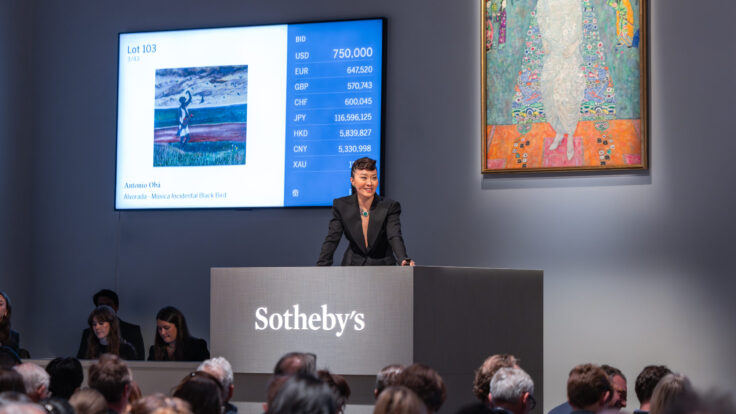
Sotheby’s is paying interest: I got a text on Monday morning from a guy who does a lot of business with Sotheby’s. “Wild piece in the FT,” he wrote, referring to a story headlined “Sotheby’s Offers to Pay Sellers Interest as Art Market Struggles.” The article outlined a program launched in mid-2025 called the “extended settlement
terms payments option,” whereby Sotheby’s pays clients interest—7 or sometimes 8 percent—to let the house hold the proceeds of their sales for longer than the standard payment period.
When I read the piece, though, I saw that the evidence didn’t quite live up to the headline—similar to another FT story earlier this year on art
loans, which also relied on creative interpretation of data. Citing “three people familiar with the scheme,” the FT identified payment options offered across Sotheby’s sales force: For any consignor due to receive $5 million or more, Sotheby’s offered to pay with interest over three, six, or nine months. (The normal payout comes 45 days after Sotheby’s is paid by the buyer.)
It’s not clear, however, that the program is a sign of distress. “Sotheby’s is in strong financial
health with ample liquidity,” a spokesperson for the auction house told me after I asked about the extended terms, citing the wildly successful November sales and a strong Q1. “In 2025, the company generated $1.4 billion in revenue, a 21 percent year‑on‑year increase, and has made significant progress reducing debt, which is now at its lowest level in six years.” S&P and Moody’s upgraded Sotheby’s bonds today to “stable” and “positive,” respectively, in response to its plans to issue $825
million in bonds to replace the $765 million that comes due next year.
It appears that the FT went looking for evidence of cracks in the art market in a mishmash of unrelated financial figures. These included Sotheby’s 2024 pretax loss (which encompassed a number of nonrecurring charges) and the fact that “client payables” had fallen from $1.7 billion at the end of 2023 to $1 billion at the end of 2024. The term refers to the money that consignors earned from sales of their
property—and that’s what Sotheby’s is offering to finance with the extended payments program.
What the FT failed to acknowledge is that client payables reflect the success of the auction market. They were down from 2023 to 2024 as the auction market skittered to a bottom, but surely payables—especially to clients like the Lauder family—rose in the final months of 2025 as sales popped back up. Indeed, by the end of last year, they had returned to the $1.7 billion
level. This isn’t to say that an auction house offering to pay clients for the use of their cash isn’t news. (Is 7 percent enough to entice very rich consignors to become an unsecured creditor to Sotheby’s?) It just doesn’t seem to be the news that the FT, of all outlets, thinks it is. More to the point, it doesn’t seem to be an indicator of continuing weakness in the appetite for spending money on art. - Swann’s African American art sale makes
$2.6 million: Richard Mayhew, Geoffrey Holder, Hale Woodruff, Charles White, and Al Loving were the top artists in Swann’s April sale of African American art. The sale saw a not-so-strong sell-through rate of 77 percent on 265 lots, offered at a total presale estimate of just under $2.2 million. The final total, with auction house fees, was only $2.6 million, suggesting that the overall hammer ratio
was weaker than Swann or consignors would have liked. But that shouldn’t be a surprise in a market that has made big strides over the last decade. Swann, which was established long before the major auction houses started making significant markets in the work of African American artists, continues to provide the liquidity that enables markets to evolve.
- Gagosian’s new gallery: Gagosian’s long residency at 980 Madison Avenue—a building originally
designed for Parke-Bernet, the American auction house that Sotheby’s acquired in 1964—will continue with the opening of its new street-level exhibition space, the aptly named Gallery 980, on April 25. The inaugural show features a group of Marcel Duchamp’s most recognizable readymades, created in 1964 to recapitulate his career as an artist.
|
|
|
|
After a tragically long interval, Marcel Duchamp is getting a retrospective at
MoMA that comprehends the full revolutionary impact of his conceptual work. And yes, it was worth the wait. |
|
|
|
I have been struggling for the right metaphor to explain the significance of MoMA’s new
retrospective on the artistic career of Marcel Duchamp. As almost everyone knows, Duchamp is the guy who took a urinal, turned it on its side, signed it, and called it art. With that work and others—including dozens of other readymades—he inverted art from its focus on skill, technique, and visual impact to an emphasis on ideas and even acts. Before Duchamp, works of art were made by artists. Afterward, art was whatever an artist made.
Without Duchamp, we would probably
not ask what a work of art means. (Yes, he’s to blame for that.) Nor would we sit through the many varieties of performance art. And we wouldn’t have the gnostic objects that so often clutter galleries, ranging from Piero Manzoni’s cans of his own excrement to the Earth Rooms of Walter De Maria to Ana Mendieta’s silhouettes. We wouldn’t even have the many varieties of painters who sought to de-skill their practice,
like Andy Warhol, Martin Kippenberger, Jeff Koons, or Gerhard Richter, to name only a few.
Duchamp’s revolutionary works were created 50 years before he died in 1968. But it wasn’t until after the 1973 retrospective of his work at MoMA that conceptual art came to the forefront of contemporary art. And so, another half-century later, MoMA is reintroducing Duchamp to a generation that already knows him—even if they don’t
know that they know him. That, finally, brings me to the right metaphor: MoMA’s new show is a bit like if Robert Johnson, the legendary guitarist and bluesman whose music would become the foundation of rock and roll, were reincarnated for a few nights to let us see what all the fuss was about. |
Curators Ann Temkin and Michelle Kuo from MoMA, and
Matthew Affron from the Philadelphia Museum of Art, made it clear that they had a distinct strategy for presenting Duchamp to a new generation. They wanted to strip away the myths surrounding the mythmaking artist and treat their subject like any other, with a chronological explication of his career through the objects he made. That may seem, as they admit in the catalogue, very “un-Duchampian.” And yet, for an artist whose impact was mostly about ideas and posturing, it’s
refreshing to focus on the actual works of art. Or, as Temkin said in the press preview, they wanted to “show the goods.”
Indeed, one of the central paradoxes of Duchamp’s career is that his influence has always outweighed our familiarity with his work. This is partly because the bulk of his art is locked up in the Philadelphia Museum of Art, and you have to go there to receive a grounding in what Duchamp produced. That’s not a slam on the PMA; Duchamp’s major works are on display, but
there is a mountain of other work in storage that isn’t painting or sculpture, but rather film, drawings, photography, and other printed matter.
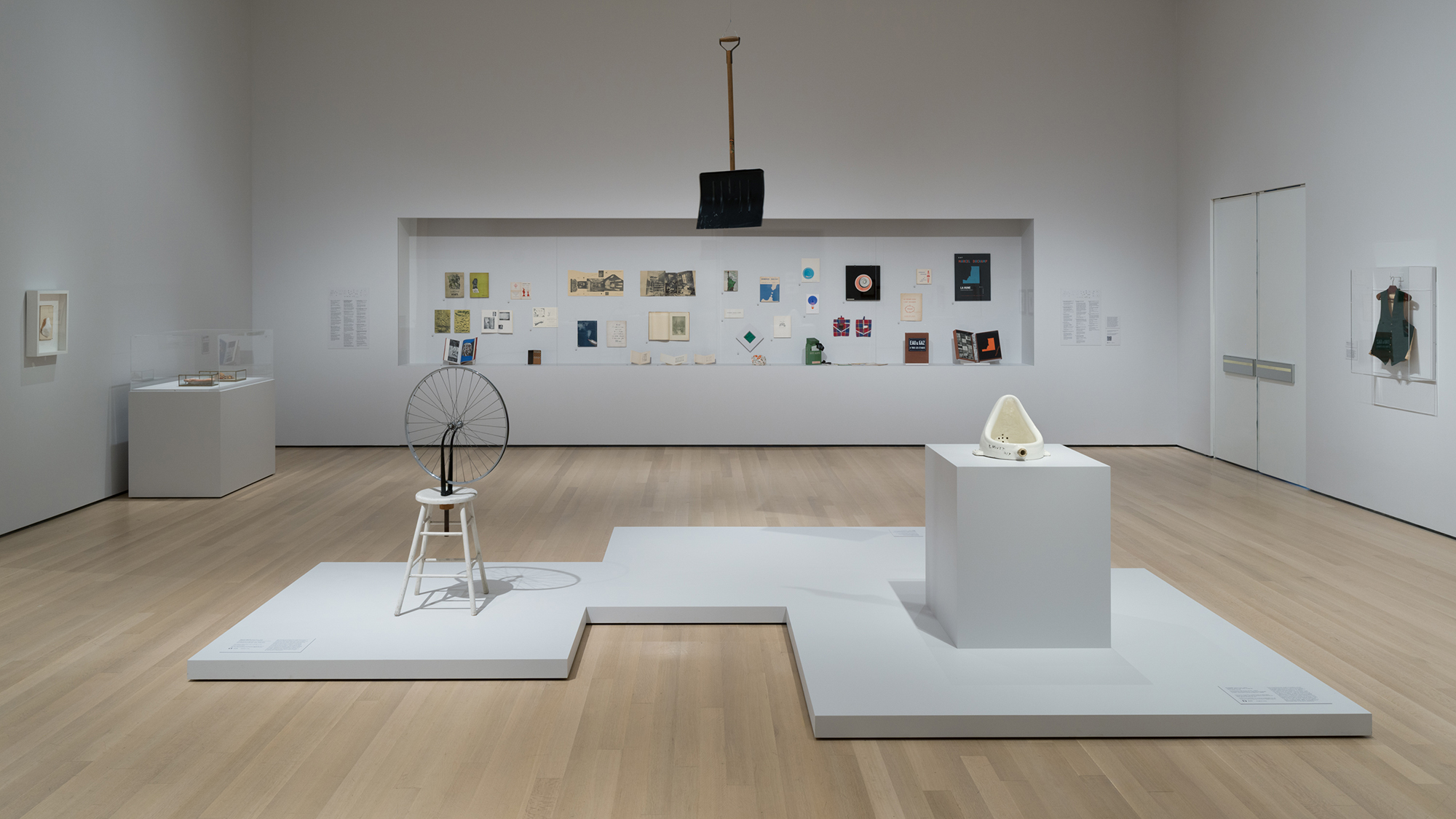
Then there’s the issue of the readymades. Most of the original objects—the very ones Duchamp used to make his radical declaration that art is whatever artists say it is—are lost. No matter. Central to his idea was that he could re-create those objects not as facsimiles, but as sufficient works in their own right. So even though the original
urinal and bottle rack are long gone, it doesn’t make the later examples of the urinal and bottle rack lesser works of art. That led the curators to make an important decision: Since they were presenting Duchamp’s career chronologically, they chose to show the borrowed extant readymades in galleries devoted to the moment when those readymades were, well, made. |
Photo: Jonathan Dorado/Courtesy of MoMA |
For instance, while the original 1917 Fountain is gone, Duchamp created different versions
of the urinal for exhibitions in the 1950s and ’60s. Making the subtle but important statement that Duchamp didn’t merely make a fetish of the original object, the curators included those versions in the galleries devoted to the corresponding later periods, rather than to the “original” 1917-era works. |
But I’m getting ahead of myself. The MoMA show is highly crafted with a didactic purpose. You can
breeze through and catch the highlights, which will still take you a good 45 minutes. Or you can let it guide you along the whole way. The curators won’t mind if you come back a few times to take it in digestible chunks. They just want you to get their point.
Duchamp came from a family of artists. His grandfather was a ship broker who made enough money to retire and devote himself to painting and printmaking. Marcel was one of four grandchildren who became artists, along with his brothers
Gaston and Raymond—who abandoned legal and medical studies to pursue art careers—and his sister Suzanne.
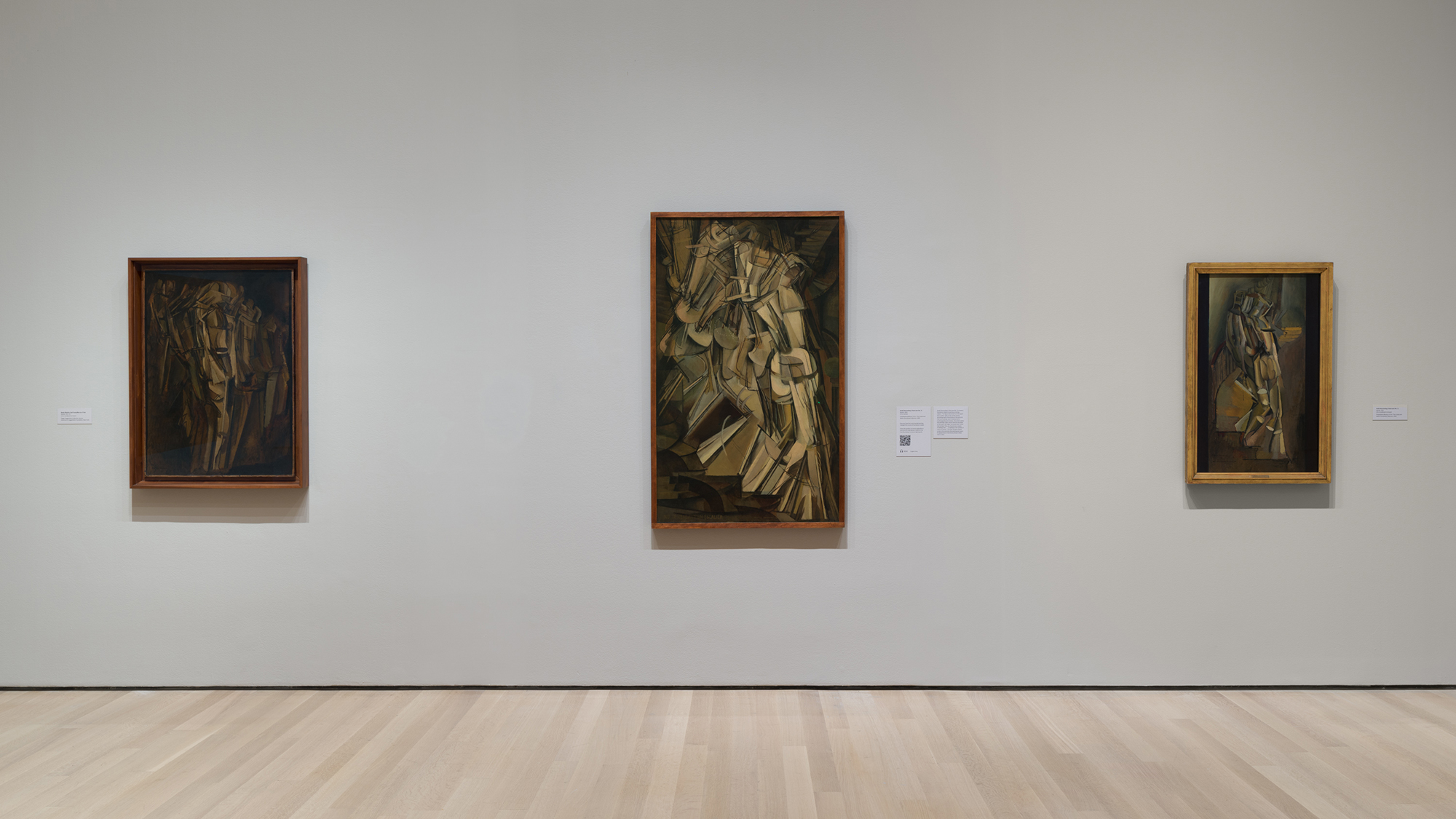
Even though Duchamp would later disavow his own skill as a painter, the show opens with two rooms of his early paintings and drawings. Heavily influenced by fauvism and cubism, the paintings are good, and lead up to his famous Nude Descending a Staircase and the later cubist images that begin to play with the idea of the
bride. The paintings really get interesting when we start to see Duchamp’s fixation on a chocolate grinder; there’s a whole wall of these paintings depicting the same object, though the colors and textures vary. The last of the paintings are based on Duchamp’s “stoppages,” or lengths of thread that he dropped to create the abstract lines used in MoMA’s own Network of Stoppages, from 1914. |
Photo: Jonathan Dorado/Courtesy of MoMA |
The next gallery is where we really get to the “goods”—it’s filled with vitrines containing many of
the most important readymades, including the Monte Carlo Bonds, Apolinère Enameled, the Fresh Widow, and a blacked-out window that Duchamp had fabricated. The bombshell work here is L.H.O.O.Q. , from 1919, a postcard of the Mona Lisa with a Vandyke beard penciled on her face and the title below—which says “she has a hot ass” in French if you say each letter by name.
The famous large glass titled The Bride Stripped Bare by Her Bachelors,
Even, from 1915-23, would’ve been installed here if it could be moved from Philadelphia. But a bit later, we see Richard Hamilton’s re-creation of the large glass from the 1960s, which shows what the masterpiece’s impact might have been without the damage that left the thick glass panels crazed. (Duchamp decided to go with the flow and declare the cracks part of the work.)
The show skips through a gallery of works by Duchamp’s alter ego, Rrose Sélavy, which combine
mechanically spinning discs and wordplay. Then comes the breathtaking assemblage of the artist’s less-recognized but hugely important La Boîte-en-valise—essentially a traveling, self-produced retrospective of his career in the form of an editioned work. Centering the show on this seemingly minor piece in Duchamp’s oeuvre is a masterstroke, framing everything that makes the artist both elusive and a lasting influence. After that, we get into the rooms that show later editions of
the readymades and the preparations for Duchamp’s last work, the disturbing and equally immovable Étant donnés, from 1946-66.
A new wave of Duchamp appreciation among museum-goers should also spark new interest from the next generation of collectors. Gagosian opens a show of readymades on April 25, two days after Phillips is offering 100 editioned works by Duchamp in a sale curated by Francis Naumann. That one includes an example of La
Boîte-en-valise estimated at $350,000; other Boîtes have sold for as much as $2 million and nearly $3 million. That’s not bad for a guy who pretended to have given up on making art. |
While in Minneapolis, I learned that the city has embarked on a three-year, $250,000 annual deal
with the Michelin Guide to have its restaurants rated by inspectors, with the hope of getting some starred restaurants on that side of the Mississippi River by next year. Candidates for the honor include Bûcheron—a French-inspired, farm-fresh, husband-and-wife restaurant where the Wallpowers ate on our first night, and which has already won a James Beard Award—and
Owamni, a restaurant of Indigenous food that is given full white-tablecloth treatment, where I’ve previously eaten.
We also had excellent meals at two Asian-inspired places: Hai Hai, a celebration of Southeast Asian street food, and Diane’s Place, where Diane Moua expresses her Hmong heritage with French technique and her long experience as a star pastry chef. Diane’s is so hard to get into, we had to eat there at eight o’clock on a Sunday morning. But the meal was well worth getting up for.
Between the restaurants and family events, we had no time to stop by Minneapolis’s excellent Institute of Art or the Walker. But I will be back in late June, when I hope to get to
see the great German modernism show at the MIA. And for those of you in the Inner Circle, I’ll be back here tomorrow. (Sign up to join the festivities.)
Until then,
M |
|
|
|
Puck founding partner Matt Belloni takes you inside the business of Hollywood, using exclusive reporting and insight
to explain the backstories on everything from Marvel movies to the streaming wars. |
|
|
|
Ace media reporter Dylan Byers brings readers into the C-suite as he chronicles the biggest stories in the industry:
the future of cable news in the streaming era, the transformation of legacy publishers, the tech giants remaking the market, and all the egos involved. |
|
|
|
Need help? Review our FAQ page or contact us for assistance. For brand partnerships, email ads@puck.news. You received this email because you
signed up to receive emails from Puck, or as part of your Puck account associated with {{customer.email}}. To stop receiving this newsletter and/or manage all your email preferences, click here. |
Puck is published by Heat Media LLC. 107 Greenwich St., New York, NY 10006 |
|
|
|
|