Hi, and welcome back to Line Sheet. Are you wearing Carhartts and Salomons right now?
We’ve
got a grab bag of news today to ease you into the weekend: luxury exec intel from Europe, tales of D.T.C. destruction in San Francisco, and a reveal of what the most upscale mega-mall in America is selling right now.
For the main event, Sarah Shapiro investigates whether Banana Republic can ever be more than a reminder that the word “metrosexual” was used frequently in the early aughts. Plus, the week in feedback, from Alix Earle’s big beauty win to the
future of Dario Vitale.
Also mentioned in this issue: Stefano Cantino, Ayo Edebiri, Richard Dickson, Ryan Murphy, Zoë Kravitz, Sandra Stangl, Francesca Bellettini, Mickey Drexler, Greta Lee, Alfonso Dolce, Robyn Adams, Hillary Kerr, Jessica
McCormack, Alfred Chang, Raf de Cárdenas, Ana Andjelic, Becky Malinsky, Liana Satenstein, Jessie Buckley, Danielle Goldberg, Domenico Dolce, and more… |
Three Things You Should Know…
|
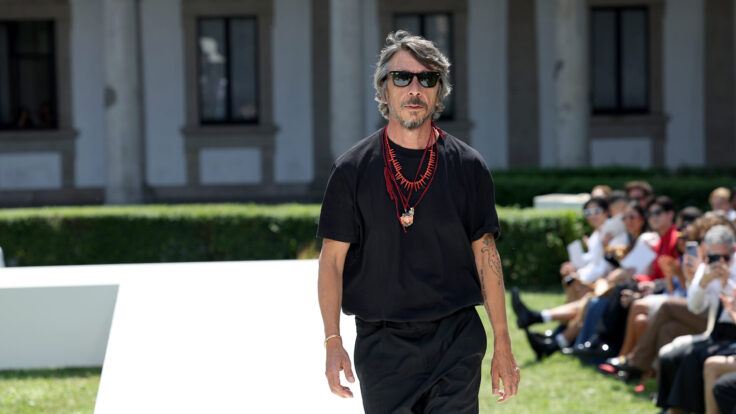
- Cantino’s Dolce
vita: As I hinted yesterday, former Gucci C.E.O. Stefano Cantino is about to finish up his garden leave after being replaced by the person who originally hired him, Francesca Bellettini, in September 2025. I’m told that Cantino’s new gig at Dolce & Gabbana will be announced as soon as his noncompete ends. Dolce & Gabbana’s current C.E.O. is Alfonso Dolce, the brother of Domenico Dolce. I’ll have
more on Monday.
|
|
|
|
A MESSAGE FROM OUR SPONSOR |
Introducing the first agentic storefront
Swap built the first agentic Storefront that replaces
your traditional static website with an immersive agent-led commerce experience, guiding shoppers through product discovery, to virtual-try on, to checkout in a single experience.
Learn More |
|
|
|

| Malique Morris
|
|
- Everlane’s landlord
drama: Here’s a red flag for Everlane’s turnaround attempt under new C.E.O. Alfred Chang: Gazetteer reports that the L Catterton–backed basics brand is being sued by its landlord for unpaid rent on its San Francisco headquarters. According to an unlawful detainer action filed in San Francisco Superior Court, Everlane owes $51,273.40
and was served a three-day notice on March 18 to pay or vacate. “Everlane has been in ongoing, good-faith discussions with its landlords regarding its San Francisco office. We can confirm the recent filing was a routine procedural step in that process and not adversarial,” the company said in a statement, which also confirmed its plan to move its headquarters to Los Angeles in August.
As Lauren
reported last month, Everlane’s revenues have slipped to $170 million, down from around $200 million at its pre-pandemic peak, and the company’s been working hard to recapture its past glory. Splashy marketing campaigns, including one fronted by neo-jazz pop star Laufey, have obviously yet to translate into meaningful sales growth. Meanwhile, Quince
effectively co-opted Everlane’s transparent-pricing playbook en route to $1 billion in annual sales and a $10 billion valuation. Everlane is now seeking a new investor to inject cash and help clear its debts. Beyond the $130 million equity financing it has already raised, the company carries a $25 million loan from Gordon Bros. and a $65 million asset-based revolving credit line.
The recent collapse of Allbirds, another D.T.C. darling of the 2010s, could chill investor appetite, making
fresh financing even harder to secure. It wouldn’t be surprising if an Everlane fire sale is on the horizon, especially if the brand can’t raise money.
|
|
|
|

| Sarah Shapiro
|
|
- What rich people in
the O.C. are buying right now: Orange County’s South Coast Plaza is the biggest mall in California and one of the premier retail destinations in the country—especially for brands with big ambitions. It’s telling that both Jessica McCormack and Khaite, to pick two recent examples, chose S.C.P. for their West Coast debut locations over, say,
Beverly Hills. On a recent Wednesday afternoon at the mall, the designer boutiques were humming. Chanel had a velvet rope and a line of about 10 people waiting to get in as shoppers inside worked with sales associates. Some of the items on display had already been sold—but, as one associate explained, Chanel dictates that visual merchandising remain untouched for two weeks. (One customer had purchased a pair of shoes and was literally counting down the days until she could return to take them
home.) Dior, Hermès, and Loewe were similarly busy, sans lines at the door. At a mall that does more than $2.58 billion annually, the traffic felt both robust and intentional.
|
|
|
|
Once a respected, middle-market power player and sentimental benchmark of suburban
childhoods, Banana Republic is now a well-marketed, slightly adrift mall brand still searching for a signature—and a reason to matter. |
|
|
|
Ryan Murphy’s Love Story has had everyone recalling the 1990s in Kodak hues over
these past few months. The fashion industry has been particularly given to nostalgia given the show’s depiction of Carolyn Bessette’s time working at Calvin Klein. Naturally, Calvin’s been enjoying a Love Story bump. But all the ’90s nostalgia got
me thinking about Banana Republic, too. |
|
|
|
A MESSAGE FROM OUR SPONSOR |
Introducing the first agentic storefront
Swap built the first agentic Storefront that replaces
your traditional static website with an immersive agent-led commerce experience, guiding shoppers through product discovery, to virtual-try on, to checkout in a single experience.
Learn More |
|
|
|
In an upcoming episode of Fashion People, creative director and consultant Raf de Cárdenas, who worked on the men’s collections at Calvin at the time, recalled a telling moment backstage at a show. A colleague had dismissed one look as “very Banana Republic,” which Klein himself overheard and quickly corrected. The mall brand, the designer noted, had captured a mass audience at an enviable price point. Put some respect on its name, Klein advised in
so many words.
Can Banana Republic, which once coasted in Calvin’s wake, also rise again? In the heyday of its cultural relevance, Mickey Drexler’s Gap Inc. helped the brand transcend its roots in safari cosplay to become a kind of knockoff Theory, which was itself borrowing heavily from the minimalism of Klein (and Helmut Lang and Jil Sander). But by the late aughts, all of that had given way to a general American office wear
aesthetic—and some serious creative malaise.
Banana Republic’s sales peaked in 2014, when it generated about $2.9 billion across more than 600 stores. According to Richard Dickson, the current C.E.O. of parentco Gap Inc., the brand did just $1.9 billion last year—a billion-dollar drop-off, exacerbated by years of resale mania, the D.T.C. boom, and an increasingly barbelled retail landscape dominated by luxury on one side and fast fashion on the other. Banana Republic,
like a lot of brands that once carved out a slightly elevated niche in the mall, is still trying to figure out where it belongs.
Sales numbers illustrate its ugly reality. According to Consumer Edge, which tracks spending across 40 million credit cards, Banana Republic’s average transaction size this quarter is $107—above Gap ($70 to $75) and Old Navy ($55 to $60), but nowhere near designer territory. Its consumer base leans older and affluent: 53 percent of spend comes from shoppers 45
and up, while 47 percent of revenue is driven by households earning $150,000 or more. The under-35 cohort has grown modestly—up three points since 2023—suggesting some early traction for Millennials. But the cross-shopping data is more revealing. Banana Republic customers are still circulating among the mall mainstays—American Eagle, Abercrombie, J.Crew, Ann Taylor, and Madewell. They’re not trading up into luxury, or even consistently mixing in contemporary labels. |
On the company’s most recent earnings call, Dickson highlighted Banana Republic’s men’s business—specifically
its traveler pants, cashmere, and outerwear—as an area of strength. Women’s, he said, was “becoming more consistent,” a phrase that felt intentionally vague, gesturing at denim skirts and sweaters without landing on a defining item. That’s the crux of the issue. No one can name a Banana Republic hero product the way they can cite the Dôen Sebastiane skirt, an Alo Airlift legging, or a Coach Tabby handbag. As Ana Andjelic, Banana Republic’s former chief brand officer, told me,
“For a brand with such a strong point of view, it is unfortunate how much difficulty it has had expressing it in recent years.” |
|
|
|
Leadership turnover hasn’t helped. Sandra Stangl, who
struggled with her mandate, exited as brand C.E.O. in May 2024, and Dickson has been running the brand alongside its leadership team ever since. Multiple sources describe him as deeply engaged—hands on, even—and treating Banana Republic as something of a personal project. (One former employee told me that Dickson is simply having too much fun to step
back.) He may well be the most effective steward the brand has had in years, but the underlying question remains: Does Banana Republic—which Gap Inc. considered selling for years—still have a distinct role within the group’s portfolio?
To its credit, the brand has made a series of smart, culturally attuned—if micro—moves of late. Like every other retailer in the game, it did a Love
Story edit. There was a February partnership with Liana Satenstein on a Neverworns Live event, tapping into her genuine nostalgia for the brand from her suburban Massachusetts childhood, and a collaboration with Abandoned Republic blogger Robyn Adams, whose archival project now feeds into the e-commerce experience. More recently, Banana hired celeb stylist Danielle Goldberg, whose clients include Zoë
Kravitz, Ayo Edebiri, Greta Lee, and Jessie Buckley, to style its lookbook.
Influencers continue to post Banana Republic finds with genuine enthusiasm, flagging potential hits: Hillary Kerr’s praise for the linen shorts, Becky Malinsky’s shout-out of this
sweater, and Satenstein’s “bury me in that coat” supple suede jacket. The marketing spend is doing its job there. But the brand is noticeably absent from the monthly ShopMy bestseller lists tracked by Line Sheet—arguably a more telling signal of real consumer traction. In a moment when you can walk through a
crowded mall, have lunch at an Upper East Side restaurant, or scroll through Instagram Reels and instantly recognize the brands people are wearing, Banana Republic still doesn’t register. |
On the
best campaigns of the season: “Honorable mention for the Eckhaus Latta bum-bag video campaign on Instagram. Totally mesmerizing and utterly delightful!” —An art world person
On Dario’s next move: “He’s needed at Kenzo.”
—A consultant who knows these things
More Dario hopes and dreams: “Omg how fun would it be if Dario went to Armani. To die.”—A stylist who wishes these things
On the amazing performance of Reale Actives: “Wait, Alix Earle isn’t the Call Her Daddy person?” —A beauty entrepreneur |
Until Monday,
Lauren
P.S.: We use affiliate links because we are a business. We may make a
couple bucks off them. |
|
|
|
|
|
DYLAN BYERS & IAN KRIETZBERG |
|
|
|
Need help? Review our
FAQ page or contact us for assistance. For brand partnerships, email ads@puck.news.
You received this email because you signed up to receive emails from Puck, or as part of your Puck account associated with {{customer.email}}. To stop receiving this newsletter and/or manage all your email preferences, click here. |
Puck is published by Heat Media LLC. 107 Greenwich St., New York, NY 10006 |
|
|
|
|



_01KMR6FGPE9SGV090DJE88XJH7.png "Swap Commerce")
_01KMR6FH5863WFKFZHF2Z0B8FT.png "Swap Commerce")